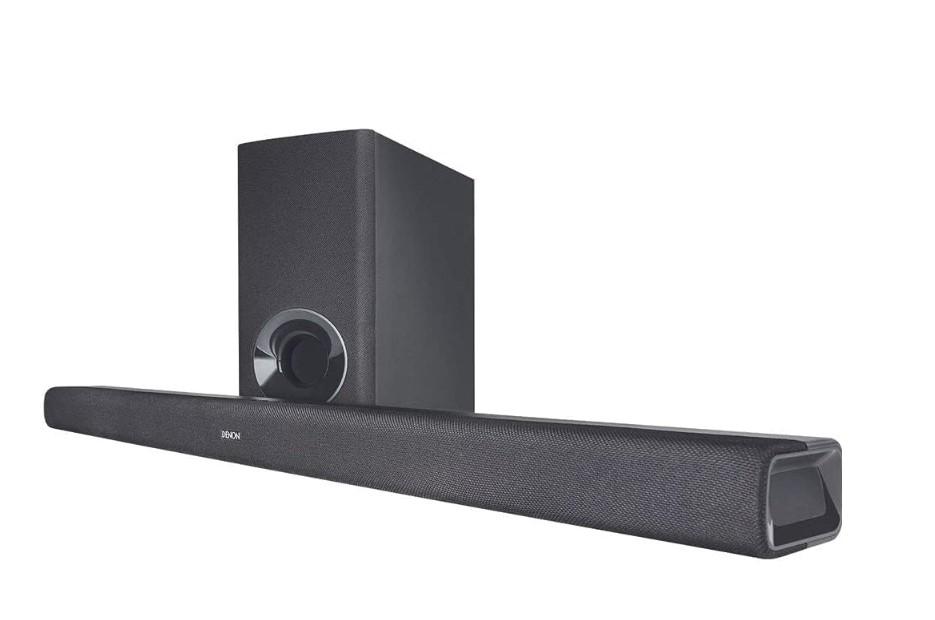
Denon DHT-S316 Soundbar Review
There is a particular frustration familiar to anyone who has invested in a flat-panel television of the last decade: the picture is extraordinary and the sound is an embarrassment. Manufacturers have traded acoustic volume for slim bezels and wall-huggable profiles so aggressively that the speaker arrays inside most modern TVs represent little more than a compliance checkbox, generating thin, tonally displaced audio that sits nowhere near the screen it is supposed to accompany. Soundbars exist precisely to address this compromise, and Denon — a company that spent a century building its reputation on getting audio right — entered the category with characteristic intent. The DHT-S316 is a 2.1-channel system consisting of a slim stereo soundbar paired with a wireless subwoofer, positioned squarely in the middle of Denon’s consumer soundbar lineup and designed with a single operative goal: to give an ordinary television’s audio the body, width, and weight it was never built to deliver on its own.
Brand Heritage & Product Context
Denon was founded in 1910 as Japan’s first audio equipment manufacturer, a company born from the ambition of Frederick Whitney Horn and the accumulated precision culture of Japanese engineering. The Denon name, an abbreviation of the company’s postwar identity as Nippon Columbia’s electronics division, came to represent a particular strand of audio philosophy — conservative in character, meticulous in execution, and resistant to the kind of trend-chasing that can make a product feel dated within a product cycle. The company’s engineering firsts are well documented: Japan’s first professional disc recorder, the world’s first commercial PCM digital recording system, a hand in producing the earliest commercial CDs, and decades of AV receiver development that made the Denon name synonymous with home cinema processing at virtually every price tier. The DL-103 moving coil cartridge, unchanged in essential form since 1963, remains a working embodiment of that design philosophy.
Within Denon’s current soundbar range, the DHT-S316 occupies the middle tier — above the single-body DHT-S216 and the compact DHT-S217, both of which use integrated passive radiators rather than a dedicated external subwoofer, and below the more recent DHT-S517 and DHT-S716H, which add Dolby Atmos decoding and upward-firing drivers. The S316 was introduced at CEDIA 2018 and has been maintained in production longer than many contemporaries, a signal that Denon identified it as filling a gap between the entry-level integrated-sub systems and the premium Atmos tier — a gap defined by customers who want serious bass reinforcement without the cost or complexity of a height-channel setup.
Design and Build
The DHT-S316’s physical presence is defined almost entirely by restraint. The soundbar measures 35.43 inches wide, 3.22 inches deep, and a mere 2.15 inches tall — dimensions that allow it to sit in front of virtually any TV on a stand without obscuring the screen’s lower edge or blocking the infrared sensor window. The chassis is finished in matte acoustic fabric across the front face, with plastic end caps finished in a low-gloss black that manages to look deliberate rather than merely economical. The Denon logo sits centered and discreet below a row of four LED indicator lights — the only status display the unit offers, cycling through color and number combinations to indicate input source and volume level. This LED-only interface is one area where the DHT-S316’s budget positioning becomes apparent; remembering which color combination indicates Bluetooth standby versus optical input is a small but recurring friction that a single-character display would eliminate entirely. Four physical control buttons on the top surface of the soundbar cover power, volume, input selection, and Bluetooth pairing, duplicating the functions available on the supplied remote.
The remote itself is a compact, plasticky affair that includes the full control set: input switching, volume, bass level adjustment, mute, and selection between three EQ modes — Movie, Music, and Night. The three-stage Dialogue Enhancer is accessible here as well, a function that prioritizes the upper midrange frequencies where speech intelligibility lives without altering overall volume. Wall mounting is accommodated through two integrated keyhole slots on the rear panel, and Denon includes a paper mounting template in the box that makes alignment straightforward. The wireless subwoofer is a compact, fabric-fronted enclosure measuring approximately 13.4 inches tall by 6.7 inches wide by 12.3 inches deep — small enough to tuck against a wall or behind furniture, and at 11.35 lbs light enough to reposition without difficulty. It connects to the soundbar wirelessly over a proprietary radio link that pairs automatically on power-up, requiring no manual pairing process. Both HDMI and optical cables are included in the box, which makes the complete absence of anything to purchase at setup a genuine practical advantage.
© hifireport.com — All rights reserved.
Under the Hood
Denon’s published specification sheet for the DHT-S316 is notably sparse on internal detail — a common practice at this tier, where manufacturers often prefer to let the listening experience do the argumentative work rather than invite direct component-by-component comparison with competitors. What is confirmed is a four-driver soundbar configuration: one 25mm round tweeter and one 32 x 112mm racetrack-profile midrange driver per channel, housed at opposing ends of the bar’s front face. This racetrack form factor — elongated elliptical cones that fit within a low-profile chassis where a conventional circular driver cannot — is widely used in slim soundbar design and represents a reasonable acoustic engineering compromise given the available internal volume. The subwoofer deploys a 140mm bass driver in a bass-reflex ported cabinet, which provides better low-frequency extension at modest excursion levels than a sealed equivalent of similar size would allow.
Total system power is rated at 80W, split evenly as 40W to the soundbar amplifier and 40W to the subwoofer amplifier — figures consistent with a Class D amplification topology, though Denon does not specify this directly. The DSP engine handles Dolby Digital and DTS decoding along with Denon’s proprietary Virtual Surround processing, which applies psychoacoustic algorithms to two-channel output to simulate a wider surround field. This is a crosstalk-cancellation and HRTF-based approach rather than a true multi-channel decode, and it behaves accordingly — producing a broader and somewhat more enveloping presentation than pure stereo without approaching the spatial specificity of a physical 5.1 array. Bluetooth 4.2 with A2DP profile support handles wireless audio streaming; the absence of aptX support is a minor limitation that means SBC remains the ceiling for wireless audio quality. HDMI ARC with CEC enables TV remote volume control via a single cable connection, and the optical input accommodates a second source simultaneously. A 3.5mm auxiliary input on the rear panel provides a third connection option, though it bypasses the onboard Dolby and DTS decoders since those require a digital input signal.
Listening Tests
I ran the DHT-S316 through a 65-inch LG OLED television via the supplied HDMI cable, with the soundbar sitting on the TV bench directly below the screen in its default position. Supplementary listening via Bluetooth used an iPhone streaming Apple Music lossless files, and a secondary session connected the optical output of a Sony 4K Blu-ray player directly to the soundbar’s optical input. The subwoofer was positioned in the left corner of the room, approximately eight feet from the listening position, and paired with the soundbar automatically on first power-up without any intervention.
The first and most immediate impression is of scale. The DHT-S316 simply sounds larger than a television’s built-in speakers — the soundstage extends noticeably beyond the physical boundaries of the screen, and the floor established by the subwoofer provides a sense of room-filling bass foundation that transforms the experience of watching any content with significant low-frequency energy. Playing action sequences from a variety of streamed films, the combination of the soundbar’s midrange drivers and the 140mm woofer delivers convincing weight and forward projection. Dialogue clarity is the system’s clear performance priority, and the Dialogue Enhancer mode earns its presence: at its first or second step, it lifts speech intelligibility in busy mixes without introducing the honky, scooped character that lesser dialogue processing can produce. Voice reproduction through the racetrack midrange drivers is clean and reasonably natural in timbre, projecting forward at a consistent level even as soundtrack elements swell around it.
Where the DHT-S316’s sonic character invites measured qualification is at the frequency extremes. The high end is deliberately tamed — the 25mm tweeters roll off earlier than audiophile instincts would prefer, softening the edge transients of cymbal crashes, upper percussion, and the presence-range detail of acoustic string instruments. This is preferable to the alternative of brittle or hardened treble reproduction, and in the context of television viewing it is a more natural failing than the opposite; film soundtracks mixed for cinema-grade playback often contain high-frequency content that becomes fatiguing on domestic-scale systems. The subwoofer, for its part, integrates smoothly with the bar through most of its operating range but begins to assert its own character at elevated volumes, where it can lend a slightly heavy-footed quality to rhythmically complex music. The Virtual Surround mode provides useful width enhancement for film soundtracks but is most convincing at moderate listening levels; at high volumes the psychoacoustic processing introduces a mild diffuse quality that reduces stereo imaging precision. The Night Mode, which compresses the dynamic range to keep the loudest and quietest elements closer together, is genuinely useful for late-night viewing and works without the clamped, lifeless quality that compressors at this level sometimes produce.
© hifireport.com — All rights reserved.
What Users Are Saying
Among the most consistently reported experiences from long-term users of the DHT-S316, the transformation of television dialogue intelligibility stands out as the feature that most routinely exceeds initial expectations. Owners frequently describe specifically the Dialogue Enhancer as a function they did not anticipate relying on regularly and now find indispensable — particularly in households where differing preferred volume levels between family members have historically required constant negotiation. The wireless subwoofer pairing is another point of recurring satisfaction: users across multiple retail platforms cite the automatic, no-configuration subwoofer connection as a setup experience that removes the single most common friction point in soundbar installation, with several noting that the entire system was operational within minutes of opening the box. The HDMI ARC integration with TV remote volume control — allowing the entire system to be operated from a single remote without reprogramming or additional equipment — draws consistent appreciation from listeners who prioritize simplicity, and CEC compatibility across major television brands is noted as reliable in practice. The physical profile of the soundbar, and specifically its ability to sit below even modestly sized screens without encroaching on the picture, is mentioned with regular frequency by users who had previously assumed a soundbar would require either a wall mount or a dedicated furniture arrangement to work aesthetically.
Verdict
The Denon DHT-S316 succeeds at its stated purpose with the kind of solid, unspectacular competence that is genuinely undervalued in a market segment prone to overclaiming. It is a meaningfully better acoustic experience than the television audio it replaces — larger in soundstage, substantially more impactful in the bass register, clearer in the midrange, and notably more involving during any content with a serious soundtrack. The Dialogue Enhancer is a practically useful feature rather than a marketing placeholder, and the HDMI ARC implementation is reliable. Denon’s production quality ensures the unit feels considered even if it is not luxurious, and the wireless subwoofer pairing is as frictionless as the setup process as a whole.
Its limitations are those of the category and the price tier rather than failures of execution. The LED-only status display requires memorization rather than glanceability, the high-frequency rolloff will disappoint listeners accustomed to full-range stereo systems, and the subwoofer’s behavior at higher volumes with music reminds you that its primary design brief was cinema rather than concert hall. Listeners looking to prioritize Dolby Atmos decoding or streaming platform integration will find more current offerings in the DHT-S517 and DHT-S716H relevant. At the entry of the dedicated-subwoofer soundbar category, similarly positioned alternatives from Yamaha — the YAS-209 and its successors — offer app-based EQ control as a competitive differentiator, and the Polk Audio Signa S2 represents a materially less expensive option that sacrifices little in raw performance.
For the listener equipping a living room or bedroom television with a serious TV-viewing audio upgrade — someone who values dialogue clarity, reliable bass reinforcement, and a setup process that genuinely requires no expertise — the DHT-S316 is a straightforward recommendation. It delivers what it promises, from a company that has been making audio work correctly for over a hundred years.
Specifications
- Configuration: 2.1-channel
- Soundbar Drivers: 2× 25mm tweeter + 2× 32×112mm racetrack midrange (2 per channel)
- Subwoofer Driver: 140mm bass driver, bass-reflex ported
- Total System Power: 80W (40W soundbar + 40W subwoofer)
- Audio Decoding: Dolby Digital, DTS Digital Surround
- Sound Modes: Movie, Music, Night
- Dialogue Enhancer: Yes (3-stage)
- Virtual Surround: Yes (psychoacoustic DSP)
- HDMI: ARC / CEC: Yes / Yes
- Digital Input: Optical (Toslink)
- Analog Input: 3.5mm auxiliary
- Bluetooth: Version 4.2 / A2DP / SBC (no aptX)
- Bluetooth Range: ~10m (32.8 ft)
- Subwoofer Connection: Wireless (proprietary)
- Wall Mount: Keyhole-style, integrated
- Remote Control: Yes (included)
- Auto Power Off: Yes
- Standby Power: 0.3W
- Soundbar Dimensions (H×W×D): 2.15″ × 35.43″ × 3.22″ (5.46 × 89.99 × 8.18 cm)
- Soundbar Weight: 3.9 lbs (1.77 kg)
- Subwoofer Dimensions (H×W×D): 13.41″ × 6.72″ × 12.29″ (34.06 × 17.07 × 31.22 cm)
- Subwoofer Weight: 11.35 lbs (5.15 kg)
- Available Color: Black
- Included Accessories: Soundbar, wireless subwoofer, remote control (battery included), HDMI cable, optical cable, wall-mount template

- LET YOUR TV COME TO LIFE – Equipped with dual 1.25″ x 4.4″ mid-range drivers, detailed crisp 1″ tweeters and Dolby DTS, you will, via this sound bar for TV, IMMERSE YOURSELF IN VIRTUAL SURROUND SOUND AT HOME WITH THEATER-QUALITY AUDIO
- DEEP POWERFUL BASS – Give your favorite movies, music and shows the rich bass they deserve with this soundbar with wireless subwoofer. No tangled wires or cables Just place included wireless subwoofer anywhere in room and let whole place rumble
- HEAR EVERY WORD WITH DIALOGUE ENHANCER – Denon brings an intelligent way of enhancing dialogues that makes them sound clear without having to adjust the volume. Even the most complex audio tracks will be loud and clear with this soundbar for TV