
Denon DL-103 Review
There are very few objects in any field of technology that remain commercially available, substantively unchanged, for more than six decades and continue to be considered genuinely competitive with designs produced in the present year. The Denon DL-103 is one of them. Designed in 1962 as a joint development between Denon’s engineering division and Japan Broadcasting Corporation — NHK — the DL-103 was created to serve the exacting and highly practical demands of broadcast vinyl playback: consistent output across production batches, reliable tracking through a full working shift, compatibility with the heavy professional broadcast arms of the era, and a conical stylus geometry that would read both mono and stereo groove configurations without requiring cartridge changes between records. It became the broadcast standard. In that capacity it has remained, in continuous production, for more than sixty years — a run that places it alongside the Klipschorn loudspeaker and the SME 3012 tonearm as one of a tiny handful of audio components that the industry has simply declined to improve upon in any fundamental way. When Denon opened consumer sales of the DL-103 in 1970, what listeners were acquiring was not a cartridge designed to impress at demonstration, but a transducer designed to be accurate, consistent, and enduring — an entirely different set of virtues, and in the view of a substantial and loyal global community, the more important ones.
Brand Heritage & Product Context
The DL-103 represents the most direct expression of Denon’s broadcast engineering heritage available in the current consumer catalog. The path from the company’s 1910 founding through its development of professional disc recording equipment, its manufacture of the first Japanese monaural LP cartridge in 1950, and its long partnership with NHK in developing the stereo broadcast standard that became the DL-103 is a continuous engineering lineage rather than a marketing narrative assembled after the fact. The DL-103 was designed at the Denon Audio Works factory — the same facility where it is hand-assembled today — with a cross-shaped armature wound with ultra-fine copper magnet wire, a two-part aluminum cantilever with telescoped sections designed to cancel internal resonance, and a single-point suspension system supported on a thin wire fulcrum that clarifies the center of vibration across the full reproduction frequency range. The NHK specified a conical stylus of 16.5-micron radius capable of reading both mono and stereo groove geometries, channel separation above 20 dB across the critical 1–5 kHz range, and tracking ability sufficient for continuous broadcast operation without stylus degradation over a working period. The DL-103 exceeded all of those specifications, and the specifications have not changed since.
Within Denon’s current consumer cartridge lineup, the DL-103 occupies a position that can be described only as historically unique. It is the parent design from which the DL-103R, the DL-103 SA, and the various limited-edition collaboration models — including the recent DL-103o — all derive their fundamental architecture. The DL-103R modifies the coil winding to 6N oxygen-free copper and reduces the generator’s internal impedance from 40 ohms to 14 ohms, with a resulting reduction in output voltage from 0.3 mV to 0.25 mV. The SA variant introduced a Shibata stylus on the same generator. The DL-103 itself carries none of these modifications — its coil is wound with the same copper magnet wire used in the original production, its impedance is 40 ohms, its output is 0.3 mV, and its stylus is the same 16.5-micron conical profile that was specified for NHK broadcast use. That is not a limitation of the product; it is the product. The DL-103 in its original form is the reference against which every variant and modification should be understood.
Design and Build
The DL-103’s physical presentation has the utilitarian directness of professional equipment: a compact, squat black plastic body with no beveled edges, no decorative elements, and a straightforward labeling that states the model designation and nothing else. Denon has updated the body mold at least once in the product’s history, and the current body is slightly more refined in its finish than the earliest production examples, but the essential geometry and material choice remain consistent with the original broadcast-use specification. The squat, right-angled body profile is, as has been noted by cartridge installers for decades, genuinely easier to align on a headshell than the more complex body shapes of some competitor cartridges — the flat parallel surfaces align against a headshell scale clearly and without ambiguity. The terminal pins at the rear are color-coded to the standard convention and are robust enough for repeated cartridge changes, which matters because the DL-103 has one of the most active modification and retipping communities of any cartridge currently in production: Soundsmith, Zu Audio, Ortofon retip services, and numerous independent specialists offer cantilever upgrades, body replacement, and stylus profile changes that transform the DL-103 into a different cartridge while preserving the generator architecture that defines its sound. The absence of threaded mounting holes — the DL-103 is secured to the headshell with bolts and nuts rather than machine screws — is a minor installation inconvenience that has been noted since the 1970s and is simply part of the ritual of working with this cartridge.
The packaging is characteristically professional-grade: minimal material, a protective foam holder, a stylus guard of straightforward plastic construction, and an individual frequency response graph for the specific production unit in the box — the latter a production consistency claim that Denon has maintained throughout the cartridge’s history, and one that reflects the broadcast environment’s requirement that every unit perform identically to the specification rather than to a statistical mean. The body weight of 8.5 grams, shared with the DL-103R, is the same figure that has been specified since the original design, and it is a weight determined by the generator architecture and body dimensions rather than by any attempt to hit an aesthetic target.
© hifireport.com — All rights reserved.
Under the Hood
The DL-103’s generator structure is a direct continuation of the moving coil architecture that Denon refined through its PUC series professional cartridges in the late 1940s and early 1950s. The cross-shaped armature at the center of the assembly carries separate left and right channel coils wound around its four faces, providing good dynamic balance between channels and ensuring that the center of gravity of the moving assembly remains close to the pivot axis of the cantilever suspension. The two-part aluminum cantilever — a tube within a tube arrangement in which the inner section’s resonance is cancelled by the outer section’s contrary resonance behavior — achieves a mechanical impedance characteristic across the audio band that a single-section aluminum tube of the same mass cannot replicate. This is an engineering solution specific to the DL-103 architecture and is one of the structural details that distinguishes the original design from the simplified cantilever assemblies found in mass-market competing cartridges. The single-point suspension on a wire fulcrum provides the restoring force and defines the compliance, specified at 5 × 10⁻⁶ cm/dyne at 100 Hz — a figure that places the DL-103 firmly in the low-compliance category and determines the tonearm mass requirement that has been central to discussions of the cartridge since its consumer introduction.
The coil winding in the standard DL-103 uses copper magnet wire of the grade available in 1962 — not the 6N OFC material that distinguishes the DL-103R. The resulting 40-ohm internal impedance is higher than the DL-103R’s 14-ohm figure, which has two practical consequences. The first is thermal noise: a 40-ohm resistive source generates more Johnson noise than a 14-ohm source at the same temperature, contributing a slightly higher noise floor at the phono stage input that is audible as a marginally less dark background between musical events. The second is phono stage loading: the 40-ohm source impedance presents differently to a phono stage’s input loading network than the 14-ohm source impedance of the DL-103R, with the effective voltage division at the phono stage input varying according to the ratio between source impedance and load impedance. A 100-ohm phono stage load produces a different effective gain and a different frequency response interaction with a 40-ohm source than with a 14-ohm source, and the optimal loading for the DL-103 tends to be found between 100 and 1,000 ohms depending on the specific phono stage and the listener’s tonal preference. The higher output voltage of 0.3 mV — compared with the DL-103R’s 0.25 mV — is a direct consequence of the higher source impedance in the same generator architecture, and it marginally reduces the gain requirement of the downstream phono stage, which can be an advantage in phono stages where gain and noise trade off directly.
Sound Performance
I mounted the DL-103 on the same Jelco SA-750L medium-mass tonearm used for the DL-103R evaluation — effective mass 15 grams, with a 12-gram Denon PCL-300 headshell producing a system resonance of approximately 9 Hz — loaded at 200 ohms into a Musical Surroundings Nova III MC phono stage set to 62 dB of gain. The slightly lower gain than the 64 dB used for the DL-103R evaluation reflects the original DL-103’s 0.3 mV output; the 200-ohm loading, against the DL-103R’s 100-ohm setting, was arrived at empirically by comparing the sound at 100, 200, and 470 ohm settings — 200 ohms producing the most balanced combination of body and treble extension in this particular phono stage. Speakers were the same ProAc Response D Two, amplified by the Sugden A21SE. Records evaluated included Japanese pressings of Charlie Parker’s Bird and Diz, a UK first pressing of Van Morrison’s Astral Weeks, and the same Beethoven seventh symphony on German analog pressing used in the DL-103R evaluation.
The DL-103’s sonic character is immediately identifiable as a family relationship with the DL-103R while being distinct in a specific and consistent way: there is more weight, more body, and a slightly warmer tonal center to the DL-103 that the 103R’s OFC coil and lower impedance geometry refines rather than replaces. Where the DL-103R presents an ensemble with a degree of upper-midrange transparency and treble openness that moves it slightly closer to the analytical style of contemporary high-end MC design, the DL-103 retains a tonal fullness in the lower midrange and upper bass that gives instruments a physical presence — a sense of occupying real space and having genuine mass — that is immediately appealing and that becomes more apparent over extended listening than it is on first hearing. The Charlie Parker session, a Columbia recording with the characteristic close miking and compression of the bebop studio style, reproduced with a midrange density that placed the alto saxophone in the center of the image with exactly the forward, bodied quality that the microphone placement was intended to create — not a romantically softened version of the recording, but an honest rendering of its own character.
The treble of the DL-103 extends cleanly through the upper audio band — the specified frequency response of 20 Hz to 45 kHz is not merely a theoretical limit but is supported by a physically flat frequency response graph included with each unit — but it does not have the final degree of airiness and high-frequency sparkle that finer stylus profiles and the 103R’s OFC coil contribute to extended listening. The top octave, above approximately 12–14 kHz, has a slight natural roll that prevents harshness on hard-produced recordings while also softening the finest detail retrieval relative to a modern analytical MC. This is a characteristic of the conical stylus profile and the original copper coil material that is very much a part of the DL-103’s character rather than a deficiency — it is why the cartridge sounds right on a wide range of production styles and musical periods. Soundstage imaging is wide and stable, with instrument placement that is convincingly three-dimensional within the constraints of the recording. Bass on the Astral Weeks pressing — a record where the bass guitar and double bass function as melodic co-leads — was reproduced with the full harmonic complexity of both instruments, the DL-103’s characteristic bass body conveying the resonant chamber of the upright bass alongside its pitch information in a way that added musical meaning rather than simply sonic mass.
© hifireport.com — All rights reserved.
What Users Are Saying
The DL-103 occupies a unique position in the analog listening community because its enthusiast base is simultaneously composed of two very different groups: first-time moving coil users attracted by its accessibility and professional-heritage reputation, and experienced audiophiles who regard the DL-103 as a permanent reference and modification platform rather than a stepping stone to something more refined. Among the former group, the experience of transitioning from a moving magnet cartridge to the DL-103 is consistently described in terms of a fundamental rather than a marginal improvement — the kind of change that reorganizes the listener’s understanding of what vinyl playback can communicate rather than simply elevating quality within an existing framework. Among the latter group, discussion centers on the modification ecosystem: the Zu Audio Denon DL-103 with aluminum-alloy body and high-output coil, the various Soundsmith cantilever retip options ranging from conical to line contact to nude optimized contour, the Orsonic headshell with integral body damping, and the many DIY body replacement projects involving materials from ebony to Bakelite to aluminum to titanium. The DL-103’s generator — the cross-armature, wire-suspension assembly that has been in production since 1962 — is the consistent element in all of these modifications, a structure whose sonic contribution is considered sufficiently distinct and valuable that a substantial community of craftspeople has built a market around changing everything else about the cartridge while leaving the generator unchanged. That is an unusual form of tribute.
Verdict
The Denon DL-103 is not the cartridge to recommend if the objective is to minimize the total cost of entry to high-quality moving coil playback, nor is it the cartridge to recommend if the objective is to maximize measured performance at a given investment level. The DL-103R achieves lower source impedance, lower thermal noise, and a measurably more refined high-frequency character through its OFC coil modification, and at a price increment that is modest relative to the performance benefit. The argument for the DL-103 in its original form is a different one, and it is an argument that many audiophiles make and sustain over long listening careers: the original copper coil, the 40-ohm impedance, and the specific interaction between this generator and the phono stages that were designed when this cartridge was already a reference produce a tonal character — weighted, bodied, warm in the lower midrange, honest at the top — that the DL-103R’s refinements alter as much as they improve. Whether the refinements of the 103R constitute an improvement or a different voicing is a question that only individual ears in individual systems can resolve.
For listeners who want the original, unmodified expression of the DL-103 design — the broadcast-specification, NHK-validated, sixty-year production run in its complete and unaltered form — the DL-103 in its standard configuration is an irreplaceable experience and an honest recommendation. It requires the same medium-to-high mass tonearm matching as the DL-103R, the same dedicated MC phono stage or step-up transformer provision, and the same patience with the nut-and-bolt mounting that has been a modest inconvenience since 1970. In return, it offers a musical directness and tonal completeness that represents one of the most defensible value propositions in analog source — a cartridge that experienced analog listeners return to after exploring designs at many times the price, and that broadcasts, in the most literal sense of the word, a message about what vinyl replay is supposed to sound like.
Specifications
- Type: Low-output moving coil (MC) phono cartridge
- Stylus: Conical, 16.5-micron (0.65 mil) radius; solid diamond
- Cantilever: Double-walled (telescoped) aluminum
- Coil: Copper magnet wire (original specification)
- Output Voltage: 0.3 mV (1 kHz, 50 mm/s, horizontal)
- Output Impedance: 40 Ω ±20% (at 1 kHz)
- Load Impedance (minimum): 100 Ω
- Channel Balance: ≤1 dB (at 1 kHz)
- Channel Separation: ≥25 dB (at 1 kHz)
- Frequency Response: 20 Hz – 45 kHz
- Dynamic Compliance: 5 × 10⁻⁶ cm/dyne (at 100 Hz)
- Tracking Force: 25 mN ±3 mN (2.5 g ±0.3 g)
- Recommended Tonearm Effective Mass: 12–20 g (medium to high mass)
- Body Weight: 8.5 g
- Mounting: Standard 1/2-inch (12.7 mm); nut-and-bolt (no threaded holes)
- Recommended Phono Gain: ≥60 dB (direct MC); SUT into 40 dB MM stage also suitable
- Optimal Loading Range: 100 Ω – 1 kΩ (system-dependent; 200 Ω typically a good starting point)
- Production Origin: Japan (Denon Shirakawa Audio Works, continuous production since 1962)
- Individual Frequency Response Graph: Included with each unit
- Body Color: Black
© hifireport.com — All rights reserved.
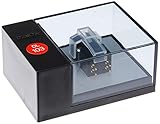
- Denon Classic turntable cartridge, the dl 103, has been an industry standard for decades