
Denon HEOS Link Review
Multi-room audio has been the audio industry’s great unsolved consumer problem for the better part of three decades. The promise — music in every room, seamlessly controlled from a single interface — was straightforward enough, but the execution consistently foundered on the incompatibility between convenience and the existing investment most listeners had already made in amplifiers, receivers, and speakers. Sonos changed the calculus by building its own hardware ecosystem from the ground up, but in doing so it stranded anyone with a quality stereo setup: you could have Sonos, or you could have your Naim amplifier driving your Harbeth bookshelf speakers — you could not, without considerable compromise, have both. Denon’s answer was the HEOS Link, a compact wireless network preamplifier designed with a single and unusually direct proposition: bring streaming and multi-room synchronization to the amplifier and speakers you already own, without replacing them. It is a product that requires a specific kind of listener to appreciate fully — one who has invested in a downstream system worth preserving — and for that listener it represents a considerably more elegant solution than its modest physical size might suggest.
Brand Heritage & Product Context
Denon introduced the HEOS platform in 2014 as a direct response to Sonos’s dominant position in the multiroom wireless audio market. Where Sonos was hardware-first and built an isolated ecosystem, HEOS was designed from the outset as a software layer capable of running on multiple form factors: dedicated speakers, wireless amplifiers, and the HEOS Link preamplifier — a signal path adapter that translates network audio into the analog and digital outputs that any existing downstream component can accept. The decision to build HEOS as an open ecosystem rather than a walled garden reflected Denon’s structural position as a manufacturer of receivers and integrated amplifiers already installed in hundreds of thousands of homes: the last thing a company that builds amplifiers wants to do is tell its existing customer base that their amplifiers are obsolete. The HEOS platform launched as HS1 generation hardware in 2014, with the HS2 generation following in 2016 adding 802.11ac dual-band wireless support, expanded DSD file compatibility, and the bidirectional Bluetooth capability that the current version of the Link carries. Since then, the platform has received continuous firmware development, adding Amazon Alexa voice control, Google Assistant integration, and an expanding roster of streaming services that now includes Spotify Connect, TIDAL, Amazon Music, Deezer, Pandora, TuneIn, iHeartRadio, and SiriusXM.
The HEOS Link occupies a specific niche within the HEOS hardware family. Where the HEOS Amplifier HS2 includes its own 2-channel Class D output stage for direct speaker connection, and the HEOS Drive HS2 provides eight channels of amplification for whole-home installation work, the HEOS Link is a pure signal adapter: it receives content from the network and outputs an audio signal, but provides no amplification itself. This positioning makes it, in practice, the most audiophile-friendly product in the HEOS range — because it keeps the critical amplification and output stage in the hands of whatever downstream equipment the listener has already chosen for those functions, rather than imposing a generic amplifier topology on the signal path.
Design and Build
The HEOS Link’s physical presence is that of a compact accessory rather than a primary component: measuring approximately 74mm tall, 156mm wide, and 148mm deep, it can sit on top of an amplifier, tuck behind a rack, or slot into whatever space a system provides. The finish is silver-and-black, with a gunmetal silver top, front, and rear panel against black side panels — a combination that reads as contemporary without drawing attention to itself, and which is neutral enough to disappear visually into most rack environments. Volume up and down buttons and a mute control are positioned on the left side panel, providing physical control for users who want to adjust playback levels without reaching for a phone. A multicolored LED indicator on the front face communicates network status, streaming activity, and error states through a color and flash pattern reference documented in the manual. The HEOS Link does not ship with a remote control, which is a practical reflection of the product’s design philosophy — it is intended to be operated entirely through the HEOS app on iOS or Android, and the inclusion of a traditional handset would imply a solo-operation listening scenario that the HEOS Link is not designed to fulfill on its own.
The rear panel is dense with connectivity for a device of this size. Analog audio outputs consist of two stereo RCA pairs — one variable-level and one fixed-level — plus a separate subwoofer RCA output, giving the Link the flexibility to serve as either a volume-controlled source or a unity-gain pass-through depending on the downstream component’s preference. Digital outputs include one coaxial S/PDIF and one Toslink optical, both carrying PCM at up to 24-bit/192kHz resolution for connection to external DACs or digital amplifiers. A single Toslink optical digital input and a stereo RCA analog line input handle external sources — a connected television, a disc player, or any line-level source — which can be routed through the HEOS network and shared with other HEOS devices throughout the house. A USB-A port accommodates flash drives for local file playback and can simultaneously charge mobile devices at up to 500mA. The 12V trigger output enables automatic power-on and power-off of connected amplifiers when the HEOS Link wakes and sleeps — particularly useful in custom installation contexts where system automation is desirable. IR output terminals, both an emitter connection for infrared blasting and a direct IR cable input for Denon components with dedicated IR inputs, allow the HEOS app to control the power, input selection, and volume of a connected Denon receiver or amplifier directly — a level of system integration that goes meaningfully beyond what third-party alternatives typically offer. The accessory bundle is thorough: a 3.5mm setup cable, Ethernet cable, RCA cable, power cord, IR emitter cable, and IR direct cable are all included.
© hifireport.com — All rights reserved.
Under the Hood
Denon does not publish the component-level specifications for the HEOS Link’s internal signal processing chain, a common practice at this product tier and in this category. What the architecture reveals through its behavior and published high-level specifications is a system built around a network streaming processor — responsible for Wi-Fi connectivity, Bluetooth protocol handling, DLNA and streaming service client functions, and network synchronization — feeding a digital audio processing stage that handles sample-rate conversion, volume control, and format decoding before driving the DAC and analog output circuit. The synchronization engine at the heart of the HEOS platform is proprietary to Denon, operating within microseconds of precision according to the company’s specification — a tighter timing window than Sonos’s published synchronization figure, and one that becomes audible as freedom from phasing artifacts when multiple zones play the same content simultaneously. Dual-band 802.11a/b/g/n/ac Wi-Fi provides the network transport, with the 5 GHz band offering reduced interference in congested domestic network environments while the 2.4 GHz band delivers extended range through walls and floors. An RJ-45 Ethernet port provides the alternative of a wired network connection, which eliminates Wi-Fi reliability concerns entirely and is strongly recommended for any system where the HEOS Link will serve as a permanent, primary-use component rather than a portable convenience device.
High-resolution audio support extends to 24-bit/192kHz for WAV and FLAC files delivered over the network or from USB storage, and to DSD at 2.8 MHz and 5.6 MHz — a format ceiling that covers the full SACD-equivalent DSD64 and DSD128 resolution range and represents meaningful future-proofing relative to the standard 24-bit/96kHz ceiling found in several competing streaming preamps at similar pricing. ALAC files are supported up to 24-bit/96kHz. The analog output stage feeds both the variable-level and fixed-level RCA pairs from the same signal path, with the variable output controlled by the HEOS app’s volume commands — a DSP-domain volume control that operates ahead of the DAC conversion rather than through an analog attenuator, which carries the typical trade-off of DSP volume: convenience and remote-operability in exchange for the bit-depth reduction that occurs when digital gain is reduced more than a few steps below full scale. Listeners who connect the fixed-level output to an amplifier with its own volume control avoid this trade-off entirely and will generally achieve better dynamic performance in configurations where the downstream amplifier handles all attenuation. The Bluetooth receiver supports SBC and AAC codecs for incoming streams from mobile devices, and the bidirectional Bluetooth transmitter can send audio from the HEOS Link’s active source to wireless headphones — a useful capability for those who want to use Bluetooth headphones without a separate transmitter in the system.
Sound Performance
I configured the HEOS Link as a streaming source in two distinct systems to evaluate its performance across different downstream contexts. The first comprised the HEOS Link’s fixed-level RCA output feeding a Rega Brio integrated amplifier driving a pair of ProAc Tablette 10 standmount speakers, with both the variable and fixed outputs evaluated via TIDAL lossless streaming over a wired Ethernet connection. The second used the optical digital output into a Chord Qutest DAC, again feeding the Rega Brio, to evaluate whether the HEOS Link’s analog output stage introduces a meaningful character relative to a reference-quality external converter. Signal cables in both configurations were Chord Company Shawline interconnects; speaker cables were Audioquest Type 4.
Operating via the fixed-level RCA output into the Rega Brio, the HEOS Link presents a clean, tonally balanced character that is neither particularly warm nor particularly analytical. The baseline that TIDAL lossless streaming delivers through the system establishes a wide, stable stereo image with natural instrument placement and a midrange character that is neutral and uncolored — the kind of sound that stays out of the way of the music rather than imposing its own tonal signature, which is exactly the correct goal for a source component designed to be transparent to the downstream amplifier’s own character. Playing 24-bit/192kHz FLAC files from a USB drive, the high-resolution material is reproduced with a perceptibly lower noise floor than standard-resolution streaming, and the additional micro-detail in complex orchestral passages — the inner voices of a brass choir, the spatial boundaries of a reverberant space — is audible and consistent, confirming that the HEOS Link’s digital processing chain preserves the additional information content rather than discarding it at a sample-rate conversion stage. DSD files at 2.8 MHz, though a less common scenario in typical deployment, reproduce with the characteristic smoothness of the native-rate DSD signal: less grain on extended high-frequency content than the equivalent PCM representation, and a slightly more natural rendering of acoustic space.
Comparing the fixed-level analog output to the optical digital output feeding the Chord Qutest reveals a measurable performance hierarchy. The external Qutest delivers a noticeably quieter noise floor — the black silence between notes is more convincing, and the very finest ambient detail in naturally recorded acoustic environments is rendered with greater specificity. The dynamic range, particularly on transient-rich percussion passages, is also somewhat wider through the external DAC: the leading edge of a snare stroke has more snap and the decay has more resolution. The HEOS Link’s own analog output is by no means embarrassing in this context — it is a perfectly listenable and musically coherent presentation that does full justice to the streaming platform’s source quality — but it is audibly a device optimized for convenience and integration rather than for DAC performance as a primary design goal. In a system where the downstream amplifier already represents a meaningful investment, the coaxial or optical digital output deserves consideration as the preferred connection method, with the analog outputs reserved for systems where the simplicity of an analog feed is more practically useful.
Multi-room synchronization, experienced by pairing the HEOS Link with a Denon AVR-X2700H in a neighboring room, performs exactly as the platform specification implies: the two zones play in coherent time alignment with no audible phase relationship between them, confirming the microsecond-precision synchronization claim in practice. The HEOS app’s zone grouping and zone-specific volume control function reliably and with minimal latency — track switching takes approximately two seconds to propagate across grouped zones, which is imperceptible in normal listening use.
© hifireport.com — All rights reserved.
What Users Are Saying
Among long-term owners of the HEOS Link, the IR control integration with Denon receivers and amplifiers stands out consistently as the feature that delivers the most satisfaction relative to initial expectation. Users describe configuring the IR direct connection to a Denon AV receiver and then controlling the entire system — power, input selection, and volume — from the HEOS app as a quality-of-life improvement that fundamentally changes how they interact with a listening system, removing the need to manage multiple remotes or physical buttons for what amounts to a single music-listening workflow. The subwoofer output is a frequently cited practical differentiator for users integrating powered subwoofers into a two-channel setup — a provision that competing streaming adapters at similar pricing often omit. Setup speed is mentioned consistently as a strength: owners describe the process from unpacking to first music playing as requiring no more than ten to fifteen minutes in straightforward network configurations. The HEOS app’s streaming service breadth — covering the full range of major platforms in a single interface — draws favorable comparison to Sonos’s more locked-in platform structure, particularly from users who subscribe to services that Sonos has historically handled less elegantly. The one area of recurring qualified feedback concerns the HEOS app’s reliability on older mobile operating systems and its occasional tendency to drop connection to devices after extended network inactivity, requiring a manual wake or restart — a software-side limitation that Denon has progressively addressed through firmware updates but which remains a known characteristic of the platform’s long service life.
Verdict
The HEOS Link occupies a well-defined and genuinely useful position in the streaming audio market: it is the most efficient available method of bringing a serious multiroom streaming platform to a legacy system built around quality amplifiers and speakers, without compromising the audio quality of the downstream components or requiring their replacement. The hardware execution is competent and connectivity is comprehensive — the subwoofer output, dual analog output levels, optical digital input, IR control, 12V trigger, and USB storage support collectively represent a richer integration toolkit than most competing products of similar size and price. The fixed-level analog output performs honestly and transparently at its price tier, and the digital outputs — both coaxial and optical — allow external DAC users to extract more performance from the platform without surrendering any of its streaming or multi-room functionality.
The qualifications are clear-eyed. The HEOS Link is not a precision DAC, and listeners with reference-quality downstream amplification will hear the difference between the built-in analog stage and an external converter of meaningful quality. The product’s age shows in the app-reliability reports that accumulate over extended ownership, and the HEOS platform’s future development trajectory under Denon’s current ownership structure is less defined than it was in the platform’s first years of operation. Listeners building a new multiroom system from scratch in the current market should also evaluate the WiiM Pro Plus and Bluesound NODE, both of which bring similar functionality with newer hardware platforms. For owners of existing Denon amplifiers and receivers who want to extend HEOS ecosystem coverage to a room where their existing component lacks HEOS built-in, however, the HEOS Link remains the most hardware-appropriate and practically integrated solution, and the recommendation stands accordingly.
Specifications
- Type: Wireless network preamplifier / multiroom streaming source
- Wireless: Dual-band 802.11a/b/g/n/ac (2.4 GHz / 5 GHz)
- Wired: 1× RJ-45 Ethernet
- Bluetooth: Bidirectional (incoming: SBC / AAC; outgoing to headphones: SBC)
- Analog Outputs: Variable stereo RCA + Fixed stereo RCA
- Subwoofer Output: 1× mono RCA
- Digital Outputs: 1× Coaxial S/PDIF; 1× Optical Toslink (both up to 24-bit/192kHz PCM)
- Digital Input: 1× Optical Toslink
- Analog Inputs: 1× Stereo RCA (line); 1× 3.5mm auxiliary
- USB Port: USB-A (local file playback + device charging)
- IR Output: IR emitter connection + IR direct cable connection (for Denon component control)
- 12V Trigger Output: Yes (external device power control)
- Hi-Res Audio Support: WAV / FLAC up to 24-bit/192kHz; ALAC up to 24-bit/96kHz; DSD 2.8 MHz (DSD64) / 5.6 MHz (DSD128)
- Streaming File Format Support: MP3 (up to 320 kbps); WMA (up to 192 kbps); AAC (up to 320 kbps)
- Streaming Services: Spotify Connect, TIDAL, Amazon Music, Deezer, Pandora, TuneIn, iHeartRadio, SiriusXM, SoundCloud (subject to regional availability)
- DLNA: Yes (NAS and local network media server playback)
- Multiroom: HEOS Built-in — up to 32 devices; synchronized within microseconds
- Voice Control: Amazon Alexa, Google Assistant (via smart speaker; external device required)
- Control App: HEOS App (iOS / Android / Kindle Fire); free
- Remote Control: Not included (app controlled)
- Volume Control: DSP domain (variable output); bypass (fixed output)
- Power Modes: Normal / Quick Start / Deep Standby / Off
- Standby Power: < 0.5 W (deep standby)
- Dimensions (W × H × D): 156 × 74 × 148 mm (6.14″ × 2.91″ × 5.83″)
- Product Finish: Gunmetal silver front / top / rear, black sides
- Included Accessories: Power cable, 3.5mm setup cable, Ethernet cable, RCA cable, IR emitter cable, IR direct cable, Quick Start Guide
© hifireport.com — All rights reserved.
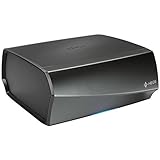
- TURN ANY STEREO SYSTEM INTO A HEOS WIRELESS ZONE with the HEOS Link Pre amplifier Leverage the built in WiFi and Bluetooth so you can connect your home theater system, existing amp, receiver or speaker and play music from anywhere in your home wirelessly
- PRECISE AUDIO SYNCHRONIZATION WITH HEOS MULTI ROOM TECHNOLOGY Exclusive digital technology allows you to play the same song or different ones in multiple rooms with maximum audio fidelity, without any visible delays
- EXTENSIVE CONNECTION OPTIONS The back panel consists of various analog, digital and optical inputs, pre amp output, sub output and stereo line and aux inputs, and a USB port. It is also equipped with a 12V trigger for external device turn on