
Divini S-S12 Signal Cable Review
When it comes to domestically produced cable brands, Divini is one you should absolutely not overlook. If you’ve ever used their cables, I believe you’ll never forget them.
Divini started with speakers, and their most talked-about products are their DIY speaker kits. They design everything perfectly, leaving only the task of tightening screws to you. If you’ve ever assembled IKEA furniture, you definitely have the ability to assemble a pair of Divini KIT speakers. I’ve tried it myself, and it’s quite fun. Moreover, the sound of the KIT-M is not bad at all. You’d never imagine that as an amateur, you could create a pair of speakers that produce such sound. This is the greatest joy that the Divini KIT series brings.
In addition to kits, they also offer as many as four series of speakers, allowing consumers with different budgets to find their favorites. Beyond being a brand and manufacturer, Divini is also a distributor. They represent world-renowned driver manufacturers such as Seas, Scan-Speak, and Morel. Jantzen components, popular among audiophiles, are also handled by them.
Compared to those who deliberately conceal their origins and fabricate a false foreign identity, Divini, which never hides its Taiwanese roots, is even more admirable. They openly tell everyone: Divini (Tianle Audio) is a Taiwanese brand, aiming to market its products worldwide. Taiwanese brands should have such confidence. Hats off to Divini/Tianle Audio!
As a component and speaker manufacturer, Divini also holds another identity: a cable brand. Over the years, they have been focusing on cable development, making their products increasingly refined, high-end, and full of surprises.
Scientific Principles in Cable Design
Their approach to cable design is not based on mysticism but on logic and scientific principles. This is the same philosophy they apply to speaker manufacturing, where scientific evidence dictates everything. They emphasize four key aspects: conductor, insulation, structure, and connectors. These four elements are indeed the main pillars of cable design. If you can optimize these four points as much as possible, wouldn’t you be able to create excellent cables? This is Divini’s thinking, and pushing it to the extreme led to the birth of the S-S12 signal cable.
OCS Single Crystal Silver Conductor
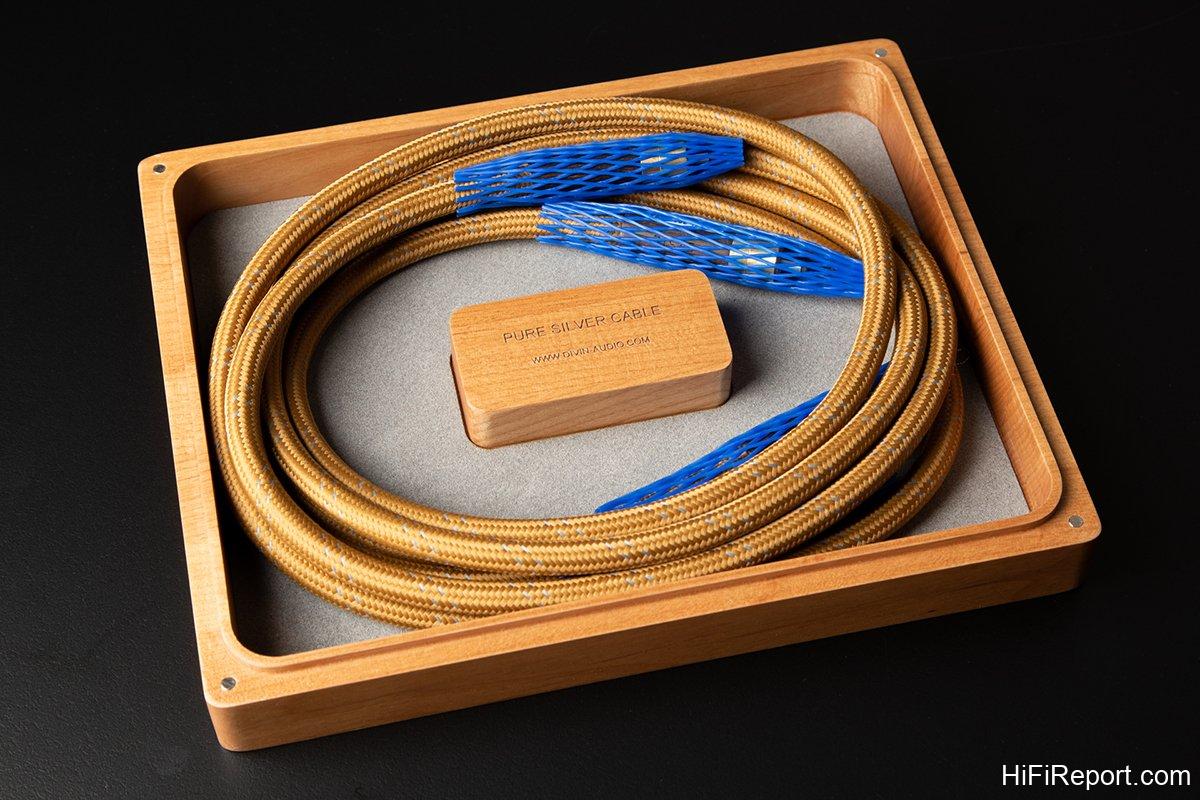
The S-S12, a model name that sounds like a missile, is Divini’s current flagship signal cable. The conductor is made of 6N purity OCS single crystal silver, manufactured using Professor Ohno’s continuous casting method from Japan. Theoretically, the crystal length can reach 150 meters, allowing for more accurate and faster signal transmission. Furthermore, pure silver is inherently the most efficient metal for signal transmission. For many years, single crystal silver has been considered the best conductor by high-end cable manufacturers. The S-S12 utilizes single crystal silver.
Balanced Structure and Triple Shielding
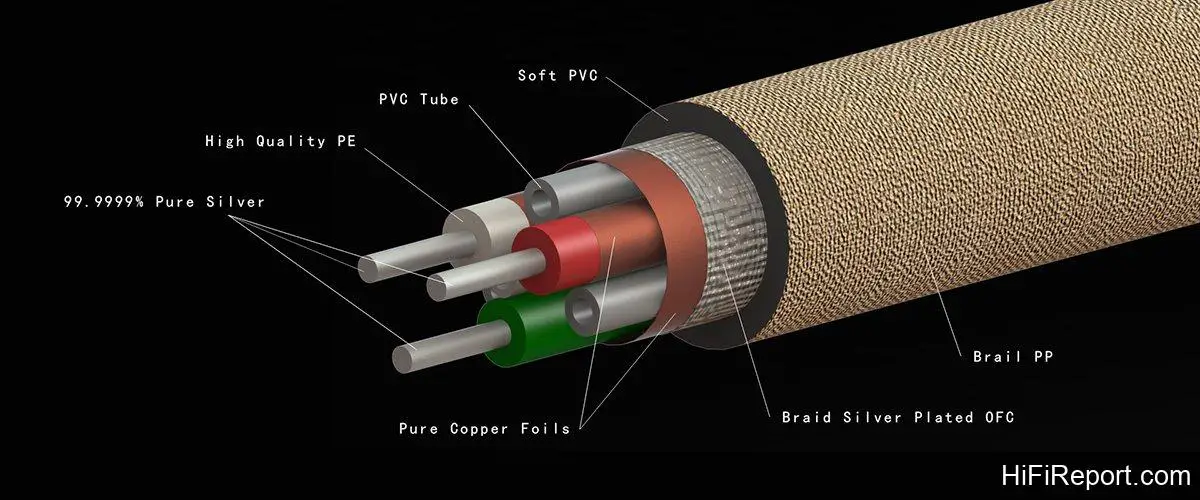
Divini designed a three-core structure for the S-S12. Among them, two strands of 0.11mm single crystal silver litz wires serve as signal conductors, and another 0.22mm single crystal silver wire acts as the ground wire. Although Divini currently only offers a single-ended version of the S-S12, its internal structure is actually balanced.
Shielding is also meticulously implemented. The S-S12 has a total of three layers of shielding, including two layers of thick copper foil—one layer individually wraps the inner wires, and another layer simultaneously covers all three inner wires. Externally, a braided mesh made of 0.1mm silver-plated copper wire is added, striving for the most comprehensive shielding to isolate unwanted external electromagnetic interference.
The manufacturer further states that their triple shielding, combined with a thickened ground wire, helps stabilize the signal ground, thereby reducing voltage fluctuations during signal transmission. This results in even less signal loss. Consequently, the S-S12 is expected to deliver more abundant sound energy and higher precision.
Rosewood Shell and Pure Silver Connectors
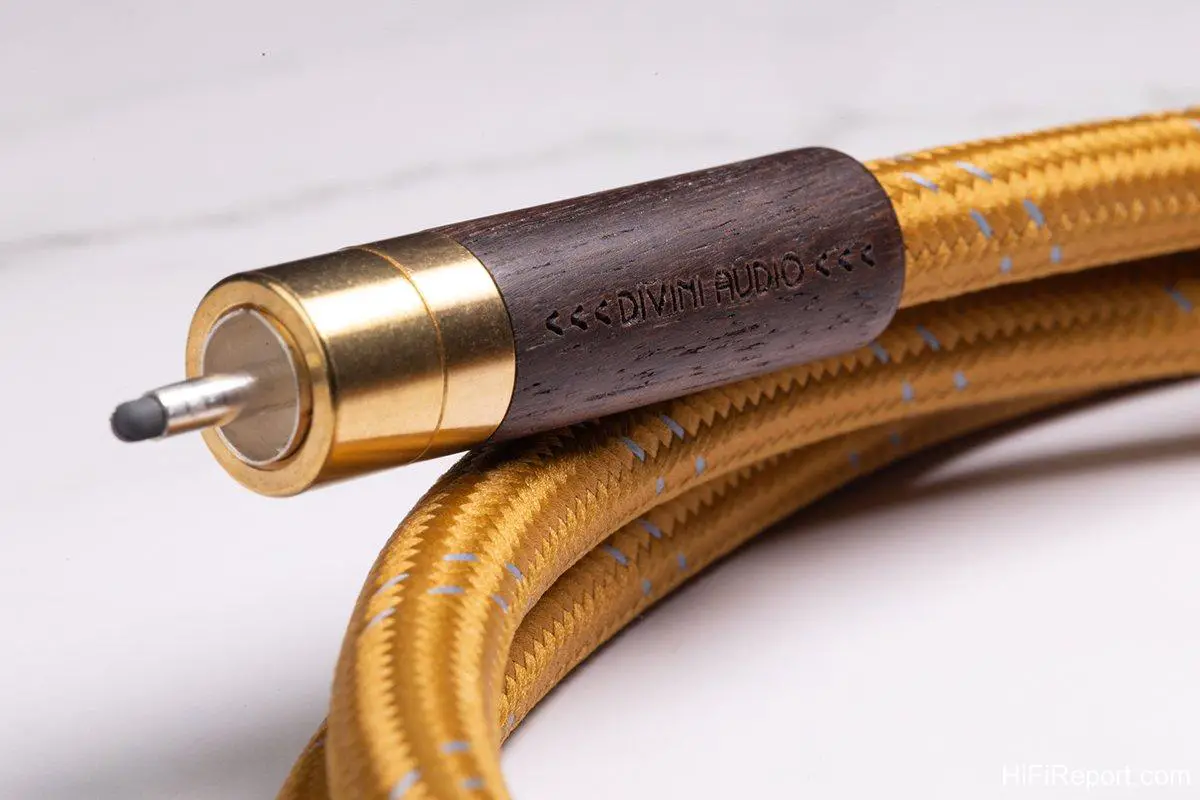
As for the connectors, they are even more delightful. Typical RCA connectors are made of metal, but Divini has been researching the relationship between wood and resonance for years, exploring ways to incorporate wood into cable design. Previously, they launched RCA connectors with pure copper gold-plated contacts and maple wood shells, which were also available for retail.
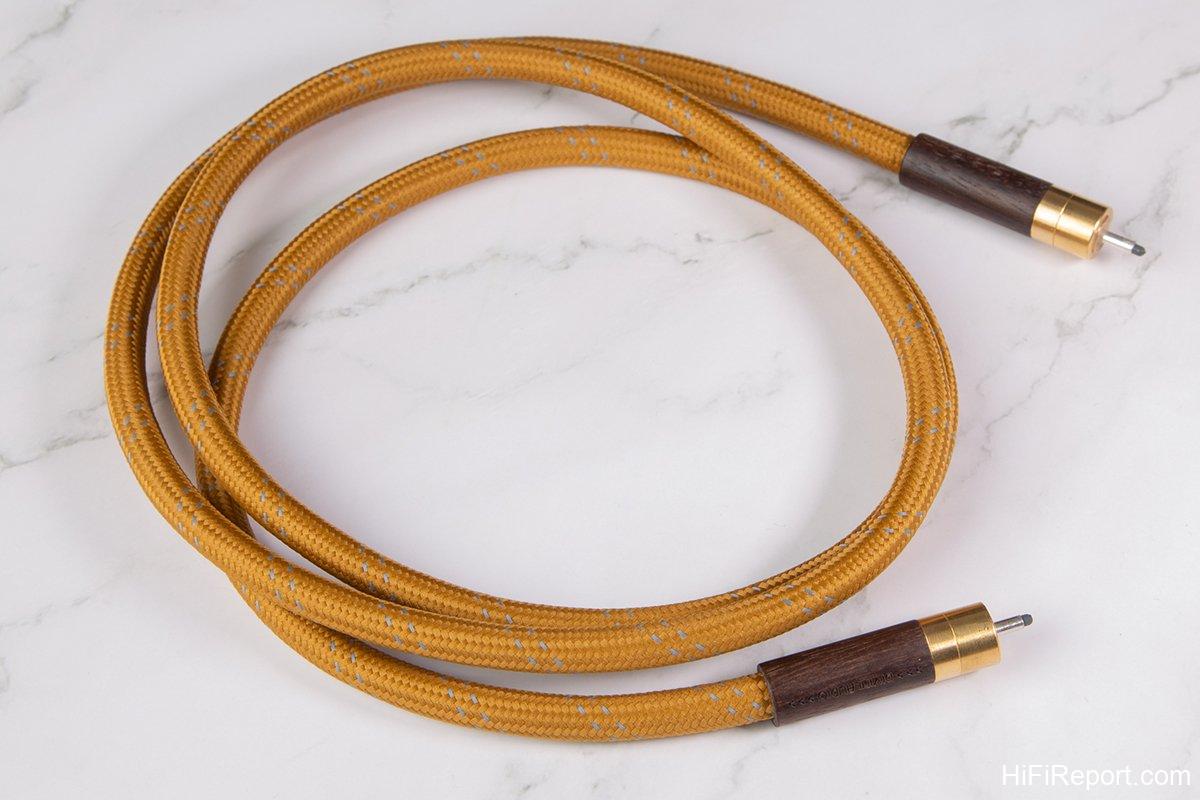
On the S-S12, Divini employs their newly developed top-tier connectors. The signal contacts are upgraded to pure silver, the outer cover is pure copper gold-plated, and the shell is made of rosewood, precision-machined from solid wood. Pure silver contacts offer fast transmission, low impedance, and are beneficial for high-frequency transmission. Combined with the S-S12’s single crystal silver conductor, the entire signal cable is “silver throughout.” The pure copper gold-plated outer cover and rosewood shell enhance the connector’s vibration damping and make it non-magnetic.
After soldering the wires, Divini first injects electronic insulating (likely refers to epoxy or sealant), then wraps it with copper foil before installing the connector shell, ensuring that the transmission process is not affected by external electromagnetic interference. From the cable material to the connectors, and to the handcrafted details, Divini is telling you: “I am Made in Taiwan, and I am proud.”
Sound Performance: Black Background, Tight Imaging, and Rich Tone
Actually, regarding the sound characteristics of the Divini S-S12, I really don’t need to say much. The manufacturer has clearly described them on their official website, and it’s indeed as they say, without exaggeration. Its sound is very clean, with an extremely quiet background. Therefore, both the subtle details in the music and the ambience of the stage are easily revealed.
The soundstage expands naturally and evenly. At the same time, its sound source has high cohesion, resulting in tight and clear outlines. This consequently improves image separation, making the expanded soundstage seem even wider. It also demonstrates comprehensive performance across the frequency spectrum. The high frequencies carry a brilliant richness, with a bright but not harsh tone, which easily brings out the colors of the music. The midrange resolution is outstanding, with three-dimensional imaging and high realism. The bass is clean and not bloated, with ample quantity and effortless extension. More remarkably, its bass resolution is exceptionally good.
Rich Information for Lively Performance
If you are a jazz enthusiast, you should try the S-S12. When listening to Miles Davis’s classic album “Kind of Blue,” the S-S12 fills the music with color and makes the performance incredibly vivid. In “So What,” the opening unfolds with a dialogue between bass and piano. The bass plucking is tight and elastic, with particularly distinct note definition, and a hint of softness and warmth in the decay. The piano embellishes with a calm demeanor, like starlight in the night sky. The drum set taps cymbals, and the subtle sounds are truly vibrant.
Then, Miles’s trumpet sounds, advancing in a fixed “long-short” rhythm, accompanied by John Coltrane’s tenor saxophone, adding thickness to the harmony. Subsequently, the music enters the trumpet solo, with the rhythm section continuing to provide stable support. The progression of these musical elements is clearly revealed by the S-S12. The sound texture is extremely realistic, and this realism is composed of rich information. Moreover, whether it’s the trumpet or the saxophone, the metallic texture is excellent. Brass instruments need to have luster and color, and the S-S12 slightly enhances that brightness, making the decay even more beautiful. You can also feel the subtle vibrations of the saxophone reed when played, giving the saxophone a different sonic texture from the trumpet. Having so much rich information is truly wonderful, isn’t it?
Sharp Imaging and Soundstage Separation
Listening to Keith Jarrett Trio’s “Standards, Vol. 1,” an album I love, and along with Vol. 2, I own both CD and vinyl versions. However, I am now listening on Tidal, using Telos EMP as a transport, playing through Roon. Here, I want to clarify a misunderstanding: there is no absolute truth that CDs always sound better than streaming. Regarding this track alone, I have CD, vinyl, and Tidal’s high-resolution files simultaneously, and I don’t think Tidal files are inferior to the former two. On the contrary, the MQA version on Tidal has the best image density and separation.
Back to the listening experience. The S-S12 makes the already calm and rational ECM recording sound even cleaner and more transparent. However, because the background is black enough, the outlines are sharp enough, the images are three-dimensional enough, the density is solid enough, and the soundstage separation is sufficient, after installing the S-S12, the system’s sound becomes more immersive. Especially Keith Jarrett’s almost constant humming, coupled with the well-defined stage presence, makes the vivid performance truly captivating. The piano tone’s decay is truly enchanting—is it brought by the silver cable? As for the bass string vibrations during plucking, and the gentle accompaniment of the drums, these are the most subtle sounds that contribute to the richness of the music.
Captivating Piano Tone with Luster
The S-S12 possesses superb resolution but does not introduce any harshness. Many people fear that silver cables are grainy and sharp. In fact, truly good silver cables do not have such issues, and they can bring a beautiful luster that copper cables struggle to achieve, along with a better sense of space and excellent transient response.
Taking Renaud Capuçon and French musicians’ performance of Schubert’s Trout Quintet as an example, the S-S12 makes the characteristics of these five instruments more distinct and vibrant. The images are clear, the outlines are sharp, and even the pizzicato movements are visually discernible. The piano is bright with a hint of crispness, poetically expressing the shimmering water. The violin is melodious and carries a gentle and beautiful temperament, elegant and precious—a quality rarely found in other versions. Listening to the cello’s singing with a rich nasal tone, the ensemble is truly beautiful. And remember the double bass? Schubert rarely added a double bass to chamber music, but just this one instrument adds weight and depth to the music, creating more expression.
Layered Beauty of Sound
Listening to Jos van Immerseel conducting Anima Eterna Orchestra’s Beethoven Symphony No. 3, this orchestra is a historically informed performance ensemble with a smaller scale than modern orchestras. The smaller scale makes it more agile, and the music flows faster. This “Eroica” indeed has a faster tempo than modern orchestra versions, and it’s more refreshing. The sound produced by this type of orchestra is not thick but more transparent, and the separation of voices is better. This perfectly highlights the advantages of the S-S12.
Here, I hear a more vivid orchestral performance. The strings are lively, and when Beethoven attempts to stack harmonies in a canon-like manner, I further appreciate the layered charm. This type of orchestra lacks weight and thickness but helps us revisit the sonic landscape of Beethoven’s era. After the recapitulation in the first movement, the majestic momentum brought by the French horn is still exhilarating. As for my favorite passage, the three-part fugue in the middle section of the second movement—one of the greatest fugues in music history—under the S-S12’s resolution, the layers of the fugue become clearer and more distinct.
Abundant Energy and Dynamic Range
I chose a small-scale orchestral version. If you switch to a modern orchestra, the emotion will not be diminished, and might even be amplified. Listening to Neeme Järvi conducting the Gothenburg Symphony Orchestra’s Tchaikovsky 1812 Overture, this recording version also includes a choir, adding diverse facets to the music. The opening choral hymn, compared to common orchestral versions, reveals a sense of the cruelty of war and the desolate atmosphere of the battlefield.
The S-S12 creates a broad and deep soundstage, and throughout the music, you can feel that the soundstage is incredibly stable, with very clear positioning of instruments. Shouldn’t it always be like this? It should be, but not every cable can achieve such clarity and definition. I love the brilliance that the S-S12 brings to brass instruments. Perhaps it’s the color unique to silver cables, just a bit more than copper cables, but this step up takes it to another level. Listening to the war scenes that Tchaikovsky creates in the middle section, the surging and interweaving sound waves represent the back-and-forth of war. If the sound layers are clear, this piece of music is extremely enjoyable. Are silver cables thin? No, I don’t think so. At least when the music reaches the end, celebrating victory, the energy that erupts is rich and abundant, and the cannon fire sounds incredibly impactful. Importantly, when reproducing this piece, the S-S12 expresses the texture of the music more clearly.
Realistic Vocal Reproduction
So far, I haven’t mentioned vocals. Actually, based on my previous descriptions, experienced audiophiles can probably imagine the S-S12’s vocal performance. Yes, your guess is correct. The S-S12’s vocal performance is definitely pleasing. It doesn’t try to please you with a thick midrange, nor does it try to bewitch you with a sweet tone. The S-S12 presents the texture that vocals should have in an unimaginable way.
I won’t use common audiophile demo tracks as examples but instead use early recordings of Callas’s opera performances. Listening to the “Pure Callas” album, created by Warner for the opera goddess, all selections are remastered from analog master tapes to digital master tapes. The newly produced sound quality is even higher than the original digital versions. For example, in Violetta’s “Sempre libera” from *La Traviata*, Callas’s singing is not the most beautiful version, but it is the most varied and emotionally vivid. The subtleties lie in her transitions and decays, plus her more dramatic singing than others, increasing the range of volume changes. These subtle details are what make Callas extraordinary. The S-S12 preserves all these details, presenting them without embellishment, making the music expressive and touching.
Divini Flagship: A Contender Against International Brands
At this point, I should conclude my remarks. The sound of the Divini S-S12 is indeed remarkable. I have heard similar sound performance from other brands’ cables, but those cables were priced much higher than the S-S12. This is Divini’s flagship signal cable. The price is not cheap, but in terms of its performance, it indeed has the ability to compete internationally, and the results may be surprising. If you have a cable budget of $640 – $925 USD (NTD 20000-30000), don’t limit yourself to foreign brands. The Divini S-S12 is worth giving a chance to perform. Then, you will know its prowess!
Specifications
* Type: Analog Signal Cable
* Conductor: 99.9999% 6N OCS
* Wire Gauge: 0.528 sq x2 + 0.94 sq x1
* Structure: 3-layer shielding (silver-plated copper braid x1; copper foil x2)
* Outer Diameter: 10.0mm
* Length (Standard): 1.0M; 1.5M