
Divini Audio PT-Z Power Cable Review
This year at the audio show, Divini Audio unveiled a pair of striking new cable designs: the Trans-Z speaker cable and the PT-Z power cable.
Both of these offerings are not only exquisitely crafted but also feature a truly unique design philosophy.
What exactly makes them unique? The most prominent and immediately noticeable characteristic is their “independent conductor” design.
Speaker cables typically have positive and negative conductors. Divini’s Trans-Z design separates these positive and negative conductors, running them independently with a gentle twist, and securing them with a splitter featuring an aluminum alloy body and solid wood housing.
This type of design isn’t entirely unprecedented; some manufacturers have explored it before, but it remains relatively uncommon.
Divini Audio intends to make this independent conductor design a signature feature across this product line.
Independent Three-Wire Construction
The PT-Z power cable follows the same design principle.
How many conductors are in a power cable? Live (hot), neutral, and ground – three in total.
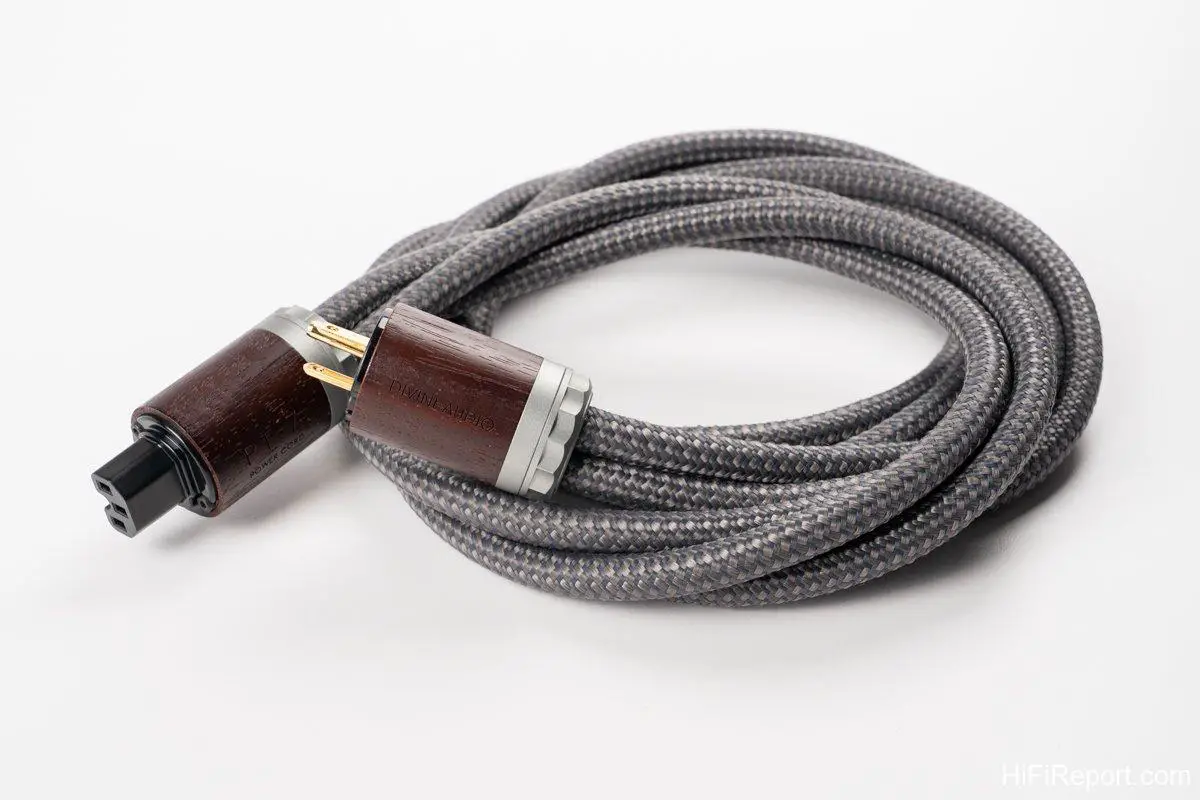
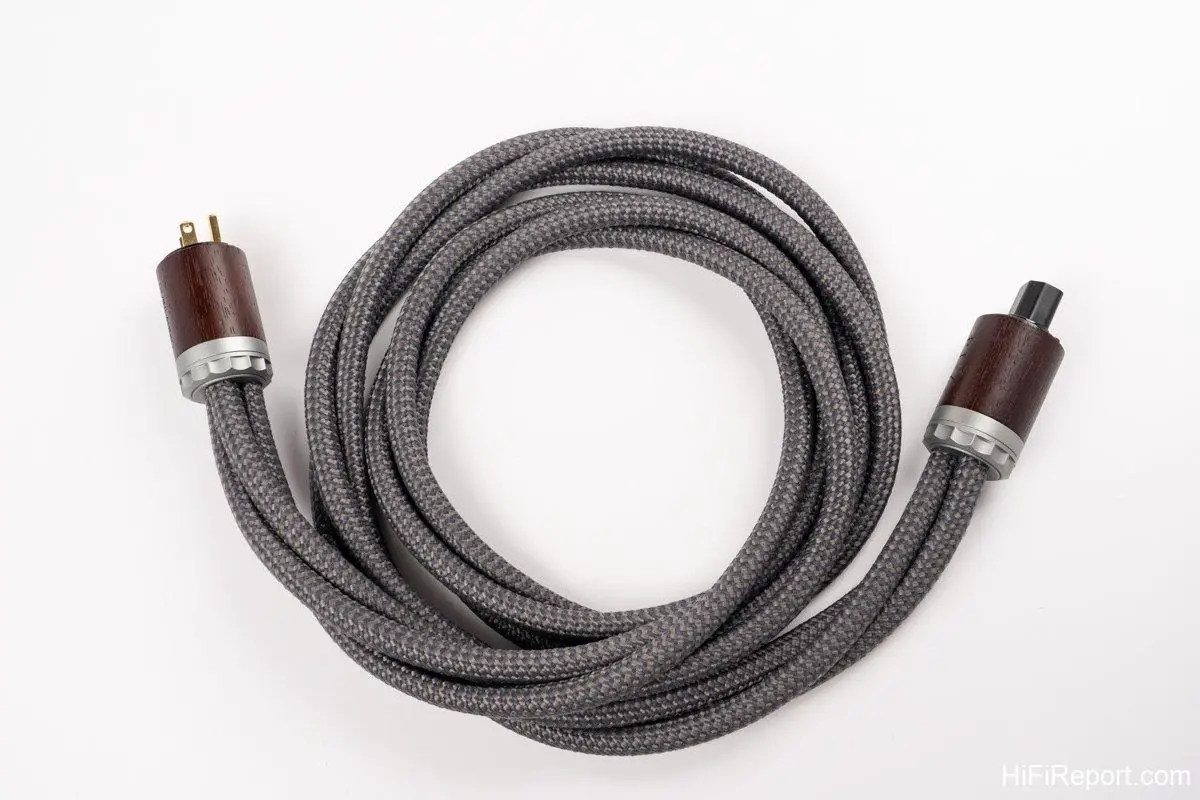
The PT-Z takes this approach and separates all three conductors. Why? Divini’s goal is singular: to maximize the isolation between these conductors and minimize mutual interference.
Seven Conductors, Four Gauges, Double Shielding
All three conductors (live, neutral, and ground) share the same construction.
Each conductor consists of seven individually insulated strands.
These seven strands are made of OCC copper and comprise four different gauges.
These seven individually insulated strands of four different gauges are then twisted together, with fiber bundles interspersed throughout for vibration damping.
Once twisted into a conductor, it’s further protected by a double-layer shield. The inner layer is a thick copper foil, and the outer layer is a braided shield made from 0.12mm OFC silver-plated copper wire.
Finally, a flexible PVC jacket is applied, and the entire cable is wrapped in a nylon braid.
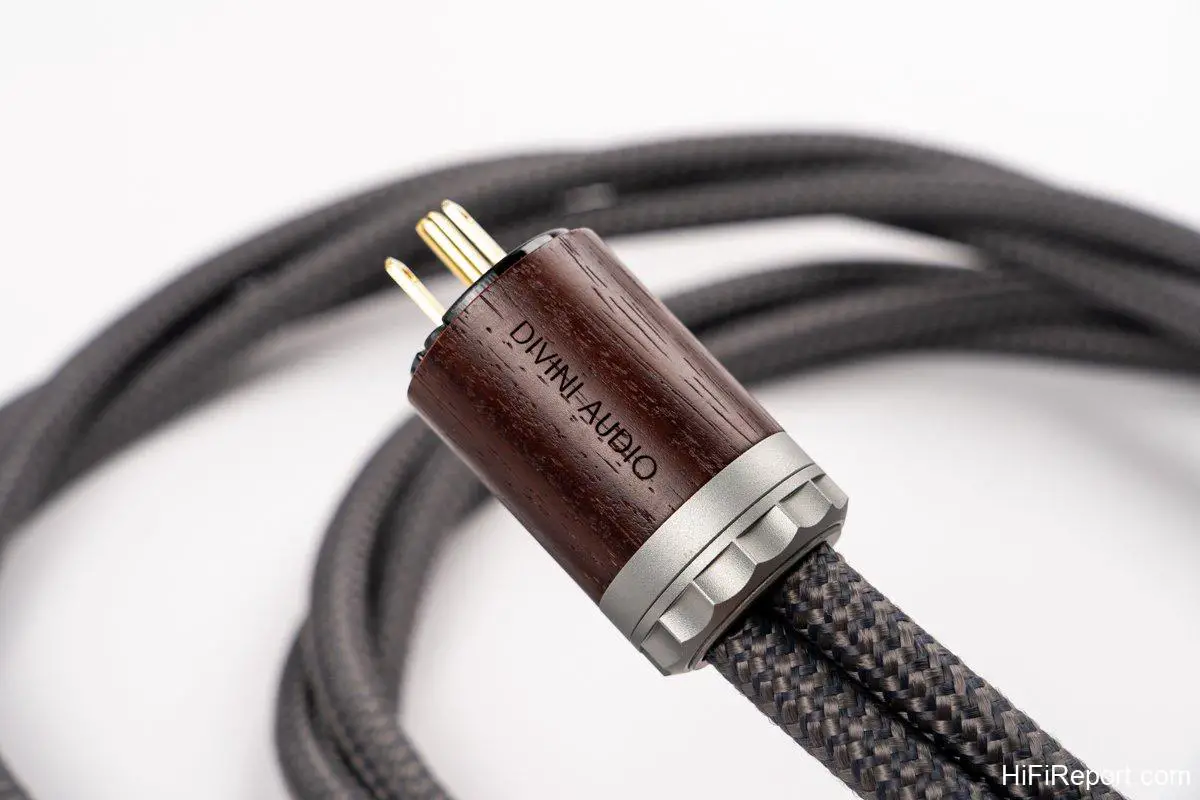
This construction results in each of the three conductors achieving a substantial 10AWG gauge, easily capable of handling the power demands of various audio components.
The manufacturer emphasizes that giving the ground conductor such a large cross-sectional area minimizes voltage fluctuations and grounding instability, ensuring a highly stable ground connection.
Custom Connectors with Rosewood Housing
The PT-Z’s male and female connectors feature gold-plated pure copper conductors, balancing elasticity, strength, and conductivity.
The connector housings are exquisitely crafted. These are custom-designed by Divini to accommodate the cable’s unique three-conductor architecture.
The housings are machined from metal and feature a wave-like decorative pattern on the base.
Divini excels at integrating metal and wood in their connectors – a design choice that is not only aesthetically pleasing and unique but also serves a purpose in vibration damping and anti-magnetism.
For the wooden component of the PT-Z connectors, they’ve chosen rosewood, with the model number elegantly engraved.
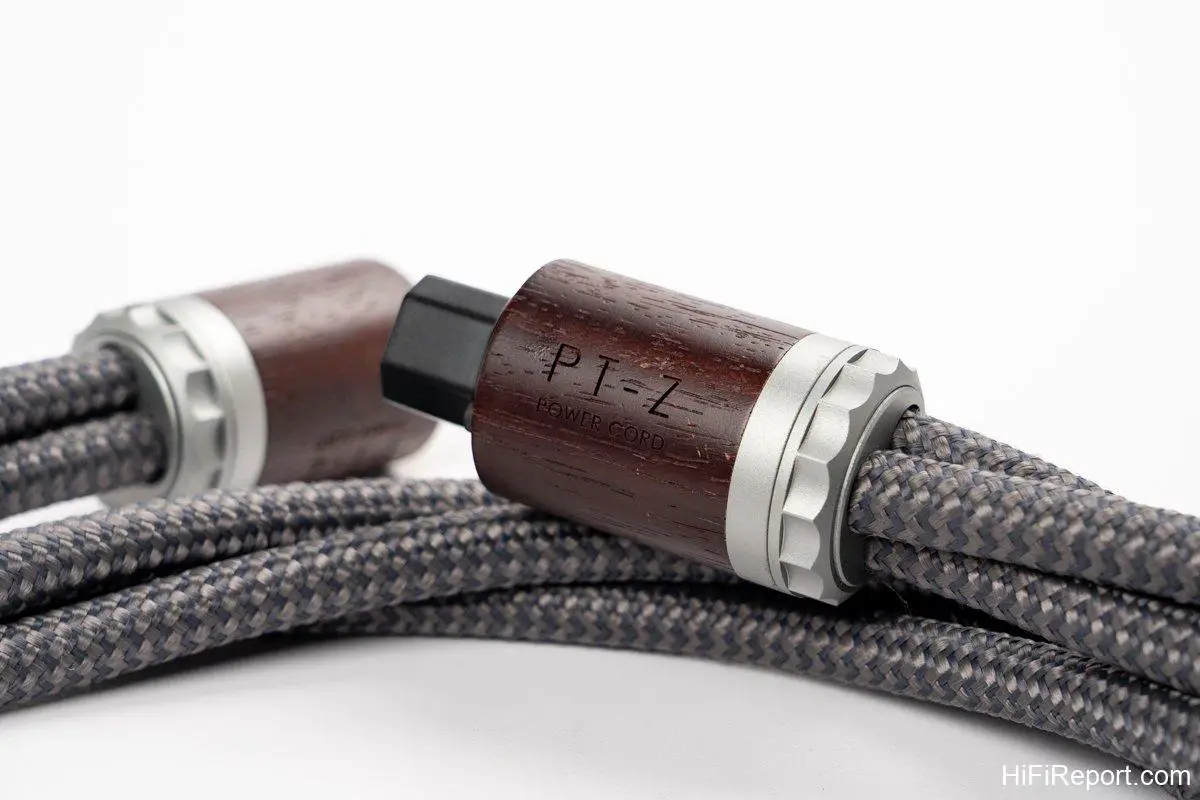
The review sample uses US standard plugs, but they also offer European Schuko versions, maintaining the same overall design.
Audible Impact: Enhanced Imaging, Sharpness, and Detail
How does it sound? I must say, the sonic improvements with the PT-Z are immediately apparent upon connection.
And the degree of improvement is as striking as the cable’s unique three-conductor design – it’s hard to ignore.
The first impression after installing the PT-Z is a noticeable solidification and focus of the sonic image. Sharpness and resolution are immediately enhanced, giving the sense that all sound sources have become more defined, their locations more precise, details clearer, and textures more palpable.
These changes create a more vivid and visual sonic picture.
Take, for instance, Astor Piazzolla’s music performed by the tango orchestra Astoria. In “Histoire du Tango: 1900 – Bordello,” Astoria combines a string quintet with accordion, percussion, woodwinds, and other diverse instruments, creating a rich tapestry of musical possibilities.
The flute leads the melodic line, while the accordion, violin, and piano provide harmonic support.
The percussion is vibrant and almost constant, serving as rhythm, accompaniment, and ornamentation, injecting the music with a lively and energetic spirit.
Dynamic contrast is central to the tango spirit, and it’s through these dramatic shifts that the passionate and intense emotions are conveyed.
The PT-Z brings the entire performance to life. Each instrument is rendered with greater clarity and presence, and the overall sound becomes more vibrant and impactful.
The flute’s penetration is enhanced, the percussion is more articulate and defined, the music’s dynamic impact is more pronounced, and the essence of tango is intensified.
Punchy Drums, Compelling Dynamics
Listening to Vital Tech Tones’ “VTT2” album, this power trio blending rock and fusion jazz, known for their intense musical style, the PT-Z further energizes the sound, making the “Vital” and “Tech” aspects even more pronounced.
The album’s opening track, “VTT,” a favorite among audiophiles, features funk-infused bass lines that demand both elasticity and power, with a need for speed. The PT-Z emphatically makes this track sound faster, punchier, and more powerful.
As for “Drum Stop, No Good,” the drum performance is utterly captivating. The impact of the toms is visceral, the kick drum is deep and resonant, the snare drum crackles with detail, and the cymbals shimmer with a crystalline brilliance that seems to sustain endlessly. The drum kit alone almost demonstrates the cable’s strengths.
Beyond the kick drum, the massive and deep bass lines also reveal the PT-Z’s capability for delivering rich and profound low frequencies.
Expanded Soundstage and Layered Depth
Furthermore, it expands the soundstage, pushing its boundaries outwards. Width, depth, and height dimensions all seem to expand.
Combined with the increased sonic density, the musical picture becomes clearer, as if upgrading to a larger screen, broadening the auditory perspective.
Listening to Myung-Whun Chung conducting the Orchestre de l’Opéra Bastille in Saint-Saëns’ Symphony No. 3.
The expanded soundstage allows Saint-Saëns’ intricate ensemble and counterpoint arrangements to shine.
Saint-Saëns was both a French master deeply rooted in classicism and a musical craftsman who infused his work with romantic flair.
In his music, one can appreciate clear structures – contrapuntal, harmonic, and formal – alongside richly layered harmonies and colors, blending rationality and emotion, purity and lyricism.
Chung’s interpretation of Saint-Saëns’ Third with the Bastille Orchestra is a prime example.
With the PT-Z in the system, the cable further resolves the expanded soundstage into even more distinct layers, making Saint-Saëns’ compositional style and characteristics even more tangible and clear.
The first half of the first movement presents both bright, joyous, and luminous themes, as well as darker, more ominous themes derived from the Dies Irae.
The PT-Z, connected to the amplifier, expands the soundstage, making the cyclical development and thematic interplay even more narratively compelling.
In the latter half of the first movement, featuring the organ, the PT-Z allows the deep low frequencies to expand naturally. It seems to enhance the low-frequency energy without adding any muddiness or bloat.
As the strings rise and harmonize with the organ, the clear and smooth string sound swells in waves, like gentle ocean tides or a soft breeze, creating a particularly tender and beautiful effect against the organ backdrop.
The allegro section in the first half of the second movement, with its scherzo-like character, creates a contrasting emotional landscape compared to the preceding adagio.
Amidst the surging waves of strings and winds, the sound is vibrant and bright, the rhythm brisk. With the PT-Z in place, the system delineates clear and beautiful layers within the sonic picture.
The woodwind solos, the interplay of the two pianos, and the rapid violin passages are all rendered with clarity and three-dimensionality, painting a vivid and dynamic soundscape.
The solemn and glorious latter half of the second movement begins with a majestic organ, joined by the string section unfolding in counterpoint. This chorale-like introduction elevates the music to a sacred pinnacle.
Listening to the very end, with the organ, brass, and timpani in unison, the result is a powerfully impactful coda.
The PT-Z imbues the audio system with lively, agile, bright, and powerful characteristics, enhancing the brilliant and colorful sound of Saint-Saëns’ Third Symphony, and amplifying its profound emotional impact, moving from form to feeling.
Grand and Colorful Piano Reproduction
When playing piano recordings, the PT-Z demonstrates its ability to provide a high-density sonic foundation, coupled with its fast transient response and rich detail retrieval.
Take Alfred Brendel’s performance of Liszt’s Piano Sonata in B minor as an example. This single-movement sonata sees Liszt introduce three thematic melodies in the introduction, which are then developed and transformed throughout, forming the exposition’s themes and transitions.
In the expansive development section, these themes are further explored and modulated, creating new musical passages.
The fugue in the latter part of the development section is particularly striking, revealing Liszt’s deep religious sentiment.
The PT-Z delivers a focused piano tone with rich and expansive harmonics, enhancing the instrument’s inherent beauty and adding to its timbral complexity and brilliance.
The sonic foundation laid by the left-hand chords in forte passages showcases the music’s grandeur.
In the pianissimo coda, the melody unfolds slowly, with a lingering resonance, and the gently descending bass lines evoke the fading vibrations of the piano strings.
The piano as rendered by the PT-Z is characterized by refined timbre, grand scale, magnificent presence, and vibrant colors.
Effortless Nuance and Enhanced Realism
When it comes to vocal reproduction, the PT-Z’s cohesive imaging, rich detail retrieval, and vibrant tonal palette create a distinctive sonic signature.
Listening to Veronique Gens’ “Néère” album, featuring art songs by three French composers, Gens’ performances are ethereal and dreamlike, imbued with poetic imagery.
The PT-Z renders Gens’ vocal lines with clarity and three-dimensionality, capturing the nuances of her expressive singing. Subtle variations in French pronunciation, such as the fricatives and delicate articulations, are effortlessly conveyed. The PT-Z brings the vocal performance into sharp focus.
The accompanying piano possesses excellent sonic density, richness, and harmonic depth. The gentle, sustained chords, paired with Gens’ voice, are simply sublime.
Try It and Hear for Yourself
If you’re skeptical about power cables making a difference, you owe it to yourself to try the Divini PT-Z.
If you doubt that domestic brands can produce exceptional audio products, the Divini PT-Z will challenge your preconceptions.
If you find your system sounding a bit flat and yearn to experience more musical color and vitality, the Divini PT-Z is worth exploring.
If you’re still not convinced by my experience, I encourage you to audition the Divini PT-Z at your nearest dealer.
Ultimately, the best way to judge is to try it and listen for yourself.
Specifications
* Type: Power Cable
* Conductor: 99.99999% OCC Copper
* Shielding: Copper Foil + Silver-Plated Copper Mesh
* Outer Diameter: 13mm x 3 Conductors
* Contact Material: Red Copper