
Dynaudio Core 7 Review
In the professional music production process, the equipment used by the creator often dictates the perfection of the final product. Whether producing small-ensemble classical music, symphonies, or pop, game soundtracks, and the like, high-caliber professional monitoring speakers capable of revealing every minute detail are essential for precise rendering. The subject of this article, the Core 7 from Danish brand Dynaudio, is precisely such a robust performer.
This publication previously reviewed the Core 59 from the same series, and its exceptional soundstage left a deep impression. While the Core 7 is a more accessibly priced version, it shares similar acoustic design principles with the Core 59. For instance, it features the new Esotar Pro soft-dome tweeter and also incorporates the special Hexis design.
Hexis Technology
This Hexis design places a dome structure behind the tweeter’s diaphragm, allowing airflow to be smoother and the frequency response flatter. This effectively eliminates unwanted resonances, resulting in cleaner high-frequency performance and more accurate imaging from the Core 7. An additional benefit of the Hexis design is a significant reduction in listening fatigue, which is crucial for music producers who spend long hours monitoring.
This ensures they can confidently deliver perfect musical works.
Woofer Design
Moving from the tweeter, let’s look at the Core 7’s mid-woofer design. This driver utilizes Dynaudio’s exclusive Magnesium Silicate Polymer (MSP) diaphragm, combined with a pure aluminum voice coil, glass fiber former, and an advanced magnet system. This combination allows it to produce very full yet accurate mid-bass frequencies.
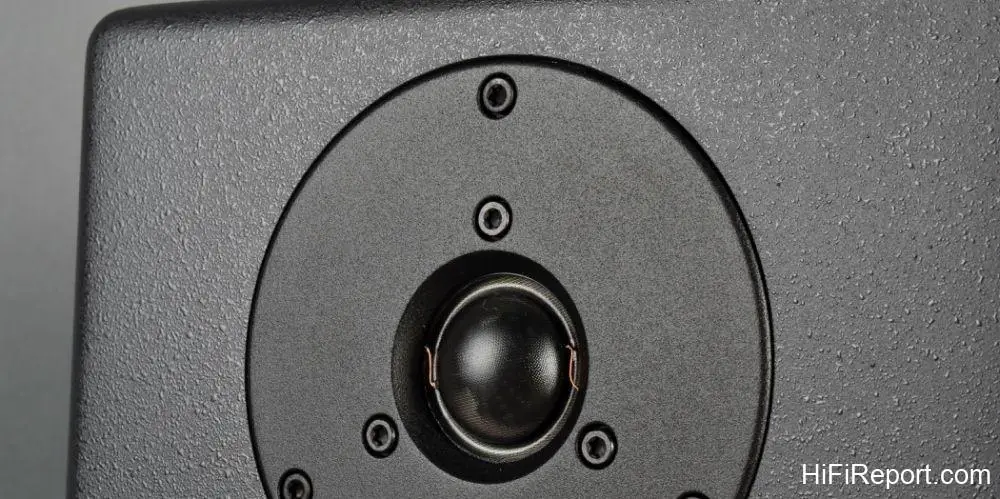
To elaborate, the MSP diaphragm is extremely lightweight, rigid, and highly damped, properties that enable it to deliver both excellent low-frequency extension and focused midrange coherence.
Powerful Amplification
In terms of drive, the Core 7 features high-power Class D amplification from Pascal of Denmark. It employs a bi-amplified design, with each driver powered by its own amplifier: the tweeter is driven by a 150-watt amplifier, and the mid-woofer by a robust 500-watt amplifier. This design provides exceptional control over the drivers.
Furthermore, to ensure the speakers deliver peak audio performance, the Core 7 is equipped with the most advanced DSP technology, capable of extending the low-frequency response down to 44Hz (with a -6dB point at 38Hz). This makes it adept at handling any type of music.
DSP Filtering
Considering the varied usage habits of different users, the Core 7 includes two DSP filter functions tailored for different placement scenarios. For example, when the monitoring system is installed on a large mixing console, the “Desk” mode can be selected. This mode effectively compensates for the primary reflection caused by the desktop surface. When placed close to a wall, the “Soffit” mode can be engaged to compensate for the increased bass response and maintain spectral balance.
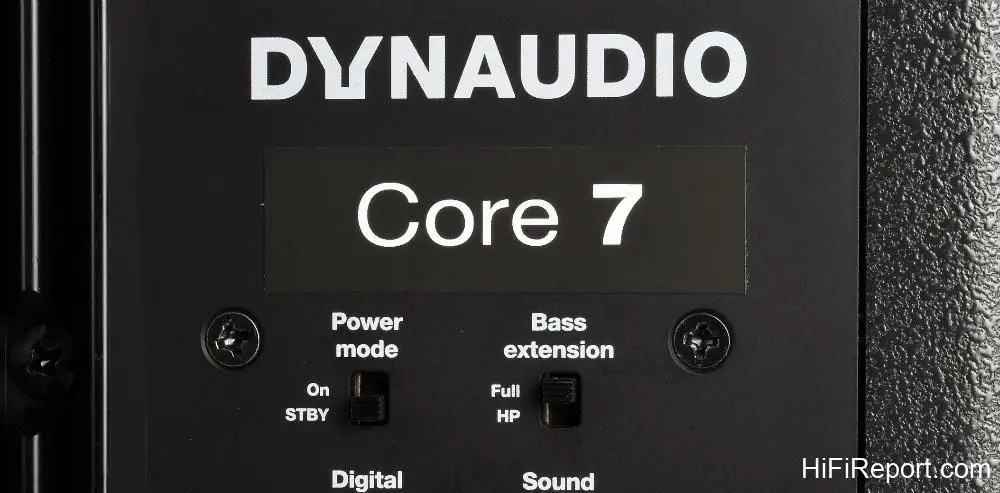
The Core 7’s other filter offers two modes: “Wall” and “Corner.” Placing the speakers against a wall or in a corner introduces different boundary effects. Adjusting to the appropriate setting compensates for these effects, particularly low-frequency reflections. Essentially, both of the Core 7’s DSP filters can be adjusted according to the actual usage environment to achieve optimal sound quality.
Full-Band Balancing Filter
Most monitoring speakers attempt phase balance by subtly adjusting high and low-frequency levels, but this often fails to achieve the most neutral presentation. To allow every user to tailor the sound to their exact standards, Dynaudio has specifically designed a balancing filter function on the Core 7. This full-band filter enables users to adjust the frequency response curve in a more comprehensive way to achieve their desired sound signature.
In practice, adjusting the full-band filter knob to “Dark” attenuates the 20kHz signal by -1.5dB while boosting the 20Hz signal by +1.5dB. When set to “Bright,” the 20kHz signal is boosted by +1.5dB, and the 20Hz signal is attenuated by -1.5dB. While these adjustments seem subtle, they allow for a perfectly balanced sound.
Gain Matching & Max SPL
Furthermore, in a professional monitoring system, both the signal-to-noise ratio and signal resolution are critical to performance. Therefore, whether using analog or digital sources, it’s essential to ensure perfect gain matching between the source equipment and the speakers. Addressing this, Dynaudio has designed the Core 7 with a gain range from 0dBu to +24dBu, allowing adjustment to match various front-end input devices.

Additionally, regarding the maximum bit depth of the audio signal, whether your front end uses analog or digital input, you can adjust it via the Core 7’s maximum SPL control knob. For instance, to achieve the highest bit depth performance, you can set the SPL to 112dB. If your typical use case requires lower bit depth performance, you can simply select a lower SPL.
Flexible Placement
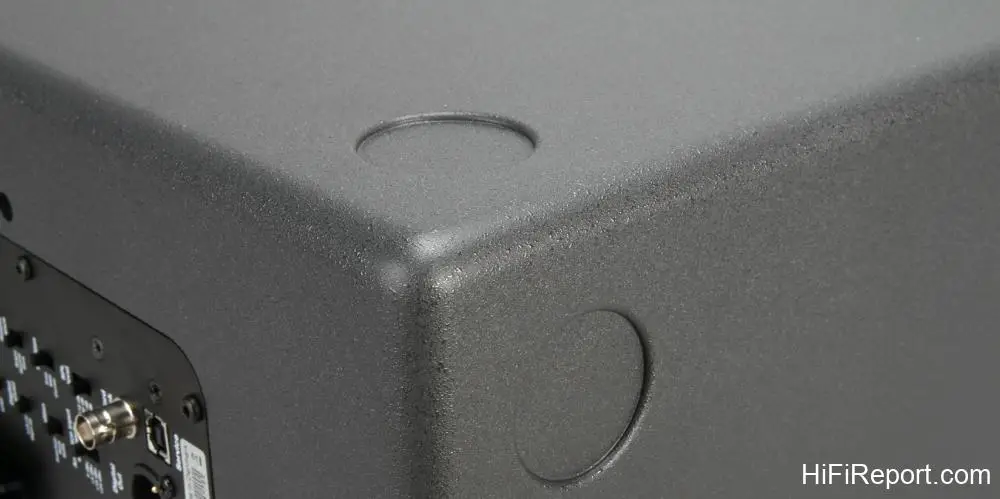
For convenience in placement, the Core series inherits the multi-directional placement flexibility of the Air series. For example, the Core 7’s cabinet features recesses on all four sides compatible with dedicated isolation pads. When placing the speaker, regardless of the platform material, using the isolation pads significantly reduces the contact surface and minimizes unwanted resonances.
The multi-directional placement and rotatable driver design allow for excellent sound quality in professional recording applications, whether placed vertically, horizontally, wall-mounted, or even inverted.
Thanks to its compact structure, the Core 7 offers significant installation flexibility. It can be used in professional recording studios, broadcast trucks, mobile facilities, radio, theatre, and also installed in immersive mixing rooms and various custom systems. Notably, the Core 7 can also be used to build multi-channel systems; combined with custom K&M stands, you can even create a Dolby Atmos system.
Listening Impressions
During actual listening tests, I paired the Core 7 with a Cos DAC D2 and used lossless audio files ripped from CDs. Shortly after listening began, the Core 7’s balanced monitoring characteristics were evident, very similar in direction to the higher-end Core 59. When listening to classical music, instruments had excellent body and a remarkable sense of stage.
This was particularly noticeable with large-ensemble pieces, where the positioning of various instruments—violins, cellos, brass, and timpani—felt very focused, clear, and grand.
Detailed Classical Performance
Going into more detail, when listening to small-ensemble pieces with the Core 7, subtle details were revealed. The nuances in the force of the violin bow strokes were discernible, capturing a texture as fine as winter melon fuzz. Piano keys were rendered distinctly, like pearls scattered before your eyes. Timpani hits were full and solid, their resonant rumble felt with a presence so steady and impactful it made you easily overlook the speakers’ physical size.
Pop, Rock, and Electronic Performance
For pop, rock, jazz, and electronic music, the Core 7 also delivered excellent low-frequency quantity. The bass was deep-reaching yet elastic, providing an engaging presentation for rhythmically driven tracks. Despite its strong bass performance, it didn’t compromise the overall spectral balance. Guitar string vibrations were rendered completely, piano key presses remained distinct, and electric bass was solid and steady.
The overall soundstage was very good, making it hard not to sway along with the music.
Midrange and Vocal Performance
Additionally, I noted that despite being a two-way design, these Core 7s possessed the same focused midrange as the three-way Core 59. When listening to vocals, even without toe-in, the singer’s voice felt precisely and richly positioned in the center. Although the vocal presentation leans towards a monitoring style and isn’t overly large-bodied, it still revealed very subtle transitional details. It didn’t sound dry; instead, it had considerable substance.
To put it plainly, you could feel the genuine emotion of the singer through them.
Conclusion
In conclusion, the Core 7 is a high-level monitoring speaker built to satisfy professional music producers, delivering outstanding performance across all music genres. If you require professional monitoring capabilities, the Core 7 is an excellent choice. Furthermore, if you value pedigree, you should definitely give the Core 7 a chance, as its drivers are handcrafted by Dynaudio at their factory in Denmark.
This ensures pure sound quality and exceptional consistency between drivers—the best quality guarantee available!
Specifications
* Type: 2-way Active Studio Monitor
* Built-in Amplification: Pascal Class D, 500W (Mid-Woofer), 150W (Tweeter)
* Frequency Response: 38Hz–31kHz (-6 dB), 45Hz–27kHz (±3 dB)
* Input Terminals: Analog and AES3 Digital Input
* Digital Audio Compatibility: Up to 192kHz / 24bit
* Maximum SPL: 112 dB @ 1m (Anechoic), 118 dB (Half Space)
* Crossover Frequency: 2,300 Hz
* Cabinet Structure: Bass Reflex
* Drivers: 1″ Fabric Soft Dome Tweeter × 1, 7″ MSP Mid-Woofer × 1
* Dimensions (H.W.D.): 390 × 220 × 370 mm
* Weight: 14.7 kg