
EarFun Air Pro 4 Review
Overview
EarFun has spent the last several years building a reputation for squeezing premium features into affordable earbuds, and the Air Pro 4 is the company’s most ambitious effort yet. Released in summer 2024 as the successor to the Air Pro 3, this fourth-generation model is a stem-style true wireless design that pairs adaptive hybrid noise cancellation rated at up to 50dB with a Qualcomm QCC3091 system-on-chip and a genuinely deep bench of high-resolution Bluetooth codecs.
The feature list reads like something from a flagship. Snapdragon Sound certification, aptX Lossless, LDAC, LE Audio and LC3 support, six microphones with AI-assisted noise reduction, Bluetooth 5.4, multipoint pairing, in-ear detection, IPX5 water resistance, and app-based EQ customization all come standard. EarFun rates battery life at up to 11 hours per charge and up to 52 hours with the charging case, with a ten-minute quick charge delivering roughly two hours of playback.
Reviewers have responded warmly. CNET named the Air Pro 4 an Editor’s Choice, praising the “surprisingly good performance and a robust feature set.” PCMag handed it an Editors’ Choice award and a 4.5 “Outstanding” rating, calling the sound clean and detailed and the noise cancellation powerful. SoundGuys scored it 8.4 overall and described it as a significant upgrade over its predecessor. Pricing varies by retailer and over time, so check the product page for the current figure.
Design and Comfort
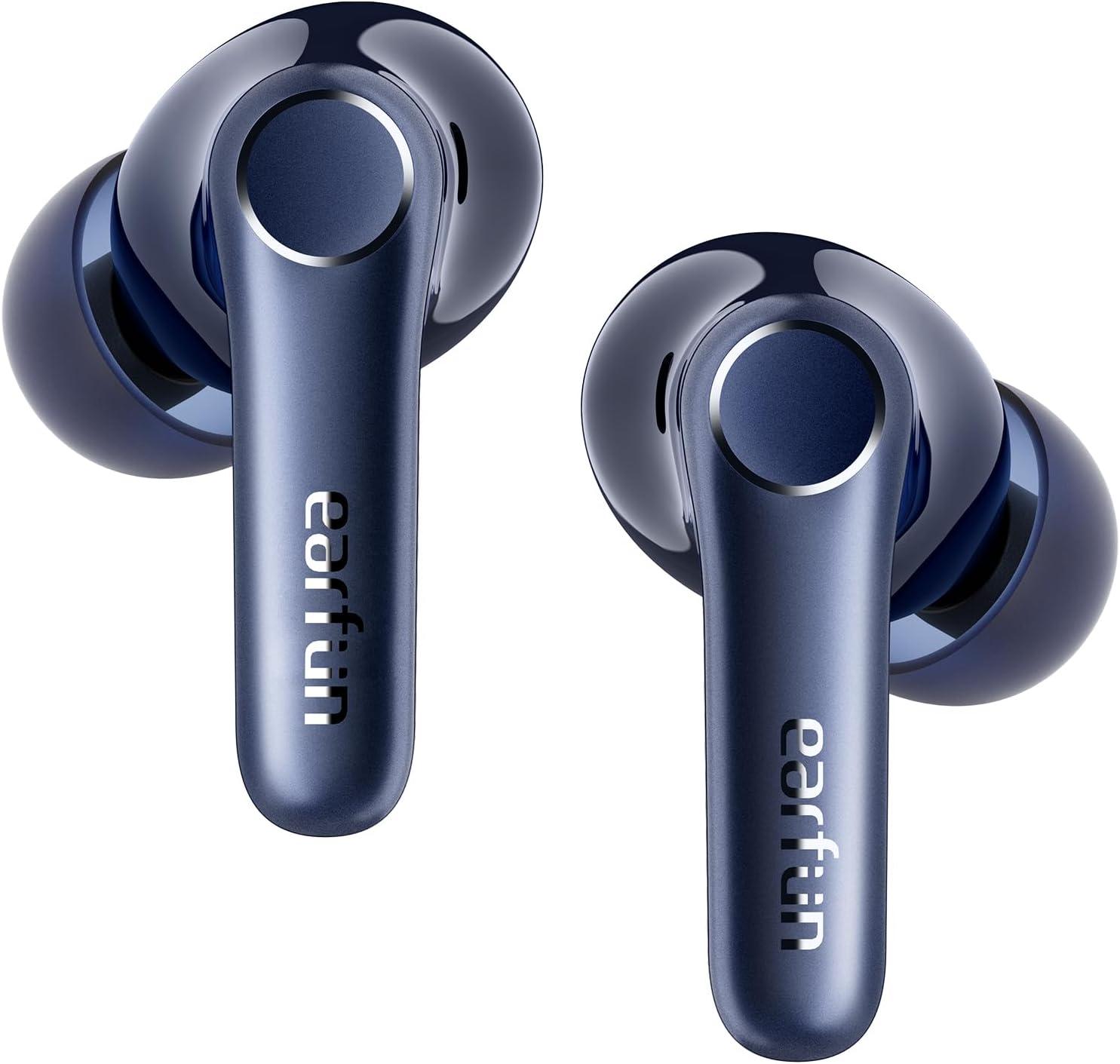
Visually, the Air Pro 4 changes very little from the Air Pro 3. The long stem form factor returns, and the earpieces are primarily black with a deep bluish silver outer edge and a metallic ring that defines the touch control area. If you have seen an EarFun earbud before, you will recognize this one immediately.
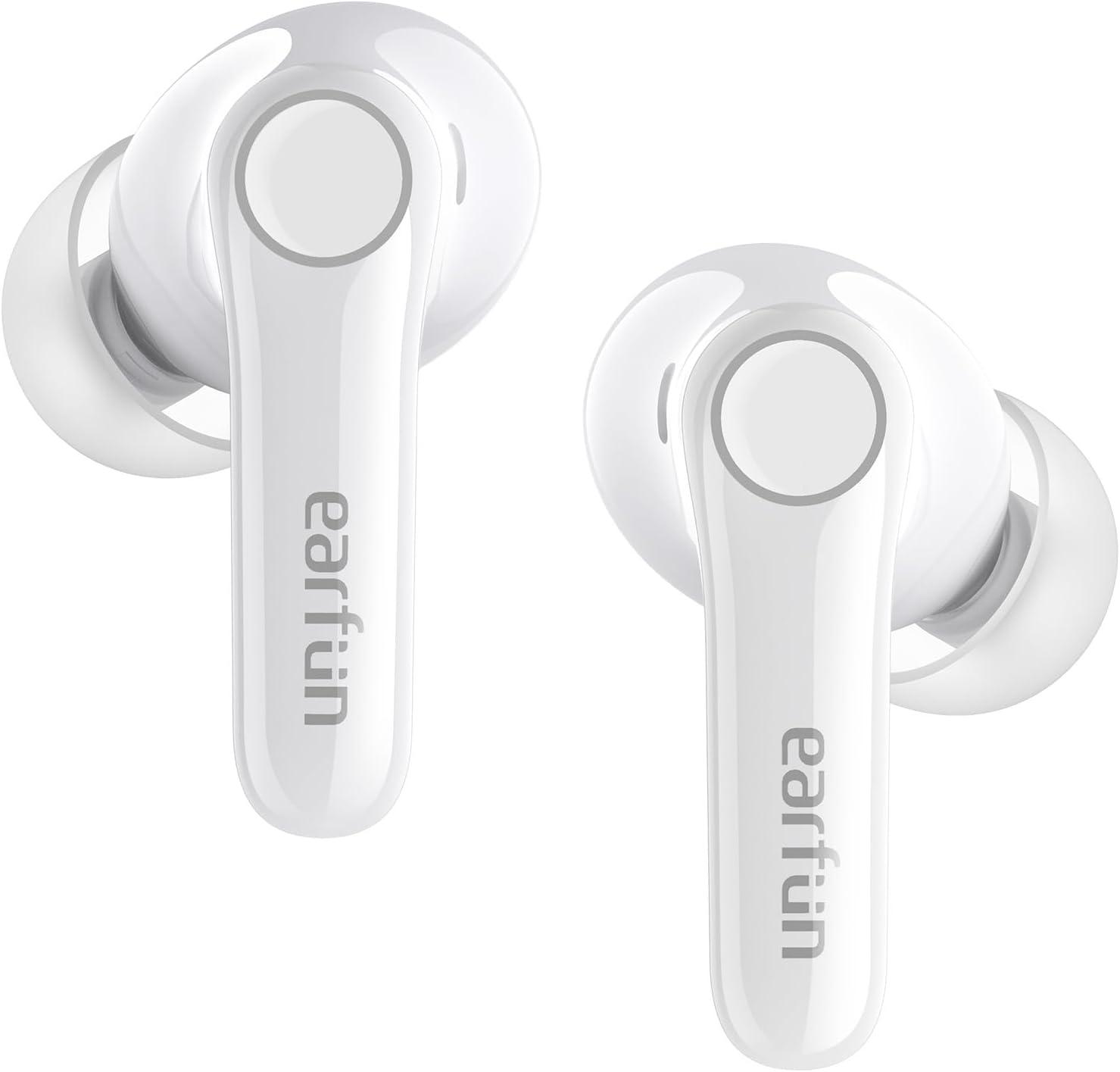
That continuity is mostly a good thing. The earbuds are exceptionally light — around 0.17 ounces per earbud, with the charging case adding roughly 1.58 ounces — and the light weight translates directly into long-wear comfort. Tom’s Guide called them “very comfortable,” and SoundGuys noted they could be worn for hours at a time without fatigue. PCMag reported that they stayed secure through a lengthy run, requiring only a few adjustments along the way.
Fit flexibility is a strength. The box includes five pairs of silicone ear tips in different sizes, which is more than most competitors supply and gives listeners a better chance of sealing the ear canal properly. A good seal matters here, because it directly affects both bass response and how much work the noise cancellation has to do.
The charging case measures roughly 62 x 47 x 29mm, making it small enough to slip into a pocket without drama. TechRadar singled out the case as a highlight, noting it remains compact despite including wireless charging. Durability is rated IPX5, which means the earbuds handle rain, sweat, and gym sessions without complaint. SoundGuys rated build quality 8.3 out of 10 and reported no concerns wearing them outdoors in wet conditions.

Connectivity and Codec Support
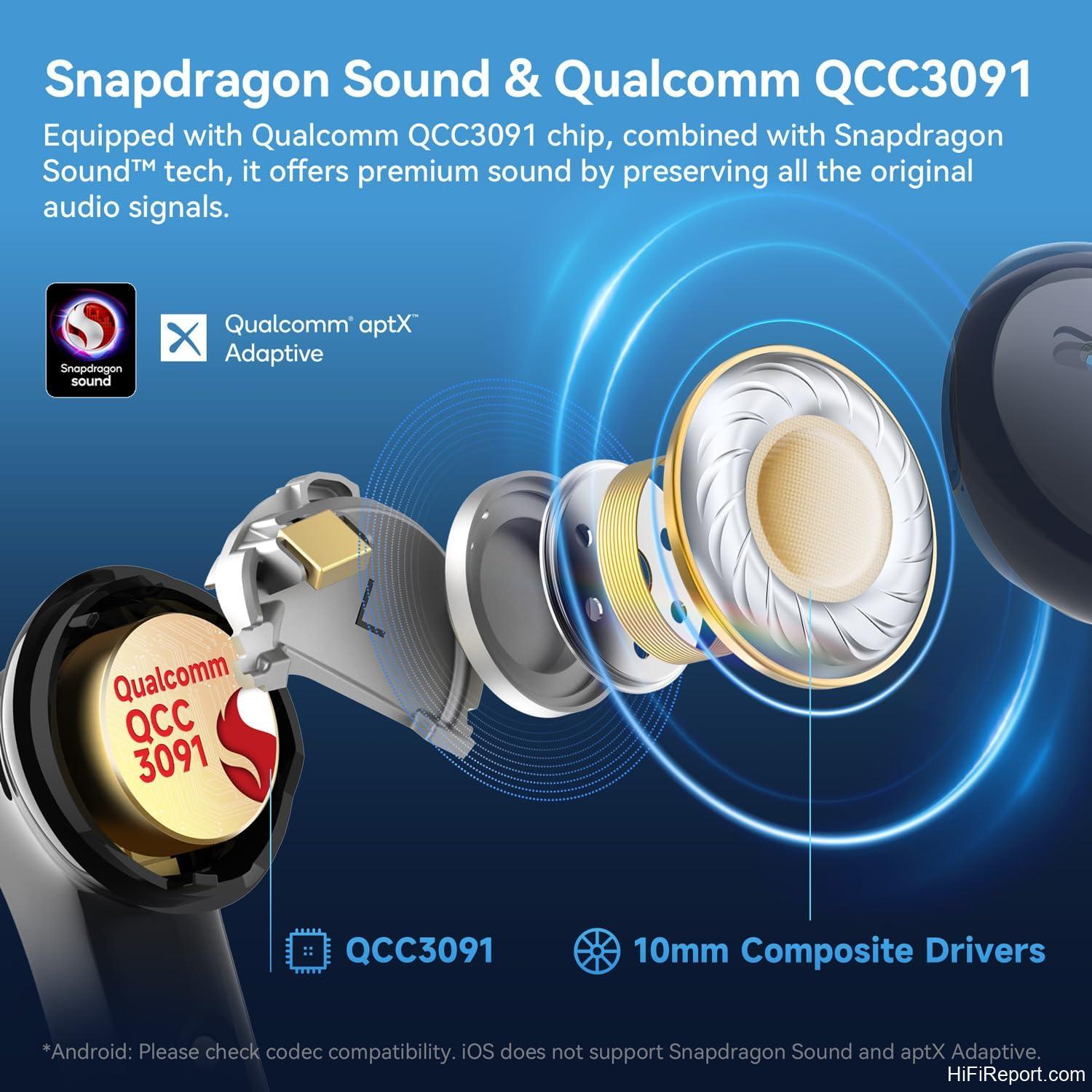
This is where the Air Pro 4 separates itself from most of its peers. Inside runs Qualcomm’s QCC3091 chipset with Snapdragon Sound certification, and the codec list is unusually broad: SBC, AAC, aptX Adaptive, aptX Lossless, LDAC, and LC3 for LE Audio. PCMag described the selection as among the largest it has seen from a pair of earphones, and noted that rival options in the same space typically support LDAC but skip aptX entirely.
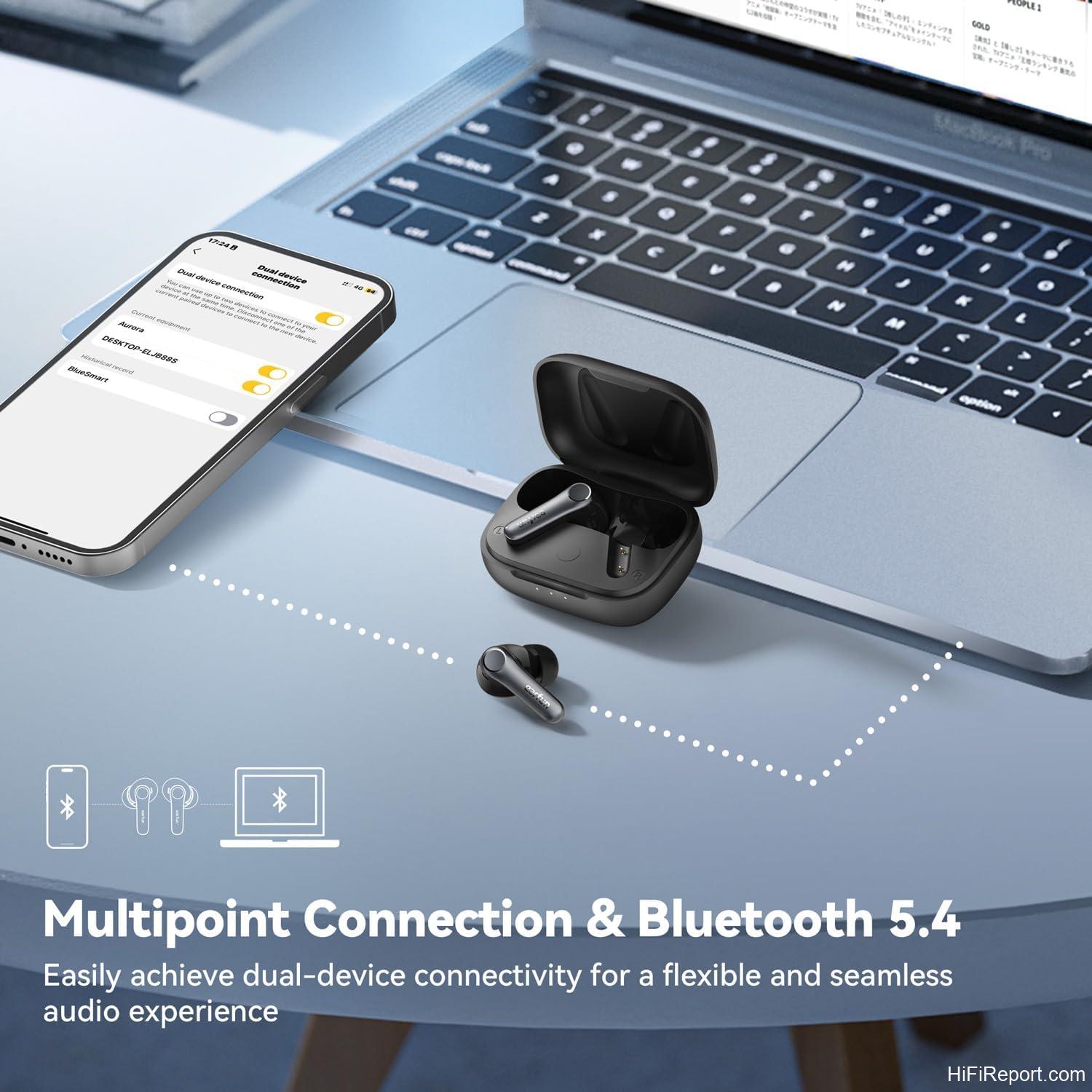
For Android listeners in particular, that matters. LDAC and aptX Lossless both allow for higher-bitrate streaming than the baseline SBC and AAC codecs, and the earbuds support Auracast broadcast audio as well. Bluetooth 5.4 handles the radio side, with multipoint pairing allowing two devices to stay connected simultaneously — handy for bouncing between a laptop and a phone without re-pairing.
The experience is not flawless. PCMag encountered a few issues during testing: the earbuds were not always in sync with each other at the start of playback, and a glitchy hiss appeared when connected to a Windows PC. The sync problem disappeared with a replacement set, and the hiss appeared specific to Snapdragon-powered laptops. Google Fast Pair makes setup on Android quick, and the app includes a firmware update path — EarFun recommends resetting the earbuds after a firmware upgrade.
Noise Cancellation
EarFun rates the adaptive hybrid ANC at up to 50dB, driven by the company’s QuietSmart 3.0 system. The adaptive part is real: the earbuds detect the shape of your ear canal and adjust the cancellation accordingly, which helps account for the fact that no two ears seal the same way.
Copyright protected. First published on hifireport.com; any unauthorized copy violates the intellectual property rights of hifireport.com.
In practice, reviewers found the cancellation genuinely effective. PCMag described it as powerful for this class of earbud, and Tom’s Guide counted it among the model’s strengths, noting that there are five distinct ANC modes to choose from. SoundGuys awarded the noise cancellation a 7.5 out of 10 and rated passive isolation lower at 5.7, which is typical for a stem design that does not jam deeply into the ear canal.
That abundance of modes is also the most common criticism. TechRadar argued that EarFun stuffed too many features into the package, and that the differences between the various cancellation profiles were hard to keep straight. The reviewer eventually gave up and settled on a single setting — likely what most owners will do as well. It is a usability complaint rather than a performance one, but it is worth knowing before you dig into the menu system.

One trade-off is documented by SoundGuys: engaging ANC has an audible impact on sound quality. That is not unusual for active noise cancellation, but it means listeners who care most about fidelity may want to toggle cancellation off in quiet environments.
Sound Quality
Inside the Air Pro 4 sits a 10mm composite dynamic driver. EarFun does not publish a frequency range, but the tuning drew consistent praise. Tom’s Guide described the sound as gorgeous and well balanced across genres, and PCMag highlighted rich bass alongside bright, detailed treble. For a pair of earbuds in this segment, the consensus is that the default tuning is enjoyable rather than clinical.
SoundGuys ran the earbuds through its MDAQS analysis, which produced a timbre score of 4.9, a distortion score of 4.0, an immersiveness score of 4.2, and an overall score of 4.8. Those numbers point to a tuning that prioritizes a natural tonal balance rather than exaggerated low end, with distortion reasonably well controlled at normal listening levels.
There are caveats. Tom’s Guide observed that sound tends to bleed at high volumes, which means the earbuds leak audio outward when pushed hard — a problem on a crowded train or in a quiet office. The same review noted the absence of spatial audio, a feature some competitors now offer. TechRadar reported some audio peaking and considered the sound merely acceptable rather than exceptional.
Customization helps close the gap. The companion app includes a sound profile EQ, so listeners can adjust the tuning to taste rather than living with the default curve.
Calls and Microphone Performance
EarFun equips the Air Pro 4 with six microphones, an AI algorithm, and Qualcomm’s cVc 8.0 noise reduction, with the promise of clearer voice pickup in noisy surroundings. On paper, that is a serious array for earbuds in this category, and it is the same class of technology found in far more expensive products.
© hifireport.com – Original review content by hifireport.com. Reprinting without written permission is not allowed.

Independent testing is more measured. SoundGuys found the microphones to be less impressive in noisy environments, which is the scenario where call quality matters most. The AI processing does a decent job in moderate conditions but struggles to fully isolate a voice when there is a lot of competing sound around it.
That is a common limitation across true wireless earbuds and not a disqualifying flaw. If your calls mostly happen indoors, you will likely be satisfied. If you regularly take meetings on a busy street or in a loud open office, temper your expectations and consider whether a dedicated headset makes more sense for critical conversations.
Battery Life and Charging
EarFun claims up to 11 hours of playback per charge and up to 52 hours total with the USB-C charging case. A ten-minute quick charge is said to add about two hours of listening. Those are strong numbers on paper, and independent testing largely backs the per-charge figure while falling short of the case total.

Tom’s Guide measured roughly 11 hours of playback with ANC off and about 41 hours when counting the case. With noise cancellation engaged, the same testing produced around 7.5 hours per charge and roughly 27.5 hours with the case. TechRadar likewise reported about 7.5 hours per earbud with ANC active, which is well ahead of many rivals.
SoundGuys awarded battery life a 7.2 out of 10, the lowest of its category scores, suggesting that while runtime is competitive, it is not the model’s standout attribute. The takeaway is simple: expect a full workday of listening with cancellation on, and considerably more if you leave ANC off. The case supports wireless charging, which TechRadar highlighted as a premium touch in an otherwise compact design.
Controls, App, and Features
Touch controls live on the metallic ring on each earbud, handling playback, calls, volume, and mode switching. PCMag found them finicky, which is a recurring complaint about touch-based controls on stem earbuds. In-ear detection is also on board and pauses playback automatically when you remove an earbud.
This article is the original property of hifireport.com. All rights reserved. Unauthorized reproduction is strictly prohibited.

The EarFun Audio app handles firmware updates, EQ adjustment, and control remapping. It is feature-rich, and that is both the strength and the weakness. TechRadar counted roughly 30 equalizer presets and found scrolling through them more work than it was worth. Combined with the multiple ANC modes, the overall configuration experience can feel overwhelming.
The practical advice is to set the earbuds up once, pick a preferred EQ profile and a single noise-cancellation mode, and then leave the app alone. Do that, and the Air Pro 4 delivers a smooth everyday experience. Treat the app as a sandbox to explore constantly, and you may find it tiring.
What Customers Are Saying
Individual customer reviews were not available for this report, so sentiment here rests on the aggregate rating. On Amazon, the EarFun Air Pro 4 holds a 4.4 out of 5 average across more than 7,000 ratings.
An average that high, sustained over thousands of ratings, indicates broad satisfaction rather than a niche following. Buyers who leave ratings in this range typically report that the product met or exceeded expectations, and a large sample size tends to smooth out the extremes. At the same time, an average below a perfect score means a meaningful minority of buyers came away with reservations — the kind of mixed feedback that often centers on fit, app complexity, or connectivity quirks.
Read that number as a signal, not a verdict. It suggests a product that most people are happy with, while leaving room for the possibility that your ears, your phone, or your use case lands you among the critics.
Pros and Cons
- Effective adaptive hybrid noise cancellation with automatic ear-canal detection
- Very comfortable, lightweight stem design with five sizes of ear tips
- Broad codec support including aptX Lossless, LDAC, and LC3
- Bluetooth 5.4 with multipoint and Google Fast Pair
- IPX5 water resistance for rain, sweat, and gym use
- Strong measured battery life with ANC engaged
- Rich, well-balanced default sound with app-based EQ
- Wireless charging case that stays pocketable
- Sound bleeds at high volumes
- No spatial audio
- Multiple ANC modes and dozens of EQ presets can be confusing
- Touch controls described as finicky
- Microphone performance suffers in noisy environments
- ANC engagement audibly affects sound quality
- Some reported sync and connection quirks, particularly with Windows PCs
Verdict
The EarFun Air Pro 4 succeeds by doing the difficult thing well. It delivers adaptive noise cancellation that reviewers consider effective, a codec suite that rivals far more established brands, a comfortable stem design, and battery life that holds up under independent testing. Awards from CNET and PCMag, plus a strong SoundGuys score, reflect a product that punches above its position in the market.
It is not flawless. The touch controls need refinement, the microphone array struggles in loud environments, audio leaks at high volumes, and the sheer number of ANC profiles and EQ presets makes setup more work than it should be. SoundGuys also flagged that engaging cancellation changes the sound signature, which discerning listeners will notice.
For most buyers, those are manageable compromises. If you want high-resolution Bluetooth codecs, competent noise cancellation, and all-day comfort from a lightweight design, the Air Pro 4 is one of the more complete packages available. If spatial audio or best-in-class call clarity are must-haves, look elsewhere. Note that EarFun has since introduced a “plus” variant of this model with Bluetooth 6.0, so it is worth confirming which version you are looking at before ordering.
Specifications
- Model: TW600
- Type: True wireless in-ear
- Drivers: 10mm composite dynamic
- Chipset: Qualcomm QCC3091 with Snapdragon Sound certification
- Connectivity: Bluetooth 5.4
- Codecs: SBC, AAC, aptX Adaptive, aptX Lossless, LDAC, LC3 (LE Audio)
- Multipoint: Yes, two devices simultaneously
- Fast pairing: Google Fast Pair
- Noise cancellation: Adaptive hybrid, rated up to 50dB, QuietSmart 3.0
- Microphones: Six, with AI algorithm and Qualcomm cVc 8.0
- Battery life (ANC off): Up to 11 hours per charge, up to 52 hours with case (manufacturer claim); measured about 11 hours and 41 hours total
- Battery life (ANC on): About 7.5 hours per charge, about 27.5 hours with case (measured)
- Quick charge: Ten minutes for up to two hours of playback
- Charging: USB-C, wireless charging supported
- Water resistance: IPX5
- Weight: About 0.17 ounces per earbud, 1.58 ounces charging case (5g / 43g)
- Case dimensions: 62 x 47 x 29mm
- Earbud dimensions: 30 x 25 x 20mm
- Ear tips: Five sizes of silicone included
- App: EarFun Audio app with EQ and sound profiles
- In-ear detection: Yes
- Color: Black
- Release: Summer 2024

- CNET Editor's Choice Award--"Earfun's flagship Air Pro 4 noise-canceling earbuds deliver surprisingly good performance and a robust feature set for an affordable budget.”
- Adaptive Hybrid Active Noise Canceling up to 50dB. Premium noise cancelling powered by adaptive ANC technology and QuietSmart 3.0. EarFun Air Pro 4 noise cancelling earbuds automatically detect your unique ear canal shape to achieve maximum noise-canceling performance.
- Qualcomm Snapdragon Sound with aptX Lossless. Featuring Qualcomm QCC3091 SoC with aptX Lossless Audio, Certified Snapdragon Sound, and Hi-Res Audio. EarFun Air Pro 4 wireless earbuds deliver robust bass, articulate midrange, and sparkling treble. Support for LDAC, LE Audio, and LC3 codecs ensures compatibility with high-fidelity sources.