
Edifier Stax Spirit S10 True Wireless Earbuds Review
Have you ever experienced planar magnetic headphones? Because the diaphragm of a planar magnetic driver is incredibly lightweight, with the voice coil printed directly onto it and driven by push-pull magnets on either side, they offer exceptional speed and low distortion. This makes them highly prized by a certain group of headphone aficionados.
If you haven’t yet tried planar magnetic headphones, you really should. Their sound signature is distinctly different from the more common dynamic driver earphones.
[ Subscribe to the HiFiReport Youtube channel and hit the bell icon! ]
Pioneering Planar TWS
Let me ask again: have you heard of true wireless earbuds featuring planar magnetic drivers? Most true wireless earbuds on the market use either dynamic drivers, balanced armatures, or a hybrid combination of both.
Beyond that, I genuinely haven’t heard of any true wireless earbuds that employ planar magnetic technology.
But Edifier is set to disrupt this dominance by dynamic and balanced armature drivers.
In late 2011, Edifier announced the acquisition of Stax, a renowned Japanese manufacturer of electrostatic headphones. Then, in 2016, they invested in Audeze, an American brand specializing in planar magnetic headphones. These two significant investments have provided Edifier with substantial momentum for development.

Their first foray into the high-end headphone space, venturing beyond dynamic drivers, was the Stax Spirit S3 planar magnetic over-ear Bluetooth headphones, released in 2022.
They established the Stax Spirit name as Edifier’s flagship series, applying the planar magnetic driver technology inspired by Audeze while carrying forward Stax’s long-standing pursuit of high-end sound quality and craftsmanship.
Therefore, we can say that the Stax Spirit S3 is a fusion of Edifier, Stax, and Audeze.
The story didn’t end there. In 2024, Edifier followed up with the flagship Stax Spirit S5 over-ear Bluetooth headphones, which boast an even more elegant and stylish design than the S3. Simultaneously, they introduced something entirely unprecedented: a planar magnetic true wireless earbud – the star of this review, the Edifier Stax Spirit S10.
EqualMass Ultra-Thin Diaphragm
The Stax Spirit S10 features a Ø12mm planar magnetic driver. The diaphragm itself is remarkably thin, measuring only 2µm (micrometers), which is just 0.002 mm.
Just how thin is that? The diameter of a PM2.5 particulate is 2.5µm. This means the S10’s diaphragm is even thinner than a single PM2.5 particle.
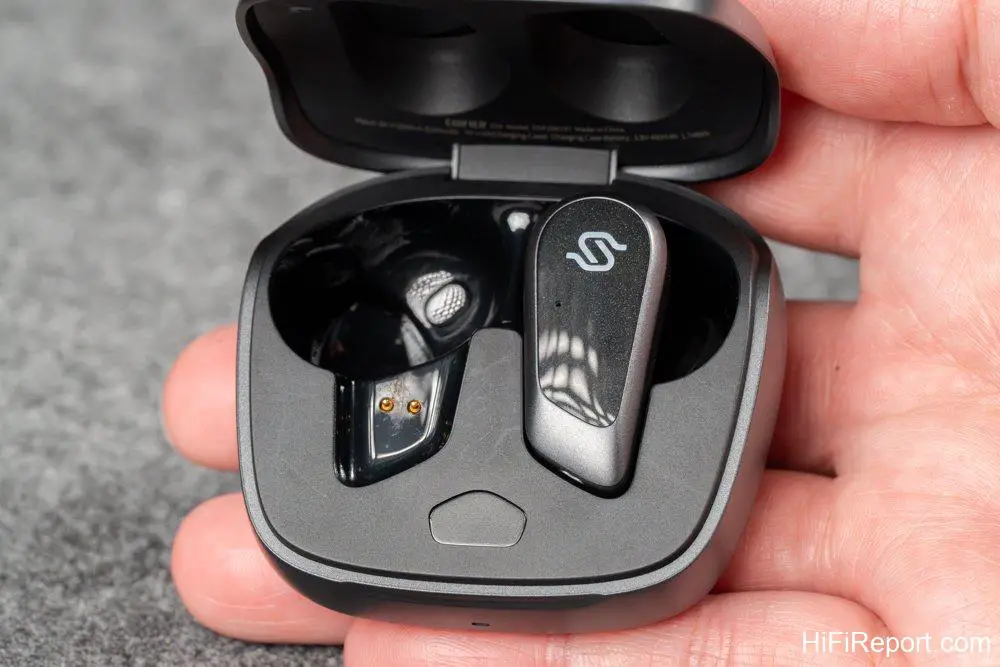
The metal voice coil is directly printed onto the diaphragm. Even with the voice coil, the planar diaphragm’s total thickness is a mere 10µm, still significantly thinner than the 70µm to 90µm diameter of a human hair.
It is precisely this lightweight and ultra-thin nature of the planar diaphragm that gives it its exceptional speed, allowing for superior transient response and detail retrieval compared to dynamic drivers.
Edifier also emphasizes that the Stax Spirit S10’s planar diaphragm utilizes the second generation of their patented EqualMass technology.
This technology ensures the voice coil metallic traces are printed more densely, offering higher coverage, and their distribution creates a more uniform magnetic field. Furthermore, the diaphragm’s overall mass is balanced due to the symmetrical coil structure.
In-ear monitors (IEMs) using planar magnetic drivers are not uncommon; you can find a fair number of Planar IEMs on the market.
However, true wireless earbuds employing planar magnetic drivers are genuinely unheard of.

Edifier’s move not only breaks new ground in the industry but also solidifies its reputation.
Latest Qualcomm Chip
The Stax Spirit S10 is equipped with Qualcomm’s new QCC5181 chip. It supports Bluetooth 5.4, features 3rd Gen Qualcomm® Hybrid Active Noise Cancellation, Snapdragon Sound™ technology, and is compatible with audio codecs including LDAC, LHDC 5.0, aptX Adaptive, and aptX Lossless.
Edifier has consistently aimed to provide products that support high-resolution audio. Many of their products have received certification from the Japan Audio Society’s Hi-Res standard, allowing users to experience lossless and even high-resolution audio quality.
Of course, the source device for playing audio also needs to support these codecs. If you’re using an iPhone, unfortunately, the highest quality you’ll get is AAC.
Enhanced Voice Calls
The Qualcomm chip used in the S10 also supports aptX Voice technology, offering a 32kHz voice call frequency response, which significantly enhances voice call performance.
It features three built-in high-sensitivity microphones that, combined with aptX Voice technology, can automatically filter out ambient noise. This ensures that the person on the other end of the call can hear you clearly, even in noisy environments.

In real-world use, the S10’s call quality is indeed impressive. Train noise on the subway and strong winds in station passages were significantly suppressed.
Ultra-Low Latency & EQ
It supports an ultra-low latency of 89ms, ensuring perfect synchronization between audio and video whether you’re gaming or watching movies.
To use this feature, you need to enable the “Game Mode” function within the Edifier ConneX App.
Through the app, users can name their earbuds, adjust Active Noise Cancellation levels, customize control settings, and most importantly, fine-tune the EQ.
The app provides three preset EQs: “Original,” “Dynamic,” and “Electrostatic.” There’s also an “Audiophile Mode” that allows users to create their own custom EQ curve.
Convenient Wear Detection
Naturally, the S10, with its Bluetooth 5.4 specification, supports dual-device connection. Users can pair it simultaneously with their work laptop and smartphone, switching seamlessly between calls, meetings, and music listening.

The true wireless S10 also includes wear detection sensors.
When you remove an earbud, playback automatically pauses. Putting it back in resumes playback, making usage intuitive and user-friendly.
If you haven’t set up touch controls to switch between ANC and Ambient mode, you can also simply remove one earbud to talk to someone. The music currently playing will automatically pause and resume only when you place the earbud back in.
Up to 28 Hours Battery
The Edifier Stax Spirit S10 also offers excellent battery life.
With Active Noise Cancellation enabled, it provides up to 18 hours of continuous use. If ANC is turned off, the battery life extends to a remarkable 28 hours.
Should you run out of power, a quick 15-minute charge can yield 2 hours of listening time.
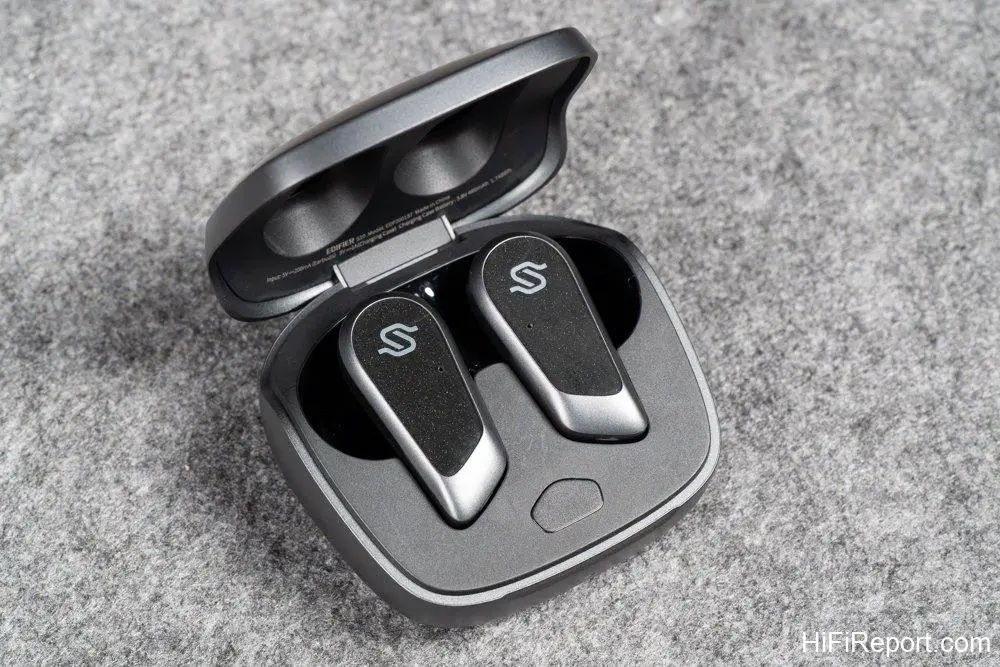
The earbuds are rated IP54 for dust and water resistance, handling splashes and airborne dust without issue.
Users can confidently wear the S10 during exercise, whether indoors or outdoors. Sweating or light rain won’t be a problem.
Generous Ear Tips
Over the years, Edifier has been dedicated to enhancing the customer experience, and this is evident in the packaging.
Consistent with the packaging of the other Stax Spirit series models, the S5 and S3, the three-dimensional color printing on the box gives customers a sense of refinement upon unboxing.
The accessories are also a highlight.
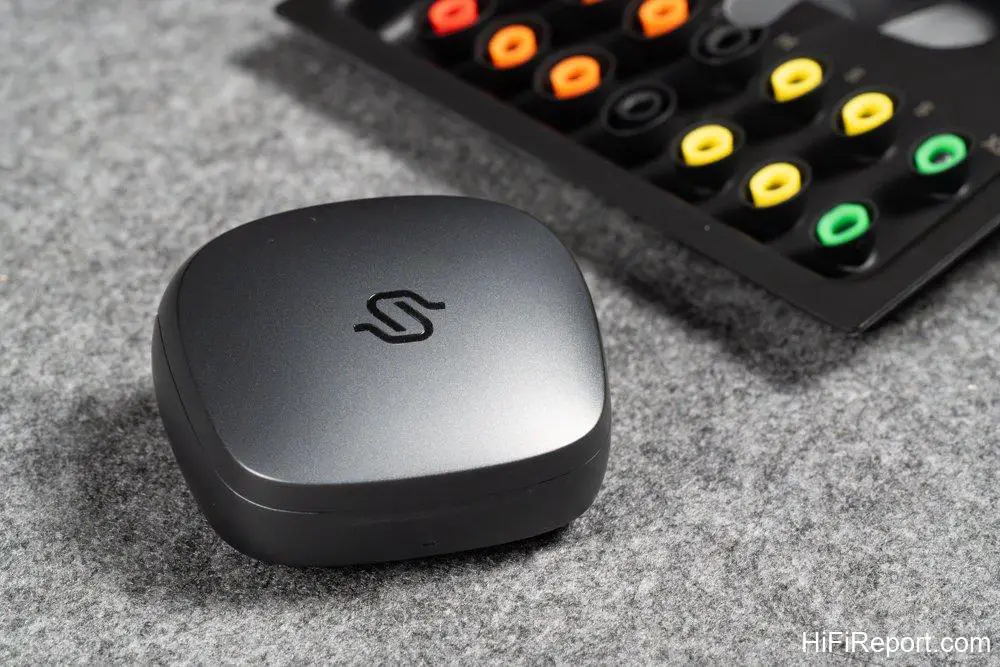
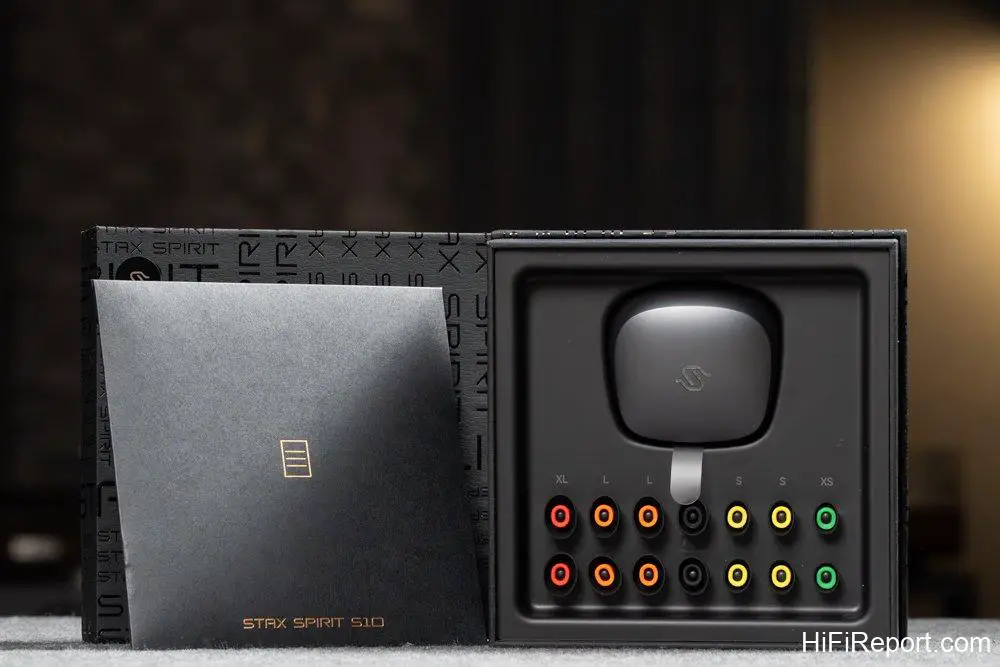
Opening the box reveals rows of silicone ear tips, color-coded by inner ring to distinguish sizes.
Aside from XL and XS sizes, which come with one pair each, the L, M, and S sizes include two pairs each.
The difference between the two pairs of the same size lies in their height, which subtly affects the amount of bass. Users can choose based on their preference.
Lifting the layer holding the ear tips reveals another accessory box underneath. This contains a drawstring storage pouch, allowing you to keep the S10 securely inside and protect the charging case surface from scratches – another thoughtful touch from Edifier.
A USB Type-C cable is also included in the pouch for charging.
Minimalist, Stylish Design
The quality of the earbuds and charging case also demonstrates Edifier’s commitment.
Unlike over-ear headphones, true wireless earbuds offer less room for intricate design elements, materials, and structures. With true wireless, there are fewer areas to apply design flair; most considerations revolve around color and shape.
Even so, there’s still a need to express personality within limited space.
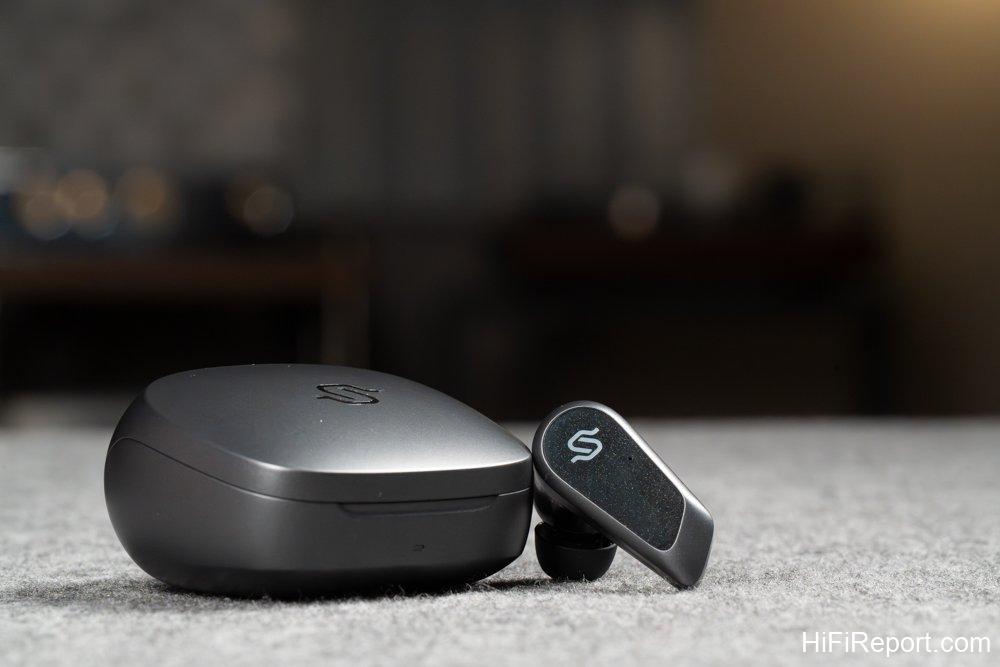
The Stax Spirit S10’s charging case has a clam-shell design and is only available in a matte iron grey color. There are no other color options.
The outer surface of the earbuds features a finish similar to automotive metallic paint, giving the S10 an overall urban-chic aesthetic.
EQ Presets Sound Different
The Edifier Stax Spirit S10’s sound can be adjusted using the built-in EQ in their app. I personally preferred the “Original” mode, which offers a balanced frequency response suitable for various music genres.
The “Dynamic” mode enhances the bass and slightly recesses the midrange, making it suitable for rock, hip-hop, or other rhythm-driven pop music.
The “Electrostatic” mode slightly reduces bass quantity, making the midrange and treble particularly bright and lending a distinct sense of transparency to the sound. Using EQ to simulate the sound of electrostatic headphones is a clever nod to the Stax Spirit name.

My listening impressions below are primarily based on the “Original” mode. Comparisons using other modes will be noted where applicable.
Spacious, Transparent Sound
When playing Lang Lang’s “The Disney Book,” the S10 is able to render a spacious soundstage. The sound isn’t confined to a small area.
This expansive, open soundstage allows the musical presentation to unfold naturally and orderly. In my opinion, the S10’s ability to delineate the soundstage is first-class for true wireless earbuds.
Using planar magnetic drivers, the S10’s sound is transparent and layered, and piano notes sound crystal clear and brilliant.
In “Original” mode, the S10 has a warm midrange, sufficient bass, and a solid foundation, without sacrificing bass in pursuit of transparency. On balance alone, I’d give it at least an 85, if not 90 points.
Using “Dynamic” mode causes string instruments to recede slightly due to the weaker midrange.
If switched to “Electrostatic” mode, piano notes sound even more crystalline, but the sense of weight from the orchestra is reduced, making orchestral tutti passages feel a bit lacking.
Planar Speed and Detail
Benefiting from the fast response speed of the planar magnetic driver, the S10 excels at revealing musical details. Information quantity never seems to be an issue, and the S10 manages to deliver this wealth of detail without causing listening fatigue.
Taking the jazz album “1+1=3” as an example, the standard trio of piano, bass, and drums weave a spectacular tapestry. The piano, playing the main role in driving the melody, not only sounds solid but also reveals the texture of the notes.
The details in the drum performance are overwhelmingly abundant. The drumming is fast and energetic, and the distinct characteristics of various drums are clear. The S10’s clarity is sufficient for me to use it for monitoring music.
As for the bass, the full, deep notes are quite astonishing. If, like me, you thought planar magnetic drivers couldn’t match dynamic drivers in bass, the S10 will greatly surprise you. This bass performance is supple yet boasts a satisfying “Q” factor (a sense of tautness or resilience), all while maintaining a clear, non-muddy quality. The bass here easily deserves 90 points!
Deep, Voluminous, Detailed Bass
Let’s talk a bit more about the bass. The bass in “1+1=3” was electric bass. In Christian McBride and Edgar Meyer’s album “But Who’s Gonna Play the Melody,” they use double bass.

While the electric bass notes were full and bouncy, the natural instrument’s double bass produces more sounds typical of acoustic instrument performances.
For instance, in this album featuring two double basses playing together, when one musician bows and the other plucks, the bowed notes have a coarse, scraping string texture, while the plucked notes occasionally reveal string vibrations and scraping sounds from fingers plucking the strings.
Don’t worry about a lack of detail; these details, even in the bass frequencies, are perfectly audible. The Stax Spirit S10’s bass is truly exceptional – it can reach deep, has plenty of volume, and is packed with detail.
Lively, Layered Vocals
Moving to Anette Askvik’s track “Liberty,” Askvik’s vocals sound clear in both form and vocal line, with ample detail in pronunciation and vocal texture.
Using “Original” mode provides better vocal thickness, while “Electrostatic” mode reveals clearer and more delicate details. Both modes make Anette Askvik’s singing sound lively, just through different approaches.
Regarding the accompaniment, keyboards, electric piano, cello, saxophone, and percussion interweave to create a hazy, atmospheric mood. The solid and distinct notes of the electric piano, the clear and crisp percussion, and the textured tenor saxophone all showcase the S10’s playback capabilities.

Transparent and Sweet
The sound performance of the Edifier Stax Spirit S10 is truly astonishing. Its price tag of approximately ~$310 places it among the higher end of the true wireless earbud market; few models are more expensive, and it even sells for more than offerings from major headphone brands like Sony and Bose.
However, the S10 is genuinely well-executed and comprehensive.
Its sound is incredibly convincing – balanced and transparent, particularly that transparent and sweet quality that dynamic driver models simply can’t quite match.
The specifications and features are also almost fully loaded, including adjustable active noise cancellation, wear detection, dual-device pairing, ultra-low latency, IP54 dust and water resistance, adjustable EQ, and more. It includes almost every feature expected of a high-end true wireless earbud.
The product appearance, packaging, and accessories also demonstrate Edifier’s ambition to make the Stax Spirit S10 a premium true wireless earbud.
If you’re looking to buy a high-end true wireless earbud around the ~$310 price point, there are indeed many options.
However, among this multitude of brands and models, only the Edifier Stax Spirit S10 uses a planar magnetic driver. At least for now, it is the only one.
If you want something truly different, how can you miss out?
Specifications
* Type: True Wireless Bluetooth Earbuds
* Driver: Ø12mm Planar Magnetic Driver
* Bluetooth Specification: 5.4
* Supported Audio Codecs: LHDC, LDAC, aptX Lossless, aptX Adaptive, aptX Voice, Snapdragon Sound, AAC, SBC
* Frequency Response: 20Hz~40kHz
* Playback Time: 28 hours (ANC off), 20 hours (ANC on)
* Quick Charge: 15 min for 2 hours playback
* Charging Time: 1.5 hours
* Input: 5V/1A
* IP Rating: IP54