
Elac Varro DS1000 Subwoofer Review
In any home theater system, premium low frequencies are an absolute must. Without them, the thrill of watching movies is severely diminished. The challenge, however, lies in achieving quality bass – it needs to be abundant yet clear, layered, and fast. On top of that, ideally, it should be easy to adjust and not break the bank.
What kind of bass solution can comprehensively tick all these boxes? Elac’s new DS1000 active subwoofer seems poised to do just that.
Varro Series Evolution
Elac’s line of active subwoofers has entered a new era, dubbed Varro. This generation is segmented into three series: PS, RS, and DS, with the DS series representing the pinnacle. The highly acclaimed SUB 2000 series from the past is now streamlined, with the SUB 2070 remaining and updated to the SUB 2070.2. The key differences include an enhanced DSP processor and the integration of a new generation of app control, making adjustments significantly easier than before.
The DS series currently features two models: the DS1000, which is the subject of this review, and the larger DS1200. The primary distinction lies in their driver configuration: the DS1000 employs dual 10-inch drivers, while the DS1200 uses dual 12-inch drivers. Structurally and functionally, both models are identical.
The driver placement in the DS1000 inherits the design from the previous SUB 3070 model. This involves positioning the two bass drivers on opposite sides of the cabinet, allowing sound waves to radiate outwards. However, they are not strictly back-to-back. Instead, the trapezoidal cabinet, narrower at the front and wider at the rear, creates a slight angle between the drivers, enabling them to fire outwards and slightly forwards.
Unique Driver Design
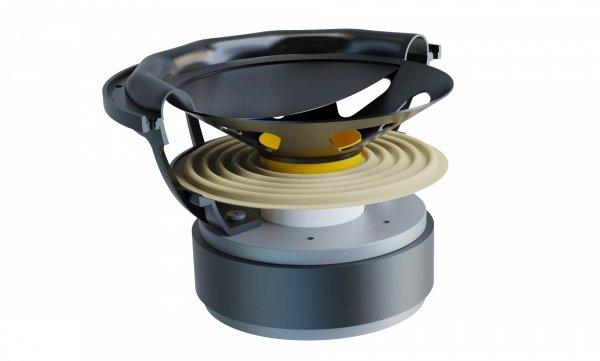
The most significant innovation in the DS1000 is the introduction of the newly developed HEX driver. The most distinctive feature of this new driver is the shape of its surround. Instead of the traditional half-circle, it features a subtle 12-sided peak-like structure, reminiscent of a mochi ring donut from Mister Donut.
Why this design? According to Elac’s website, this geometric shape allows the surround to exhibit more linear displacement when subjected to the pushing and pulling forces from the diaphragm. This ensures that the displacement variation remains consistent, unlike irregular changes that can occur with traditional surrounds during extreme excursions. Consequently, the driver maintains lower distortion levels, even at high sound pressure levels.
The new HEX driver also incorporates a novel design for the diaphragm itself. While the material remains Elac’s favored AS aluminum, this version adds a layer of paper cone. Using a special bonding technique, the aluminum and paper cones are combined to form a sandwich diaphragm. This design leverages the transient response characteristics of paper and the rigidity of aluminum, while simultaneously allowing for extremely long excursion, thus balancing large dynamics with deep bass extension.
Naturally, excellent drivers require equally capable amplification. To this end, all models in the new Varro generation of subwoofers are equipped with high-performance BASH amplifiers, differing only in their power output ratings. The BASH amplifier module in the DS1000 features input signal voltage sensing. This allows the switching power supply to deliver the required power with maximum voltage swing, achieving maximum dynamic range without generating excessive heat.
The DS1000’s amplifier boasts a continuous output of 1000 watts, with peak transient output reaching an impressive 2000 watts – certainly more than sufficient. This ample power, driving two 10-inch drivers, enables the DS1000 to reproduce extremely low frequencies, reaching down to 18Hz, despite its sealed cabinet design.
Comprehensive App Control
Even with formidable performance, a subwoofer’s potential can’t be fully realized if it’s difficult to use or calibrate. This is where Elac’s third-generation app, Elac Sub Control 3.0, comes in. It allows users to effortlessly adjust and control the DS1000 via a Bluetooth connection from their smartphone. Everything from volume, crossover frequency, phase, and delay to even EQ can be adjusted from the comfort of your sofa. The app can even control multiple subwoofers, eliminating the need to bend over or crawl behind the subwoofer to make adjustments, and removing the worry of placing the subwoofer in an inaccessible spot.
Furthermore, the app includes an automatic EQ function. If you can’t place the DS1000 in the acoustically optimal location, the Auto EQ can be incredibly useful. Using it is simple: within the Elac Sub Control 3.0 app, select Auto EQ, place your phone close to the DS1000, and press Start. The DS1000 will then emit test tones from 20Hz to 200Hz for the phone to measure. Next, return to your listening position, hold the phone, and measure again. The app will automatically compare the test tones received at both locations and perform automatic equalization adjustments to achieve a smoother bass response.
(Image caption 1: The Elac Sub Control 3.0 app can control up to 3 subwoofers. The screen shows the app has found one DS1000.)
(Image caption 2: Controlling the volume via the app is both convenient and precise.)
The Auto EQ offers three pre-set modes that users can switch between based on the content being played to achieve different listening experiences.
(Image caption 3: Phase can be freely adjusted from 0 to 360 degrees.)

(Image caption 4: The crossover point is adjustable from 40Hz to 150Hz, and the LFE setting can be toggled on/off.)
(Image caption 5: Subwoofer delay can also be set.)
(Image caption 6: The DS1000 features an input signal sensing wake-up function. Here you can set the minimum input level required to wake up the DS1000.)

(Image caption 7: In addition to Auto EQ, the DS1000 also boasts a more powerful parametric EQ, allowing for finer adjustments.)
(Image caption 8: Besides Auto EQ, the DS1000 also features a more powerful parametric EQ for more precise adjustments.)
Even more convenient, the DS1000 has a built-in wireless receiver. Users simply need to purchase the optional AirX2 wireless transmitter and connect it to their AVR’s subwoofer output. This allows the subwoofer signal to be transmitted wirelessly to the DS1000, with support for wireless connection of up to three subwoofers. Freed from signal cables, users have greater flexibility in choosing the optimal placement for their subwoofer(s).
The DS1000’s input interface is also very versatile. In addition to RCA and XLR stereo or LFE inputs, it thoughtfully provides a set of left and right channel speaker inputs, allowing direct connection to a power amplifier. This is a highly convenient input option for those looking to build a 2.1 channel music playback system. Furthermore, the DS1000 is equipped with an RJ45 network port for automatic control via third-party software, making its feature set very comprehensive.
Effortless Integration
The listening test was conducted in the HiFiReport listening room. I used the existing speakers in the room: a pair of Dynaudio Contour 60 floorstanding speakers for the front left/right channels, a pair of Divini KIT-M bookshelf speakers for the left/right surrounds, and a Capriccio Continuo Admonitor Preference Plus bookshelf speaker with a Submonitor MKIII bass column for the center channel. The amplifier was a Primare SPA25 AVR, forming a 5.1 channel system. The DS1000 was positioned between the right front speaker and the center channel.
The Primare SPA25 is equipped with Dirac Live. Before starting the listening test, I used Dirac Live for automatic room correction. During this process, I enabled the LFE input on the DS1000 via the app, set the crossover to the highest frequency, and set the volume to 50, leaving the rest to Dirac Live. The DS1000’s built-in Auto EQ or parametric EQ were not used.
Perhaps it was the powerful performance of Dirac Live, or perhaps the exceptional capabilities of the DS1000, or maybe a combination of both, but after letting Dirac Live complete its automatic setup, I didn’t need to make any manual adjustments. The result was a very smooth sound, with bass that was rich, full, clear, and natural, without drawing undue attention to the subwoofer itself. This demonstrates the seamless integration of the DS1000 with the five main speakers, forming a cohesive system. Compared to past experiences where automatic room correction always required some manual fine-tuning of the subwoofer’s crossover or volume, the DS1000 required no such intervention.
All-Round Performance
Using some highly familiar segments from the Dolby Atmos Blu-ray test disc, it immediately became apparent that the DS1000 delivers outstanding performance across various aspects, including bass quantity, extension, clarity, layering, and speed. It truly excels in every area.
Take, for instance, the “Horizon” video segment. There are several scenes with high-energy bass output, such as the spaceship flying overhead and the waterfall sequence. Through the DS1000, you not only feel the substantial bass scale, excellent thickness, and weight, which provide a sense of impact, but more importantly, the bass retains layering and texture, rather than blurring into a single monolithic rumble.
Another example is the segment from the movie “In the Heart of the Sea,” where the ship encounters a storm on the open sea. The vessel battles monstrous waves, accompanied by thunder – a deluge of sound effects. The DS1000 consistently provided layer after layer of sonic pressure, intensifying the tension of the movie’s scenario.
Honestly, the DS1000’s cabinet volume isn’t particularly large, and it’s a sealed enclosure. However, thanks to two very capable 10-inch composite aluminum cone drivers and a continuous output of 1000 watts, it can still deliver abundant bass. Many people’s listening spaces can’t accommodate very large subwoofers, yet they desire sufficient, or even more, bass. The DS1000 perfectly addresses this need.
However, more than the quantity of bass, I’m concerned with its quality. After all, a movie doesn’t constantly feature intense, action-packed scenes; there are often fluctuations. Therefore, bass detail during quieter moments is even more crucial. This requirement certainly didn’t pose a challenge for the DS1000. For instance, in the “Amaze” segment, a sudden afternoon thunderstorm descends upon a lush tropical rainforest. The thunder is sometimes near, sometimes far, sometimes strong, sometimes weak, sometimes long, sometimes short, interwoven with the sound of rain. The layers of sound are richly varied. With the DS1000’s assistance, the subtle shifts in the low frequencies are clearly audible, sounding lingering and distant, as if the thunder is rolling in from afar, perfectly matching the visuals which have shifted to a wide shot of the sky filled with dark clouds over the entire forest. Without clear bass layering in this segment, the atmospheric tension would be significantly diminished.
Swift and Agile
Beyond its abundant output, excellent resolution, and rich layering, another notable advantage of the DS1000 is its speed. It is truly fast. Take the “Star Wars Battlefront” segment from the Dolby Atmos test disc, which shows the first-person perspective of this Star Wars shooting game. Amidst the sounds of various guns and cannons firing, explosion impacts, and collisions, there are also the whooshing sounds of aircraft flying by quickly. A multitude of sounds cascade, creating a dazzling sonic environment. If the subwoofer isn’t fast enough or responsive enough, the sound can indeed become chaotic. But for the DS1000, this challenge is merely a piece of cake, a trifle. Consequently, I watched the entire five-plus minutes of game footage with great enjoyment – it was truly exhilarating!
Finally, I listened to the Blu-ray of “Zero Distance Party” by Taiwan’s renowned fusion jazz band, Infinite Fusion. This recording captures a small live concert where everyone present, musicians and fans alike, listened through headphones. The fans were seated right next to the musicians, truly at “zero distance.” All the headphones provided at the venue were Audio-Technica studio monitor headphones, meaning the audience was essentially “monitoring” the musicians’ performance and the live mixing effects. This highlights the demanding recording quality of this Blu-ray. Since they are performing fusion music, the performance of rhythm and speed is particularly important, and this is precisely the DS1000’s strength. It ensures that the basslines have absolutely no ambiguity, the drum hits are clearly defined without dragging, and the kick drum strikes are clean and precise. It feels both stable and light, making the overall music sound free-spirited, lively, and utterly enjoyable.
Powerful and User-Friendly
If one were to choose an honor student among subwoofers, the DS1000 would undoubtedly be selected. This is because it exhibits excellent performance in every aspect. It can handle both delicate nuances and powerful dynamics with ease, and its size is appropriate. It’s difficult to find fault with it. Most importantly, it is designed with the user in mind. Therefore, it not only provides diverse interfaces, allowing for various connection methods, including wireless transmission, but also features a highly convenient app, putting control right at your fingertips. If you are looking for a high-performance subwoofer that is also incredibly user-friendly, the DS1000 is the perfect choice.
Specifications
Elac Varro DS1000
* Type: Dual-driver sealed active subwoofer
* Drivers: 10-inch HEX surround bass driver × 2
* Amplifier Power: 1,000 watts continuous, 2,000 watts peak
* Frequency Response: 18Hz – 150Hz
* Maximum SPL: 115dB
* Crossover Frequency: 40Hz – 150Hz (adjustable)
* Inputs: RCA, XLR, Speaker Level Input
* Dimensions: 371 × 429 × 370 mm (H×W×D)
* Weight: 32.4 kg