
Esoteric Grandioso N1T Review
I often wonder, do network streamers really need to be expensive to sound good? If a streamer doesn’t have a built-in DAC, it’s essentially just a simple mini-computer that faithfully passes the network-delivered music signal to an external DAC. The cost shouldn’t be high, right? It should theoretically be possible to make them affordable and good (I hesitate to say cheap and good). However, after understanding the internal workings of the N1T, I realized I was mistaken!
Audio engineers can design a network streamer to be very simple, or they can make it incredibly sophisticated, depending on the price point they are aiming for. Of course, given the price of the N1T, it should be classified as a top-tier, DAC-less network streamer.
Appearance and Controls
The N1T’s appearance is practically identical to Esoteric’s Grandioso D1X SE, differing only in the buttons on the front panel. On the far left is the standby power switch, followed by an LED indicator for clock lock. The display screen is in the center, and to the right are several buttons, including Skip, Play/Pause, and Menu. The N1T’s menu design is similar to other Esoteric products, just with fewer adjustment options.

Rear Panel Connections
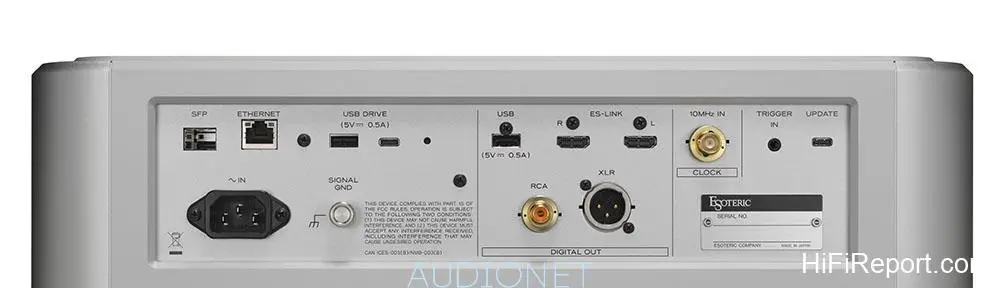
Turning to the rear panel, you’ll naturally find an Ethernet port. Next to it is an SFP fiber optic port, which allows connection to the network using an SFP (Small Form-factor Pluggable) module. SFP supports long-distance transmission, which, frankly, isn’t necessary for home audio. However, it transmits via optical pulses, supports transfer rates from 100Mbps to 10Gbps, and resists EMI, effectively isolating noise from the network. This is genuinely beneficial for home audio.
If your equipment is compatible, using it is recommended. Note that the N1T’s RJ45 and SFP fiber optic ports should not be used simultaneously.
Further right are two USB ports, allowing users to connect USB drives directly and play music files stored on them. To the right of that is a USB socket for connecting to an external DAC using a USB cable. Next are RCA coaxial digital output and AES/EBU digital output terminals, also for connecting external DACs. Additionally, there is a 10MHz external clock connection terminal.
On the far right are a Trigger In terminal and a USB terminal for upgrades/maintenance, which are not related to music playback.
Menu System Overview
Notably, the N1T features two HDMI terminals, labeled ES-Link. These are digital output terminals intended for connecting Esoteric equipment. Why two? Because the Grandioso D1X SE has a split left/right channel design. Pressing the Menu button sequentially brings up ESL, CLK, DISP, Dimmer, DPaOFF, APS. Note that the Menu has two layers; the aforementioned are the first layer. To access the second layer Menu, you need to long-press the Menu button.
The second layer Menu includes adjustment items such as OUT, MQAdec, NETM CHG, LanLED, menuTM, F/Wver., etc.
ESL has four options. ESL selects ES-Link for digital output, usable only with Esoteric’s own DACs. Normal selects the other digital output terminals. UPCONV processes the output digital signal with 8x upsampling. The final option, Stereo, is specifically for MQA-encoded music files or streams; if you’re playing an MQA signal, select this option.
CLK refers to the clock, with only Off and On options. Off means operating with the internal clock, while On prioritizes the external clock. DISP also has two options: Fs displays the sampling rate of the music signal, and Time displays the track duration. Unfortunately, the N1T cannot display the transfer rate, which would be more meaningful for streaming music.
For example, when I played Spotify, the display only showed 44.1kHz, the same as CD quality, but Spotify is highly compressed, with a very low transfer rate. The sound quality is naturally not as good as Tidal’s 44.1kHz.
Dimmer adjusts the display brightness. DPaOFF is for automatic display shutdown, with only Off and On options. Setting it to On is recommended, meaning the display will automatically turn off if there is no change for 10 minutes. This function prevents screen burn-in. APS is for power saving, with options for 30, 60, 90, 120 minutes, and Off. This means if there is no playback for 30 minutes, it will automatically switch to Standby mode to save power consumption.

If you don’t want power saving, set it to Off.
In the second-layer menu, Out selects the type of digital output, with four options: ESLINK, USB, XLR, COAX. If you select the wrong one, there will be no digital signal output. MQAdec has three options: ON activates the function (recommended setting), PTH means MQA is not active but the display still shows MQA information, and OFF disables the function.
NETM CHG has two options: Norm is the normal setting, and RAAT should only be enabled when using the Roon App. LanLED controls the network connection indicator on the front panel. Selecting On makes the blue light blink on the panel; Off disables the blinking. Setting it to Off is recommended. menuTM sets the display duration of the menu. If you select 5-30 seconds, the menu on the display will automatically disappear after that time.
If you select the infinity symbol, the menu will stay on indefinitely. The last item, F/Wver., displays the firmware version.
Internal Architecture and Technology
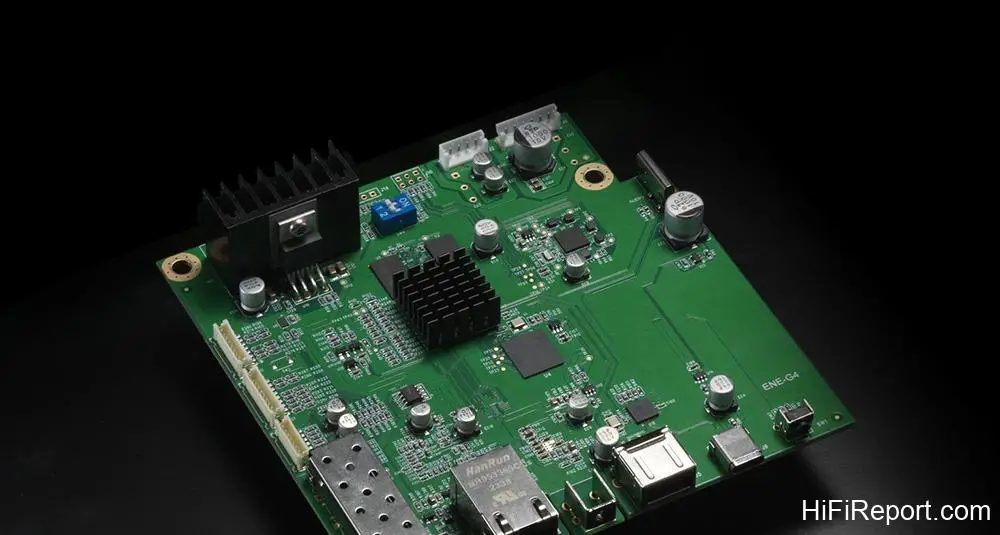
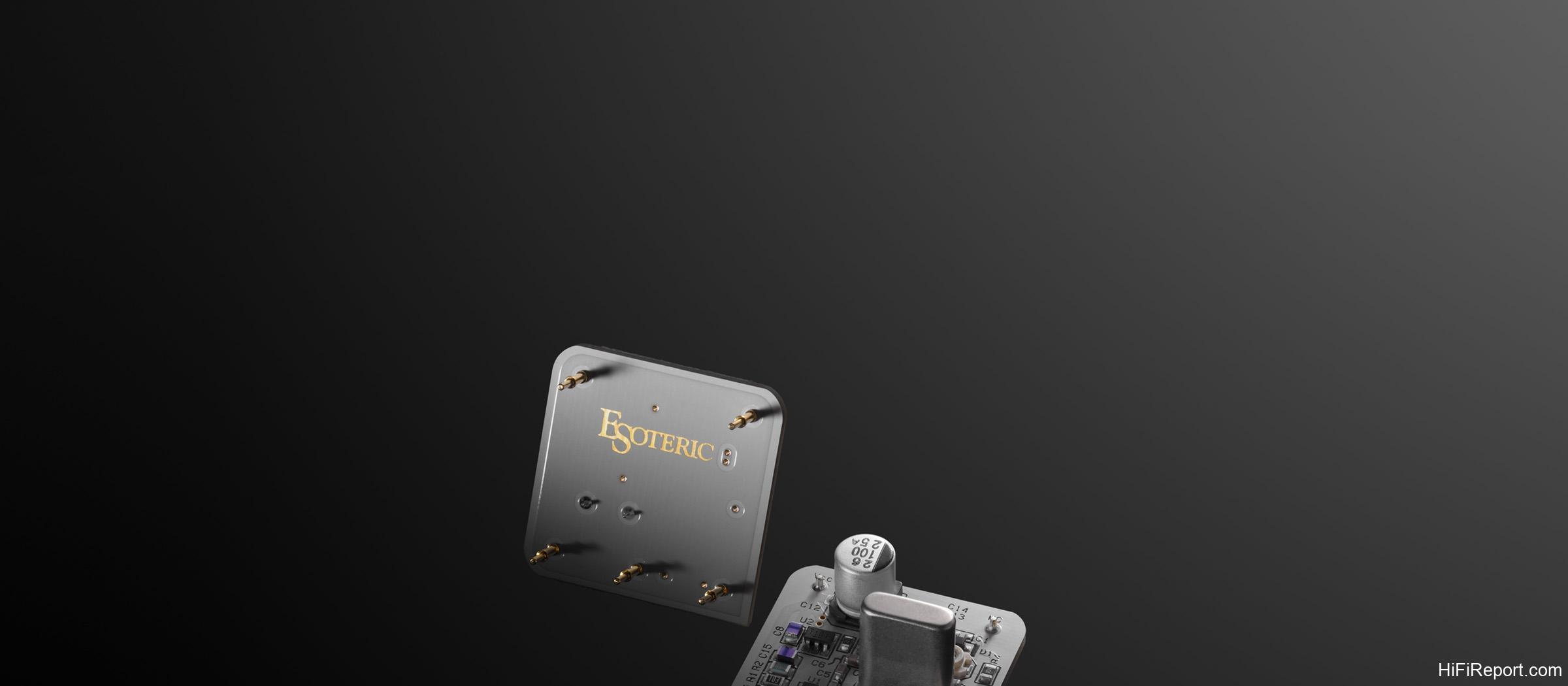
The N1T utilizes Esoteric’s fourth-generation Esoteric Network Engine G4 streaming playback system, featuring more powerful RAM and CPU. This fourth-generation streaming playback circuit is powered by an independent linear power supply. The components used in the internal circuitry have been upgraded, including custom capacitors and Schottky barrier diodes.
External connections are handled via HDMI terminals, utilizing Esoteric’s ES-Link, which has evolved to the fifth generation, hence the ES-Link 5 displayed on the screen.
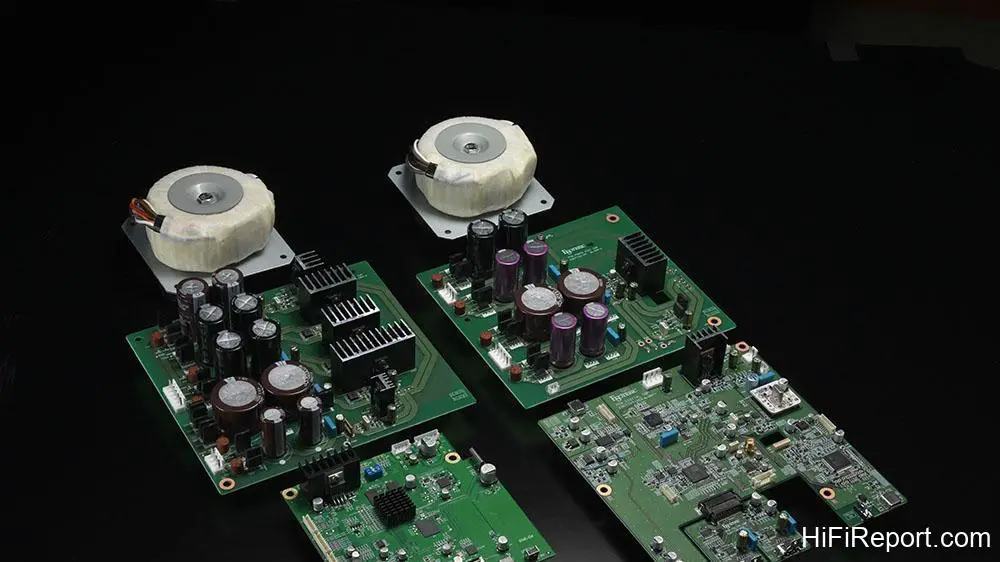
The N1T is equipped with USB ports (one Type A and one Type C) to connect to music servers or network drives. The N1T’s internal music signal path is completely isolated from the network circuitry, preventing network noise from interfering with the music signal path. Furthermore, the linear power supplies dedicated to the music signal path and network playback are also independently segregated.
The N1T houses three independent power supply systems, respectively supplying power to the streaming engine, the music signal path, and the control circuitry. Each power supply features its own low-feedback DC regulator. By reducing the amount of feedback, the N1T’s sound becomes more powerful and open.

The N1T incorporates the Master Sound Discrete Clock, a larger, customized OCXO clock module that provides more precise control over digital signals and has been extensively used in the Grandioso series. Despite having a top-tier built-in clock, the N1T can still connect to an external G1X, using the G1X to synchronize the clocking of external digital-to-analog converters with the N1T.
Supported Formats and Features
The N1T is compatible with 22.5MHz DSD and up to 384kHz/32-bit PCM. It supports a wider range of file formats, including DSF, DSDIFF, FLAC, Apple Lossless, WAV, AIFF, MP3, AAC, and MQA. It can also play professional 32-bit floating-point files. Additionally, it supports Tidal Connect, Qobuz, Roon Ready, RAAT (Roon Advanced Audio Transport, which reduces CPU workload and improves sound quality), and Spotify Connect.
Chassis Design and Isolation
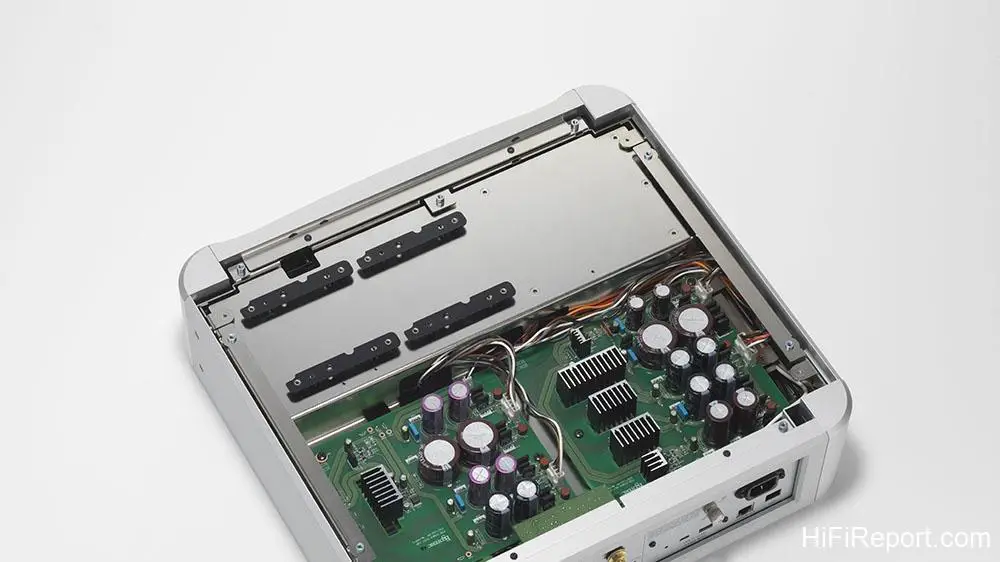
Opening the N1T’s chassis reveals an internal structure divided into upper and lower layers. The lower layer houses the power supply, while the upper layer contains various circuits. The interior is also structured with multiple layers and beams, designed to firmly secure various circuit boards and the power transformer. This design aims to prevent vibration interference between components (should any exist) while also mitigating electrical interference.
The N1T’s chassis base sits on three isolation feet, utilizing Esoteric’s patented new spike design. These spikes are not rigidly fixed; the upper and lower parts are in a semi-detached state. They rely on the weight of the unit pressing down, suspending the top of the feet from the lower base plate. When placed, the weight of the equipment connects it to the lower base plate. The top of the spike is conical, reducing the contact area.
The bottom features a circular concave shape, with only the edge contacting the surface.
Listening Experience
During my listening sessions with the N1T, I primarily used Tidal Connect, Spotify Connect, and AirPlay (for listening to Apple Music). For the digital-to-analog converter, I used the Grandioso D1X SE, of course. The preamplifier was a Spectral DMC 30 SS, feeding directly into ATC SCM 100 ASL dual active loudspeakers. Esoteric’s control app is based on the Lumin platform.
However, with Tidal Connect and Spotify Connect now available, if you only want to stream music, you can bypass the Esoteric app entirely and use Connect directly.
During the listening process, I listened to Tidal, Apple Music, and Spotify. All three streaming platforms gave me a pleasure I had never experienced before, clearly indicating that an expensive network player has its value. Regardless of which platform I played, the sound consistently exhibited excellent quality, being smooth, full-bodied, warm, and free of harsh edges. If you ask me if it sounds better than playing a CD?
While my impression of listening to the Grandioso P1 SE is still fresh, I can tell you that comparing a CD to Tidal 44.1kHz, the P1 SE’s sound is still superior. Where is it better? The sound quality is a bit better. However, if comparing Tidal high-resolution music, such as 96kHz or 192kHz, the P1 SE doesn’t necessarily have the advantage. High-resolution music still surpasses CD’s 44.1kHz. Therefore, if you want to enjoy high-resolution music, streaming is unavoidable.
Listening to Tidal with excellent sound performance was expected. However, even listening to Apple Music and Spotify showed significant improvements in sound quality, which surpassed my expectations. We know that with typical audio equipment, listening to Apple Music requires using AirPlay to push the stream from your phone to the network player. This adds a step, which can potentially degrade sound quality slightly.
Furthermore, AirPlay can only transmit up to 44.1kHz (or 48kHz for video), so you cannot hear high-resolution music using AirPlay (even though Apple Music high-resolution compression can reach 24/192).
Yet, despite this, I still heard improvements in Apple Music through the N1T compared to usual. Firstly, the sense of space was better. Secondly, the decay of instruments extended longer. Thirdly, the sound quality was enhanced. Fourthly, the sound became fuller. Honestly, I rarely listen to Apple Music normally, except for Mandopop songs. But with the N1T, I found that even though Apple Music could only be streamed via AirPlay, classical music sounded remarkably good.
Furthermore, I must also mention Spotify. While I know listening to Spotify with the N1T might seem like overkill – its highest transfer rate is only 320kbps, using the N1T is like using a sledgehammer to crack a nut – you might not believe it, but Spotify played through the N1T became noticeably fuller, creating the illusion of having more musical information. Additionally, the bass quantity was more substantial, and the sound was warmer.
Seeing the N1T’s display showing 44.1kHz (though it can’t show the compressed transfer rate), I even found myself believing that was the actual 44.1kHz sound quality I was hearing.
Ideal System Pairing
For a network streamer of the N1T’s design and price, unless paired with Esoteric’s own equipment, few people would likely be willing to spend this amount. If someone does decide to purchase it, the most ideal setup would likely be the “six-piece” system. What is the six-piece system? It’s the N1T network player, the G1X external clock, and the D1X SE split left/right channel digital-to-analog converter. Wait, that’s only four pieces!
Don’t forget the P1X SE CD transport, which has a separate power supply. Adding that makes it six pieces.
Specifications
* Product Type: Network Streamer
* Release Date: December 2024
* Supported Formats: FLAC, Apple Lossless (ALAC), WAV, AIFF, MQA, DSF, DSDIFF (DFF), DoP, MP3, AAC
* Input Terminals: Ethernet, SFP, USB-A, USB-C, BNC Clock Input
* Output Terminals: ESL-Link, AES/EBU, RCA Coaxial
* Maximum Supported Resolution: PCM 32bit/768kHz, DSD 22.5MHz
* Weight: 23.1 kg