
Focal Azurys Review
I had been eagerly anticipating the arrival of two particular headphones for review in our office. Then, last month, I received an intriguing invitation from Focal’s distributor, Onkyo, to visit the MUSEND headphone store in Taipei’s Ximending district. The purpose? A listening session for the closed-back Azurys headphones.
While I’ve attended numerous headphone events before, they usually feature flagship products like the Focal Utopia 2022 or T+A Solitaire P. This time, however, Onkyo was making a significant effort for a pair of headphones priced just slightly over $350 USD. As a Focal headphone owner myself, my interest was immediately piqued. I wondered, what makes the Azurys so special? Or perhaps, what astonishing system pairing had MUSEND prepared? The prospect was exciting!
The Venue: MUSEND
Located on Emei Street in Ximending, MUSEND is a key battleground for headphone enthusiasts in recent years. Upon arriving, I found that while the store isn’t huge, it’s incredibly well-equipped, stocking everything from entry-level true wireless earbuds to high-end desktop headphone systems. The staff present were highly professional, ready to provide satisfying answers to any questions regarding headphone selection or system matching.
Beyond the extensive product range, MUSEND’s listening environments are clean and comfortable, with multiple dedicated spaces. Testing headphones here might even include enjoying coffee brewed by the staff, a level of professionalism that rivals top-tier coffee shops. It’s no wonder MUSEND is constantly busy; during my visit alone, several groups of customers arrived sequentially. The diverse headphone selection keeps enthusiasts captivated, with many settling in for hours of listening.
Of course, Onkyo chose MUSEND not just for its professionalism, but also because it’s one of the most comprehensive Focal headphone retailers in Taiwan. Their display cabinets feature the entire lineup, from the flagship Utopia 2022 home headphones to the Bathys wireless model. Various levels of headphone amplifiers and DACs are also readily available, ensuring customers can find the optimal pairing for any model they wish to audition.
And on that day, the protagonist of the session, the Azurys, had been waiting patiently.
Design and Features of the Focal Azurys
Before diving into the listening experience, it’s essential to introduce the Azurys. Compared to Focal’s home headphones, its design is lighter and more compact, featuring an elegant water blue finish. The headband is narrower and crafted from flexible silicone, with a non-slip suede-like synthetic fiber on the inner side. The outer side is made of fine lambskin, offering excellent comfort and conforming perfectly to various head shapes.

The ear pads feature thick foam cushions covered in breathable synthetic fiber, ensuring comfort and preventing stuffiness even during extended wear outdoors.
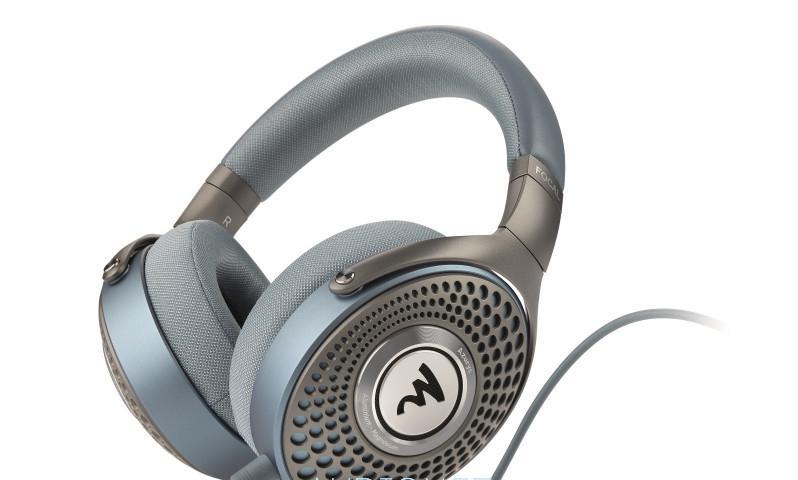
The Azurys housing is made from lightweight plastic, complemented by an aluminum frame. This frame features the familiar concentric circle grille pattern with Focal’s flame logo at the center, a design motif shared with closed-back home models like the Stellia and Celestee. The yokes connecting the earcups are also crafted from aluminum, enhancing the headphones’ rigidity.

Focal has even applied a magnesium coating to the yoke surface for a brighter, more striking look, and likely to help reduce earcup resonance. Despite being an entry-level model, the design details are remarkably meticulous.
M-Shaped Dome Dynamic Driver Technology
Furthermore, although the Azurys headphones are slightly smaller than typical wired Focal headphones, they are equipped with a standard-sized 40mm Aluminum-Magnesium M-shaped dome dynamic driver. This signifies that the Azurys can still move sufficient air within their small chambers to reproduce full musical detail. This diaphragm is a signature design feature of Focal’s higher-end headphones.
Viewed in cross-section, the diaphragm exhibits an “M” shape, designed to distribute vibrations more uniformly, resulting in a more linear transmission of sound waves to the eardrum. The Aluminum-Magnesium material also shares similar characteristics with the beryllium diaphragm found in the top-tier Utopia 2022, including low mass, high rigidity, and resonance points in the extremely high-frequency range where human hearing is less sensitive.
This avoids the ringing coloration often associated with conventional metal diaphragms, making the high frequencies sound softer and less aggressive.
Portability and Connectivity
For enhanced portability, the Azurys’ cable differs from standard Focal headphones, utilizing a simpler single-sided detachable design with a common 3.5mm connector. This allows users to easily detach or swap cables for upgrades. Additionally, the headphones have a low impedance of only 26 ohms and a high sensitivity of 100dB, making them very easy to drive. Good sound quality can be achieved even with a portable player.
The headphones also come with a refined hard carrying case, offering excellent protection when you’re on the go.
The Listening Setup
Although the Azurys is designed for mobile use, the dedicated team at MUSEND still prepared a professional headphone amplifier to drive it, aiming for the best possible sound. This amplifier was striking, with a black chassis accented by gold buttons and knobs. I learned it was the ONIX Miracle XP-10, represented by MUSEND themselves. This is a three-in-one unit combining a DAP, DAC, and headphone amp.
Its most unique feature is a slot on the top panel that allows a matching ONIX DAP to be directly docked as the music source. The DAP’s large touchscreen panel then doubles as the amplifier’s control interface. It also pairs with a dedicated XPS linear power supply, truly an example of maximizing both practicality and audiophile design.
Listening Impressions
I’ve listened to many Focal headphones in the past and am a Stellia owner myself, so I thought I could somewhat predict the Azurys’ capabilities. However, Focal once again exceeded my expectations! Compared to the fast, clear style of the higher-end models, the Azurys’ sound is smoother, warmer, and highly musical. The mid-bass region has a bit more body, but without obscuring details. It still retains the transparency and layering characteristic of Focal headphones.
Playing Beethoven’s Piano Trio No. 5 led by David Grimal, the Azurys’ chamber music texture was immediately pleasing. The background was quiet, string lines were full-bodied, and instrument shapes didn’t sound small or thin. They maintained significant weight even in a small circumaural headphone.
Instrument separation was also excellent, adding distinct layers to the back-and-forth dialogue between instruments. The piano had a rounded, sweet quality to its attack, and dynamic keystrokes were sharp without the low end sounding boomy. The violin sounded smooth and sweet, with just the right touch of shimmer and hall sound. The cello’s nasal tone felt warm and hydrated, and there was a slight, rich bloom to the bowing, making the lower frequencies sound more stable and weighty.
Next, I played “The Ice Hotel” from Stacey Kent’s “Breakfast On The Morning Tram” album. The female vocals through the Azurys had a lovely sweetness. Sibilance was smooth and soft, avoiding any fatiguing sharpness while still revealing subtle vocal details. The striking of the cymbal on the drum kit produced a round, weighty metallic texture, showcasing the charm of the Aluminum-Magnesium driver.
Accompanied by warm guitar, the jazz music became even more comfortable and enjoyable for extended listening.
Then I moved to a larger ensemble, Nemanja Radulovic’s performance of Tchaikovsky’s Violin Concerto. I immediately noticed the Azurys’ expansive sound. The soundstage felt open and unrestricted, a rare advantage for a closed-back headphone of this size. The violin lines were full and rich. While the shimmer was more subdued than on higher-end models, the high frequencies sounded very soft and sweet.
Throughout the piece, I could also feel the Azurys’ excellent transient response; even during rapid, intense passages, bowing details remained clear and distinct. Its impressive low-frequency energy effectively conveyed the grand scale of the string section, and the inner voices were clearly layered. If I were listening blind, I might not believe this sound was coming from a small, closed-back headphone!
Finally, I put on “Playing God” from Polyphia’s album “Remember That You Will Die.” The Azurys handled it with ease. The complex interplay of electric bass and double bass drum was solid and full. Even with aggressive distortion on the electric guitar solo, the individual notes remained clear, and the performance layers were distinct, without sounding blurry or out of control.
This demonstrated Focal’s exceptional bass control, making the heavy metal music feel impactful, with a steady rhythm that hits you right in the head – enough to leave any rock fan thrilled!
Conclusion
While the Focal Azurys headphones are considered an entry-level model, this listening session surprised me even more than other Focal home headphones. This indicates that the Azurys is not just a practical choice but also possesses significant sonic potential. When you’re out, you can pair it with a DAP to enjoy Focal’s beautiful sound in a simple setup. At home, you can connect it to a better headphone amplifier to fully unlock its audio capabilities.
If you’re looking to get into Focal headphones, the Azurys is definitely a versatile and excellent value option that can serve you well both on the go and at home.
Specifications
* Product Type: Closed-back, circumaural headphones
* Frequency Response: 15Hz – 22kHz
* Impedance: 26 Ohms
* Sensitivity: 100dB SPL
* Total Harmonic Distortion: < 0.3% THD * Driver: 40mm Aluminum-Magnesium M-shaped dome dynamic driver * Headphone Weight: 294 grams