
Focal Sopra No2 Review
HiFiReport Audio, a long-established audio shop, is tucked away in an alley between Bade Road and Civic Boulevard.
However, it’s a block away from the bustling Civic Boulevard, and while not exactly serene, stepping inside and closing the glass door is enough to make you forget the nearby hustle and bustle.
Sopra No2: Focal’s Cornerstone
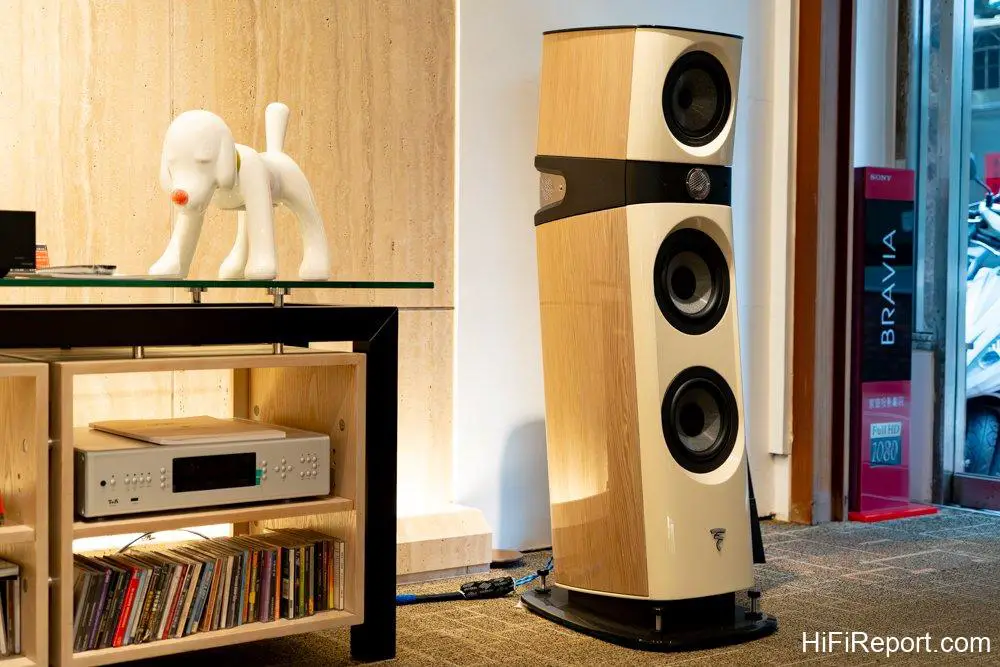
What was I listening to at HiFiReport this time? The Focal Sopra No2.
As the second-tier flagship series, positioned just below Utopia, Sopra holds a critically important place in Focal’s product lineup.
Although the Sopra series was launched back in 2015, it remains highly competitive in both appearance and sound performance. Its design incorporates core technologies found in Focal’s high-end loudspeakers.
Among the series, the Sopra No2, with its medium-sized floorstanding form factor, is the most popular on the market.
The Sopra No3, which approaches the scale and presence of the Utopia Scala, is more suitable for larger spaces.
Furthermore, if a consumer were considering only “value for money,” the Sopra No1 bookshelf model might easily be overlooked compared to the Sopra No2 floorstander.
Therefore, looking up and down the range, the Sopra No2 is the most accessible choice for consumers, making it unsurprising that it’s the best-selling Sopra model. It’s certainly no exaggeration to call it Focal’s core product.
Back when the Sopra No2 was first released in 2015, the editor-in-chief wrote a review. Shortly after, he went to another dealer for a second audition.
As soon as the Sopra No2 was launched and became available, HiFiReport dispatched the editor-in-chief to write two reviews; if that doesn’t make it a core product, what does?
Proprietary Drivers, Utopia-Inspired Cabinet
The Sopra No2 is a three-way, four-driver, bass-reflex floorstander. All its drivers are developed and manufactured in-house by Focal.
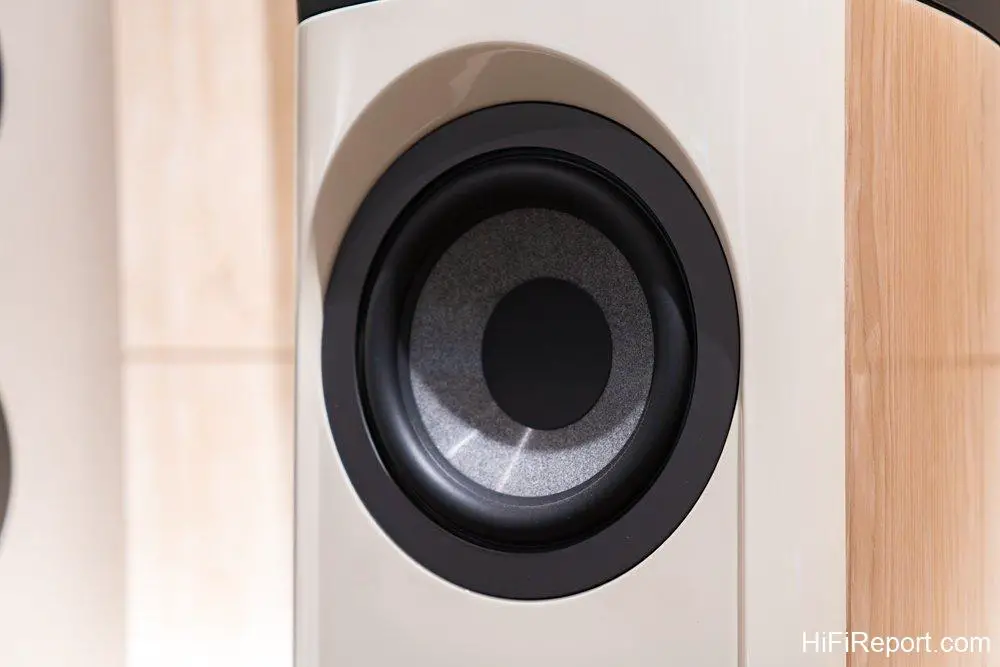
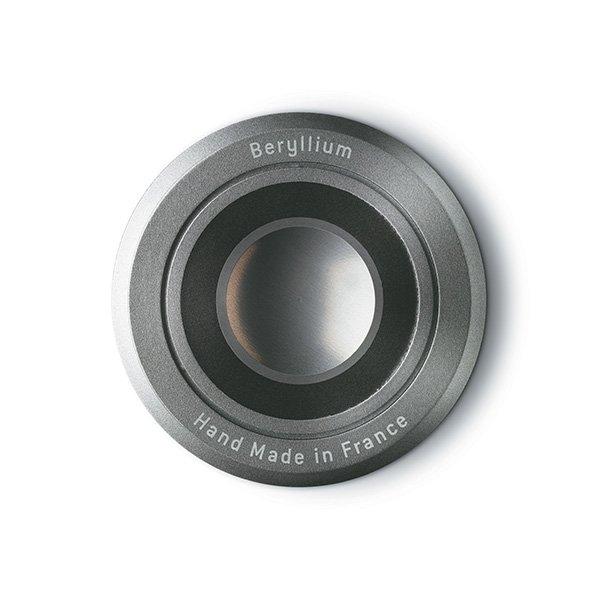
It features a 1-inch inverted dome beryllium tweeter at the top. Below the tweeter is a 6.5-inch W-Cone sandwich cone midrange driver. Below the midrange are two 7-inch bass drivers.
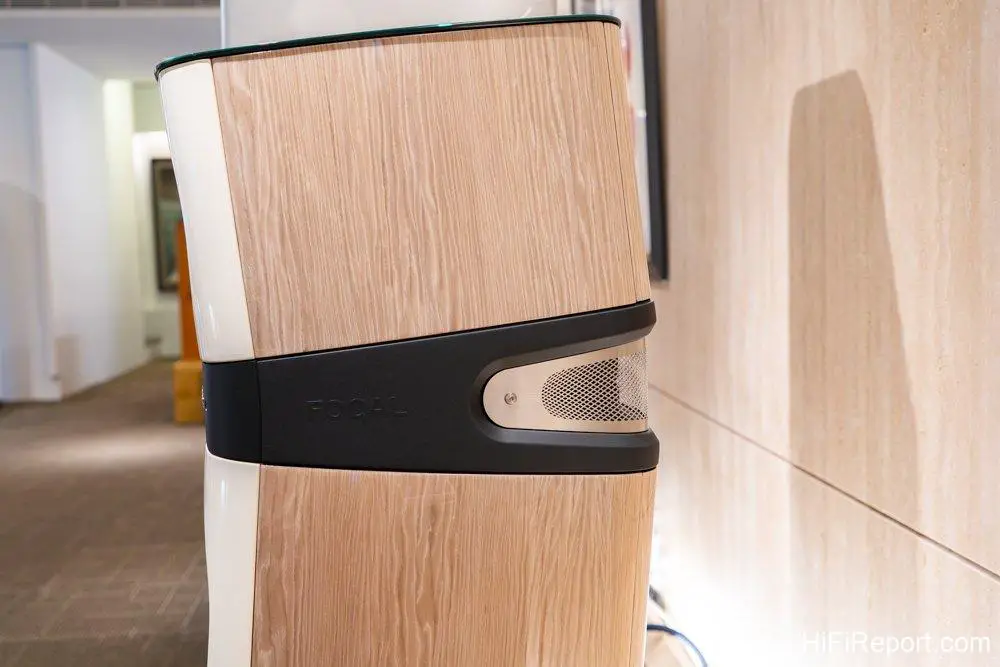
Seen from the side, the Sopra No2 is angled slightly, centered around the tweeter. The lower half slopes backward, positioning the bass drivers relatively forward. The tweeter returns to a vertical angle, while the midrange driver is angled slightly forward.
This design, using cabinet angles to create precise front-to-back spacing for each driver and thus correct for time alignment, has been a hallmark of Focal since the JMLab era (Focal’s predecessor). It first appeared on the Utopia series and is a true Focal signature technology.
Drivers Are Key: Performance and Low Distortion
As mentioned earlier, Sopra is an extremely important series for Focal, bridging past and future in terms of technology and design.
For Focal, the primary objective in designing loudspeakers is to have the right drivers.
Over the years, they have invested significant effort in improving driver performance and addressing various issues related to driver movement.
Each evolutionary phase has focused on two main goals: first, designing cones with improved rigidity and lower mass; and second, enhancing the motor system’s drive and control capabilities.
The former makes the cone easier to drive, while the latter allows the magnet system to move the cone with greater efficiency, all while achieving remarkably low distortion.
W-Cone Sandwich Cones for Midrange & Bass
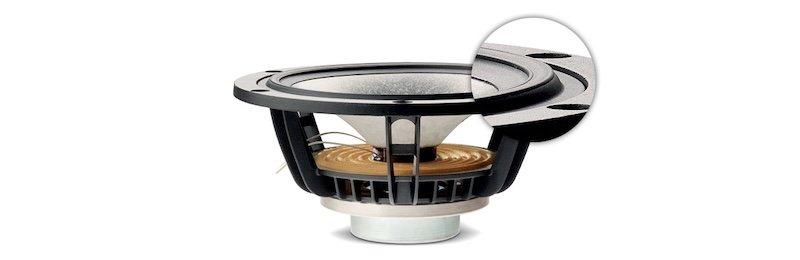
The cones used in the Sopra’s midrange and bass drivers are the same W-Cone type found in Focal’s Utopia speakers.
This sandwich cone consists of a central layer of structural foam bonded between two layers of glass fiber.
Compared to Aramid fibers or Kevlar, which were also previously used for speaker cones, the W-Cone is thinner, lighter, and significantly stiffer (20 times harder than Kevlar and Aramid), while also offering improved material homogeneity.
Focal used those materials in the JMLab era, but the new W-Cone possesses superior characteristics.
TMD Suspension: Like Taipei 101’s Damper
Furthermore, to achieve clearer and more precise midrange reproduction, having an excellent W-Cone diaphragm requires a suspension that can minimize distortion.
In 2015, Focal introduced the Tuned Mass Damper (TMD) suspension technology, and the Sopra was the first loudspeaker to feature it.
Traditional driver suspensions typically use a single curved rubber surround. TMD adds two rings, called “tuning rings,” above the suspension. This design increases the suspension’s mass, enhancing harmonic damping during the driver’s piston-like movement, particularly beneficial in the 1kHz to 2kHz response range. This results in lower suspension distortion during driver motion and helps prevent diaphragm deformation.
Focal claims the inspiration for this design came from the tuned mass damper used in Taipei 101 skyscraper.
Just as the damper helps Taipei 101 counteract swaying forces, TMD helps counteract the tendency for the diaphragm and surround to deform.
NIC Technology: Precise Motor Control Developed Over Three Years
Beyond improved diaphragms and suspensions, we look inside the driver to the motor system.
Using simulation software, Focal studied the magnetic field variations within the Sopra’s mid-bass drivers during operation.
Simply put, a driver’s motor system consists of a voice coil and a magnet. The driver moves because electric current flowing through the voice coil creates an electromagnetic force in the presence of the magnetic field, and this force pushes the voice coil, thus producing sound.
However, the electromagnetic force between the voice coil and the magnet is not constant; it varies depending on their distance, eddy current effects, and different frequency responses, leading to magnetic field non-uniformity.
This affects the sound by causing it to become blurred and reducing resolution.
Traditionally, manufacturers concerned with this issue often add a copper Faraday ring to the bottom of the driver’s magnet assembly.
Indeed, a Faraday ring can effectively improve the precision of driver movement and thus enhance sound resolution. However, this method can also diminish dynamic performance and musical contrast.
Could it be improved further? After three years of relentless effort, Focal developed the Neutral Inductance Circuit (NIC) technology, for which they obtained a design patent.
What is it? Essentially, it’s an optimized and improved Faraday ring, differing from traditional designs in size, materials, and placement.
Given this is their patented technology, Focal hasn’t disclosed specific details, but since the Sopra, NIC has become one of the core technologies in Focal’s mid-range and high-end loudspeakers.
Beryllium Tweeter with IHL Horn Loading
W-Cone, TMD, and NIC are technologies used in the midrange and bass drivers. What about the tweeter? Focal has something there too.
Sopra uses a beryllium diaphragm tweeter of the same caliber as the Utopia series, featuring an unusual inverted dome design.
Most dynamic tweeters we see are dome-shaped, but Focal has been making inverted dome tweeters for a long time.
This inverted dome design provides a larger contact area between the voice coil and the diaphragm, leading to better control when the voice coil drives the diaphragm.
Focal also transitioned to using metal tweeters across their range early on, utilizing beryllium diaphragms in their high-end models.
Beryllium is extremely rigid, seven times harder than titanium, and is the only metal that can scratch glass. Focal chose it precisely for its high rigidity, despite its expense – nearly fifty times the cost of gold.
Consequently, beryllium tweeters are reserved for Focal’s high-end Utopia, Sopra, and Kanta series.
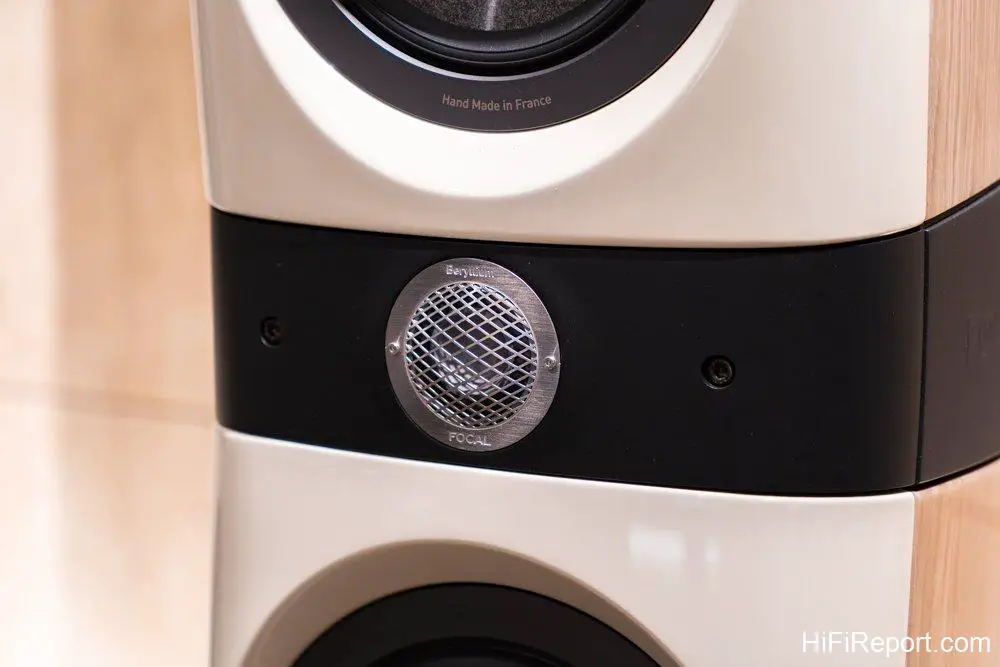
Furthermore, there’s a clever design behind the tweeter: a V-shaped horizontal assembly.
This Infinite Horn Loading (IHL) design creates a horn-like cavity behind the beryllium tweeter, which also contains damping material. This arrangement eliminates backwave interference from the tweeter, resulting in cleaner, more natural, and more precise high-frequency performance.
Focal previously had a similar Infinite Acoustic Loading (IAL) technology, but the IHL used in Sopra is even more effective than IAL, reducing backwave interference by 30%.
Simply looking at the Sopra No2’s drivers might not reveal their sophistication, but a closer look at the technology reveals that every detail is the result of extensive, time-consuming research.
Gamma Structure Cabinet, Curved Design
Even the cabinet is built with expertise.
To create the best speaker cabinets, Focal acquired the woodworking factory that previously manufactured cabinets for them. This “own a cow to drink milk” approach is uncommon in the industry.
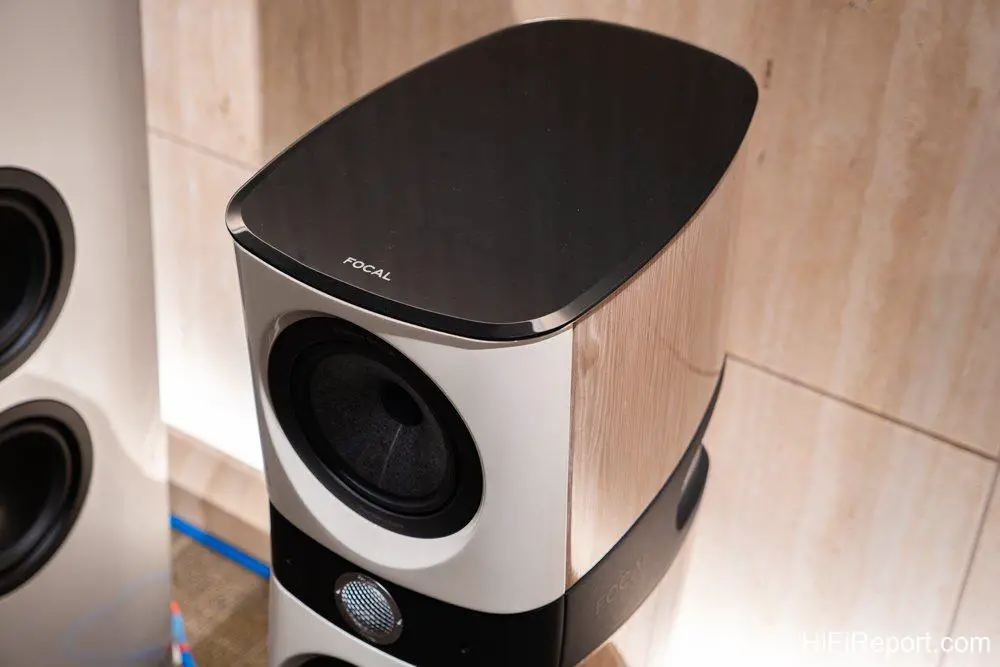
The Sopra cabinet uses a “Gamma Structure,” which provides high rigidity and damping.
The main cabinet material is MDF (Medium Density Fiberboard), but structural integrity is controlled through varying board thickness, reinforced design, and heavy-duty construction to prevent vibrational interference.
They also laminated thicker MDF baffles. This allows for the creation of curved cabinets, which helps prevent internal reflections and increases rigidity. Second, the thickened front baffle provides better support for the drivers.
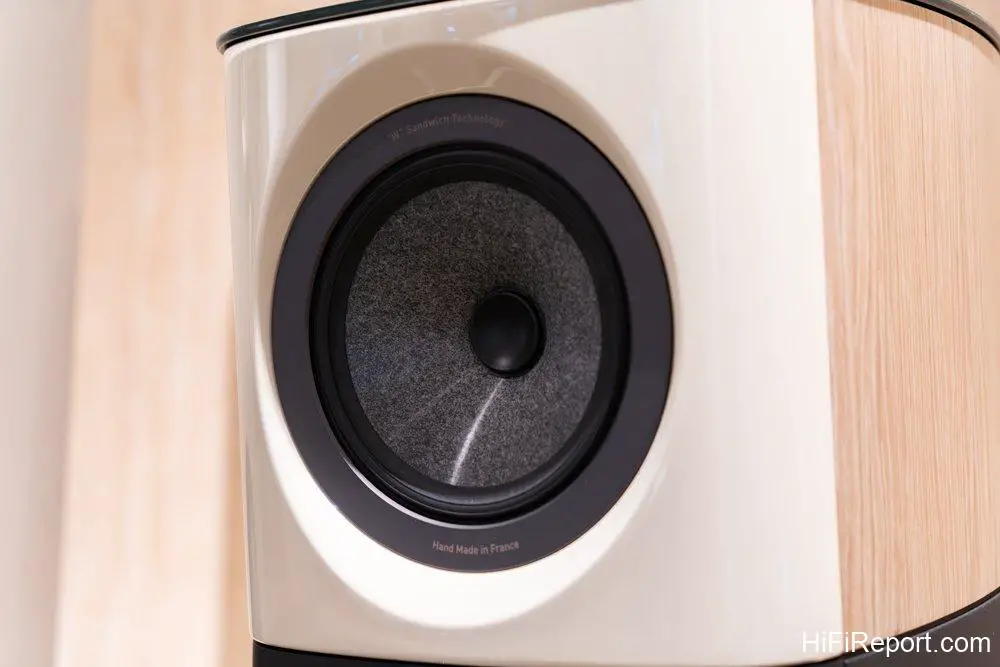
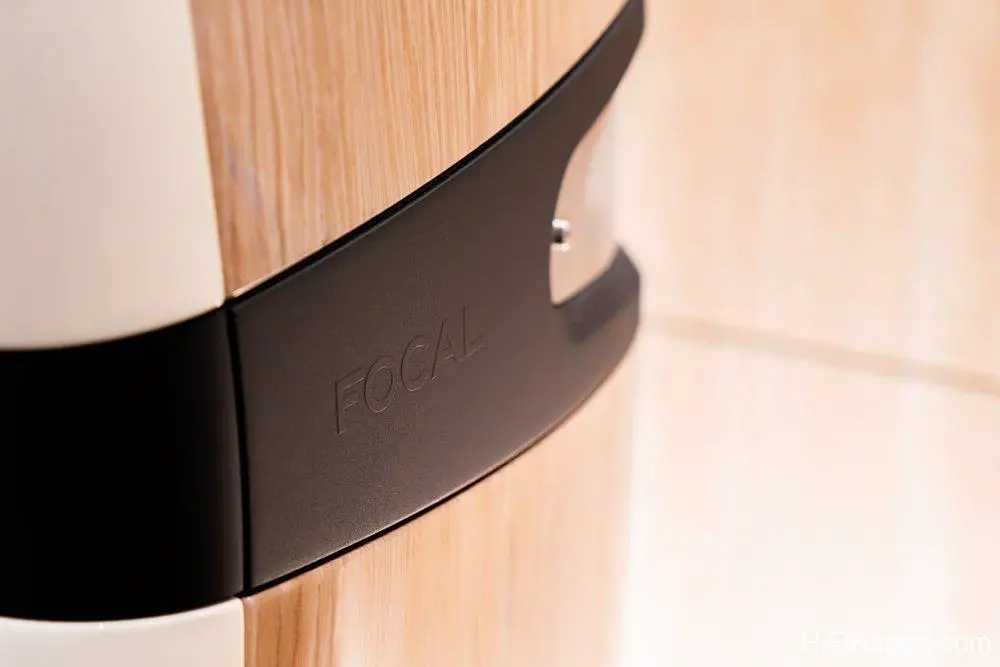
Naturally, being French, Focal doesn’t lag in aesthetics.
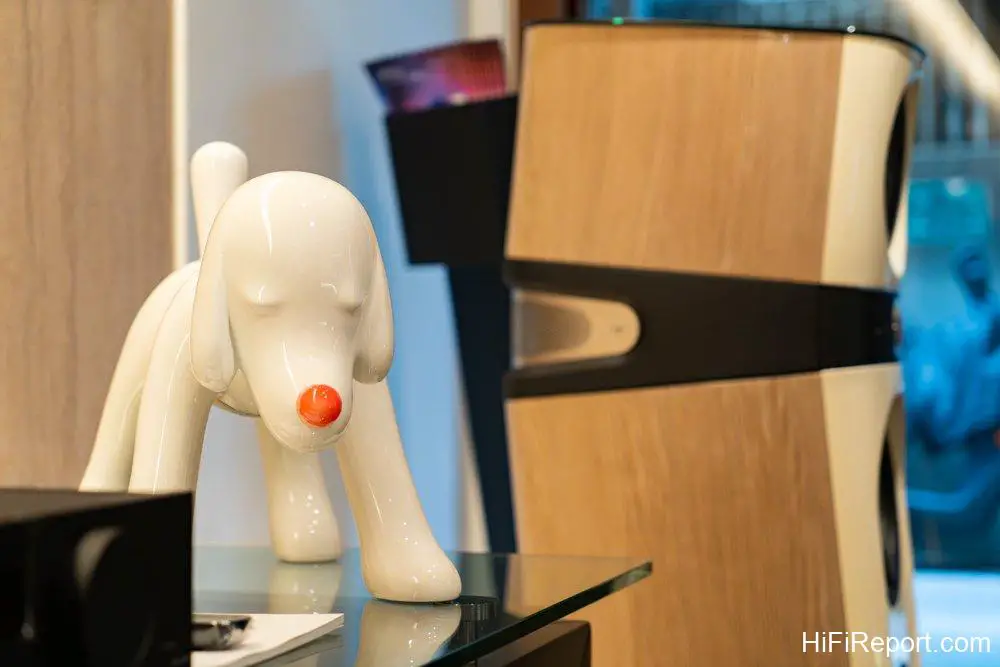
In addition to multi-layer exquisite lacquer finishes, they also offer versions combining real wood veneer, adding a touch of elegance and artistic flair to the Sopra speakers.
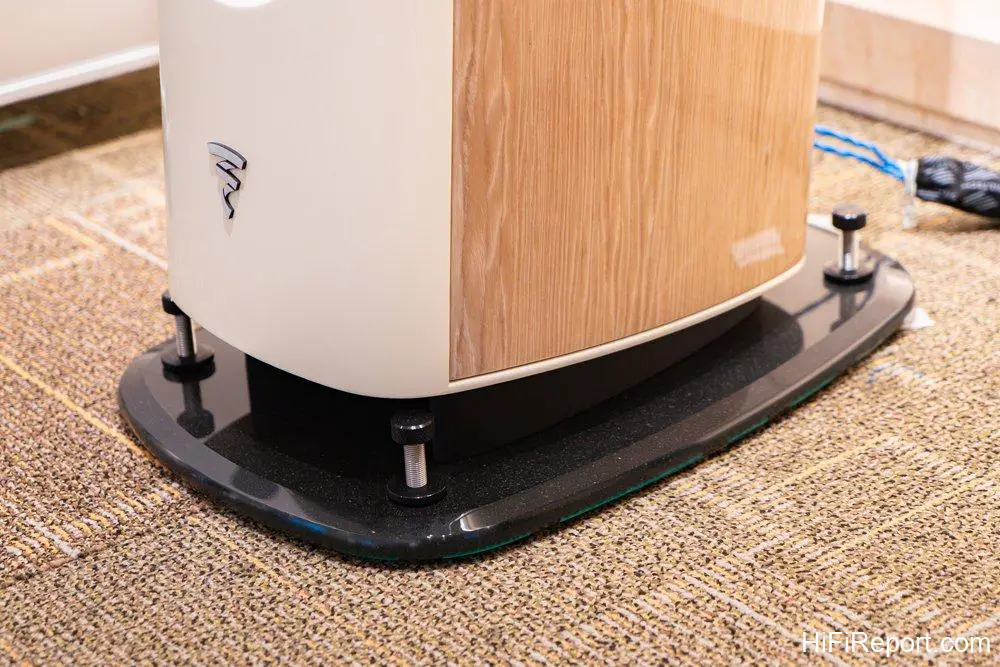
The top panel and base are made of tempered glass. The use of different materials helps to mitigate material resonance.
The spikes also feature a unique design, using robust threaded posts that can be adjusted manually to level the speaker.
It’s hard to believe these speakers were introduced in 2015; they still look like they embody High End audio genes in every aspect.
HiFiReport’s Setup: Perfect for Any Home
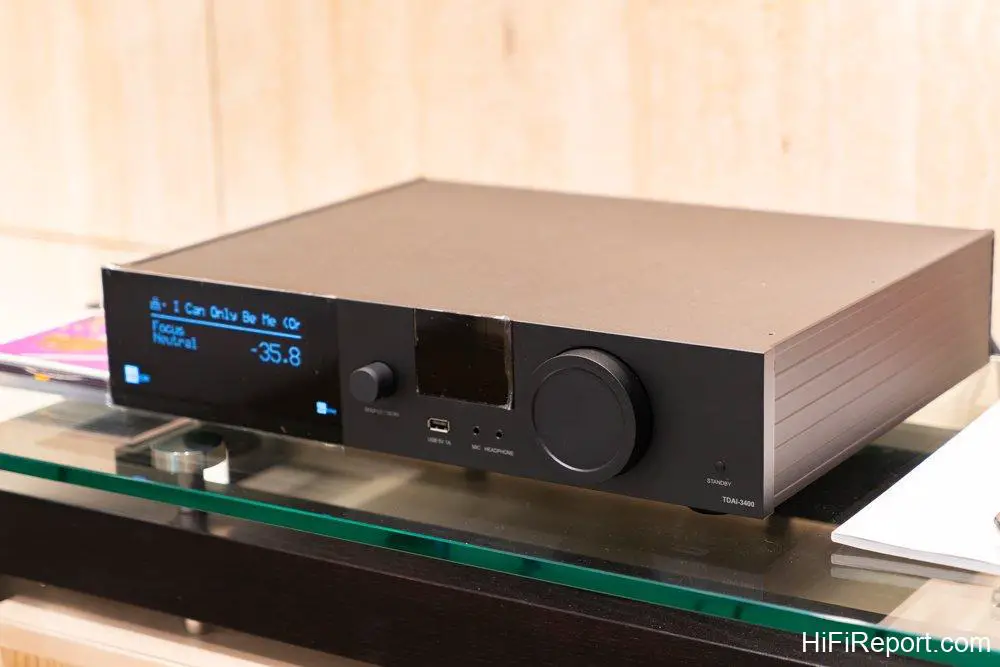
HiFiReport Audio’s demonstration setup was remarkably simple: just a Lyngdorf TDAI-3400 driving the Sopra No2, with no other components.
The Lyngdorf unit functions as an amplifier, a streaming player, and a DAC.
Naturally, using a Lyngdorf amplifier means utilizing Lyngdorf’s proudly acclaimed RoomPerfect room correction technology.
After applying RoomPerfect correction, these Sopra No2 speakers, even placed quite close to the wall, sounded as if they were pulled out into the room, delivering clean bass, distinct layering, and a three-dimensional soundstage.
Lyngdorf TDAI-3400: Power, Streaming, Room Correction
When the RoomPerfect correction was turned off, the bass initially sounded like there was more of it, but it was loose, shapeless, and lacked detail. The sound became blurred, and the music felt compressed together with hardly any layering.
Switching back to RoomPerfect (shown as ‘Focus’ mode in the app), the sound instantly opened up again. The layers reappeared, separation improved, the bass became clean, and the soundstage became sharp.
Although the TDAI-3400 has been out for a while, through successive firmware updates, the technology inside remains Lyngdorf’s latest, performing on par with later products. This is a piece of audio equipment that evolves and improves over time.
While not particularly large, the TDAI-3400 boasts powerful output: 400W into 4 ohms and 200W into 8 ohms.
The Sopra No2 has an impedance of 8 ohms, and the TDAI-3400’s 200W maximum output drives them effortlessly, like a 3000cc sedan cruising on the highway.
Even if the specifications aren’t overtly extravagant, the power is more than sufficient, leaving no cause for concern.
Creating a Grand Soundstage? Effortless.
Consider, for instance, the live recording of singer-songwriter Fink performing with the Royal Concertgebouw Orchestra.
Fink’s “indie” style music, combined with electronic hip-hop effects and the RCO’s orchestral accompaniment, creates a broad sense of space and adds tremendous power to the songs.
Listening to Fink singing in his characteristically calm, almost poetic or murmuring tone, accompanied by the orchestra’s fluctuating performance, the emotions within the music are anything but peaceful. That undercurrent of turbulence constantly stirs the listener’s heart.
The Sopra No2 lays out an expansive stage, easily separating and layering the orchestra. When a song ends, the excited shouts and applause from the audience further enhance the sense of a vibrant live performance.
I didn’t get to experience speakers from the JMLab era, but Focal speakers from the Focal era consistently offer excellent openness. Achieving a large soundstage is not difficult for them.
Lyngdorf, using Class D amplification, calls itself a digital amplifier. Does the label “digital” mean the sound will be overly analytical and the music boring to listen to? I don’t think so.
Driven by the TDAI-3400, the Sopra No2 not only delivers an expansive space but also presents clear, distinct musical layers, effortlessly recreating the live performance environment.
The concert included a modern classical piece, “The Infernal Machine.” Percussion plays a significant role in this piece, with unexpected musical developments at every turn, embarking on exploration after exploration between harmony and dissonance.
The Sopra No2 fully demonstrated its detail retrieval capabilities with this track. Listening to the subtle sounds, it felt as though there were sounds within sounds, with even more intricate texture revealed.
As long as the source provides the information, the Sopra No2 has the ability to reproduce it.
That Guitar Sound is Truly Powerful
Fink’s vocal style isn’t sufficient to describe the Sopra No2’s handling of vocals.
Let me offer two other album examples. The first is Dan Patlansky’s “Wooden Thoughts” album, specifically the track “Big Things Going Down.” The vocals, guitar, drums, and bass each tell their own story.
Dan Patlansky’s voice carries a slight rasp, a touch of rough texture, and a slightly restrained delivery – a full bluesy character.
As for the guitar, the acoustic steel strings are struck with power, offering a crisp texture, bright tone, and solid sound with clear lines.
Whenever I’ve encountered Focal speakers in the past, I’ve always wanted to listen to metal-string instruments like guitar, piano, and cymbals because they use metal dome tweeters.
Indeed, playing Dan Patlansky’s guitar on this track, Focal did not disappoint.
Accompanying the guitar at the beginning of the song are the bass and drums. The bass is full and robust, with solid, well-defined notes.
The drums are equally impactful, hitting with a solid strike and clear rhythm.
But the moment I turned off the TDAI-3400’s RoomPerfect, the drums and bass became loose, scattering into shapeless forms. The instant I switched back to “Focus” mode (RoomPerfect), that granular, impactful bass and drums, and even the crispness of the guitar, all returned.
Lively Vocals, Solid Imagery, Visible Texture, Conveyed Emotion
For another vocal example, I turned to opera.
I listened to the Warner Classics 2014 remastered collection of Callas arias, “Pure Maria Callas.”
This remastered version renders Callas’s voice not only rounded and warm but also retains all the details. It doesn’t compromise sound quality for the sake of preserving an analog warmth or trying to eliminate analog noise.
On the contrary, the liveliness of the voice sounds almost like a modern recording, not at all like a performance from over half a century ago.
Taking the aria “Casta Diva” from the opera “Norma” as an example, Callas’s voice was three-dimensional, with a palpable form. The solid and focused singing sculpted an image of Callas performing right in front of me.
The arpeggiated strings provided accompaniment in a fixed pattern, deepening the inherent dramatic tension of the song’s narrative.
The accompanying music is sacred and peaceful, yet the high priestess Norma’s heart is troubled and restless.
Next, I listened to the two arias Violetta sings in “La Traviata” after meeting Alfredo, reflecting her fluttering heart—”È strano! è strano!” and “Sempre libera.”
Here, Callas’s interpretation subtly and genuinely conveyed Violetta’s fluctuating, complex emotions.
Callas is hailed as the “La Divina” (The Divine One) for a reason. She simply possessed the ability to precisely grasp a character’s emotions and express them.
Although this is a mono recording, it doesn’t hinder the Sopra No2’s ability to portray a dramatic soprano voice.
When Callas sang high notes, her voice consistently maintained an effortless quality. The sound was rounded and possessed excellent weight, preserving excellent balance even at the peak of her vocal power.
The Sopra No2 uses a metal tweeter, and the Lyngdorf TDAI-3400 employs Class D amplification. Wouldn’t the sound be piercing, hard, or cold? No, not at all.
Versatile Tonal Palette, Rich and Natural Sound
The Sopra No2’s ability to reproduce tonal variations is genuinely excellent.
The combination of the midrange and beryllium tweeter is truly impressive. First, the dispersion is excellent. Second, the sound is refined and easy on the ears. Third, it delivers very clear tonal presentation.
As an example, consider Fausto Mesolella’s album “Madame Terra.”
This album features both acoustic and electric guitars.
The electric guitar, using effects pedals and a wah pedal, can produce a wide variety of tones.
When the Sopra No2 played Fausto Mesolello’s guitar performance, the music flowed smoothly, with clear lines. The acoustic guitar, with its body resonance, presented a rich sound, and the notes retained a healthy body, making the guitar playing sound exceptionally real and intimate.
Fully Expressing the Piano’s Rich Nuances
When playing the piano, the Sopra No2 exhibited the instrument’s multi-faceted richness with a full tone, abundant texture, and extended frequency response.
The piano produces sound by striking keys, which activate hammers at the back to strike the strings, causing them to vibrate.
Although a single key strike produces one note, it typically strikes three strings simultaneously. These three strings vibrate together, creating complex harmonics and causing adjacent strings to resonate. Coupled with the resonance of the piano body and soundboard, the piano generates extremely rich harmonics.
Furthermore, variations in playing force, speed, chords or single notes, and pedal usage can create even more diverse tonal changes.
This is the charm of the piano and the source of the fascination with piano music.
The Sopra No2’s reproduction of the piano’s fullness was excellent. Although the listed 33Hz low-frequency extension might not seem astonishing on paper, when the piano played in the bass register, the deep notes extending downwards were certainly sufficient – sufficient to convey the scale of a grand piano.
Using Danilo Rea’s album “Lirico” as an example, the second track is an aria from Saint-Saëns’s opera “Samson and Delilah,” titled “Mon coeur s’ouvre à ta voix” (“My heart opens to your voice”).
At the beginning of the piece, the pianist’s left hand repeatedly explored deeper octaves.
The bass chords sounded profound, and when the force increased, they took on a formidable weight. At the climax near the end of the piece, there was a deep descent into the bass, expressing a profound, rich emotion, direct and uninhibited.
As for the ascending high notes, they were both bright and ringing, while simultaneously maintaining a smooth, fluid texture.

Excellent, wasn’t it?
Orchestral Power and Dynamics
Listening to Reference Recordings’ album “Tutti,” one album alone can reveal multiple aspects of a system’s performance with orchestral music.
Take, for instance, the “Dance of the Tumblers” from Rimsky-Korsakov’s opera “The Snow Maiden.” It follows a standard ABA structure, but with lively orchestration, including a rich percussion section, making the short piece sound vibrant, brilliant, and energetic.
The piece begins with the quick, forceful opening by the low strings, followed by recurring sections that resemble a scherzo, one after another.
Listening to each repetition of the music here, there’s also accompanying detail in the background.
As the powerful and brisk main theme is played, the percussion not only adds brilliant color but also brings a sense of impact. When the resonant bass drum is struck, its weighty sound further elevates the listener’s emotions.
The Sopra No2 is quite adept at rendering the lively, exciting, complex, and brisk aspects of this piece. It can also convey the grandeur of the full orchestral passages and the heavy impact of the bass drum, making for a thrilling experience.
Another selection from the album is the second movement of Bruckner’s Symphony No. 9, although only an excerpt.
This scherzo movement also features repeated themes, but with variations within the repetitions, ensuring the full ensemble never sounds monotonous.
The back-and-forth interplay brings rich and varied musical changes. The occasional fortissimo passages are full of power, fierce and rapid.
Bruckner also employs his signature technique here: following an extremely loud passage, he suddenly inserts a pause, gathering the orchestra’s energy, before resuming with an extremely soft intensity.
Listening to this dynamic contrast, back and forth, presents a challenge for any audio system: can it reproduce impactful sound during the loud passages? And can it allow the listener to hear the soft, subtle details during the quiet passages? I listened, and I can say: “The Sopra No2 has no problem.”
Equally Adept with Finesse and Force
If audio systems could be categorized as “literary” or “martial” – “literary” being skilled at rendering slow pieces, meticulously sculpting tonal texture; “martial” excelling at showcasing quick-paced agility and the grandeur of large ensembles – then the Focal Sopra No2 is a pair of speakers capable of both.
Furthermore, if audio systems could be distinguished by “internal” or “external” focus – “internal” emphasizing outstanding specifications, characteristics, and deep technical foundation; “external” prioritizing the beauty and personality of product aesthetics and design – then the Sopra No2 is undeniably proficient in both.
I ask: with such a pair of speakers that is equally adept with finesse and force, and is proficient in both internal technology and external design, what more could one possibly find fault with?
Specifications
* **Type:** 3-way, 4-driver bass-reflex floorstanding loudspeaker
* **Drivers:** 1 x 1-inch IHL Beryllium inverted dome tweeter, 1 x 6.5-inch W-Cone sandwich cone midrange, 2 x 7-inch W-Cone bass drivers
* **Frequency Response (+/-3dB):** 34Hz – 40kHz
* **Sensitivity:** 91dB
* **Nominal Impedance:** 8 Ohms
* **Minimum Impedance:** 3.1 Ohms
* **Recommended Amplifier Power:** 40 – 300 Watts
* **Crossover Frequencies:** 250Hz, 2.2kHz
* **Dimensions (HxWxD):** 1190 x 358 x 540 mm (46.85 x 14.1 x 21.26 inches)
* **Weight:** 55 kg (121.25 lbs)