
Fosi Audio ZP3 Review
Overview
The Fosi Audio ZP3 is a mid-range balanced preamplifier that fills a genuine gap in the compact hi-fi market: a full-featured, multi-input control hub with XLR balanced connectivity, a dedicated subwoofer output, and professional-grade measured performance — all at a price that would have seemed impossible for this specification level just a few years ago. This is not a power amplifier; it does not drive speakers directly. Instead, the ZP3 sits between your audio sources and your power amplifier, acting as the conductor of your system — selecting inputs, controlling volume, shaping tone, and routing audio to the right destinations.
For context, most compact preamps in this price segment offer either balanced XLR connections or multiple RCA inputs — rarely both, and almost never with a subwoofer output thrown in as well. The ZP3 includes all three, plus a 12V trigger system for synchronized power control, per-input volume memory, tone controls with a Bypass mode, a three-position High-Pass Filter, and op-amp rolling support for enthusiasts who want to tune the sound character. Fosi developed this product in direct response to community requests on audio forums — a detail that explains why the feature set feels so practical and thoughtfully assembled.
Measured performance figures confirm that the ZP3 is not just a capable-looking product on paper. With a noise floor below 6 microvolts on the balanced output and THD+N below 0.0007%, verified by independent professional review, the ZP3 competes with preamps costing three to five times as much by the only metric that ultimately matters in a preamp: how cleanly it passes music without leaving its own fingerprints on the signal. It is, by any objective measure, a remarkable piece of equipment for the money.
This review covers who the ZP3 is for, how its key technologies work, what real-world use is actually like — including some meaningful usability quirks that prospective buyers should understand before purchasing.
Key Features & Tech Specs Explained
Balanced XLR Architecture: Why the Signal Path Matters
The ZP3’s defining feature is its fully balanced internal circuit design. To understand why this matters, it helps to understand what a balanced audio connection actually does. A standard RCA cable carries audio as a single electrical signal on the center conductor, referenced against ground on the shield. Any interference picked up along the cable — from power supplies, Wi-Fi, motors, or other electronics nearby — rides into your amplifier along with the music. A balanced XLR connection works differently: it carries the same audio signal on two separate conductors simultaneously, but one copy is inverted in polarity. At the receiving end, the device flips the inverted copy back to normal and adds the two together. Since any interference that entered the cable affects both copies equally, it cancels out completely when the copies are combined. The audio signal, which was opposite on the two conductors to begin with, doubles in strength instead.
The practical result is a connection that is dramatically more resistant to outside electrical interference, delivers approximately 6 dB more signal level, and eliminates the ground-loop hum that afflicts many single-ended systems. The ZP3’s proprietary balanced amplification architecture extends this philosophy inside the unit — it is not just balanced at the connectors but maintains a differential signal path internally. Independent listening tests confirmed that the ZP3 delivers noticeably expanded soundstage width and depth when both source and amplifier are connected via XLR, compared to the same components using RCA. One professional reviewer described the spatial presentation as the best they had experienced with their reference system.
Measured Performance: What the Numbers Actually Mean
The ZP3’s independently verified measurements place it in rarified territory for a device at this price point. THD+N (total harmonic distortion plus noise) below 0.0007% — confirmed by a professional reviewer using real test equipment — means the distortion products are roughly 103 dB quieter than the signal itself. Humans generally cannot detect distortion below 0.1%, so 0.0007% represents a margin of safety that is many times greater than human perception requires. A noise floor below 6 microvolts on the balanced output translates to an SNR well above 112 dB — quieter than the background noise of a dedicated audio recording studio. In practice, professional reviewers pressing their ear against connected speakers at idle reported hearing nothing at all.
The frequency response specification of ±0.2 dB from 20 Hz to 20 kHz means the ZP3 adds no audible tonal coloration whatsoever across the entire audible range. Every frequency you send into it comes out at exactly the same relative level. This is the defining characteristic of a transparent preamplifier — one that reveals the quality of the components upstream and downstream of it, rather than imposing its own character.
The NJU72315 Volume IC: Digital Control, Analog Signal Path
The ZP3 uses the NJR NJU72315 as its volume control chip — an integrated circuit that handles volume steps in the digital domain while the actual audio signal remains fully analog throughout. This approach, combined with Omron relays for source switching, eliminates the mechanical wear and channel-tracking errors that affect traditional potentiometers over time. Every volume step is perfectly matched between left and right channels, and the per-input volume memory (the ZP3 independently remembers the last volume level used for each of the three inputs) means you never have to compensate for level differences when switching sources. Users who switch frequently between a DAC and a CD transport — which may output at different reference levels — will particularly appreciate this convenience.
A note on the bass and treble controls: the bass control ranges ±12 dB, while the treble ranges ±6 dB — a deliberately asymmetric choice that gives greater flexibility for bass shaping (often more needed) while keeping treble adjustments more subtle to prevent harshness. The Bypass switch disengages both tone controls entirely for a pure signal path, and reviewers consistently recommend leaving it engaged for critical listening.
Op-Amp Rolling: Personalizing the Sound
The NE5532 op-amps inside the ZP3 are mounted in DIP8 sockets rather than soldered directly to the circuit board. This is a deliberate design choice — it means any technically inclined user can remove them with tweezers and replace them with alternative op-amps to subtly alter the sound character. The NE5532 is an industry-standard choice with excellent performance, well-regarded by audio engineers worldwide. Users who want a warmer, more romantic presentation can experiment with alternatives like the LME49720 (which one professional reviewer received as a factory-installed variant) or more exotic options like the OPA627 or Sparkos SS3602. This customizability is rare at this price point and gives the ZP3 unusual long-term flexibility for audiophile enthusiasts.
Three-Way HPF + Subwoofer Output: System Integration Done Thoughtfully
The High-Pass Filter (HPF) is a three-position switch on the bottom panel of the ZP3, offering crossover points at 20 Hz (effectively full-range), 80 Hz, and 120 Hz. When a cutoff is selected, the ZP3 filters those lower frequencies out of the RCA and XLR main outputs and redirects them to the dedicated Sub-Out RCA jack, which carries a 20–200 Hz low-frequency signal for a connected subwoofer. The logic is the same as the HPF feature in power amplifiers: letting your bookshelf speakers operate above their bass extension limit while the subwoofer handles the low end, which improves both midrange clarity in the main speakers and bass authority from the sub. The sub output is a fixed 20–200 Hz signal — one reviewer noted that its implementation worked reliably when tested by ear, with clean frequency routing at each HPF setting. Prospective users should be aware that the HPF switch is physically located on the bottom panel, which requires lifting the unit to adjust — a minor ergonomic trade-off for a control most users will set once and leave alone.
Build Quality & Design
The ZP3 is noticeably larger than most of Fosi’s compact amplifier products, measuring 239 mm wide, 164 mm deep, and 54 mm tall — wider and shallower than the ZD3/ZA3 siblings, with a distinct aesthetic that reviewers have noted sits slightly apart from the unified design language of the Z-series. The chassis is full aluminum, low-profile, with rounded edges and an internal power supply — no external brick to manage. The signature orange-copper volume knob is retained from other Fosi products, giving the front panel a visual anchor point. Four smaller knobs handle bass, treble, and balance controls. A single multi-function button on the front left serves as both power switch and input selector, cycling through RCA1, RCA2, and XLR inputs with small LEDs indicating the active source.
Internally, the component choices reflect genuine attention to quality. Elna capacitors, Omron relays, and gold-plated RCA jacks are visible in product documentation — all choices consistent with premium home audio equipment. Professional reviewers examining the build praised the component selection as top-notch and described the overall assembly as rigorous. One reviewer noted that the rear panel connectors are somewhat closely spaced, which can make cable routing fiddly in real-world installations, particularly for users managing multiple sources simultaneously.
The power supply uses an IEC C5 connector — the same three-pin style found on laptop power adapters — rather than the standard IEC C13 socket used on most home audio components. This means standard aftermarket hi-fi power cables cannot be used without an adapter, which limits the upgrade path for users who prioritize power cable quality. The included power cable is short, which a number of forum users noted as a practical inconvenience. These are real trade-offs, and buyers should factor them in. The included accessories are: the ZP3 itself, a power cable, an IR remote control, a 12V trigger cable, and a user manual. No RCA or XLR cables are included.
Sound / Performance
The ZP3’s sound character is best described as neutral, transparent, and analytical — a preamplifier that gets out of the way of the music rather than adding its own personality. A professional audio reviewer who tested it at the front of a fully balanced system (from phono cartridge through to power amplifiers, all via XLR) described the soundstage as the widest and deepest they had heard in their reference setup — an exceptional compliment. Instrument separation was described as precise and easy to follow, with vocals carrying natural timbre and recording effects clearly audible. The noise floor in this configuration was effectively zero — the only audible noise came from the downstream power amplifiers themselves.
The character tends toward the open and airy side of neutral, with dry, controlled bass and highs that have some prominence — particularly visible with bright-sounding sources. A specialist reviewer noted that the ZP3 performs best when paired with warm-sounding sources and speakers that are not already bright-leaning; in such pairings, the combination is described as genuinely excellent. With an inherently analytical DAC or bright bookshelf speakers, the ZP3’s honest presentation can become fatiguing during long listening sessions. This is not a flaw in the traditional sense — it is the natural consequence of a very accurate, very transparent preamplifier; it reveals what is upstream of it with high fidelity, which means the quality of your source and speakers matters more here than with a more forgiving, colored preamp.
Multiple forum reviewers and community members who tested the ZP3 across digital sources — CD transports, streamers, DACs — consistently described the sound as detailed, airy, and spatially expansive, with excellent dynamic reproduction. One user who tested it at idle with connected speakers reported hearing absolutely nothing — no hum, no hiss, no noise of any kind. This practical silence at idle is a meaningful real-world indicator of the product’s measured noise performance. Users pairing the ZP3 with the Fosi V3 Mono power amplifiers via balanced XLR, specifically, reported results they described as genuinely thrilling.
Real-World Use Cases
The ZP3’s sweet spot is as the control center of a dedicated home hi-fi system built around a power amplifier and passive speakers. If you own a quality DAC that outputs balanced XLR, a power amplifier with XLR inputs, and one or two additional RCA audio sources (a CD transport, a streaming device, a turntable with phono pre-amp), the ZP3 connects all of them in one place and manages volume and input switching with a remote from across the room. The 12V trigger input and output mean the ZP3 can power the entire system on and off in sequence — connect it to a compatible DAC via trigger, and the entire chain wakes together with a single button press. For users building a Fosi ecosystem around the ZD3 DAC and ZA3 power amplifier, the ZP3 closes the loop as the missing volume-control hub, with the remote managing all three devices simultaneously.
The ZP3 is also an excellent companion for desktop audiophile setups where the user has graduated beyond a simple DAC-to-amplifier chain. Users who have both active powered monitors and a passive subwoofer will benefit from the concurrent RCA and XLR outputs — the two outputs work simultaneously, so connecting the XLR to a power amplifier and the RCA to a sub simultaneously is straightforward. The per-input volume memory makes switching between a work computer audio source and an audiophile-grade DAC for evening listening seamless — the ZP3 returns to your preferred volume level for each source automatically.
Where the ZP3 is less suited: users who do not already own a separate power amplifier will need to add one (the ZP3 is a preamp only and cannot drive speakers directly). Users who need optical or USB digital inputs should look at an integrated DAC-preamp instead. And users who frequently switch between sources at very different volume levels — particularly mixing RCA and XLR sources — should be aware that there is a level mismatch between the RCA and XLR outputs that requires careful gain management, particularly at high-volume settings. This is the ZP3’s most significant real-world usability limitation and is noted consistently across independent reviews.
What Real Users Are Saying
Across enthusiast forums, the Fosi community platform, and professional review outlets, the ZP3 has generated a strong consensus on its core strengths. The quality and extent of the soundstage when used in a fully balanced system is the single most frequently praised characteristic — reviewers and community users alike describe a three-dimensional, precise sound image that is meaningfully better than what they achieved with their previous preamps. Multiple users describe placing their ear against the speaker grille at idle and hearing complete silence — zero hiss, zero hum — which made a strong impression as a real-world indicator of the ZP3’s measured noise performance. The remote control, volume memory, and overall system integration experience within the Fosi ecosystem are consistently highlighted as high-value practical features.
The ZP3’s ability to open up systems that users were already happy with is a recurring theme in community feedback. Reviewers describe replacing their existing preamps as an experiment and being surprised to find their friends commenting on what had “improved” in the system without being told anything had changed. One professional reviewer who tested it against their reference Jeff Rowland preamplifier described specific aspects of the ZP3’s reproduction as simply spectacular. Users pairing the ZP3 with non-Fosi power amplifiers — particularly ZeroZone and NuPrime designs — report especially favorable results, noting that the combination produces a listening experience well above what either component’s individual price would suggest.
Community users who are enthusiastic about op-amp rolling note that the NE5532 / LME49720 stock configuration is already respectable, and that upgrading to premium aftermarket op-amps such as the OPA627 or Sparkos alternatives takes the ZP3 to a meaningfully higher level of performance — a popular and well-documented modification for technically curious users. The subwoofer output and three-position HPF are consistently praised as rare and practical additions to a preamp in this category, with users who own subwoofers specifically citing the HPF as one of the features that sealed their purchase decision.
The consistent feedback from more technically demanding reviewers is balanced by an important caveat: the ZP3 is a product of brilliant potential with some real usability rough edges that Fosi has not yet smoothed out. The absence of any volume level indicator, the output level mismatch between XLR and RCA outputs, and the bottom-panel placement of the HPF switch are the three most frequently cited friction points. Users who can manage around these constraints — by setting a consistent volume reference or using the product in a simpler, dedicated setup — report overwhelmingly positive long-term experiences.
Pros & Cons
Pros
- Exceptional measured performance confirmed by independent testing: THD+N ≤ 0.0007% and SNR ≥ 112 dB place the ZP3 in reference-grade territory for a preamp at this price point, with a noise floor so low reviewers reported absolute silence at idle (based on third-party measurements)
- Fully balanced XLR architecture — inputs and outputs — provides measurably superior noise rejection and expanded soundstage compared to single-ended RCA-only alternatives; simultaneous RCA and XLR output supports multiple downstream connections at once (based on third-party evaluation and spec analysis)
- Per-input volume memory independently stores volume levels for each of the three inputs (RCA1, RCA2, XLR), eliminating the need for manual re-adjustment when switching between sources with different output levels (based on spec analysis and user feedback)
- Op-amp sockets (DIP8) allow user-replaceable NE5532 op-amps to be swapped for alternative options, giving technically inclined users a documented pathway to customize the sound character without modification (based on spec analysis and third-party evaluation)
- Three-position HPF (20 Hz / 80 Hz / 120 Hz) plus a dedicated sub output (20–200 Hz) enables proper subwoofer integration and main-speaker bass offloading, a feature set rare in preamps at this price tier (based on spec analysis and user feedback)
- 12V trigger input and output enable full-system synchronized power on/off with compatible components, plus a remote control that operates multiple Fosi devices simultaneously (based on spec analysis)
Cons
- No volume level display or indicator of any kind — the volume position is not shown numerically or visually, which requires careful manual management when switching inputs at different reference levels to avoid sudden loudness jumps that could damage speakers (based on third-party evaluation and user feedback)
- The XLR balanced output level is significantly lower than the RCA output level, creating a mismatch that requires gain compensation when using both outputs simultaneously — for example, running XLR to a power amplifier and RCA to a subwoofer at the same time (based on third-party evaluation)
- The HPF and Bypass switches are located on the bottom panel, requiring the unit to be lifted for adjustment — inconvenient for users who may want to change the HPF setting frequently depending on content (based on third-party evaluation and user feedback)
- The power input uses a non-standard IEC C5 connector (laptop-style three-pin), which prevents the use of standard aftermarket hi-fi power cables without an adapter; the included power cable is also short (based on third-party evaluation and user feedback)
Who Should Buy This?
The ZP3 is the right choice for the dedicated hi-fi listener who already owns — or plans to own — a separate power amplifier and wants a sophisticated, fully balanced control hub at the center of their system. This means users who have a quality DAC with XLR outputs, a power amplifier with XLR inputs, and one or more additional analog sources they want to connect cleanly and switch between with a remote. It is also the natural centerpiece of a Fosi Z-series ecosystem: users building around the ZD3 DAC and ZA3 or V3 power amplifier will find that the ZP3 closes the system into a coherent, remote-controlled whole with trigger-synchronized power management. For this type of user — methodical, component-focused, and comfortable with a modest learning curve — the ZP3 is difficult to beat at anything close to this price.
Enthusiasts who enjoy tweaking and experimentation will find the op-amp rolling support a compelling long-term feature. The ZP3’s sonic character rewards matching with warm-sounding power amplifiers and speakers rather than already-bright-leaning systems. If you listen predominantly to classical, jazz, acoustic, or well-recorded studio music through a revealing balanced chain, the ZP3’s transparency will serve you very well. Users who have a subwoofer as part of their system and need a clean, multi-frequency-switchable HPF will find the ZP3’s implementation particularly useful — this feature is largely absent from competing preamps in the same price segment.
Users who may want to consider alternatives include those who frequently switch between multiple sources across RCA and XLR with different reference levels, where the output level mismatch and absence of a volume display requires careful management. For users who need this kind of multi-source flexibility with simpler volume management, a DAC/preamp combination with a built-in display — such as the SMSL SU-10 or the Fosi ZH3 used in preamp mode — may offer a more convenient daily experience. Users who need digital inputs (optical, coaxial, USB) should look at an integrated DAC-preamp rather than the ZP3, which is a purely analog device.
Verdict
Score: 8.7 / 10 — Sound: 50% | Build: 20% | Features: 20% | Value: 10%
The Fosi Audio ZP3 is, by its measured performance, one of the most transparent and technically accomplished preamplifiers available at this price point — and it is a product that has genuinely excited the audiophile community that asked for it and now lives with it. The balanced XLR architecture, the measured noise floor that rivals professional studio equipment, the thoughtful feature set including HPF, Bypass, op-amp rolling, 12V trigger, and per-input volume memory — these are not aspirational marketing checkboxes. They are real, functional attributes that work as specified and that reviewers across multiple outlets have verified with test equipment and listening sessions.
Recommended — with the important caveat that buyers should go in with clear eyes about the usability quirks. The lack of a volume display and the XLR/RCA output level mismatch are real friction points that require careful attention, particularly in complex multi-source setups. For the right user — a patient, system-minded listener who values measured performance above all and has the time to set the ZP3 up thoughtfully — it is genuinely a product that can make an entire system sound better than the sum of its parts. Those who have taken the time to dial it in correctly are, almost without exception, delighted.
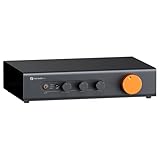
- Home Audio Control Hub: Features 3-in-3-out options for connecting up to three audio sources. Includes a remote control for one-touch input switching and volume adjustment—making it easy to manage your home audio system with freedom
- Versatile Connectivity: Equipped with RCA1/RCA2/XLR inputs and RCA/XLR/Sub-Out outputs, the ZP3 integrates multiple devices with ease. Supports balanced XLR in/out for cleaner sound, plus RCA/XLR signal conversion for maximum compatibility
- Audiophile-Grade Components: Built with premium parts including ELNA capacitors, relays, NJR NJU72315 volume IC, and gold-plated RCA jacks. These components reduce noise and distortion, delivering exceptional clarity and high-fidelity performance