
Furutech NCF Booster-Brace Power Socket Stabilizer Review
During an editorial meeting, this product was assigned to me for review. Initially, I was quite reluctant. However, after reluctantly putting it to the test, I must thank the editorial team for this arrangement.
This listening experience broadened my horizons and taught me a valuable lesson.
What exactly is it? The answer is the NCF Booster-Brace, a power socket stabilizer from Furutech.
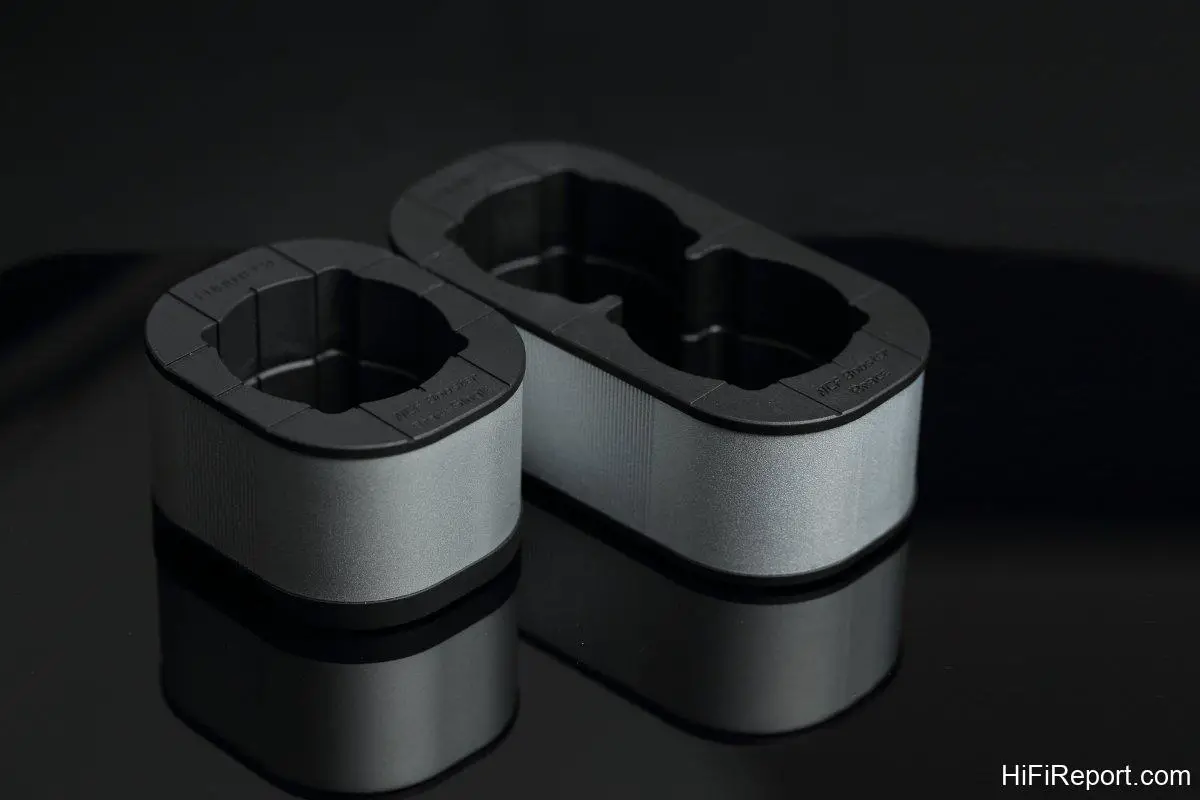
As the name suggests, this product is designed to be attached to a power strip. Its purpose is to prevent power cords from tilting due to gravity when inserted into sockets, thereby maintaining optimal contact.
Is this really necessary? If you value the performance of your audio system, then every little detail matters. If your system is of a certain caliber, even minor adjustments can result in audible sonic improvements.
Actually, similar products have been on the market before; Furutech is not the first to create such a device. However, the Furutech NCF Booster-Brace is different from the rest. Most other similar products are machined from aluminum alloy, aiming to stabilize the power plug. Claims of shielding effects in their marketing materials are questionable.
NCF Nano Crystal² Formula
Furutech’s approach is different.
The “NCF” in NCF Booster-Brace stands for Nano Crystal² Formula. Furutech developed this special nano-crystalline formula several years ago. By incorporating crystalline materials with a specific formula, it possesses two active properties: generating negative ions and converting thermal energy into far-infrared radiation.
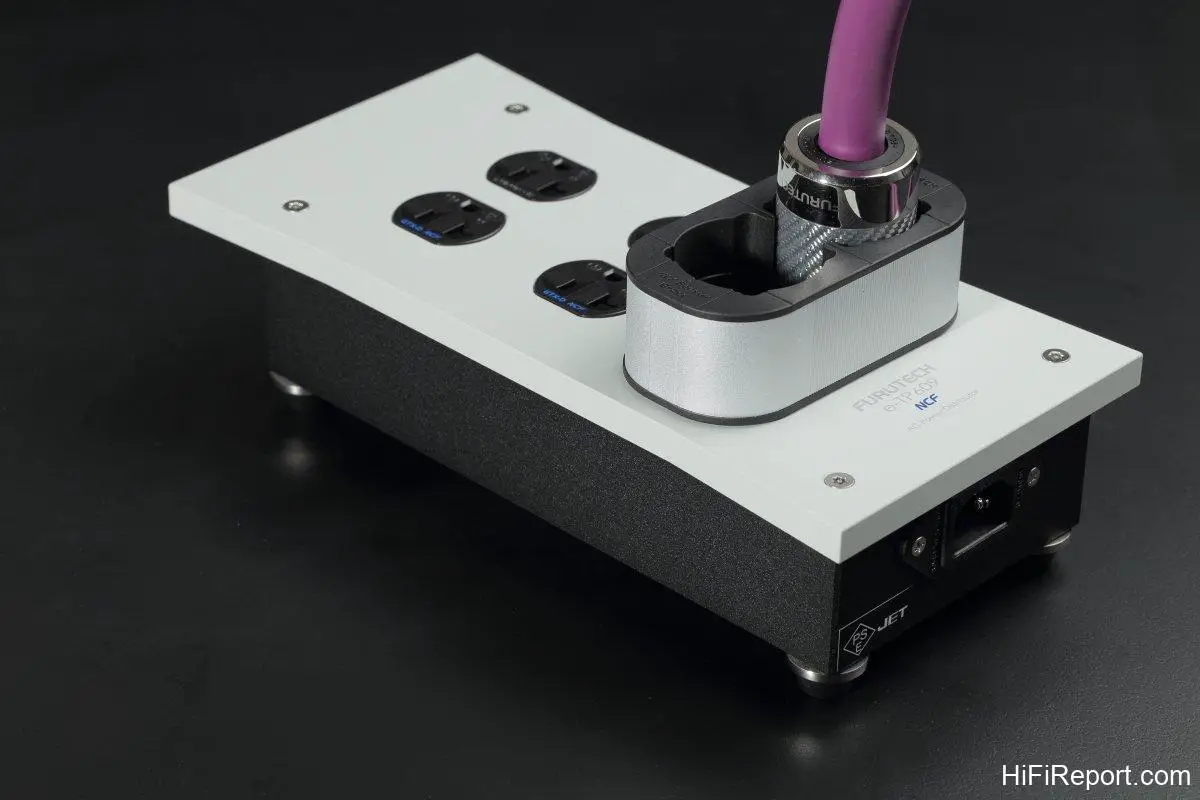
After developing this NCF formula, Furutech has extensively applied it to their products. They further developed the NCF Booster cable holder, utilizing a modular design to broaden its applications. The NCF Booster-Brace is an extension of this technology and application.
Composite Materials and Vibration Damping Structure
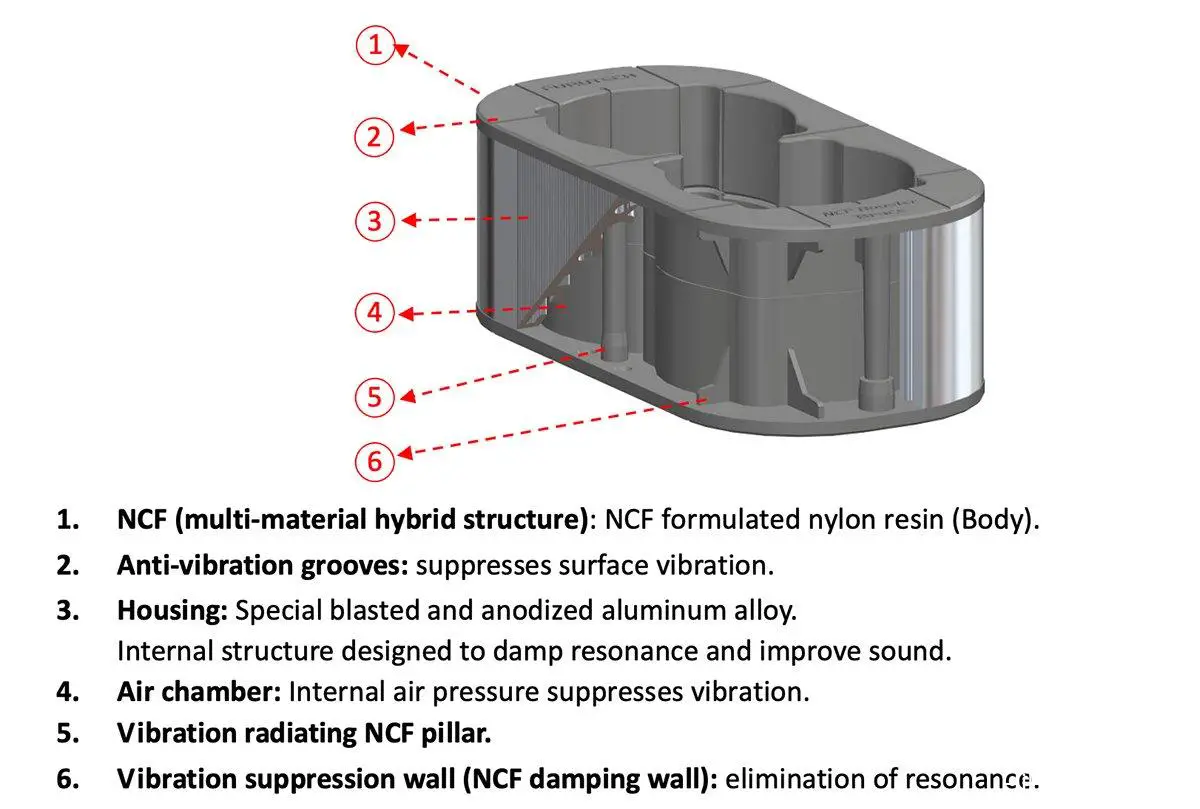
Examining the 3D structural diagram on the manufacturer’s website reveals more about the unseen aspects of the NCF Booster-Brace.
Firstly, it is constructed from composite materials. The outer layer is made of anodized aluminum alloy, while the inner body is composed of nylon resin material infused with NCF.
Secondly, to dampen vibrations, the interior features a hollow cavity. This air gap acts as a damping medium. Furthermore, the grooved patterns on the upper and lower surfaces, along with internal vibration-conducting pillars, contribute to vibration suppression.
In short, the Furutech NCF Booster-Brace achieves its objectives through a triple approach: the special NCF crystalline formula, the application of composite materials, and a unique vibration damping structure.
Undeniable System Enhancement
What is their objective? To improve the sound, of course. Is it really possible? Don’t just doubt it, I was skeptical too.
After trying it out, I was still somewhat puzzled, but one thing was certain: the haziness in my system had dissipated. The effect was genuinely noticeable.
Simply adding an NCF Booster-Brace to my power strip immediately cleaned up the sound, clarified the layers, sharpened the outlines, and brought out more details. The three-dimensionality of the soundstage also became more pronounced.
The improvement was particularly evident in the low frequencies. With the NCF Booster-Brace in place, the bass in jazz music sounded more agile and taut, with improved definition.
Brighter, Clearer, More Transparent, More Visually Engaging
For example, when listening to Diana Krall’s “Love Scenes” album, the bass in the first track, “All or Nothing at All,” exhibited a more rounded and distinct texture. In comparison, without the NCF Booster-Brace, the bass notes sounded slightly looser and muddier.
Diana Krall’s vocals also gained sharper contours, and the nuances of her articulation became more pronounced. Similar improvements were observed with Holly Cole’s “Don’t Smoke in Bed” album, which contains even more sibilance than Diana Krall’s recordings. The NCF Booster-Brace further accentuated these fine details.
Overall, the brightness and transparency of the music improved, making the listening experience more visually engaging. When playing orchestral music, this effect made the sections of the orchestra more clearly differentiated, and woodwind solos became more distinct and three-dimensional.
Taking the Beethoven’s Fifth Symphony conducted by Carlos Kleiber with the Vienna Philharmonic as an example, with the NCF Booster-Brace, the powerful and energetic bowing of the strings in the first movement had more impact and brilliance. The positions of the woodwinds became more clearly identifiable. The timpani, in particular, stood out, with clearer drum strikes and impact. The music became more vibrant and assertive.
As for the reasons behind these improvements, I cannot offer a definitive explanation. The manufacturer’s claims, as mentioned earlier, point to vibration suppression and the effects of negative ions and far-infrared radiation released by the NCF. I won’t speculate; I’m simply reporting that the NCF Booster-Brace, which I initially hesitated to try due to skepticism about its effectiveness, delivered truly significant results.
Even Better Results in Your Own System
However, since this was a review unit, the complete stabilizer set had to be returned. Therefore, I only placed the NCF Booster-Brace on top of the power strip during my evaluation. The correct way to use it is to adhere the NCF Booster-Brace to the socket to achieve 100% effectiveness.
To ensure precise placement, the manufacturer includes alignment pins and a template. During installation, insert the alignment pin into the ground pin hole of the socket, then place the template over it. Align the NCF Booster-Brace, after removing the 3M adhesive backing, and stick it onto the socket. Finally, remove the template and alignment pin to complete the installation.
Because it is affixed to the socket with adhesive, it can be used on both horizontal power strips and vertical wall sockets. Moreover, if you install it on your own sockets at home, the effect will undoubtedly be even better than what I experienced during this review.
How Seriously Do You Take Your System?
I’ve been brewing coffee for over 20 years. Friends who visit my home always request a cup of my coffee. According to them, drinking a cup of my coffee is like saving at least $200 NTD, as it’s comparable to specialty coffee from a café, which would cost at least that much.
I wouldn’t call myself an expert, but I am very particular about every cup of coffee I make. Whether using a pour-over, a siphon, or a moka pot, I have my own methods and procedures. What I’ve learned from coffee is that the more seriously I treat each cup, the more each gram of coffee rewards me.
Similarly, my experience with the NCF Booster-Brace reaffirmed this attitude. Does a power socket really need reinforcement? Does it need a stabilizer? Can adding such a stabilizer actually affect the sound? Like you, before using it, I was not only doubtful but even internally resistant.
However, after actually using it, I realized that Furutech’s efforts, and the development of products like the NCF Booster-Brace, are precisely for those who are willing to approach their audio systems with the utmost rigor. Just like my coffee, the more seriously we treat them – whether coffee or audio systems – the more they will reward us in return.
Specifications
* Type: Power Socket Stabilizer
* Dimensions: 54 x 106 x 35 mm (W x L x H)
* Weight: Approximately 100g