
German Physiks Emperor Review
Before diving into the core content, indulge me in a little musing.
During World War II, the German Tiger tank swept across the battlefield, repeatedly inflicting heavy damage on the Allied forces.
Its thick, heavy armor provided formidable protection.
And manufacturer Henschel took no shortcuts, eschewing the angled hull armor that would facilitate shell deflection; defense was purely about brute strength.
Unless attacked at close range with armor-piercing rounds, at any distance, it was nearly impossible to penetrate its defenses head-on.
The Tiger tank was equipped with an astonishing 88mm caliber cannon, capable of powerful anti-tank and bunker-busting capabilities.
The most famous incident occurred during the Battle of Kursk, where a single Tiger tank successfully held off approximately 50 Soviet T-34 tanks, destroying nearly half of the enemy force. This stands as the Tiger’s most dazzling achievement.

The Tiger tank’s service life wasn’t long, lasting less than three years during the latter part of WWII.
But its fearsome reputation precedes it; even those who aren’t military enthusiasts but enjoy movies or games have likely heard of it.
Why bring up the Tiger tank? Simply because of one phrase: Built like a tank.
I believe anyone seeing German Physiks’ Emperor preamp (and indeed, their entire Emperor series is built this way, the power amps even more so) will immediately think of this phrase.
History and the DDD Driver
German Physiks was founded in 1992, and as the name suggests, it’s a German company.
Founder Holger Mueller is himself an engineer passionate about audio. Prior to this, he owned a company called Mainhattan Acustik, specializing in producing loudspeakers and drivers.

Mueller owned a pair of Ohm-F speakers utilizing the Walsh omnidirectional driver and was fascinated by the room-filling soundstage created by 360-degree radiating speakers.
However, he didn’t possess the technology for this type of speaker himself; the speakers produced by Mainhattan Acustik still used traditional drivers.
The situation changed when he met another engineer, Peter Dicks.
Peter Dicks had spent several years researching how speaker drivers work.
Although not from an acoustics engineering background, Dicks was enthusiastic about studying the principles of converting electrical energy into sound energy in drivers.
Through mathematical calculations and engineering drawings, he designed a prototype for an omnidirectional driver.
However, Dicks searched nearly every driver manufacturer in Northern Europe, but no one was interested in his development.
Some audiophiles who had heard his prototype expressed affirmation for Dicks’ invention and suggested he try Mainhattan Acustik.
And so, the talented but unrecognized Peter Dicks finally found his patron in life—Holger Mueller.
Mueller was highly impressed with the DDD driver designed by Dicks, believing it outperformed the Walsh driver and had infinite future potential.
He simply established another company to realize Peter Dicks’ design; this new company was German Physiks.
For many years, German Physiks has been renowned for their omnidirectional speakers featuring the DDD driver.
Speakers of this type are rare on the market, and German Physiks has firmly established itself in this niche.
It wasn’t until 2018 that German Physiks stepped outside the “speaker circle,” introducing their preamplifiers, power amplifiers, integrated amplifiers, and cables. There were even stereo and monoblock power amp options, becoming a hot topic that year.
Built Like a Tank
These German Physiks electronic components are each built like tanks.
When it comes to being “tank-like,” the power amplifiers truly stand out.
The Emperor stereo and monoblock power amplifiers are officially listed at 72 kg each, equivalent to the weight of an adult man. The Emperor integrated amplifier is 6 cm shorter than the power amplifier, approximately 20% less in height, but its weight isn’t much lighter, specified by the manufacturer at 69 kg.
As for the protagonist of this article, the Emperor preamp, how much do you think it weighs? The answer is 33 kg (which is heavier than most integrated amplifiers on the market).

Robust Construction and Design
The preamp is so heavy because the chassis is exceptionally robust.
German Physiks enlisted renowned industrial designers from Germany to create a consistent product design across the entire Emperor series. This not only provides visual coherence but also meets the product’s requirements, offering the best heat dissipation, vibration suppression, and vibration channeling effects.
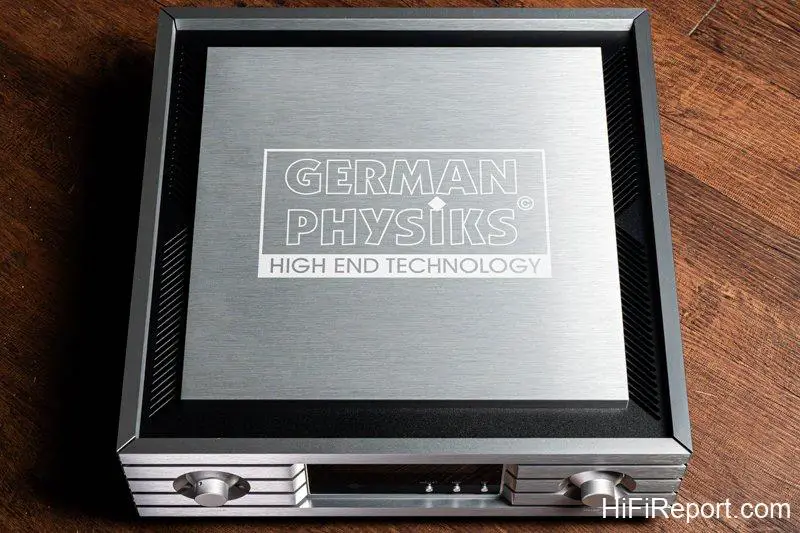
Therefore, even the preamp, though not as tall, shares the same width and depth as the integrated and power amplifiers, measuring 47 x 47 cm. This is nearly a half-meter square footprint.
While larger power amplifiers exist on the market, it’s rare to find a preamp of this size.
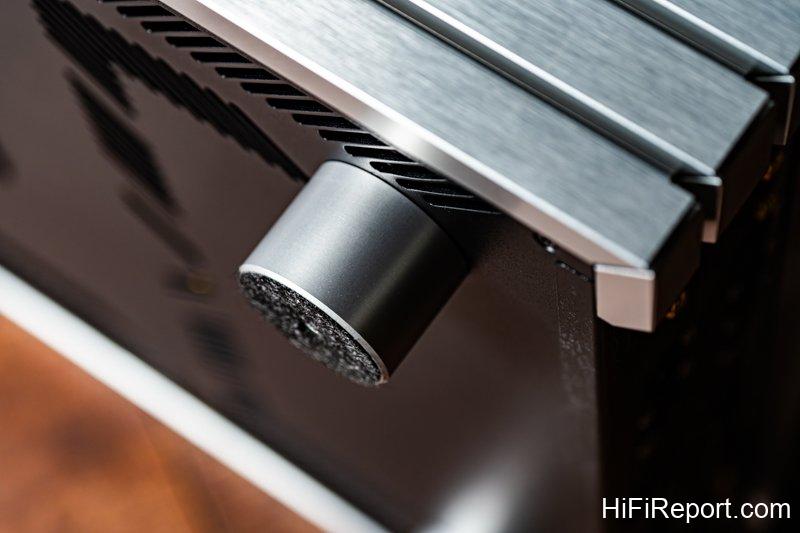
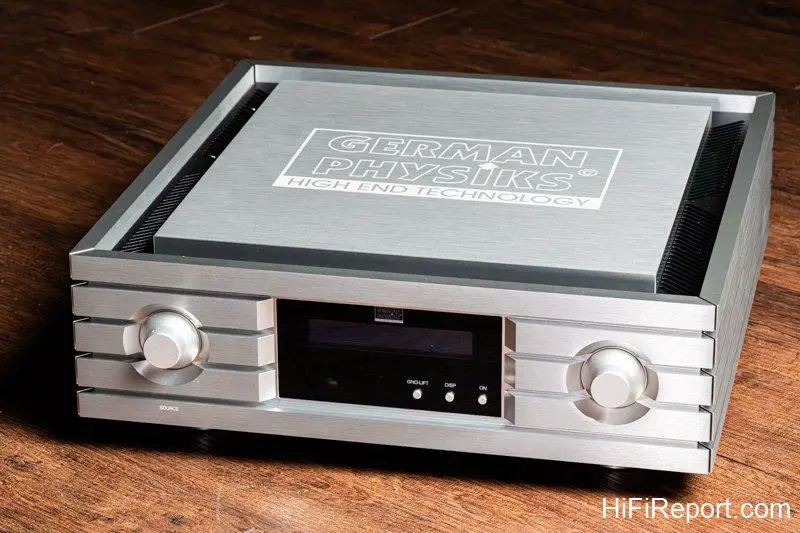
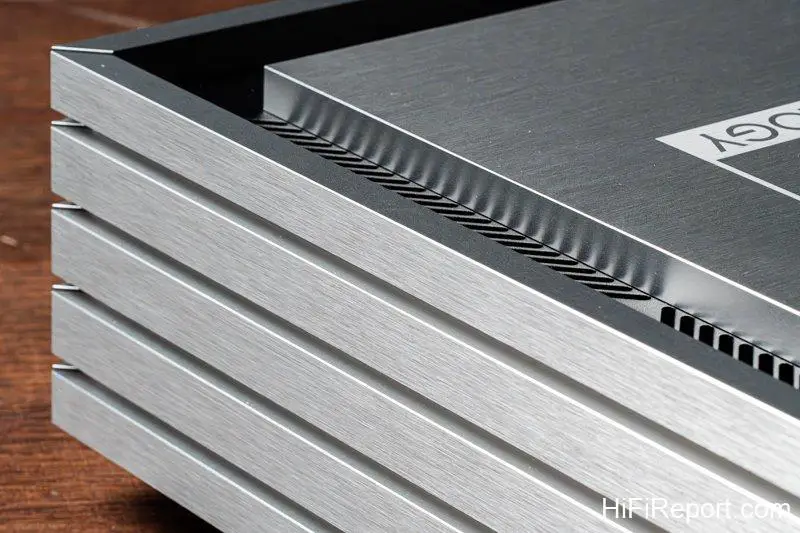
In addition to the basic steel chassis structure, the four sides feature solid aluminum alloy panels that have been anodized. Their surfaces are CNC-machined with horizontal grooves, which not only provide visual variation but also increase the surface area for better heat dissipation efficiency.
The four aluminum panels meet at the corners but are not directly joined, leaving a gap of approximately 2mm. This separation helps prevent the transmission of vibration between panels.
While pursuing a highly rigid structure, the manufacturer also considered mechanical vibration management.
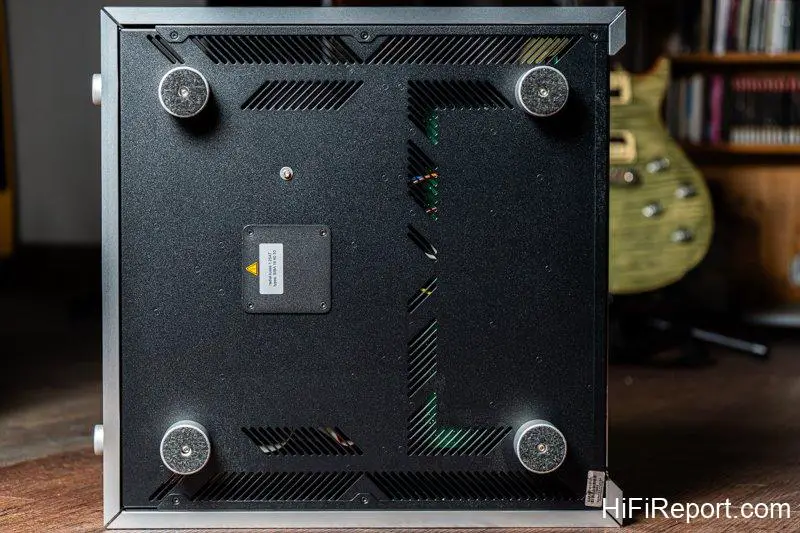
The top and bottom steel chassis panels are perforated with rows of diagonal slots for heat dissipation. The arrangement of these slots is scientifically determined based on the engineers’ simulation of airflow within the chassis.
The internal layout is further layered or compartmentalized according to the circuit requirements of each Emperor component, a result of integrating structural principles into the audio design.
The top features a common design: a thick aluminum alloy top plate with a brushed finish and a large German Physiks logo printed on it.
Because the steel chassis below is black, the entire top plate appears to float above it, a clever industrial design element.
Below the chassis are specially machined cylindrical aluminum feet, fitted with felt pads on the bottom to prevent scratching the audio rack surface and to provide a degree of damping and grip.
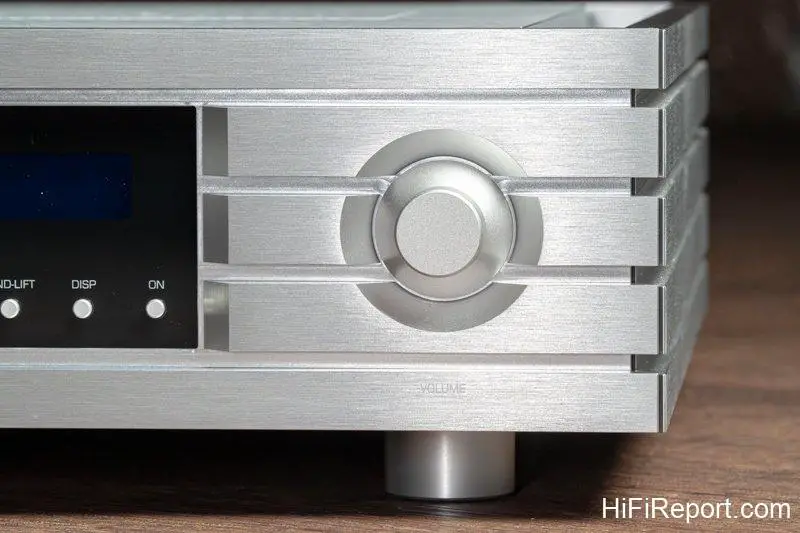
Controls and Volume Management
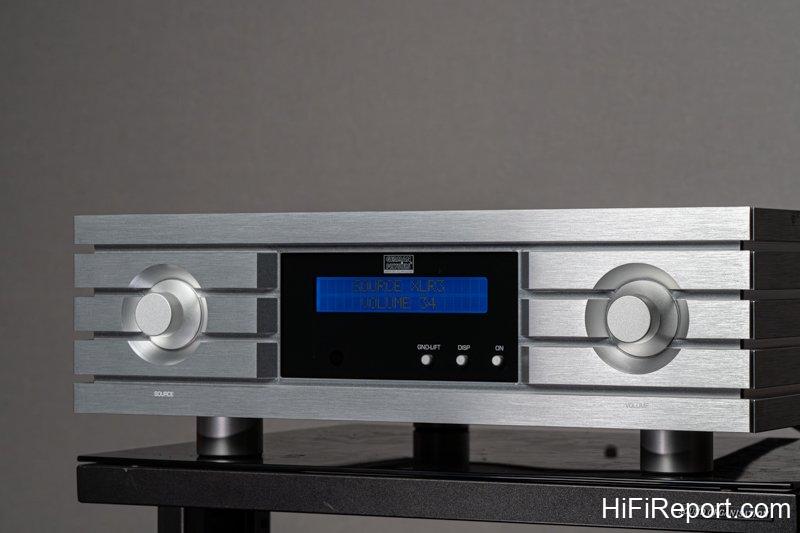
The front panel features a monochrome display showing the current input source and volume level.
The two knobs on either side are exquisitely machined. The right one controls volume, and the left selects the input.
The tactile feel of turning the knobs is excellent.
The detents when rotating the knobs are clear and distinct, with a slight damping effect, making the feel very satisfying.
Since switching is done via relays, there is an audible “click” sound when turning the knob.
Below the display window are three physical buttons: one for ground lift selection (to disconnect the signal ground from the chassis ground to eliminate possible hum due to ground loops), one for display brightness selection (which can turn the screen off), and one for the standby switch.

Dual-Mono, Fully Balanced Design
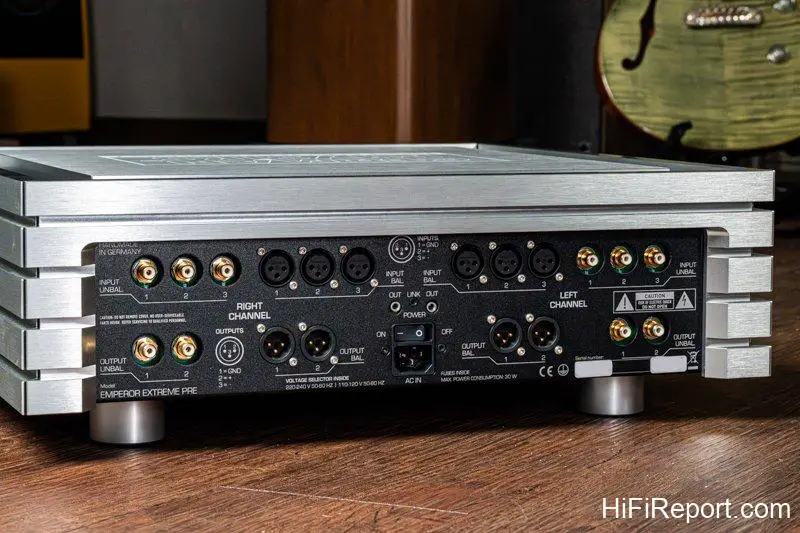
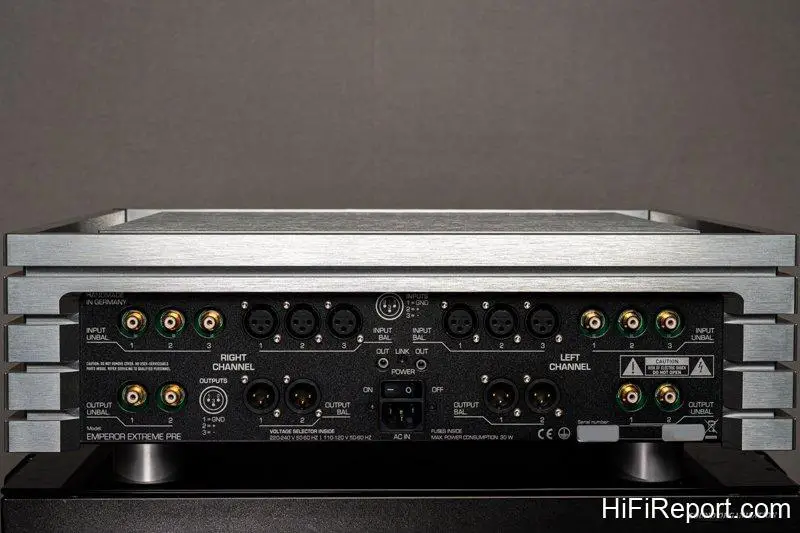
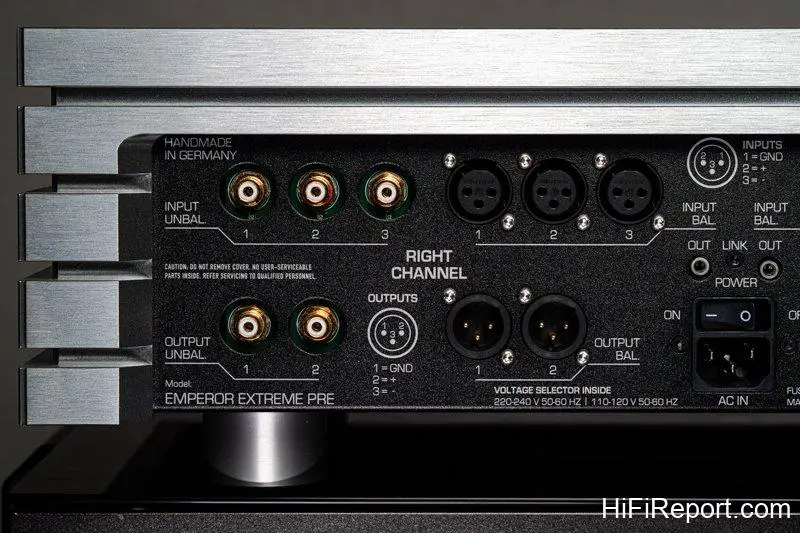
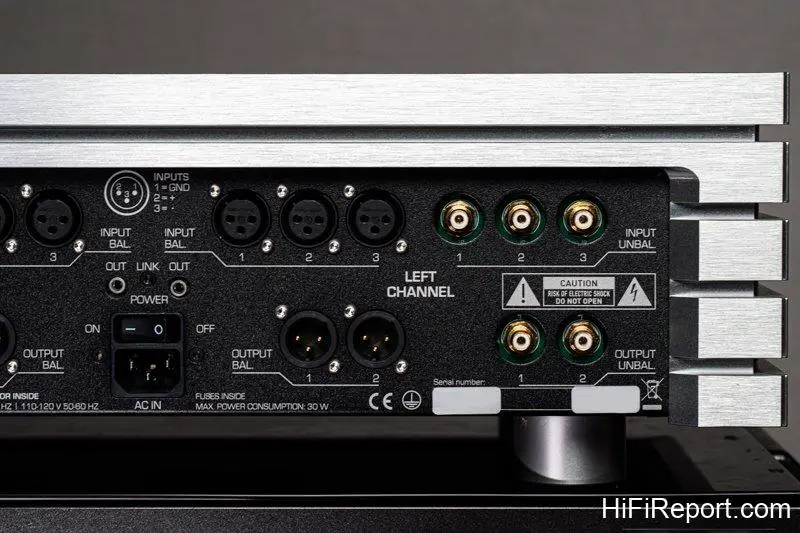
Looking at the rear of the unit, it’s clear that the Emperor preamp employs a dual-mono structure with separate left and right channels.
Both inputs and outputs are configured separately for the left and right sides.
Internally, it features fully discrete circuitry and a fully balanced architecture.
In terms of inputs, there are 3 pairs of RCA single-ended inputs, plus 3 pairs of XLR balanced inputs, which is quite generous.
Outputs are also comprehensive, with 2 pairs each of RCA and XLR. This is convenient for users who want to bi-amp or require two sets of preamp outputs.
Power Supply Design
To achieve the cleanest possible signal output, German Physiks uses custom-made toroidal transformers, providing stable, ample, and clean power to the audio circuits.
For this purpose, the audio amplification circuits and control circuits are powered by different toroidal transformers, and dedicated shielding is designed to minimize electromagnetic interference.
As mentioned earlier, the Emperor’s front panel has a standby switch. German Physiks believes that if the power supply circuit passes through the main power switch, the sound quality can easily degrade.
Therefore, the main power switch only supplies power to the standby circuit. Only after pressing “On” on the front panel will a high-current relay activate, supplying power to all the main circuits.
Premium Accessories
Regarding accessories, German Physiks pays close attention to detail.
The infrared remote control is machined from a solid block of aluminum alloy, giving it a substantial and solid feel.
Besides controlling the preamp and integrated amplifier’s volume and source input, it can also be used with source components the company plans to release in the future.
The user manual is presented in a custom leather portfolio embossed with the brand logo. Looking at this level of presentation, German Physiks clearly understands the luxury market!
Surprising Sonic Performance
Speaking of the sound, it’s truly surprising that German Physiks, a company known primarily for manufacturing speakers, can produce such a preamp.
I paired the Emperor preamp with three different power amplifiers: Jeff Rowland 555, Linear Acoustic LA 200, and EAR Yoshino 509 MK2. The speakers used were Wilson Audio Alexia V.
For the source, music was played entirely via Roon (Intel NUC acting as Roon Server), and the DAC used was the highly popular LAiV Harmony R2R DAC.
The German Physiks Emperor preamp possesses excellent transparency. The sonic foundation is clear and clean, and across the entire frequency spectrum, it presents a naturally pleasing tonality with a moderate warm white hue and brightness.
It clearly reveals the detailed textures within the music. Its clarity is such that, under the spotlight of a concert hall stage, every aspect of the performers is laid bare without reservation.

It doesn’t just have high resolution; it imbues the sound with a stable, certain weight and tangible presence.
The sound is always concrete and highly focused, leaving no room for criticism in its portrayal of dynamics and force.
What I appreciate most is its dynamic performance. Among all the preamps in the HiFiReport listening room at the time, it had the most outstanding dynamic range.
Whether the music is a soft whisper or a earth-shattering crescendo, it consistently delivers what needs to be said and expresses what needs to be shown with unwavering stability.
Once you hear the faint sounds at the quietest moments and feel the grand impact at the extreme peaks, the dramatic nature within the music unfolds.
Dynamics and Texture
Taking Reference Recording’s “Tutti!” demonstration disc as an example.
The first track, Rimsky-Korsakov’s “Dance of the Tumblers” from the opera “The Snow Maiden,” features rich, dazzling orchestration, particularly with the inclusion of colorful percussion. A cymbal crash sends shimmering gold-like sounds flying, creating a lively spectacle.
The difficulty of this music lies in its dynamics, often building softly before erupting with explosive energy.
Paired with that brilliant percussion, it’s truly exhilarating.
The rolling bass strings provide a stable foundation for the rapidly moving music.
Although the Emperor preamp is highly transparent and resolving, its low frequencies are not to be underestimated. That full, rich, and elastic bass, when the bass strings start to roll, brings the music to life.
Let’s take the excerpt from the second movement of Bruckner’s Ninth Symphony on the same disc.

This Scherzo section also tests dynamics, and it has even more detail.
The pizzicato in the strings elicits responsive echoes from different sections.
Following the pizzicato are powerful passages played by the strings in unison with the brass. Seemingly endlessly repeated short musical phrases, repeated over and over, create a cyclical, almost nihlistic mood.
Then, listen for the woodwind solo.
Listen again for the light timpani taps.
Pay attention, the Scherzo theme is repeated again.
Soft, loud, soft again, loud again.
Here, Bruckner creates a vast universe through variations in dynamics, combinations of ensemble and harmony, and the repetition and layering of musical phrases.
Compared to the lively “Dance of the Tumblers,” this piece conveys a sense of philosophical contemplation.
It is hidden within the music’s ebb and flow, its fusion and transition.
Piano Sheen and Refinement
In Radu Lupu and Andre Previn’s collaboration on Schumann’s Piano Concerto, the opening forte passage bursts forth powerfully, followed by a descending piano line that introduces the first theme played by the woodwinds, with the piano then joining in.
After that opening powerful statement, Schumann’s writing is purely lyrical, purely romantic.

Listening to the piano sound here, it is focused and solid, with a touch of roundness.
Paired with the EAR 509 tube amplifier, this feeling is particularly evident. When paired with the Jeff Rowland, it exhibits a vibrant, relaxed, and noble quality.
I really like the “sheen” it gives to the sound. The expression of sheen is an art form, or perhaps an expression of artistic temperament.
For performers, conveying musical ideas and beauty through the sheen of the notes requires contemplation and experience.
For audio equipment reproducing recordings, how designers and users perceive and handle sonic sheen also reveals their aesthetic perspective.
The German Physiks Emperor preamp is heavy and solid in appearance, resembling a heavily armored tank. Yes, its sound is powerful, resolute, sharp, clear, and has weight. However, it also possesses a degree of refinement, a touch of nobility, evident in its handling of sound density, the definition of lines it delineates, and the proportion of sheen it presents.

Balance of Scale and Detail
Let’s use the live concert album “Dvorak in Prague” to illustrate how the Emperor preamp handles grand musical scale while conveying small details.
The first piece is Dvorak’s well-known “Carnival Overture.” The orchestra opens with a double forte passage, accompanied by lively percussion, setting a celebratory tone.
Listening to this passionate, free-spirited theme, the Boston Symphony Orchestra under Seiji Ozawa maintains excellent balance within the rapidly unfolding carnival scene.
The Emperor preamp also exhibits a highly transparent sound with a bright, clear tonality, as if one could see right through the stage.
After the first theme is presented, an interlude features bass strings, the sound quality of which is quite direct and vivid.
This preamp achieves a great balance in reproducing sound quality and detail.

What does this mean? Some equipment emphasizes fullness, solidity, and thickness of texture, thereby sacrificing the expression of subtle information. Other equipment tends to reveal every detail, resulting in a thinner sound.
The Emperor preamp strikes an excellent balance in these two aspects.
It retains the tangibility and weight of the sound without compromising the reproduction of details and texture.
Not only the bass strings confirm this, but an interlude during the development section after the exposition concludes, featuring oboe and flute, also serves as evidence.
In the piece “Klid” (Silent Woods), the melancholic strains of the cello pouring forth possess the rich tone characteristic of Yo-Yo Ma’s playing.
The prominent nasal resonance, coupled with the slightly sticky cello sound, makes the connection between notes tighter, and the melodic flow smoother.

Yo-Yo Ma’s emotionally rich performance enhances the piece’s meditative quality, sonicizing the mysterious, emotional, and imaginative atmosphere within the quiet, distant forest.
Mezzo-soprano Frederica von Stade also sang at this concert.
The aria “Song to the Moon” is from the opera “Rusalka,” where the water sprite Rusalka confesses her feelings for the prince to the moon.
The harp in the introduction, using arpeggios, depicts the moonlit lake, while the orchestra, primarily strings, accompanies slowly and softly, leading into Rusalka’s song.
This is originally a soprano aria, but von Stade is a mezzo-soprano. Heard here, besides the sweetness of the voice, the slightly lower and thicker tone also imbues the music with a hint of melancholy, further reinforcing the story’s tragic nature.
Here, when singing the high notes and pouring out power, one can hear the addition of spatial reverberation.
When the Emperor preamp was paired with the Jeff Rowland 555, this part of the sound was particularly noticeable.
This “hall sound” effect appears here, but when singing high notes later, this noticeable reverberation is absent.
Was this reverb added during post-production? I won’t delve into the recording itself, as I have no way to confirm it.
But this demonstrates that the German Physiks Emperor preamp’s discriminative ability is indeed sufficient.
Clear and Textured Bass
I want to use Rick Stotijn’s album “Doppio espressivo” as an example.
This album includes double bass pieces by Bottesini, as well as pieces originally written for cello that Stotijn has transcribed for double bass.
While the double bass’s range is low, it also has mid-range and high notes, making it more challenging to perform pieces across its full range.
Taking the arrangement of Vivaldi’s Double Cello Concerto as an example, transcribed for double bass, the fuller, richer cello sound can produce a deeper, heavier string tone.
But listening to the texture and sheen of this sound—it’s truly beautiful! The Emperor preamp, with its unveiled, clear, and crisp approach, enables the full-range Alexia V to sing out the cheerful and joyful concerto.
Especially in the third movement, Allegro, the fast-paced, colorful music moves quickly yet remains clearly layered and controlled, neither rushed nor chaotic.
As for Bottesini’s Fantasie and Elegie pieces, Bottesini, himself a double bassist, has always been the most important composer of double bass music in classical music history.
Listening to the double bass here, playing the two pieces representing joy and sorrow with a full, steady tone.
The texture of the sound is beyond reproach, and the plummeting low notes consistently maintain texture, making the performance not only lively but also possessing a sense of presence akin to a live performance; this is especially evident in the piece “Elegie.”
The Emperor preamp not only imparts a bright sheen to the high frequencies and provides appropriate resolution to the mid-range but also offers full, clearly defined low frequencies.
Resolving Harmonics
When listening to a single instrument, the texture is particularly easy to highlight. Guitar is an excellent example, especially hollow-body acoustic guitar.
Hollow guitars produce sound by plucking strings, and the string vibrations resonate through the soundbox of the body, including the top, back, and sides, along with internal bracing that controls resonance.
The composition of the guitar sound includes not only the soundbox resonance but also layered harmonics, which naturally create a rich timbre.
Using Pat Metheny’s “One Quiet Night” as an example, this recording is full and warm, particularly in the thickness of the bass.

The upper mid-range and treble, while clear, also possess a warm texture.
Elastic notes, layered upon the underpinning bass lines, further enhance the layering.
Detail, Dynamics, and Realism
If listening to Bertrand Renaudin and Olivier Cahours’ collaboration album “Douo,” Olivier Cahours’ guitar sound is bright and lively, quite different in character from Pat Metheny’s album.
Here, the guitar playing is forceful. When a string is plucked, the note is projected outward. Upon close inspection, one can hear the subtle sounds of fingers touching the strings. Furthermore, there is the drummer Renaudin’s light accompaniment nearby.
I have emphasized more than once the wealth of information provided by the Emperor preamp. Similarly, I must also emphasize: its method of presenting information is very “proper”—neither tepid nor overly aggressive, just right. Details are rich and clear, yet it doesn’t sound rough or excessive.
This album allows for appreciation of both instrumental texture and the powerful, fast-paced sound production, with huge contrasts in dynamics.
The soaring high notes of the guitar shoot upwards, the scattered metallic sounds when cymbals are struck, paired with the crisp, agile, and layered drum sound—it’s increasingly addictive to listen to.
Whether forcefully strumming/plucking the guitar or powerfully striking the tom-toms, it consistently provides impact with a sense of realism and presence.
I previously compared the German Physiks Emperor preamp to the German WWII Tiger tank because it’s large, substantial, and powerful.
However, after listening to it, I realized that the Emperor’s insight into music and its agile speed make it more like a Panther tank when playing music.
Unveiling Textures and Layers
Listening to Belgian singer Melanie de Biasio’s album “No Deal,” the music blends jazz, soul, and blues styles, with a touch of haze, almost like whispered musings. Listening carefully, this album hides many “devils” in the details.
In the title track “No Deal,” many details of Melanie’s breathing and lip/teeth sounds are picked up. The transitions in articulation and vocal style are heard clearly.
The accompaniment also presents itself with texture, establishing a layered relationship with the lead vocal.
I really like the electronic bass that underpins many parts of this album. Though the sound is quiet and faint, it is distinct.
In the track “With All My Love,” the lip/teeth sounds are less prominent, and the voice is recorded slightly thicker, giving the sound more character.
In the accompaniment for this piece, the drummer constantly brushes the cymbals, creating many fragmented metallic sounds.
The synthesized electronic effects, combined with the cold notes of the electric piano and the drummer’s restless activity, make the trio in the latter half of the song truly spectacular.
Listening to the electronic bass line paired with the subtle rhythm and vibration, the Emperor preamp fully presents all this musical information.
Competing with the Best
In the past, we referred to German Physiks as a speaker company. Now, that can no longer be said.
Although I have only listened to their Emperor preamp, I can already imagine the achievements they have made with their power amplifiers and integrated amplifiers—after all, preamps are often the most challenging components to design well.
According to current trends, preamps seem to feel compelled to include more than just analog functions to be competitive, adding features like DACs, phono stages, headphone outputs, or even streaming capabilities.
However, German Physiks chose not to incorporate too many extra functions into the Emperor preamp, focusing solely on its role as a high-level line stage preamp.
Concentrating on doing one thing and doing it exceptionally well is often the unique path to success.
German Physiks likely views it this way: the Emperor preamp is meant to do what a preamp should do, and do it the best.
I believe it has succeeded.
However, when you hear its performance, you’ll feel that even if there are more expensive preamps on the market, the Emperor is in no way inferior to any of them.
Specifications
* German Physiks Emperor Preamp Type: Fully Balanced Stereo Preamplifier
* Input Terminals: XLR x 3; RCA x 3
* Output Terminals: XLR x 2; RCA x 2
* Input Impedance: 10 pF 15 kOhm
* Output Impedance: 5 Ohm
* Dynamic Range: 140 dB
* Frequency Response: 0.5 Hz ~ 95 kHz (-3dB)
* Total Harmonic Distortion: <0.001% @ 2kHz output (22Hz – 22kHz) * Signal-to-Noise Ratio: -103 dB (XLR), -104 dB (RCA) * Dimensions: 474 x 160 x 474 mm (WxHxD) * Weight: 33 kg