
Harmonic Technology Para-I Balanced Interconnect Review
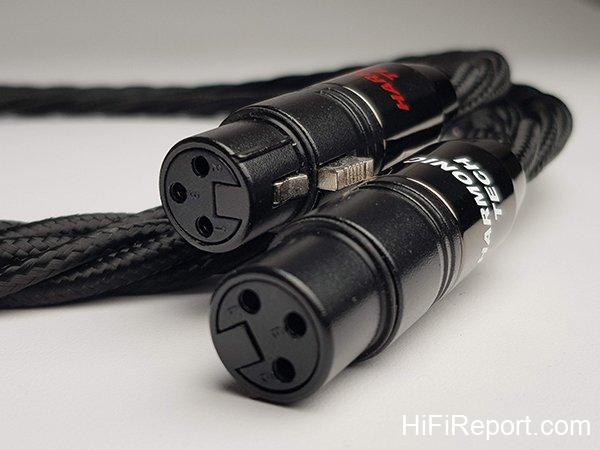
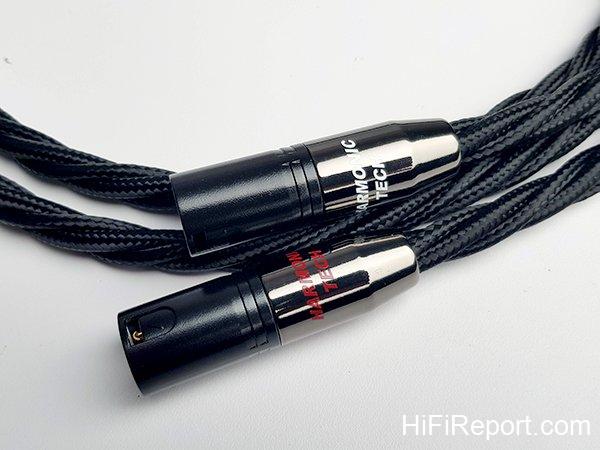
When Harmonic Technology launched their latest flagship Paramount series, they generously sent the entire range for review, encompassing the Para-P power cable, Para-I balanced interconnect, and Para-S speaker cable. I was the one who had the pleasure of unboxing them, and prior to opening, I was genuinely unaware of the contents. Upon inspection, the distinct visual characteristics of the three cables were immediately apparent. The power cable appeared most conventional, resembling a typical power cord with a striking gold jacket. The balanced interconnect was quite unique, constructed from multiple individually insulated conductors, twisted together in an all-black, almost vintage aesthetic. The speaker cable was even more unconventional – a flat design with a transparent jacket revealing the copper conductors beneath, exuding a modern, technological vibe.
My initial thought was that Harmonic Technology was introducing three separate series and had chosen different types of cables for us to evaluate. However, upon closer inspection, I noticed that all three models began with “Para-“, and it became clear that they were indeed part of the same Paramount series!
OCC Conductors, Teflon Insulation
Typically, cables within the same series or brand share similar conductors and structural designs, resulting in minimal visual differences. However, Harmonic Technology frequently deviates from this norm. This is because Harmonic Technology is a company with a high degree of technical expertise. They employ varying levels of conductor complexity, structural designs, and hybrid approaches across different grades and series of cables. They also apply different principles for different cable types. Consequently, the cross-sectional diagrams of their cables displayed on their official website are remarkably diverse, almost bewildering.
The latest Paramount series, however, utilizes Harmonic Technology’s most advanced and cutting-edge technologies, moving beyond their past approaches. This technological shift necessitates a change in construction, explaining the distinct appearances of the three cables within the series.
Let’s now focus on the star of this review, the Para-I balanced interconnect. The Para-I’s construction is quite distinctive, setting it apart from conventional balanced cables. Standard balanced cables typically feature two internal conductors, each responsible for carrying the positive and negative signal, respectively. These conductors are then encased in a dense metallic braid, which serves as the ground connection, thus establishing the balanced configuration.
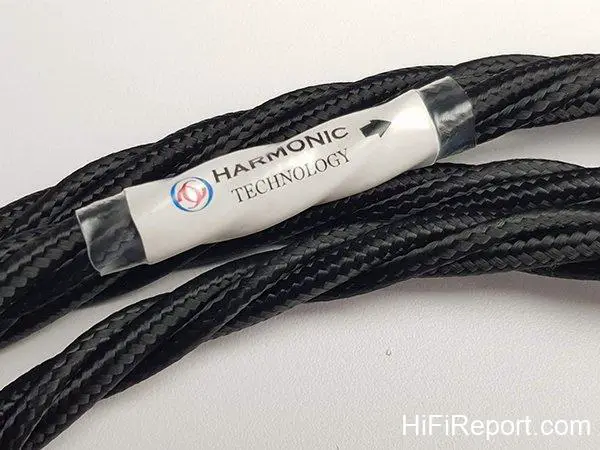
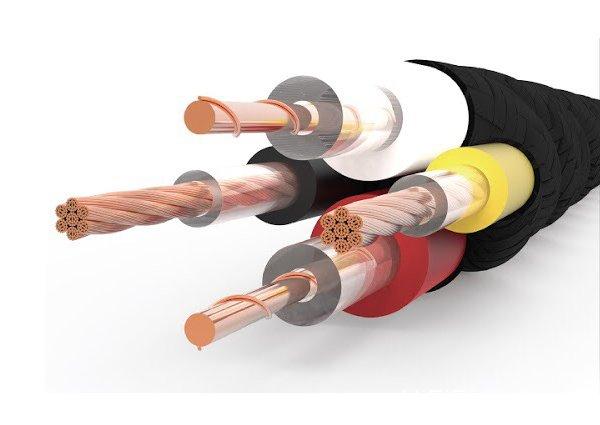
The Para-I takes a significantly different approach. It is constructed from four independently insulated conductors, twisted together to form a Quad balanced structure, completely omitting any metallic braid shielding. These four conductors can be further categorized into two types.
The first type employs a single OCC single-crystal copper solid-core conductor. Surrounding this solid core is an extremely fine single-strand wire, spirally wound around it, creating a rather unique configuration. The insulation consists of a layer of Teflon and a layer of PVC, further wrapped in a black PP braid for isolation.
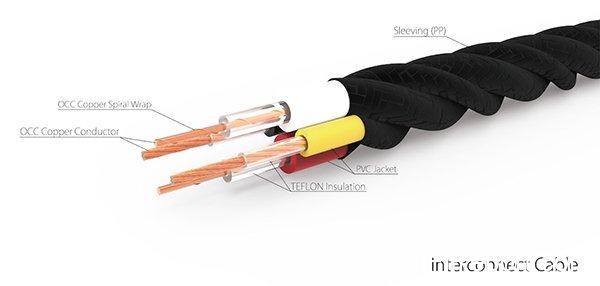
The second type of conductor is composed of seven bundles of OCC single-crystal copper multi-strand wires, twisted together. The insulation is again Teflon and PVC, and it is also encased in a black PP braid. Furthermore, the insulation thickness differs between the two conductor types. The solid-core conductor utilizes thicker Teflon and PVC layers compared to the stranded conductor, resulting in a larger overall diameter for the solid-core conductor.
These two types of conductors, four in total, are arranged in a pair-wise opposing configuration and then twisted together, forming the all-black Para-I cable. Given that the Para-I is constructed from four conductors, and a balanced cable typically has three poles (positive, negative, and ground), how are these four conductors allocated? I inquired with Harmonic Technology directly, and according to their response, one solid-core conductor is assigned to the positive terminal, another to the negative terminal, and the remaining two multi-strand conductors are both connected to the ground.
Regarding the rationale behind this unique structure and the absence of metallic braid shielding, the factory remained silent. However, regardless of the technical explanations, the ultimate judgment lies in the sonic performance. Let’s put the Para-I to the test and see how it performs in a critical listening session.
Exceptional Detail Retrieval
Before delving into the Para-I’s sonic characteristics, it’s essential to highlight one significant advantage: its user-friendliness. Compared to Harmonic Technology’s previous designs, the Para-I’s construction is remarkably simple. The simplified shielding layer, coupled with internal multi-strand wires and a twisted configuration, results in an exceptionally flexible cable. It easily adapts to tight spaces or any angle requiring bending or maneuvering.
The listening evaluation was conducted in my home setup, which includes an Audiobyte Black Dragon DAC, EC 4.8 preamplifier, NuPrime Evolution One power amplifier, and Aurum Cantus Grand Harmony loudspeakers. I connected the Para-I between the DAC and the preamplifier. This was my first experience with Harmonic Technology cables.
Even brand new, straight out of the box without any run-in, the Para-I made an immediately striking impression. My initial perception was of a sound that is clear and delicate, with an open soundstage, rich in detail and layering, possessing a clean and uncolored character, a flat and balanced frequency response, exceptionally smooth transitions, and a slightly cool tonality with an air of sophistication.
These qualities were immediately apparent when I first listened to the 2016 Audiophile & Art Exhibition Commemorative CD through the Para-I, which features recordings of Lü Shao-Chia conducting the NSO concert at the National Concert Hall. The distinctive attributes of the Para-I were easily discernible from the outset. The change was immediately noticeable, requiring no A/B comparison.
It excels at rendering subtle musical passages, making delicate nuances and minute details remarkably vivid. Consequently, quieter sections become more engaging, and the music remains captivating even at low volumes. Furthermore, the Para-I effortlessly reveals the textural nuances of various instruments, presenting them with a high degree of realism and quality, embodying a truly accurate and lifelike presentation.
The Para-I’s high and low-frequency extension, with its natural agility, is also exceptional. This contributes to an overall sonic character that is light and airy, yet without sacrificing low-frequency weight and scale.
Openness with Cohesion
In terms of soundstage, the Para-I leans towards an open presentation, creating a sense of width that extends beyond the physical placement of the loudspeakers. However, it maintains the necessary cohesiveness. I experienced an expansive soundstage that also retained a clear sense of focus, keeping the music centered and preventing it from losing its anchor.
This reminded me of the Para-I’s initial out-of-the-box performance, where the soundstage was incredibly wide and spacious, perhaps even excessively so. The musical focus felt somewhat diffuse and ungrounded, with instrumental sections seemingly scattered and lacking clear localization. While the detail and micro-dynamics were outstanding, I felt somewhat lost in the overall presentation.
However, this peculiar characteristic vanished after a period of run-in. Once broken in, the Para-I delivered improved soundstage coherence, more defined and palpable image outlines, enhanced dynamics, energy, and fullness. Weight and density also improved, while the original wealth of subtle nuances remained undiminished. It was truly remarkable, making me reluctant to disconnect it.