
Integra DRX-5.4 Review
In the realm of AV receiver brands, Integra has always occupied a rather unique space. While most brands target general retail channels, Integra focuses primarily on the custom installation market. What’s the difference, you ask? It means their products are designed with greater flexibility and enhanced performance to meet the specific customization demands of professional installers and their clients.
Compared to many European and American brands also targeting custom install, Integra offers remarkable value. Today, we’re diving into the DRX-5.4, currently the top-tier model announced in Integra’s latest “.4” series.
Key Specifications and Certifications
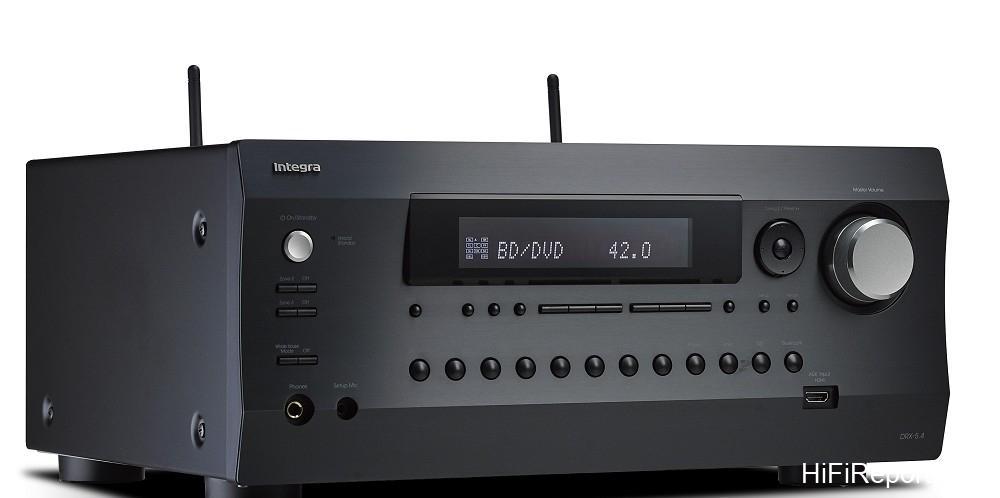
The DRX-5.4 is a high-performance 9.2-channel AV receiver boasting both THX Select and IMAX Enhanced certifications. It offers up to 11.2 channels of preamp output in the main zone. This allows it to natively power speaker configurations up to 7.1.2 (or 7.2.2) or 5.1.4 (or 5.2.4). For a full 7.2.4 channel setup, encompassing both rear and height immersion, you’ll need to connect an external 2-channel amplifier to drive the rear surround channels.
HDMI 2.1 and Video Features
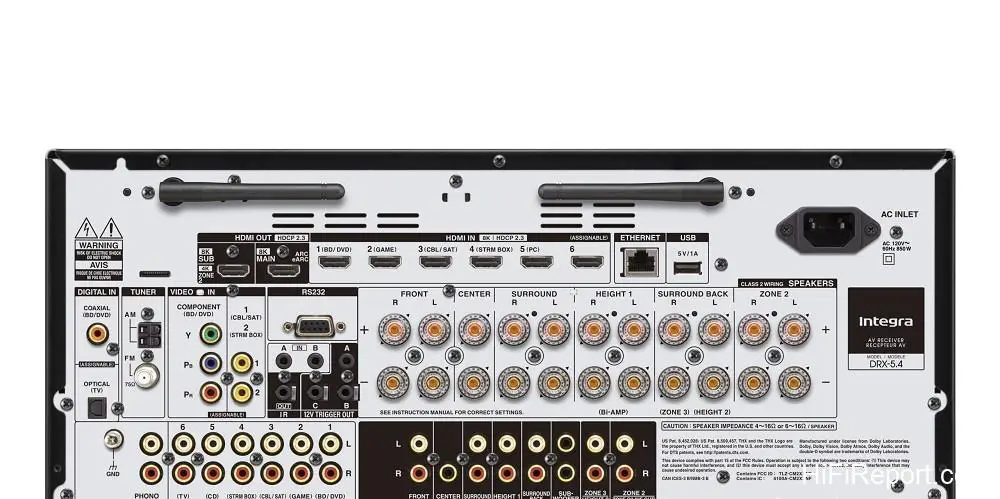
For anyone acquiring a new AV receiver, paying close attention to HDMI video compatibility is crucial, especially if you plan on gaming or connecting an 8K TV. The key is whether the HDMI ports support 4K/120p and 8K/60p. Previously, the benchmark was simply “HDMI 2.1.” However, the HDMI Forum recently relaxed its standards, allowing devices originally conforming to HDMI 2.0 specifications to be labeled as HDMI 2.1. Thus, simply seeing “HDMI 2.1” isn’t a guarantee.
Fortunately, the DRX-5.4’s manual explicitly states that all six HDMI 2.1 inputs on the rear panel support 4K/120p and 8K/60p. Furthermore, HDMI inputs 1 through 3 are specified to handle uncompressed 8K/60p 4:2:0 signals.
Connectivity and Streaming
The DRX-5.4 comes equipped with built-in Wi-Fi and Bluetooth. Its compatibility with DTS Play-Fi means it can seamlessly integrate with other DTS Play-Fi enabled wireless speakers or integrated amplifiers, allowing you to design and implement a multi-room streaming audio system throughout your home, from the living room to individual bedrooms. For streaming services, the unit supports Spotify, Tidal, and TuneIn, and is compatible with AirPlay 2 and Chromecast.
Supported Audio Formats
This receiver can access and play music files shared across your home network from sources like NAS drives, PCs, or music servers. You can also stream lossless music files directly via Wi-Fi from tablets or smartphones. Additionally, it supports direct playback of music files stored on USB storage devices (formatted as FAT16 or FAT32, limited to 20,000 files). Compared to most AV receivers, the DRX-5.4 is compatible with a wider variety of high-resolution audio formats.
Supported codecs include WMA, MP3, WAV, AIFF, AAC, FLAC, LPCM, Apple Lossless, and DSD. Multibit lossless files are supported up to 192kHz/24bit, while DSD (dsf and dff) playback is supported at 2.8 MHz, 5.6 MHz, and 11.2 MHz.
Internal Design and Components
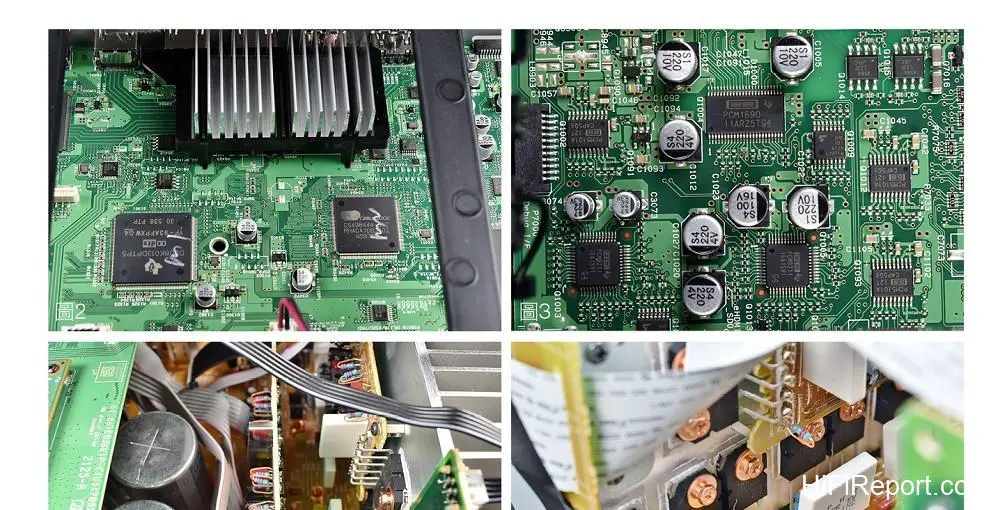
Let’s delve into the internal circuitry of this unit. To the left of the digital main board, the DRX-5.4 houses a high-speed 802.11ac Wi-Fi daughterboard built around a quad-core SoC chip. The HDMI input/output interface is located to the right and rear of the digital main board. For digital coaxial and Toslink S/PDIF inputs, the unit utilizes a TI PCM9211 chip, which includes a PLL (Phase-Locked Loop) circuit to effectively reduce jitter in the digital audio signal.
Once the digital audio signal enters the receiver, it is processed by two DSP chips working in tandem: a TI Aureus TMS320DA808 (D808K013DPTP5) floating-point DSP and a Cirrus Logic CS49844A quad-core 32bit DSP.
These chips handle various digital audio processing tasks including decoding music files and multi-channel audio, post-processing (such as IMAX Enhanced or THX modes), creating virtual height speakers, optimizing the sound quality of compressed audio, and executing both AccuEQ and Dirac Live digital room correction processes.
Following DSP processing, the digital audio signal passes through the digital-to-analog conversion stage. Here, the DRX-5.4 is equipped with four DAC chips: the main 7.1 channels are handled by an 8-channel 32-bit DAC, the TI PCM1690, which boasts a dynamic range of 113 dB. Three additional 2-channel 32-bit DAC chips, the TI PCM5101A, are used for secondary channels and the Zone 2 and Zone 3 digital-to-analog conversion.
In the stage after the DAC circuits, most devices employ low-pass filters to remove digital noise (pulses). However, this method can still leave some residual noise. Integra tackles this with their proprietary VLSC (Vector Linear Shaping Circuitry). This circuit uses a comparator to detect real-time level changes in the audio output from the DAC chip. Based on this, a vector generator generates the audio signal.
Because the output audio signal is “re-detected and regenerated,” it completely eliminates the noise components from the DAC output, resulting in a cleaner sound. The amplification component used here is the JRC NJM4580 dual OP Amp chip, which has a bandwidth of 15MHz and distortion as low as 0.0005%.
Power Amplifier and Supply
In both the power amplifier and power supply sections, Integra adheres to its consistent design approach, prioritizing dynamics. They select amplification components with excellent high-frequency characteristics (wider bandwidth), enabling broadband response with fewer gain stages and less negative feedback. From a design philosophy perspective, Integra’s style places greater emphasis on transient intermodulation distortion.
While this might lead to a slight increase in harmonic distortion, it results in a more lively and dynamic sound.
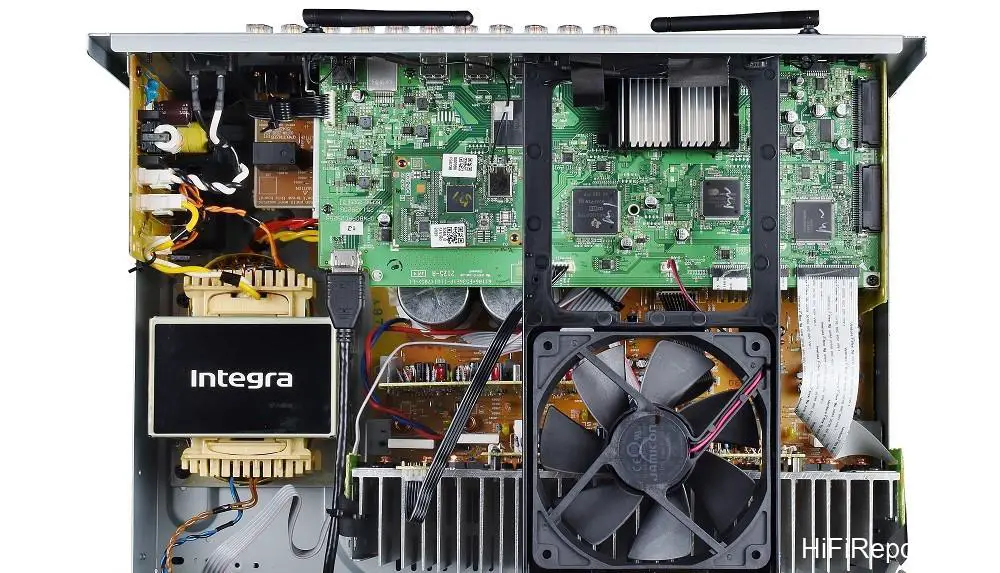
Achieving such a lively sound naturally requires ample power. For the power amplifier’s output stage, each channel utilizes a pair of Toshiba TTA0001/TTC0001 Triple Diffused Type Darlington transistors in a push-pull configuration. These transistors offer wide bandwidth (30MHz) and high current capability (up to 35 amps peak instantaneous). In the power supply section, the unit employs a copper-shielded EI transformer.
The primary power path for the power amplifier circuit, from the transformer’s secondary winding and filter capacitors (two custom-made 15,000μF audio-grade electrolytic capacitors) to the power transistors in the output stage, is kept as short as possible. Portions of this path even use copper bars (not just copper foil on the PCB) for connections. This minimizes power loss due to the amplifier’s internal resistance, enabling it to drive low-impedance speakers effectively.
It also ensures that the amplifier can deliver bursts of high energy when movie soundtracks demand instantaneous impact, resulting in more accurate and powerful reproduction.
Room Correction: AccuEQ and Dirac Live
As mentioned earlier, the DRX-5.4 offers a choice between Integra’s self-developed AccuEQ and the Swedish Dirac Live digital room correction processing. For seasoned enthusiasts, it’s no secret that Dirac Live is the preferred choice. Compared to the automatic room correction methods found in most AV receivers historically, Dirac offers three significant advantages.
Firstly, after the measurement process, it clearly shows the frequency response and transient response of each speaker “at the listening position.” This complete transparency eliminates guesswork and allows you to precisely see the changes “before correction” and “after correction” with Dirac Live.
Secondly, Dirac is highly effective at tackling Room Mode issues. The “peaks” and “dips” in the frequency response, especially in the low-frequency range (including 20Hz to 63Hz), caused by standing waves or phase cancellation from disparate energies in each channel’s subwoofer output, can be significantly flattened and filled.
Achieving the same result using traditional acoustic treatment methods (including bass traps), if not using Dirac, would cost considerably more, but the larger problem is the physical space they occupy.
The third major advantage of Dirac Live is its ability to enable “placement freedom.” This doesn’t mean ignoring the ITU-R guidelines for speaker positions and heights in a multi-channel setup. Instead, it allows you to place speakers “tight against the back wall” or even “tucked into a corner” without suffering from excessive low-frequency buildup due to boundary gain.
Not only can Dirac Live “rescue” the situation and ensure a flat bass response, but by mitigating the wall-enhanced low-frequency energy, it also helps “ease the load” on the power amplifiers in the AV receiver and active subwoofers. This increases headroom and stability. So, the “placemen freedom” I refer to is the ability to place speakers closer to walls, freeing up valuable space for living areas and pathways, rather than pulling them far out into the room as many audiophiles advocate.
In fact, pulling speakers away from walls also has guidelines; otherwise, you risk the detrimental effects of comb filtering. I encourage you to search online for more information on this aspect of audio knowledge.
Currently, amplifiers (both 2-channel and multi-channel) equipped with Dirac Live typically come with the standard version. This version corrects frequency response starting around 20Hz, with an upper limit at 500Hz. If your only goal with Dirac is to address Room Mode issues, this might suffice. However, the symmetry of the midrange and high-frequency response between channels has a decisive impact on the “imaging of sound objects.”
Many enthusiasts mistakenly believe that asymmetry in the soundstage is solely due to wall surfaces (e.g., significant differences in side wall reflections for the left and right channels).
While true that this is a common issue in semi-open spaces like living rooms or combined living/dining areas, even in seemingly symmetrical rectangular rooms, slight variations between speakers or wall reflection conditions can result in left and right channel imaging that isn’t sufficiently solid and focused. For a multi-channel system, this is even more challenging. The required symmetry isn’t just “left and right” as in 2-channel, but “full space,” including front/back and up/down.
This is the key to achieving near-perfect “soundstage continuity” and the “physical presence of objects in space.” Allow me to emphasize: this is a crucial difference between the full-range and standard versions of Dirac.
If you have a standard Dirac unit and wish to upgrade to the full-range version, which can optimize midrange and high-frequency response with a correction ceiling extending up to 20kHz (or even near 22kHz), it typically costs an additional $99. The DRX-5.4, however, includes the full-range Dirac Live from the outset.
Music Performance
For this review, I connected the unit to a 5.1.4 channel speaker system and tested using three different Dirac Live measurement and calibration methods:
1. Using the Integra App on an iPad, with the included measurement microphone.
2. Using the PC version of Dirac Live (downloaded from the Dirac website) with the included measurement microphone.
3. Using the PC version of Dirac Live with a dedicated instrument measurement microphone (e.g., miniDSP UMIK-1) and its corresponding calibration file.
I saved these three calibrations sequentially into the DRX-5.4’s Dirac Slots 1-3 (hereafter referred to as “My Dirac 1~Dirac 3”). If you only use the first Dirac calibration method mentioned above, it will fill up all three slots (so there will be no audible difference between them). Initially, I played some 2-channel music.
Although I had already spent some time adjusting the placement and toe-in angle of the left and right speakers before the Dirac calibration, I intentionally placed the speakers quite close to the corners to challenge Dirac’s correction capabilities. Consequently, with Dirac OFF, the bass sounded somewhat bloated. Switching to My Dirac 1, the bass bloat and boominess were significantly reduced.
Vocals and details in the acoustic space became clearer, high frequencies gained more sparkle, the entire frequency range exhibited faster attack and decay, and dynamic shifts became more pronounced. Images were not only precisely located but also had a clear sense of size and depth.
Switching to My Dirac 2, as configured previously, the sound characteristics were “broadly similar” to Dirac 1 since both used the included measurement microphone. However, there was one noticeable difference: Dirac 1 had a slightly thicker sound, while the midrange and low frequencies in My Dirac 2 were relatively “cleaner and tighter,” more akin to the direct, neutral, and highly analytical presentation of studio monitor speakers.
Why would there be two different calibration results using the same measurement microphone? I suspect that My Dirac 2, performed using the official standard PC version of Dirac, adhered strictly to professional standards. In contrast, using the Integra App to perform the Dirac calibration might incorporate some degree of “Integra style” tuning.
Therefore, even with Dirac calibration applied, the DRX-5.4 fully retains Integra’s characteristic American style, built upon a foundation of robust bass.
The sound performance using the instrument measurement microphone calibration (My Dirac 3) was the best of the three. It thoroughly removed the influence of the room on the frequency response.
Its tonal balance was almost identical to “listening with headphones”: the bass was solid and agile, with a quantity falling between My Dirac 1 and 2; the midrange was warm and richly layered, capturing the subtle textures of a cello and conveying the nuances and expression in a singer’s voice; the high frequencies were noticeably less bright than in the previous Dirac 1 and 2, more closely resembling the actual sound of real instruments.
Beyond tonal balance, in Stereo mode, Dirac 3 significantly improved the density of the soundstage, making the left and right sides exceptionally symmetrical and achieving superb imaging focus. Over the years, I have tested several integrated amplifiers and AV receivers with Dirac Live, whether standard or full-range versions. The key factor in unlocking Dirac Live’s full potential has consistently been “using the most accurate measurement microphone possible.”
Movie Performance
Finally, using My Dirac 3, I assessed the DRX-5.4’s performance with movie soundtracks. I listened exclusively at THX reference volume. Compared to previous generations of Integra models at this level, I find the DRX-5.4 retains the characteristic powerful energy and weight in the midrange and bass—qualities essential for a compelling cinematic experience akin to being in a movie theater.
At audio shows, some foreign visitors have sometimes commented on the unconvincing bass in certain exhibition rooms’ movie demos. Integra, however, has a long history and strong presence in the North American market, known for delivering impactful bass. So, provided you have capable subwoofers, the DRX-5.4 ensures that explosions and impacts in war, sci-fi, and action films hit with visceral punch.
This time, with the assistance of Dirac Live, I could distinctly perceive the DRX-5.4’s evolution. Despite its position as a sub-flagship model (Integra’s flagship models traditionally have 70-series numbers), I believe it possesses two characteristics that surpass many flagship AV receivers. The first is its utterly seamless channel coordination. The listener is completely unable to discern “how many speakers are being used.”
The timbre and soundstage integration between different channels are flawless, merging into a cohesive, three-dimensional space that provides 360-degree enclosure, complete overhead coverage, and feels dense yet extends far into the distance.
The second characteristic is even more remarkable.
When I played the Pixar animated film “Turning Red” with Dolby Atmos sound, recently available on Disney+, using the Dirac 3 calibration (with the instrument measurement microphone), I could not only clearly hear (not just sense) the flow of the soundfield, the shape of the sound objects, and their absolutely continuous movement paths, but the most impressive aspect was that in many scenes, the character’s voices and other sound objects seemed to “walk out” and move right beside me.
I have previously experienced AV receivers that perform well with “up-close effects,” but this was the first time I encountered a unit like the DRX-5.4 that could render sound objects moving within three-dimensional space so intimately, almost realistically enough to touch.
However, I must remind you that using a high-quality HDMI cable for eARC is essential to ensure that the audio (especially the sense of immersion) from streaming movies watched on a smart TV is reproduced to its fullest potential.
Conclusion
While the DRX-5.4 differs from flagship AV receivers in channel count, weight, and output power, the inclusion of Dirac Live makes this new model truly exceptional. If you’re seeking movie audio that can serve as a “demonstration example” in a medium-sized living room, the DRX-5.4 is an outstanding choice. For use in larger spaces, I recommend pairing it with high-sensitivity speakers.
Considering both price and performance, I believe the Integra DRX-5.4 is fully deserving of our Best Recommendation award.