
Jeff Rowland Capri S2-SC Preamplifier Review
When it comes to selecting Hi-Fi equipment with stunning aesthetics, Jeff Rowland effortlessly secures a top spot. Their signature high-quality metalwork, coupled with a sophisticated, elegant, yet avant-garde design, commands attention and even invites a touch to appreciate the shimmering, wave-like finish.
The Capri S2-SC preamplifier is a timeless classic within the Jeff Rowland lineup. It embodies all the visual hallmarks of the brand, while remaining compact in size. It won’t dominate your space or your budget, allowing you to indulge in a visually and sonically pleasing musical ambiance every day.
Enduring Design
The first generation Jeff Rowland Capri preamplifier debuted around 2006, accompanied by the matching Model 102 stereo power amplifier, forming a complete and visually harmonious “suit.” The pair was undeniably beautiful, space-saving due to their compact form factor, and yet offered ample power (100 watts per channel into 8 ohms for the Model 102). It’s easy to imagine many audiophiles being captivated by their appearance and specifications alone, leading to immediate purchases.
Subsequently, the Model 102 was upgraded to the Model 125, and the Capri also received iterative updates. However, the model name “Capri” remained consistent, with suffixes added to denote revisions, including Capri S, Capri S Series II (Capri S2), and the current generation, the Capri S2-SC.
Interestingly, across these generations, the Capri’s chassis and even the “CAPRI” lettering on the front panel have remained unchanged. Visually, distinguishing between generations requires inspecting the rear panel.
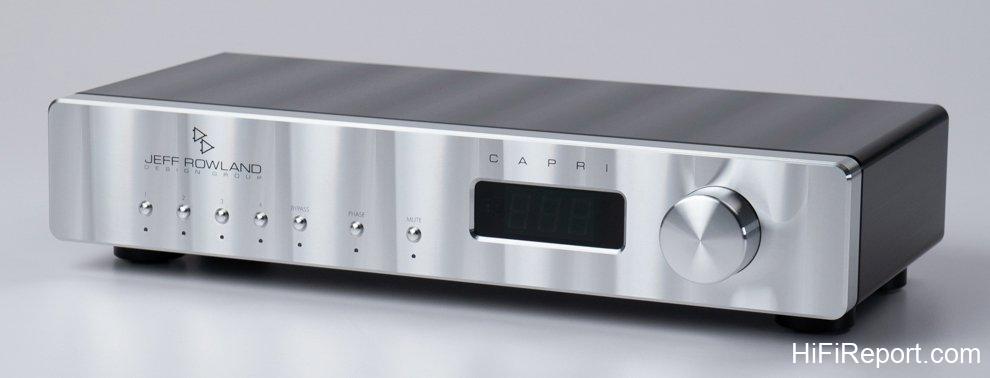
This unchanging aesthetic likely contributes to the resale value of earlier Capri models.
The “SC” suffix in the current Capri S2-SC distinguishes it from its predecessor, the Capri S2. SC stands for “Supercapacitors.”
Supercapacitor Power
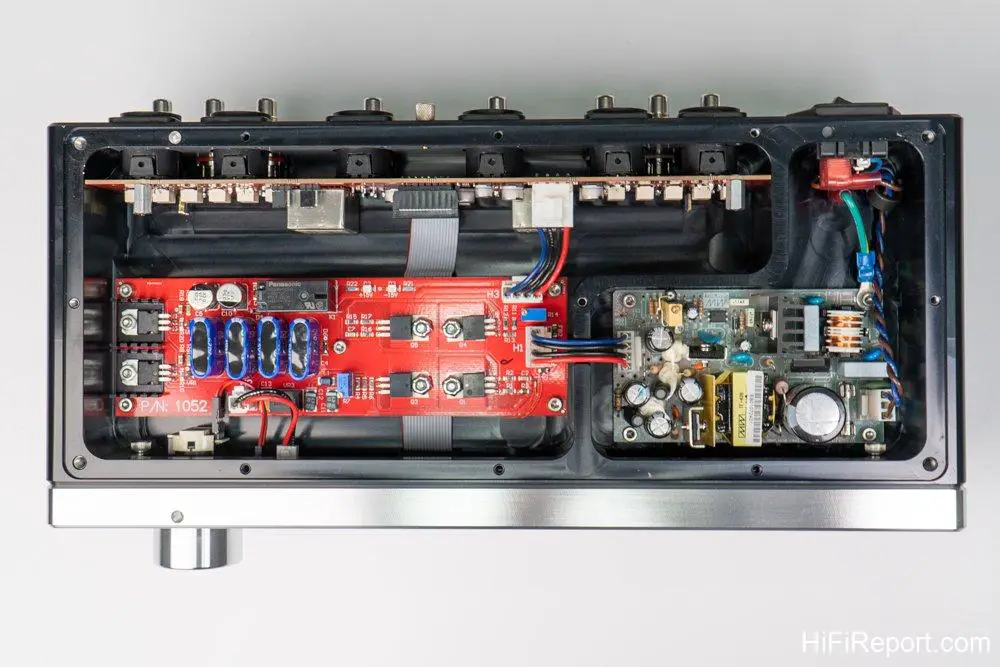
Upon removing the bottom plate of the Capri S2-SC, the most striking feature is immediately apparent: a large, rectangular red circuit board dominating the chassis floor.
Notably, in previous Capri iterations, including the immediate predecessor, this space was empty. This red circuit board is a unique addition to the Capri S2-SC.
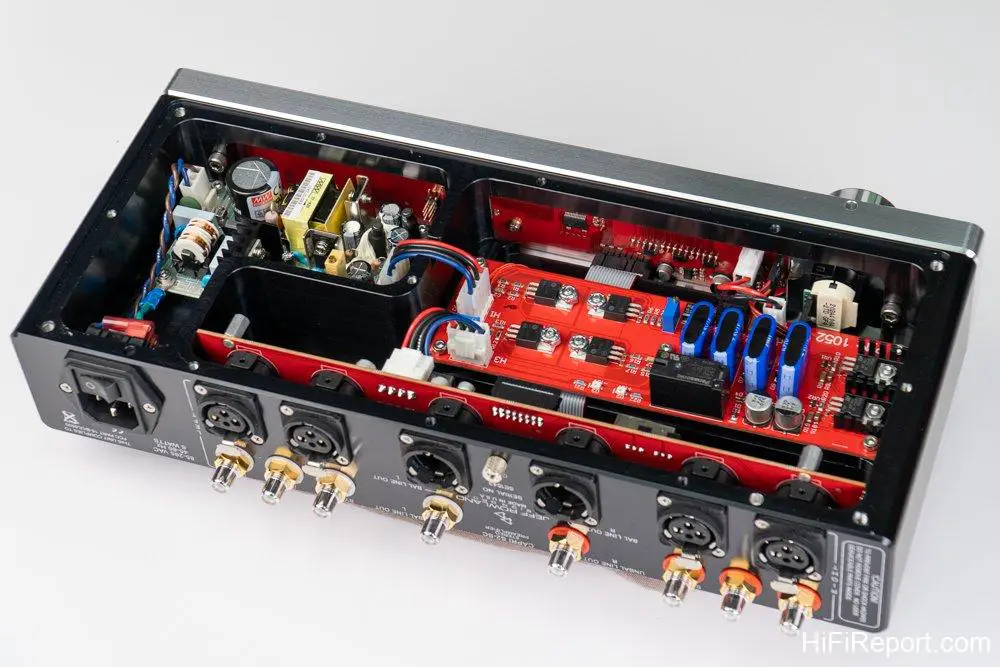
This board represents the most significant difference between the Capri S2-SC and its predecessors.
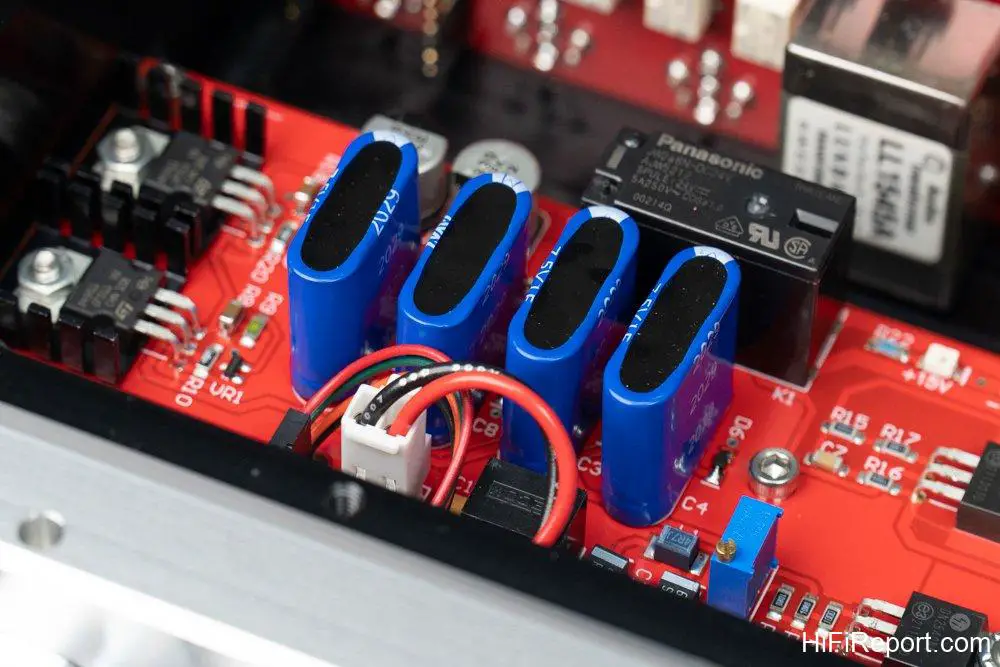
Observe the four prominent, flat-topped blue capacitors on the red circuit board. These are supercapacitors, designed to provide exceptionally clean DC power, similar to batteries, but with a significantly longer lifespan.
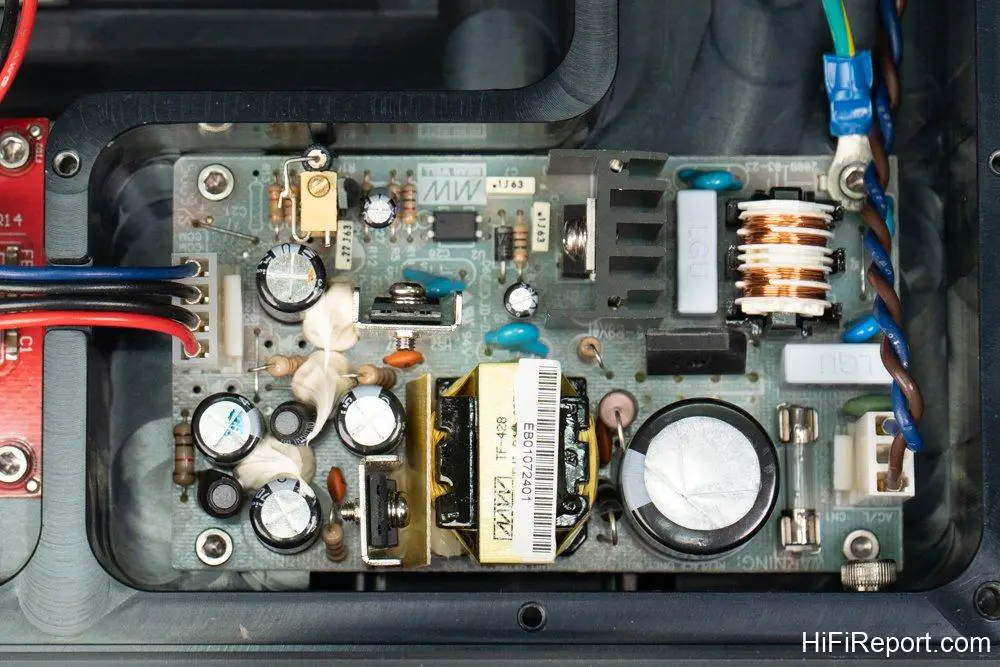
Essentially, this red circuit board houses a supercapacitor-based pure DC power supply. It is fed by a switching power supply located on the right side of the chassis. Previous Capri models, lacking the supercapacitor circuit, were powered directly by a similar switching power supply. The addition of supercapacitors in the Capri S2-SC undoubtedly results in a cleaner power source compared to its predecessors, suggesting improved signal-to-noise performance.
Furthermore, the use of a switching power supply allows the Capri S2-SC to operate on both 110V and 220V, enhancing its versatility.
Smooth Volume Control
The supercapacitor power supply feeds two main sections: the input/output interface and audio amplification circuit board, mounted on the rear panel, and the logic control and volume control circuit board, affixed to the front panel.
These two sections are likely carried over from the Capri S2 without significant changes.
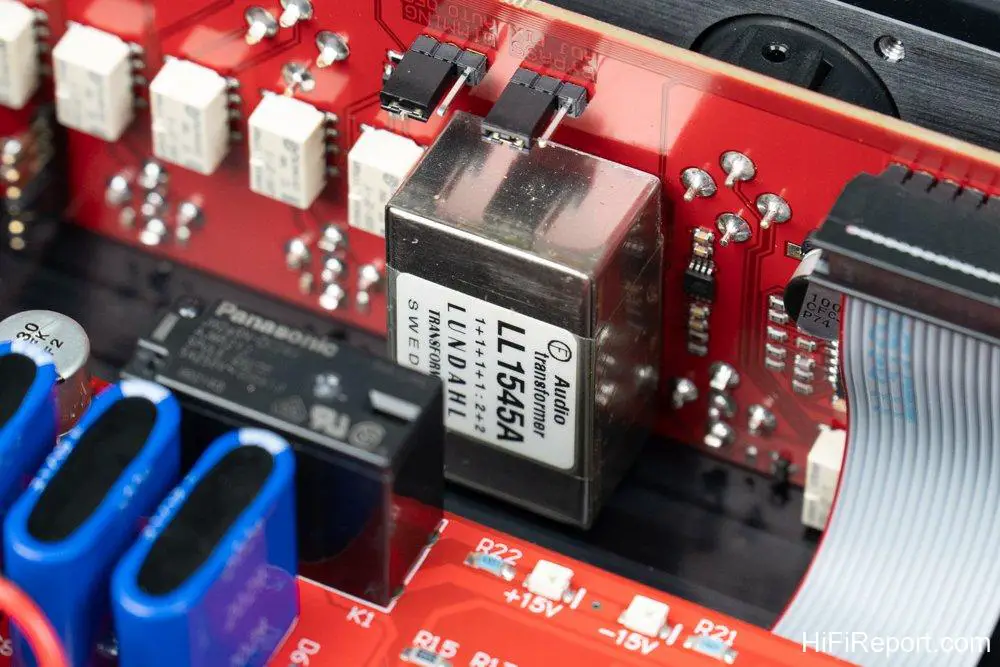
On the audio circuit board, the most prominent components are the Lundahl LL1545A audio-grade input transformers. One is used per channel for stereo operation. Their function extends beyond impedance matching with upstream equipment; they effectively isolate ground loop noise and EMI/RFI interference. They also leverage Common Mode Rejection Ratio (CMRR) to further enhance signal-to-noise performance, resulting in a purer sound.
The logic control circuit board houses the crucial volume control system. The Capri S2-SC employs an optical encoder to control the volume chip, offering 0 to 99.5 dB of attenuation in 0.5 dB steps. This provides a total of 199 discrete steps for exceptionally fine and precise volume adjustments.
Moreover, the tactile feel of the front panel volume knob is remarkably refined. It offers a slightly weighted resistance, enabling precise 0.5 dB adjustments with small rotations, while also allowing for rapid volume changes without excessive turning. The user experience is exceptionally smooth and intuitive.
Phono Stage Option
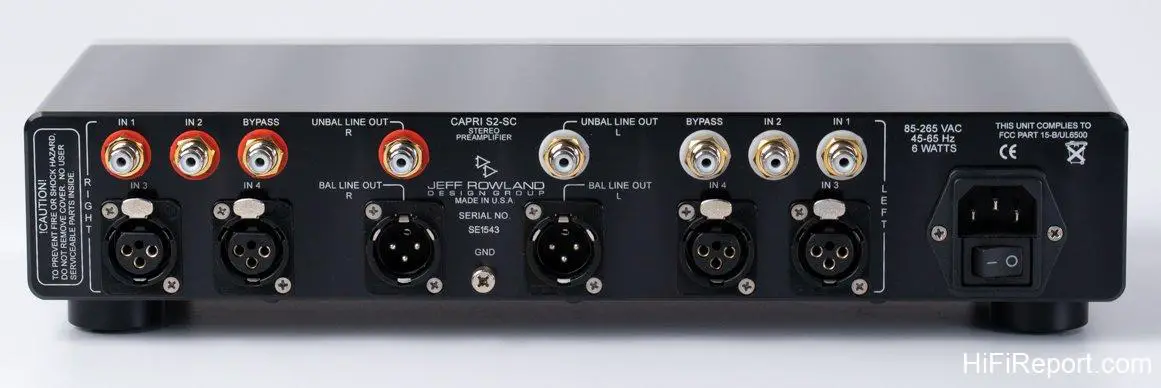
The rear panel of the Capri S2-SC features two sets of XLR balanced input terminals and two sets of RCA unbalanced input terminals. An additional set of Bypass RCA inputs is provided for integration with a home theater system, allowing connection to the main channel pre-amplifier outputs of a surround sound receiver.
Engaging the Bypass function requires accessing internal jumpers by removing the bottom plate.
Adjacent to these jumpers, another set controls the screen auto-off feature. When enabled, the display illuminates only during operation and automatically turns off five seconds after the last adjustment, minimizing potential interference with the audio signal.
The Capri S2-SC is primarily a line-level preamplifier, but it can be equipped with an optional phono stage module. Installation of the phono module occupies input 1, which is an RCA input.
Two phono stage module options are available: a standard version and a high-performance HP version. The standard version accommodates both MM and MC cartridges and offers three selectable impedance settings. The HP version is specifically designed for MC cartridges and features a Lundahl input transformer for impedance switching, catering to the requirements of various MC cartridges.
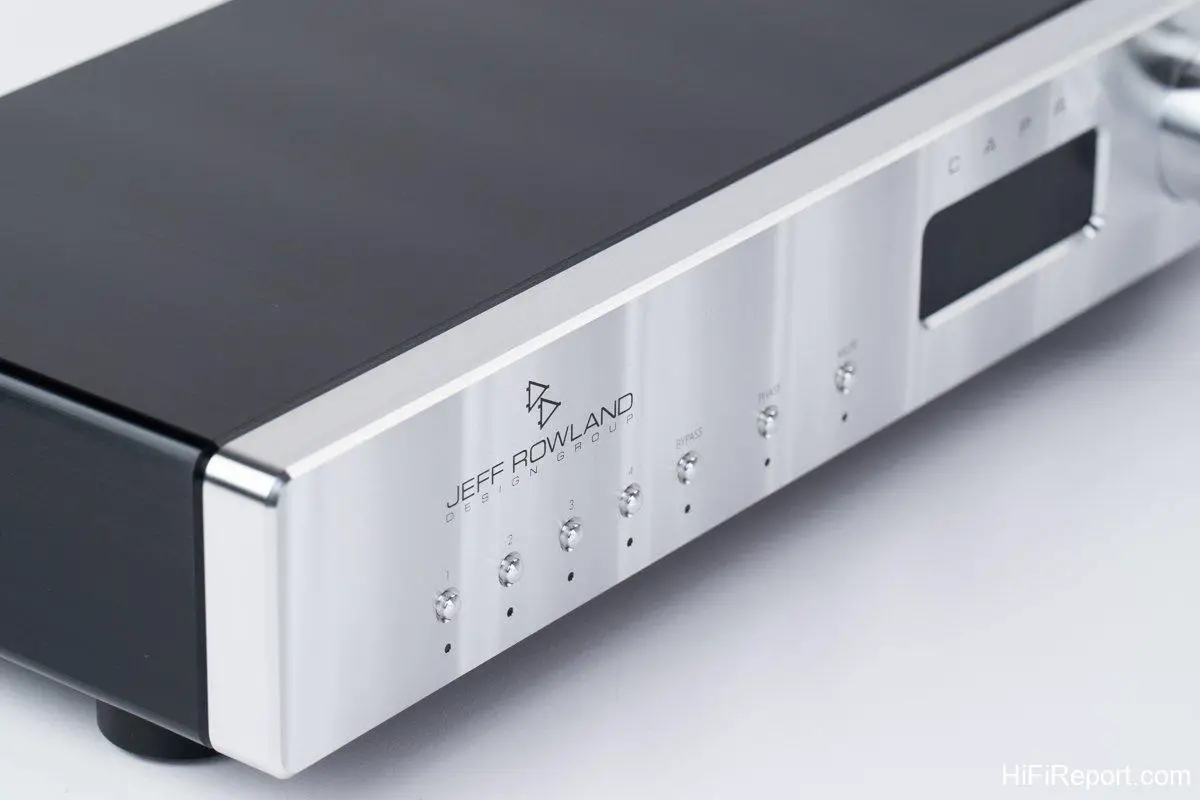
The front panel display of the Capri S2-SC, while providing only volume level information, is perfectly adequate. The large, clear digits are easily readable from a distance.
Below the display on the left side are buttons for input selection (1-4 and Bypass), phase (polarity reversal), and mute.
All these functions are also accessible via the included remote control. Additionally, the remote offers balance adjustment and manual display on/off control.
Importantly, the remote’s volume control is as smooth and precise as the front panel knob. Each press of the remote volume button corresponds to a 0.5 dB increment. Holding the button initiates continuous volume adjustment, which is remarkably smooth and responsive, stopping precisely when released.
In summary, the Capri S2-SC provides a comprehensive feature set sufficient for everyday music listening.
Exquisite Metalwork
The chassis of the Capri S2-SC is meticulously crafted from a solid block of aerospace-grade 6061-T6 aluminum alloy using precision CNC machining. This construction provides high rigidity, low resonance, and excellent shielding properties. Internally, a dedicated cavity is milled out for the switching power supply, further isolating potential noise interference.
The front panel is also machined from solid aluminum. The wave-like, gradient finish is achieved through precision diamond-tipped engraving, creating subtle, tactile undulations that are incredibly refined – a true testament to masterful craftsmanship.
The Capri S2-SC lacks a front panel power switch. A main power switch is located on the rear panel, beneath the power socket. This design suggests that the Capri S2-SC is intended to remain powered on continuously. With a mere 6-watt power consumption, it is energy-efficient, and maintaining a constant operating temperature ensures it is always ready to deliver optimal performance.
An Approachable Audio Companion
During my listening sessions, I opted not to engage the 5-second auto-off display feature. Instead, I used the Dim button on the remote to turn off the display when not actively listening, and reactivated it when needed, avoiding any potential screen burn-in and maximizing display longevity.
The listening evaluation took place in my home setup, comprising an Auralic Aries G1 wireless streaming transport, Holo Audio Spring 3 DAC, NnPrime Evolution One power amplifier, and Aurum Cantus Grand Harmony loudspeakers. My reference preamplifier was the Electrocompaniet EC 4.8.
Listening to the Capri S2-SC was a consistently comfortable and enjoyable experience. Its sound signature possesses a gentle warmth and smoothness, devoid of harsh edges or aggressiveness. It encourages relaxed listening, even at higher volumes, without inducing fatigue.
In comparison, the EC 4.8 exhibits a more assertive and defined sound, with a distinctly bolder character, akin to a robust and muscular figure. The Capri S2-SC, on the other hand, presents itself as a more affable companion, effortlessly approachable and engaging.
Playing “Mancini’s Greatest Hits,” a compilation of works by the renowned film composer Henry Mancini, conducted by Erich Kunzel and the Cincinnati Pops Orchestra, revealed the Capri S2-SC’s strengths. Tracks like “Moon River” and “Days Of Wine And Roses,” with their beautifully lyrical melodies and delicate string arrangements accompanying the chorus, were rendered with a pleasing warmth and fullness in the string sections. The sound was nuanced and controlled, avoiding both vagueness and heaviness. The strings flowed like velvet, both graceful and harmonious, light yet stable.
Furthermore, the Capri S2-SC’s harmonious presentation was underpinned by clear layering and rich textural detail. The layered strings remained distinct and coherent, with individual instrumental lines and bass frequencies discernible, demonstrating impressive resolution.
Timeless Preamplifier
Aligned with its focus on comfortable listening, the Capri S2-SC presents a more relaxed approach to image definition and soundstage rendering. The soundstage is open and expansive, with realistically sized and positioned images, faithfully conveying the original recording’s spatial characteristics.
Using the 2016 Hong Kong High-End Audio Visual Show commemorative CD, featuring a live recording of the National Symphony Orchestra conducted by Lü Shao-Chia at the National Concert Hall, the Capri S2-SC immediately showcased its well-defined and naturally proportioned soundstage in the Verdi “The Force of Destiny” overture. The spatial relationships between high, mid, and low frequencies were balanced and coherent, with smooth and natural extension across the frequency spectrum. Even the most dynamic passages were rendered with ease and fluidity, and at very high volumes, the sound maintained excellent balance, highlighting its performance capabilities.
Many might assume, based on its size and appearance, that the Capri S2-SC delivers a delicate, small-scale sound. However, this is not the case; its sonic presentation is surprisingly grand and substantial.
One of the most rewarding aspects of the Capri S2-SC is its ability to handle high-volume rock music. Its smooth and extended frequency response (10 Hz – 350 kHz / -3 dB), open soundstage, and slightly softer tonal character ensured that during my listening sessions, I never encountered harsh highs or constricted imaging. Nor did I experience any dryness, harshness, or coldness, let alone any sense of strain or edginess. This sonic profile makes it ideal for enjoying rock and pop music at higher volumes, offering both ease and warmth.
In conclusion, the Capri S2-SC is a preamplifier that combines striking aesthetics, exceptional build quality, user-friendly operation, comprehensive functionality, and high-quality sound performance. The option to add a phono stage module further enhances its versatility. This timeless and enduring preamplifier is certainly worthy of serious consideration.
Specifications
* Type: Preamplifier
* Total Gain: 14 dB
* Gain Range: 99.5 dB, 199 steps, equal increments
* Frequency Response: 10 Hz – 350 kHz / -3 dB
* Phono Module (Optional): Compatible with MM and high-output MC cartridges, adjustable loading and gain.
* Inputs: XLR × 2, RCA × 2, RCA bypass × 1
* Outputs: Balanced output × 1, Unbalanced output × 1
* Dimensions: 350 × 67 × 157 mm (W×H×D)
* Weight: 4.26 kg