
JL Audio E-Sub e112 Review
JL Audio, a venerable American company, was founded in 1975 by James Birch and Lucio Proni – thus the name JL. By 2025, the brand will boast a fifty-year history. Despite its long standing, it’s a relatively new entrant to the market here, and thus perhaps less familiar to many audiophiles. Even as Editor-in-Chief, this is my first encounter with JL Audio equipment, and frankly, it was a refreshing and quite astonishing experience.
2.1: An Affordable Path to Full-Range
Why do I describe the E-Sub e112 listening experience as “astonishing”? The traditional path to achieving a “full-range” audio system typically involves substantial loudspeakers. Reproducing low frequencies requires sufficiently large drivers and cabinet volumes to extend down to 20 Hz while maintaining adequate sound pressure and quantity. This is a fundamental constraint of acoustics, inevitably leading to significant investment in main speakers. The 2.1 channel setup, utilizing bookshelf or small floorstanding speakers paired with a subwoofer, presents a comparatively affordable shortcut to approaching full-range performance.
However, successfully implementing a 2.1 system introduces another challenge: how to manage crossover and low-frequency integration effectively.
In contrast, multichannel systems are generally easier to configure than 2.1 setups. In a 5.1 system (or any with a .1 channel), the subwoofer has a dedicated signal output, making direct connection straightforward. A two-channel system, however, only provides left and right stereo signals, lacking a distinct .1 subwoofer signal. The challenge then becomes how to achieve a “seamless transition” between the subwoofer and the main speakers.
Two Key Features for Seamless 2.1 Integration
When auditioning the E-Sub e112, I discovered it’s not only suitable for multichannel applications but also features two major strengths specifically designed to solve the integration challenge in 2.1 systems. Its ease of pairing, flexibility, and simple adjustment process are precisely what I found so impressive about JL Audio.
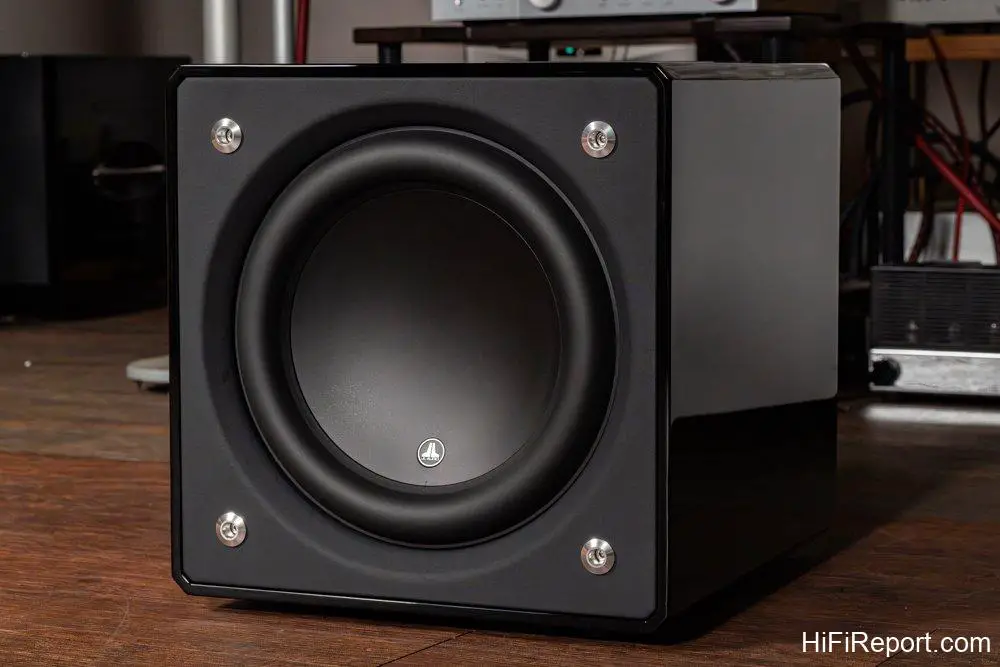
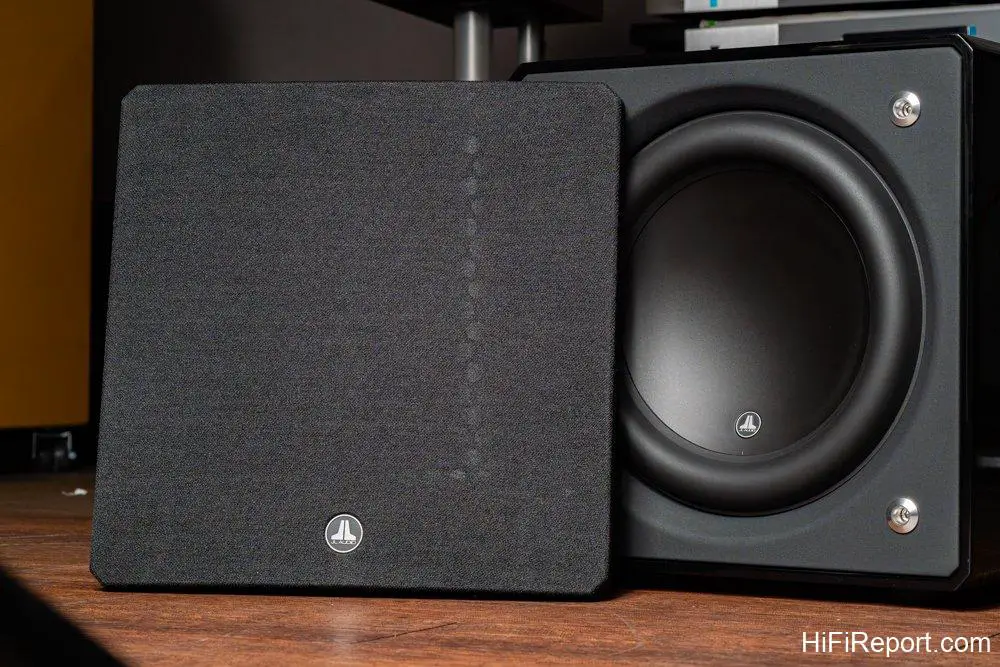
Let’s focus on the E-Sub e112’s suitability for 2.1 systems – a compelling reason for two-channel enthusiasts to consider a JL Audio subwoofer. I’ll delve into how the e112 makes 2.1 system setup effortlessly seamless during the practical listening section later.
JL Audio’s High-Tech Engineering
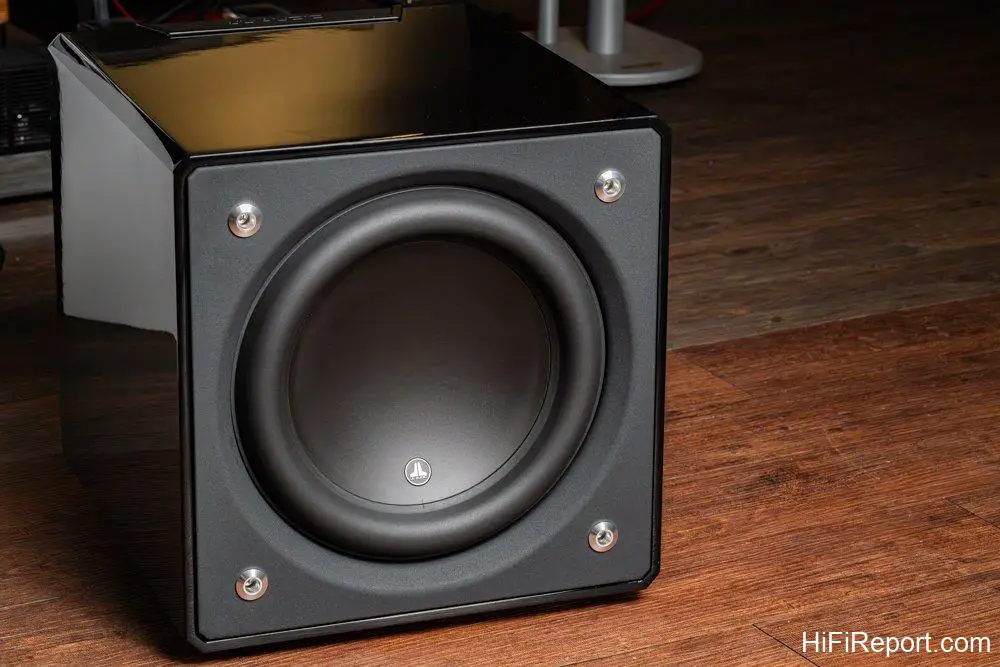
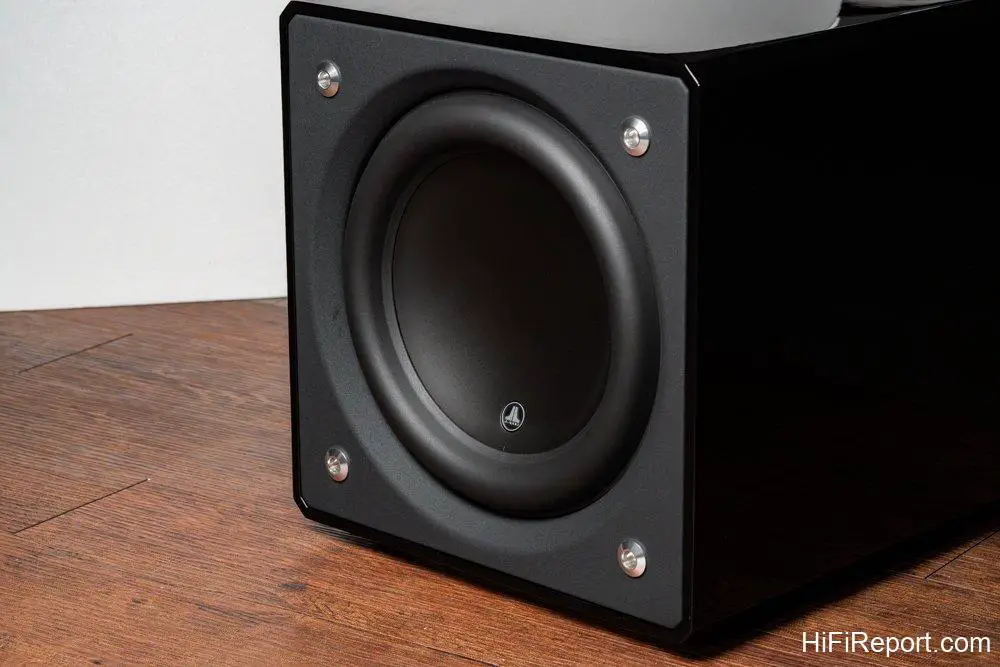
Before getting into the listening experience, I want to discuss the E-Sub e112’s design. JL Audio’s official technical information is quite substantial. The e112, in particular, features five significant proprietary technologies: DMA Optimized Motor Design, True Two-Way Crossover, Vented Reinforced Collar (VRC), Floating Cone Attached Method (FCAM), and Engineered Lead-Wire System. Each is grounded in solid acoustic physics, making this a subwoofer with considerable technological depth.
I’ll explain each feature in detail below, but feel free to skip ahead a couple of thousand words if technical specifics aren’t your primary interest.
DMA Dynamic Motor Analysis
The first proprietary technology in the E-Sub e112 is the DMA Optimized Motor Design. DMA stands for Dynamic Motor Analysis.
JL Audio began developing DMA in 1997, utilizing Finite Element Analysis (FEA) for dynamic modeling to study the behavior of a subwoofer driver’s magnetic motor under dynamic operation. This contrasts with traditional Thiele-Small or low-power measurements, which typically assume the magnetic motor is a fixed field unaffected by the driver’s mechanical motion – essentially a static measurement. DMA employs dynamic modeling to analyze the impact of voice coil, surround, and cone movement on the magnetic motor, identifying issues and proposing solutions.
What problems does DMA identify? Simply put, how the mechanical action of the driver causes non-linearity in the magnetic motor’s performance. Through dynamic modeling, JL Audio discovered that changes in power, current, excursion, and other factors during driver operation cause non-linear variations in the magnetic motor. Based on this dynamic modeling, JL Audio can design subwoofer drivers with the most linear operation possible, thereby reducing distortion.
Two-Way 4th Order Crossover for Frequency Integration
The second unique technology in the E-Sub e112 is the True Two-Way Crossover. This feature is specifically for applications pairing the subwoofer with a two-channel system, aiming to achieve excellent frequency integration between the subwoofer and the main speakers.
Two-channel outputs deliver full-range signals, unlike 5.1 multichannel systems where the .1 channel carries only subwoofer signals. Thus, when using the E-Sub e112 with a multichannel system, the Crossover switch should be set to “off.” However, when paired with a 2.1 system, enabling the Crossover is recommended.
What is the effect of engaging the two-way crossover? With a two-channel Line-in signal fed into the E-Sub e112, activating the Crossover sends the signal through a 24 dB per octave (4th order) Linkwitz-Riley low-pass filter, ensuring the subwoofer operates within the low-frequency range. Simultaneously, the Line-Out signal receives a 24 dB per octave high-pass filter, which is then sent to the power amplifier driving the main speakers. This prevents both the main speakers and the subwoofer from operating in the same low-frequency band; instead, the E-Sub e112 performs a 4th order crossover, effectively splitting the workload.
VRC for Enhanced Cooling: Keeping the Subwoofer Tight
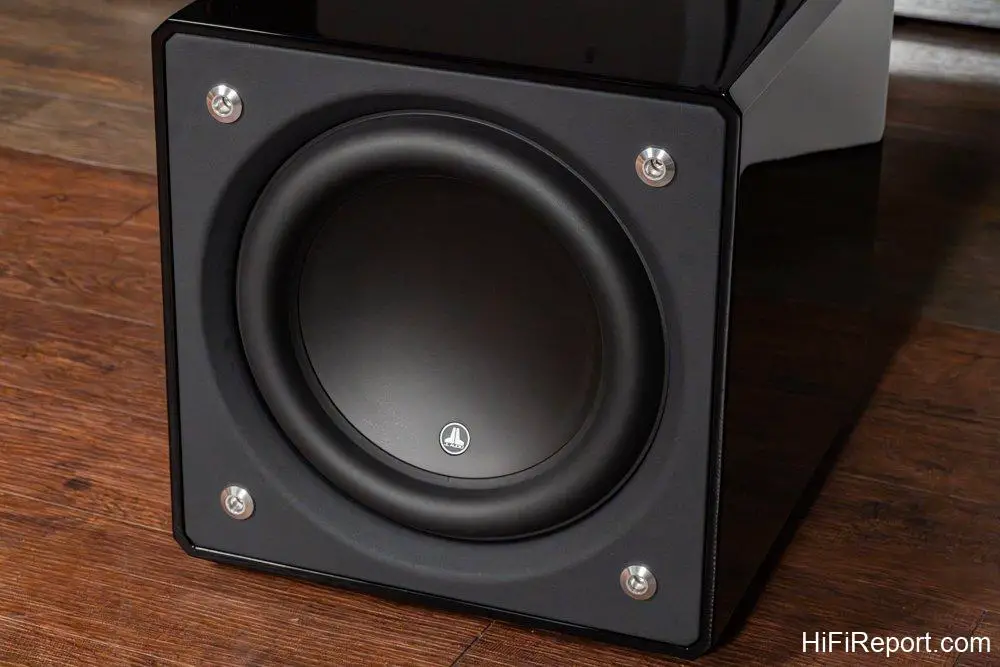
The third technology is the Vented Reinforced Collar (VRC). Because subwoofers are large and relatively heavy, requiring high power to drive, their voice coils generate significant heat. Therefore, effective cooling is crucial. The E-Sub e112 incorporates a VRC internally within the driver, situated at the junction of the cone, frame, and voice coil former. The vents on the VRC enhance airflow, improving heat dissipation.
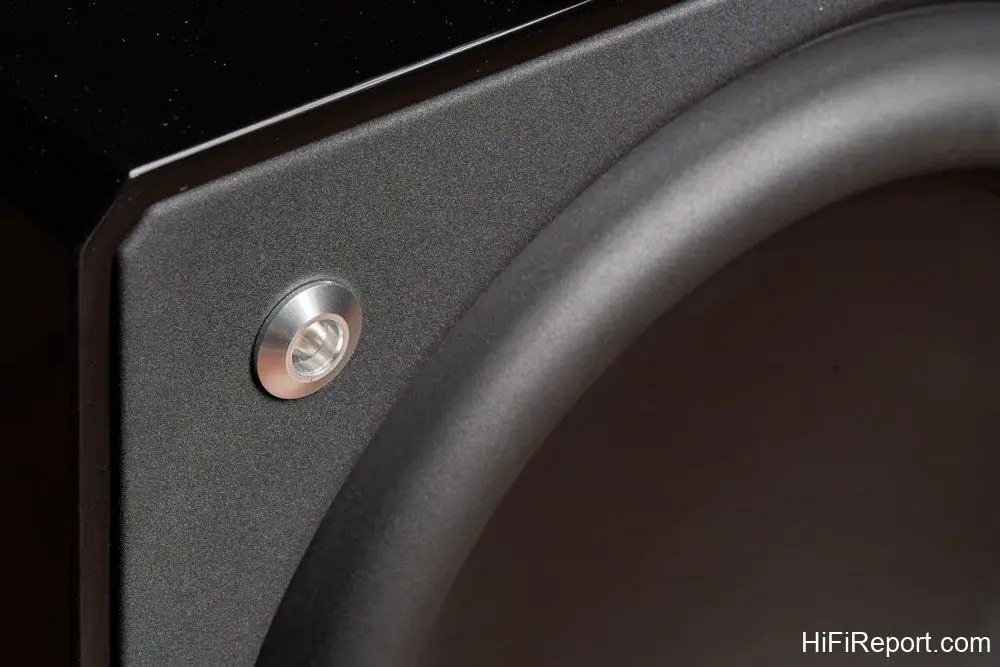
The fourth proprietary technology applied in the E-Sub e112 is the Floating Cone Attached Method (FCAM). This likely refers to JL Audio’s manufacturing process for their subwoofer drivers. They use specialized jigs to precisely align the surround, cone, voice coil former, and spider at the center. When assembling these components, instead of using high-pressure bonding, they employ a method that, while potentially allowing for slight physical tolerances at the connection points, ensures the driver’s mechanical center is perfectly aligned.
Unique Voice Coil Lead-Wire Design
The fifth technology employed in the E-Sub e112 is JL Audio’s patented Engineered Lead-Wire System. Subwoofers, due to their long-excursion design necessary to move sufficient air and reproduce deep bass, require lead wires connecting to the voice coil that are long enough to follow the driver’s extended piston movement.
Generally, there are two lead wire designs. One method involves making the lead wires long and tucking them into a groove behind the spider. This prevents the wires from interfering with the voice coil’s piston movement. However, bonding the lead wires to the spider can restrict the spider’s freedom of movement, which is a drawback. The second design is “flying leads,” where the wires are made long enough to move freely in the space between the cone and the spider. But under extreme operation, the wires can potentially contact the cone, causing mechanical noise, or they might break due to stress.
In simple terms, both traditional designs involve compromises, each with its pros and cons.
However, JL Audio’s patented lead wire design uses braided wire enclosed in a protective sleeve. This dual-component engineered design allows for higher excursion without the wire contacting the cone and causing mechanical distortion, while the protective sleeve eliminates the risk of short circuits.
JL Audio’s patented lead wire design appears to be an evolution of the flying lead concept, maintaining the wires’ freedom of movement while using braided wire and protective sleeves to prevent contact-induced mechanical distortion and enhance driver reliability.
Rare US Assembly in Florida
Finally, a notable characteristic of the E-Sub e112 is that the manufacturer emphasizes assembly at their factory in Mirama, Florida. For audiophiles who value country of origin, US assembly is certainly one of JL Audio’s selling points.
So, regarding the E-Sub e112’s five unique subwoofer technologies, the core aims are to reduce distortion, improve operational linearity, and enhance subwoofer frequency integration. Now, let’s move on to the practical listening tests!

The Option of 1, 2, 3, 4, or Even 5 Subwoofers
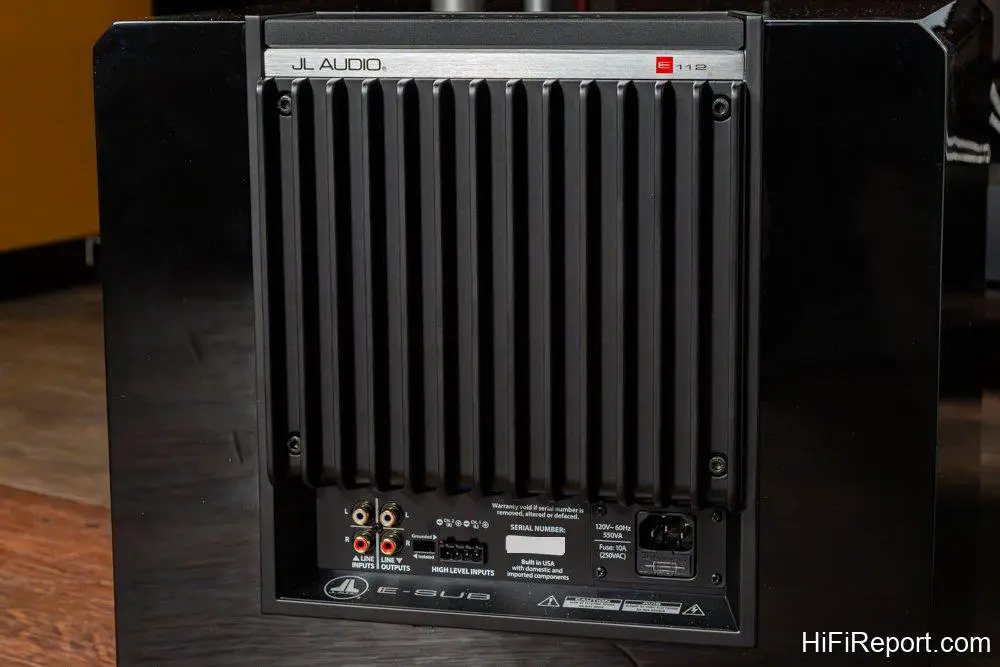
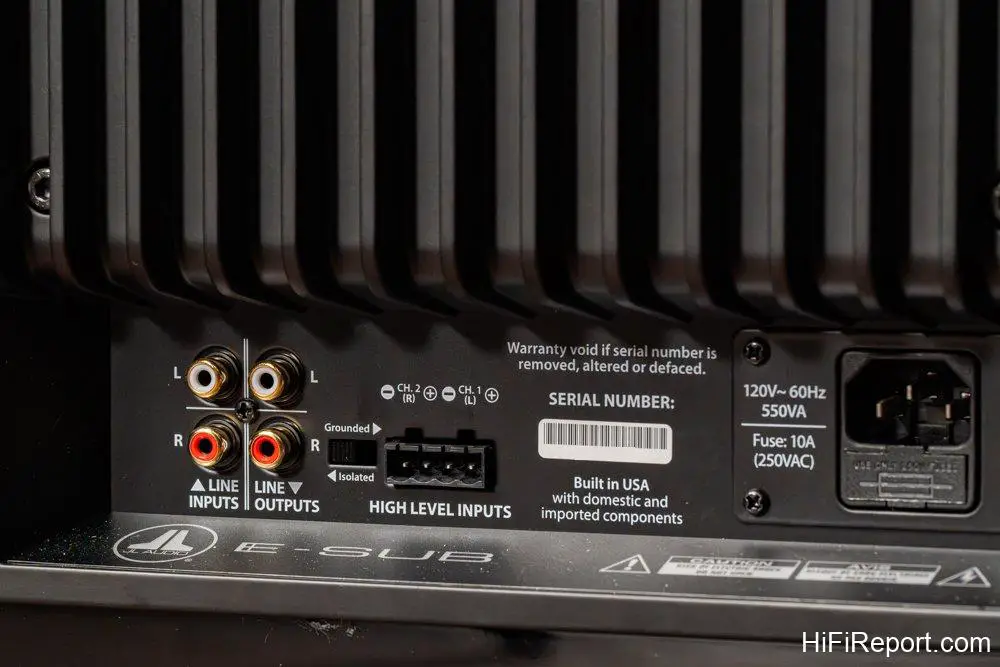
The E-Sub e112 features both RCA Line-in and high-level speaker wire inputs. The manufacturer provides terminals for connecting bare speaker wire, but as I didn’t have suitable cables on hand, I used the Line-in connection.
Here’s where the fun aspect of the E-Sub e112 comes in! The Line-in is stereo. If you only have one E-Sub e112, you would naturally connect it from your preamp’s Pre-Out. But what if you want to daisy-chain two E-Sub e112s? Simple. You can send signals from the Pre-Out to both the left and right subwoofer inputs, or you can daisy-chain using the Line-Out. Send the signal to the first subwoofer’s input (left or right), and then use its Line-Out to connect to the input of the second subwoofer (the other channel). This setup allows not just two E-Sub e112s, but three, four, or even five – just keep chaining them! JL Audio has cleverly designed this feature, which could certainly help them sell more subwoofers.

JL Audio’s Crossover is Essential for 2-Channel
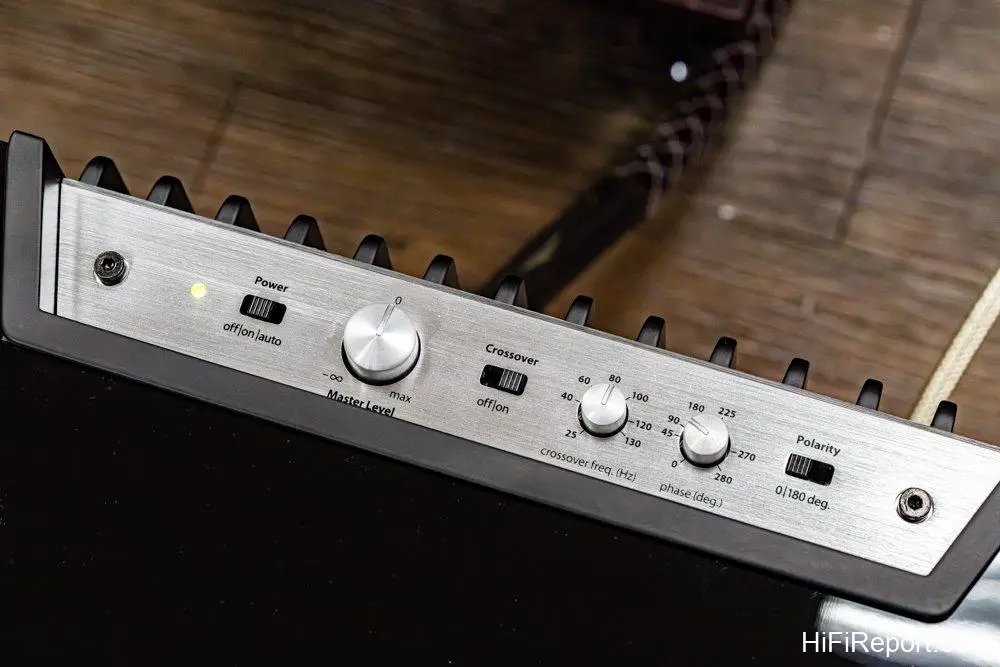
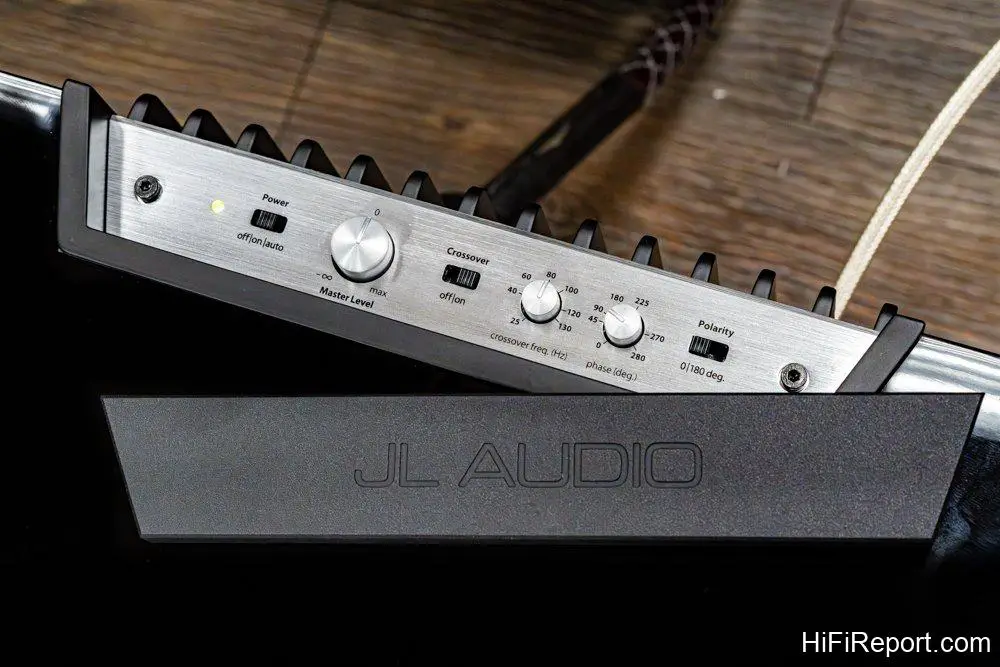
Next is the crucial setup point for the E-Sub e112. Since I was testing a two-channel 2.1 system, the Crossover was extremely important – definitely use it! My initial system pairing was a Cambridge Audio EXA100 integrated amplifier driving KEF Q Concerto Meta bookshelf speakers. I connected the EXA-100’s Pre-Out to the E-Sub e112’s Line-in. I set the subwoofer’s volume to “0” (the center detent), the crossover point to 80 Hz, the phase according to the manufacturer’s reference value of 80 (degrees), and the Polarity to the positive setting. I began by listening to AC/DC’s “Back In Black.”
The opening power chords of the muted electric guitar weren’t the main focus. What mattered was whether the subsequent bass guitar and drum rhythm could deliver that impactful, explosive low end – that’s the satisfaction of adding the E-Sub e112. With the initial simple settings, the E-Sub e112’s built-in 4th order crossover cut cleanly, and the integration between the Q Concerto Meta and E-Sub e112 seemed quite good. So, I left the first three settings untouched and proceeded to test the Polarity setting.
The Correct Polarity Setting Delivers Fuller Bass
While repeatedly listening to the intro of “Back In Black,” I switched the Polarity. There are only 0 and 180-degree options. Which position is correct? It depends on your listening space and subwoofer placement; your ears are the final judge.
How to listen? When listening to “Back In Black,” I focused on the kick drum pedal work that comes in during the intro. The Polarity setting that makes the kick drum feel more solid, more dynamic, and tighter is the correct one. After trying it back and forth five or six times, I decided on the 180-degree setting.
Movie Soundtracks Make the E-Sub e112 Driver Work Hard
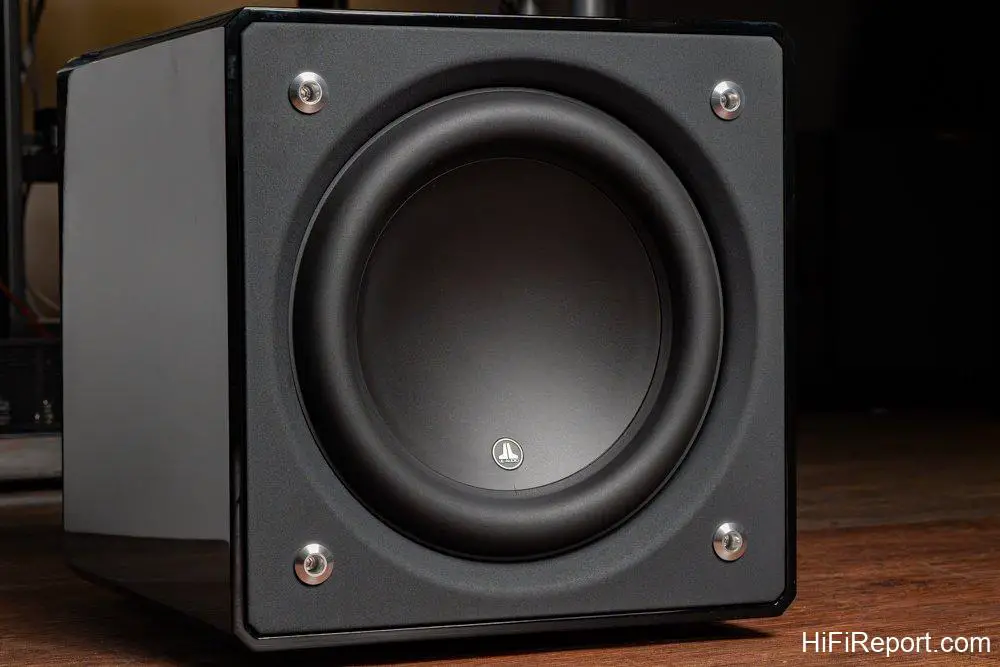
Using rock music on the E-Sub e112 only resulted in the 12-inch driver moving slightly. If you want to see the E-Sub e112 driver really jump, you need movie soundtracks.
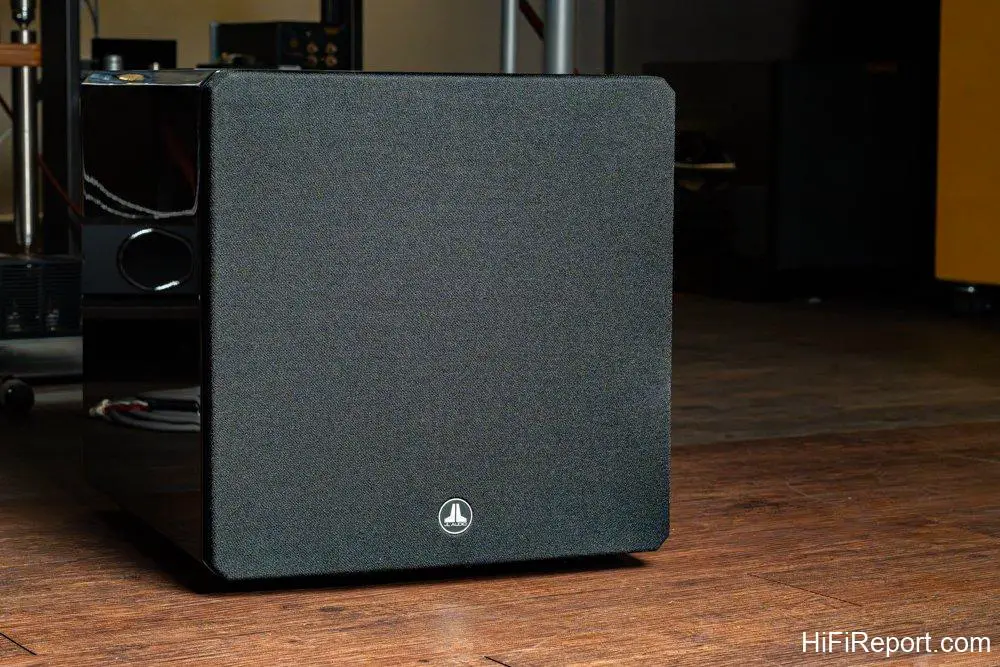
For instance, films like “Dune” or “The Dark Knight.” I don’t usually push subwoofers this hard, but the photographer wanted to capture video of the E-Sub e112 driver in significant motion, so I obliged. Fortunately, even with the uneven adjustments made “for video effect,” the E-Sub e112’s low-frequency response remained quite fast. Watching the driver move dramatically while pumping out booming movie sound effects, the E-Sub e112 certainly proved its mettle.
If the E-Sub e112 were a high-end JL Audio subwoofer, I might not find such controlled performance particularly remarkable. However, the E-Sub e112 is actually positioned in the entry-level to mid-range category. For a subwoofer priced around $3,100 to $3,400 USD, this level of performance is excellent – truly outstanding value. (Note: Based on typical conversion rates for Hi-Fi gear around this price point in 2024, NTD 100,000 is roughly USD 3,100-3,400 depending on the model and dealer margin).
Flexible Connection Methods for Preamp/Amp Pairings
The EXA100 and Q Concerto Meta pairing with the E-Sub e112 felt like a well-matched system. However, I next brought out the EAR 868P preamplifier and 509 MK II power amplifiers to explore different E-Sub e112 connection methods.
The most significant feature of the E-Sub e112’s design, particularly for 2.1 systems, is its internal 4th order crossover. When using the 868P and 509 MK II, you have options. You could use the 868P’s two sets of preamp outputs: one set to the 509 MK IIs and the other to the E-Sub e112. This way, the preamp’s volume control would simultaneously control the volume of both the subwoofer and the main speakers. Another connection method is to send the signal from the 868P preamp to the E-Sub e112 first, and then use the E-Sub e112’s Line-out to feed the 509 MK II power amplifiers.
Wait, both connection methods utilize the E-Sub e112’s internal 4th order Linkwitz-Riley crossover, right? What’s the difference? When pulling two sets of preamp outputs from the 868P, the E-Sub e112 and 509 MK IIs receive the same full-range audio signal. However, when using the E-Sub e112’s Line-out, the analog audio signal received by the 509 MK IIs has already passed through the high-pass filter, with the low frequencies removed. Therefore, although both methods use the E-Sub e112’s crossover, the signal path and the audio signal transmitted differ.
Subtle Differences in Sound with Different Signal Paths
Which connection method is better? Of course, you have to try both to find out. I started by running two sets of signals from the 868P preamp: one set to the 509 MK IIs and one to the E-Sub e112. Using the parameters established with the EXA100 and Q Concerto Meta, I listened to “Back In Black” again. Although I hadn’t adjusted the E-Sub e112’s volume, the pairing with the 868P clearly resulted in too much low-frequency output from the E-Sub e112. I slightly reduced the volume and crossover point to balance the output between the main speakers and the subwoofer. Then, I switched the connections, running the signal from the E-Sub e112’s Line-out to the 509 MK IIs.
What was the difference between the two connection methods? The subwoofer’s volume is adjustable, so the overall low-frequency quantity wasn’t the issue. However, concerning the frequency integration between the Q Concerto Meta and the E-Sub e112, connecting via the E-Sub e112’s Line-out felt cleaner and faster. Using the 868P’s two outputs to feed both the E-Sub e112 and the 509 MK IIs resulted in a slightly better sense of body and a subtle difference in tonal character. Personally, I preferred the method of using the 868P’s two sets of analog outputs. The difference isn’t about good or bad, but rather a matter of subjective listening preference. I recommend trying both methods before making your choice.
Adding “Breathing Room” to Large Floorstanders
Finally, it was time for the Wilson Audio Alexia V to enter the scene. Using two sets of signals from the 868P, one to the 509 MK IIs and one to the E-Sub e112, I switched to the Alexia V. I lowered the crossover point further, down to around 50 Hz. Why isn’t the value precise? Because the dial marking was between 45 Hz and 60 Hz, so it’s hard to say if it was exactly 50 Hz or 55 Hz. The goal was to make it sound right, ensuring the main speakers and the subwoofer didn’t overlap too much, adding a bit more weight to the lower end while simultaneously opening up the soundstage for a greater sense of space. That’s roughly the sweet spot for adjustment.
When listening to a 2.1 system, knowing if your adjustments are correct hinges on whether you can “hear the location of the subwoofer.” If you adjust the subwoofer and always perceive the bass guitar and other low frequencies emanating from the vicinity of the subwoofer, it indicates the adjustment isn’t quite right yet. However, if you adjust the E-Sub e112’s volume, crossover point, phase angle, and absolute phase to the sweet spot, you should ideally not be able to pinpoint the subwoofer’s location. Instead, it should feel like it’s simply adding “a bit more breathing room” to the overall sound – that’s when you know you’ve got it right!
Subwoofer Enhancement for Greater Immersion
Switching to the Alexia V, it was still a 2.1 system, but the sense of scale was significantly greater than with bookshelf speakers. Although the Alexia V is certainly capable of full-range reproduction on its own, adding the E-Sub e112 to supplement the very lowest frequencies undeniably added a touch more weight. More importantly, the Alexia V, when supported by the subwoofer, gained a more expansive and transparent sense of space. It’s this subtle addition of “air” that significantly enhances the immersive quality of the listening experience.
Listening to rock music earlier was, to put it mildly, “a piece of cake.” With the Alexia V paired with the E-Sub e112, it was time for Mahler. Listening to Bernstein conducting the Vienna Philharmonic in Mahler’s Symphony No. 5, the funeral march in the first movement features brass emerging from the depths of the soundstage. With the E-Sub e112, the depth of the soundstage was beautifully rendered. The trumpet’s four-note motif, pressing onward with each phrase, soaring upwards, while the cymbals punctuate the orchestral texture. Even during the trumpet passages, which have almost no low-frequency content, touching the E-Sub e112’s diaphragm revealed subtle vibrations. These were the minute low-frequency sound cues hidden within the recording of the space itself, expanding the Alexia V’s soundstage into something more transparent and profound! Following the pace of the funeral march, the strings played their ethereal melody. The music itself had relatively few extreme low frequencies, and the E-Sub e112 seemed inactive, perhaps only lazily pulsing along with the pizzicato of the double bass. But when I approached the E-Sub e112, listening to the music while touching the diaphragm, the E-Sub e112 was constantly in motion, reproducing the low frequencies in the recording, completely fleshing out the atmosphere of the orchestral performance.
Having used the EXA100, Q Concerto Meta, 868P, 509 MK II, and Alexia V in rotation, paired with the E-Sub e112, have I exhausted all possibilities? Not yet. Given its Line-in/Line-out configuration, the E-Sub e112 is actually very suitable for a 2.2 setup. Furthermore, you can use two sets of preamp outputs to feed two E-Sub e112s, or feed one E-Sub e112 with a single set of outputs and then daisy-chain to another E-Sub e112 from its Line-Out. This allows not only for dual subwoofers but potentially 3, 4, or even 5 E-Sub e112s – that would be truly a wild setup!
Practical Adjustment Was Smooth and Seamless
From a technical perspective, the E-Sub e112 boasts five major proprietary technologies, demonstrating considerable engineering depth. However, based on my practical experience with the E-Sub e112, I believe its main strength lies in its “ease of adjustment.” Regardless of the system I paired it with, I only needed to make minor adjustments to the crossover point and phase angle, and finally set the Polarity switch. With each speaker change, I could achieve proper integration within about three to five minutes. Furthermore, the subwoofer’s operational linearity is excellent, allowing for seamless volume matching with the main channels.
What did I miss during this review? A 2.2 system with two E-Sub e112s, effectively creating a four-piece speaker system. Four-piece systems often cost millions of dollars, but the E-Sub e112, priced around $3,100 to $3,400 USD each, allows for a four-piece system at less than half the cost. Next time, I’ll borrow a second E-Sub e112 to try a compact four-piece system and report back on the experience.
Specifications
* Type: Sealed Subwoofer
* Frequency Response: 22–118 Hz (+/- 1.5 dB) / 21 Hz (-3 dB) / 17 Hz (-10 dB)
* Built-in Power: 1,500 Watts
* Input Terminals: RCA x 2 (Stereo or Mono), High-Level Speaker Wire Input
* Output Terminals: RCA x 2 (Stereo or Mono)
* Volume Control: Mute to +15 dB
* Filter Mode: Low-Pass Filter
* Low-Pass Crossover Slope: 24 dB/Octave Linkwitz-Riley
* Crossover Range: 25 Hz–130 Hz
* Phase: Adjustable 0-280 Degrees (Reference point 80 Hz)
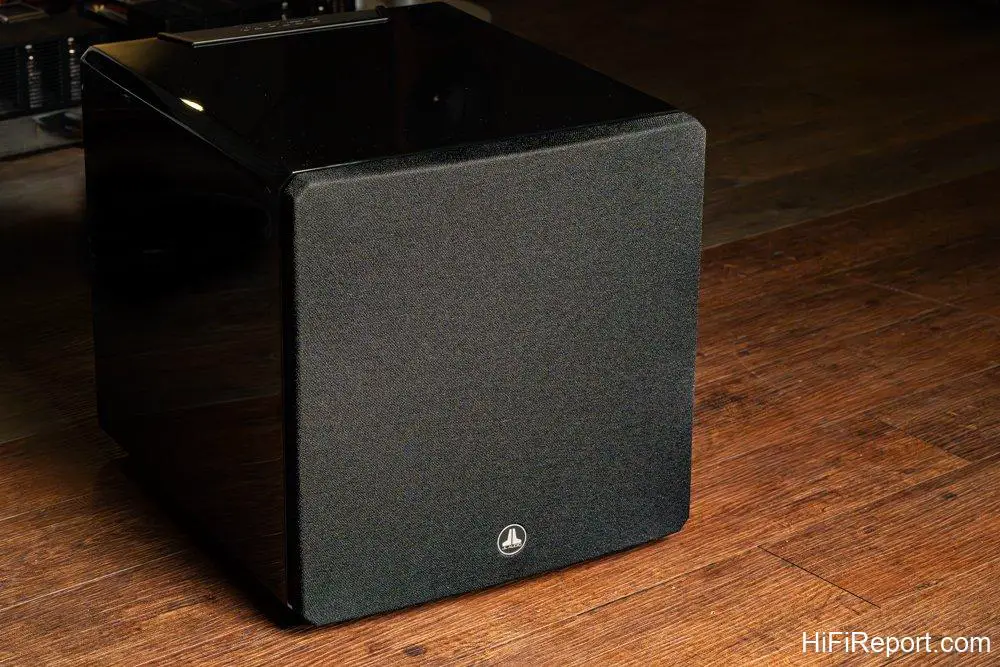
* Dimensions: 394 x 412 x 467 mm (W x H x D)
* Weight: 33.3 kg