
Kali Audio LP-6 Active Speaker Review
While this marks my first encounter with Kali Audio, an American audio brand, the LP-6 active speakers have delivered an unbelievably good sound that redefines value. I am confident that within this price range, it would be impossible to assemble a superior-sounding amplifier and passive speaker combination. Furthermore, their studio monitor-level accuracy makes them the perfect entry point into the world of high-fidelity audio.
Pursuing Unmatched Performance-to-Price Ratio
Kali Audio, a newcomer to the audio scene in January 2018, focuses on professional studio monitors. Based in Burbank, California, near numerous Hollywood-serving recording studios, Kali Audio collaborates closely with these studios in designing their products. Their mission is clear: to engineer accurate and uncolored monitoring speakers while offering an unparalleled performance-to-price ratio.
The concept of performance-to-price ratio, or value for money, is not often emphasized in the high-end audio world. Many high-end brands pride themselves on “no compromise” and “best regardless of cost” approaches, leading to increasingly higher prices and exorbitant entry points. However, the professional recording market, fueled by the rise of personal recording studios and the YouTube creator industry, has created significant demand for recording monitors. Kali Audio’s pursuit of unmatched value is a direct and powerful response to this burgeoning market.
Components Alone Would Exceed the Price
The LP-6, the most affordable monitor in Kali Audio’s lineup, caught me completely by surprise with its specifications considering its sub-$700 price tag. This price barely covers a pair of passive speakers in many cases. Yet, the LP-6 boasts a dual amplifier module, DSP sound field control, and a wealth of monitor control options. Even for DIY enthusiasts, sourcing the drivers, power modules, DSP, and speaker cabinet separately would likely exceed Kali Audio’s retail price. It’s truly incredible value.
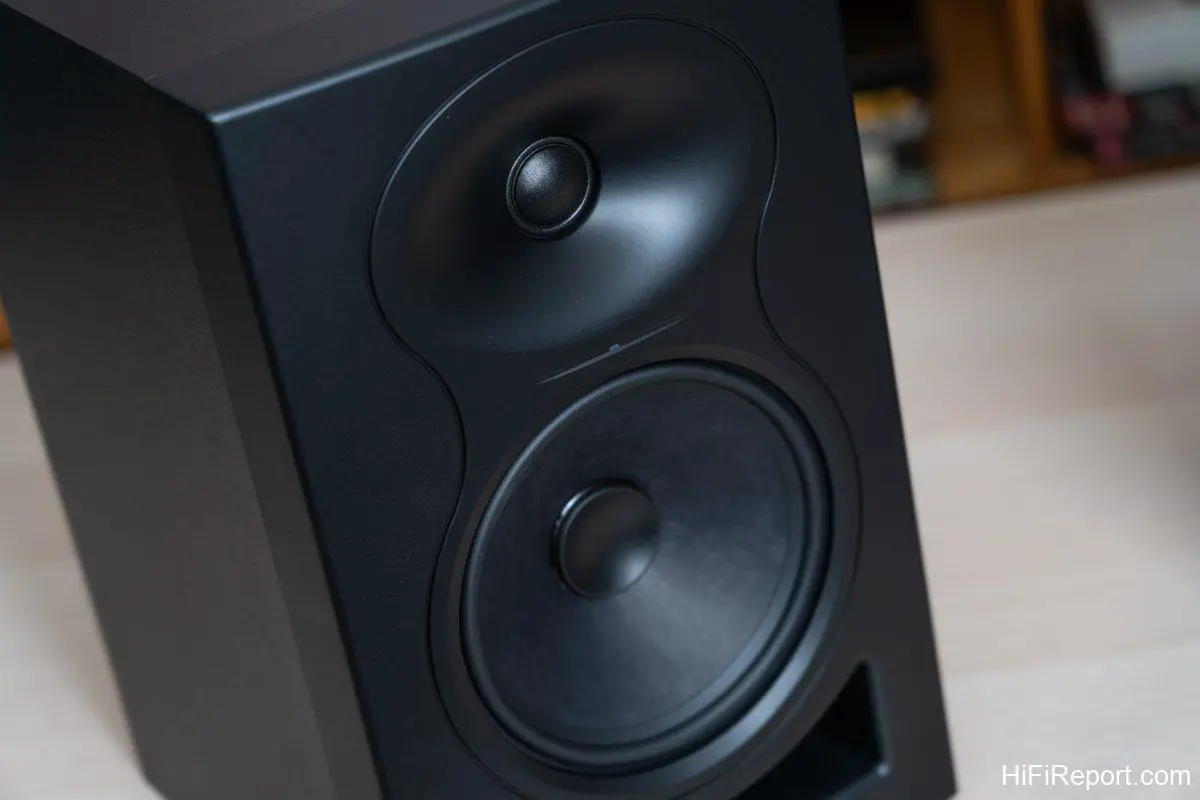
What do you get with the LP-6? These are two-way active speakers featuring a 1-inch soft dome tweeter and a 6.5-inch paper cone woofer. Each driver is powered by a dedicated 40-watt Class D amplifier module and digitally controlled by a DSP for electronic crossover, tuning, boundary EQ settings, and customizable high and low frequency trimming. Simply calculating the cost of these individual components highlights the exceptional value proposition of the LP-6.
Professional Design with Purposeful Engineering
Every aspect of the LP-6 embodies “design with purpose,” with specifications tailored to the discerning needs of professional music creators. Take the LP-6’s output volume, for example: it delivers 85 dB SPL at a distance of 2.9 meters with a 20 dB headroom.
What does this mean? The LP-6’s maximum SPL is 115 dB. Assuming a typical monitoring SPL of 85 dB, the 20 dB headroom provides ample reserve for sudden loud sounds like drum hits, explosions, or thunderous sound effects. The 2.9-meter listening distance is ideal for 1-2 person workspaces. For collaborations of three or more, the LP-8 model, designed for a 3.6-meter listening distance, offers an additional 2 dB of headroom.
Using studio monitors like the LP-6 not only provides greater SPL and headroom but also protects against speaker damage. The LP-6 incorporates a built-in limiter. If the output SPL exceeds the speaker’s limit, the limiter engages automatically, producing noticeable distortion to signal excessive levels and prompting volume reduction. While continuous operation with the limiter engaged could still potentially damage the speaker (given each driver has its own amplifier), most users would intuitively lower the volume, not just to protect the speakers, but more importantly, their hearing.
In terms of cabinet design, the LP-6 features a deliberately large front-firing bass port. This placement minimizes air turbulence noise associated with rear ports, and the large opening ensures consistent airflow velocity, enhancing low-frequency extension while maintaining clean, high-density bass.
The tweeter is surrounded by a 3D Imaging Waveguide, designed to precisely direct high frequencies. The paper cone woofer utilizes a large voice coil and magnet, improving driver linearity and enhancing dynamic range and clarity.
These product descriptions are not marketing fluff but rather professional language communicating solid acoustic engineering principles.
DSP Room EQ Compensation
In my opinion, the most impressive feature of the LP-6 is its Boundary EQ. These Boundary Compensation EQs, selectable via jumpers, allow users to optimize the LP-6’s frequency response for various room placements.
Speaker placement is a crucial concern for audiophiles. In any room, we hear a combination of direct and reflected sound. Minimizing the time difference between direct and reflected sound waves improves soundstage imaging and focus. While careful speaker placement can optimize listening position in a hi-fi context, studio monitors often have more constrained placements, frequently residing on recording desks or alongside digital audio workstations (DAWs), primarily for nearfield monitoring. Boundary EQs address these specific placement scenarios by providing tailored equalization compensation.
Kali Audio’s Boundary EQs are remarkably user-friendly. The LP-6’s rear panel features a diagram with eight setting options. Users simply select the diagram that most closely resembles their speaker placement and adjust the 1-3 DIP switches accordingly.
These preset Boundary EQ DSP values are derived from actual measurements taken by Kali Audio in real-world environments. These experiments were conducted at The Village Studios in Los Angeles, a renowned recording facility with over sixty years of history. Legendary artists like The Rolling Stones, B.B. King, and Bob Dylan have recorded albums there, and contemporary musicians such as Lady Gaga, Coldplay, and John Mayer have also graced its studios. The LP-6’s Boundary EQs are based on measurement data collected from actual placements within The Village Studios, providing meticulously crafted DSP compensation presets.
Could one claim that owning the LP-6 is akin to possessing the sound of The Village Studios? Perhaps that’s too much marketing hype.
2nd Wave Six Major Upgrades
Finally, regarding the LP-6’s design, it is essential to mention the 2nd Wave upgrade. LP-6 units manufactured after May 1, 2021, are 2nd Wave models, featuring six key improvements over the 1st Wave generation:
1. **Enhanced Power Module:** Increased maximum SPL by 3 dB without compromising driver integrity.
2. **Reduced Noise Floor:** Power module noise reduced by 12 dB, lowering background noise.
3. **Thinner Diaphragm Coating:** Improved driver efficiency.
4. **Matte Black Cabinet Finish:** Updated aesthetic.
5. **Optimized DSP Processing:** Smoother high-frequency response.
6. **Reduced Input Sensitivity:** Input sensitivity lowered by 3 dB, achieving higher output levels.
When purchasing the LP-6, it is advisable to confirm if it is the 2nd Wave version, as 1st Wave units cannot be upgraded. The factory has upgraded power modules, DSP, and even drivers, making an upgrade path impossible.
The technical specifications alone reveal the LP-6’s impressive setup flexibility, accommodating diverse nearfield monitoring requirements. The rear panel DIP switches also control +/- 2 dB high-frequency trim and input selection between RCA and XLR. Note that RCA input is -10 dBu, while XLR and TRS inputs are +4 dBu sensitivity. XLR and TRS inputs are mutually exclusive; simultaneous connection is not supported.
Minimalist Setup, Nearfield Excellence
For my listening session, I adopted a minimalist setup, using an iFi Go Blu as a DAC preamp, placed on an IKEA desk, creating a simple two-component audio system. However, the large IKEA desktop transmitted vibrations from the LP-6. To mitigate this, I placed IsoAcoustics Orea isolators under the LP-6, reducing vibration and elevating the speakers, which enhanced low-frequency clarity.
The LP-6’s sonic performance was genuinely surprising. It rendered a tangible and clear 3D soundstage even at very close distances, with remarkably precise imaging. My listening position, approximately 0.5-1 meter from the speakers, simulated a typical home recording setup at a workstation.
Consider Katja Werker’s “Contact With Myself 2.0,” a live recording from the German Stockfisch Records studio. The guitar in “Yes” originates from the left of the soundstage, the bass emerges from the center, a decorative guitar sits on the right, and Katja Werker’s vocals are centrally positioned, clear and focused.
The LP-6’s 3D soundstage is contained within the space between the speakers, not an expansive, boundless soundscape, but a precisely scaled and detailed one.
To draw a cinematic analogy, the LP-6 is like watching a movie on a high-resolution 27-inch monitor on your desk, while my reference speakers, the Wilson Audio Alexia 2, are akin to a 300-inch projection screen. The soundstage scale differs dramatically, but the imaging accuracy is excellent in both cases. The LP-6’s soundstage is smaller, but the recorded details and relative positions of instruments and vocals are remarkably precise and clear. The Alexia 2, in contrast, magnifies the soundstage tenfold. This comparison is inherently unfair, as they are not comparable systems, but the LP-6’s imaging precision far exceeded my expectations.
Clear Reproduction of Recording Characteristics and Styles
As studio monitors, Kali Audio emphasizes neutral and uncolored sound reproduction. Whether the LP-6 aligns with your definition of “neutral” requires personal listening, but in my experience, the LP-6 readily reveals the unique characteristics of different recordings. Stockfisch Records recordings, for example, exhibit particularly full mid-bass and a closer, more intimate soundstage.
Switching to Opus 3’s “Test CD 4” and listening to “Reunion Blues,” a track emphasizing recording space, depth, and dynamics, the LP-6 clearly demonstrated the recording’s pronounced spatial effects, significantly more prominent than those in the Stockfisch recording. The recording level was also comparatively lower. These nuances are critical for recording monitoring, and the LP-6 effectively conveyed the distinct sonic approaches of these two record labels.
Loud and Fearless Performance
Despite featuring only a 6.5-inch woofer, the LP-6’s bass performance is exceptional. Listening to Michael Jackson’s “Billie Jean,” the LP-6 clearly delineated the various recording effects. The kick drum had impactful force, the electric bass exhibited a slightly over-compressed, granular texture, Michael Jackson’s vocals were tightly focused in the center, and wide synthesizer chords and backing vocals filled the rear soundstage, creating a multifaceted stereo soundscape with forward and reversed elements. The LP-6 also operates linearly, maintaining excellent clarity even at low volumes and scaling linearly as volume increases. The LP-6 can reach ear-damaging SPLs without strain; if you need speakers that can play loud, the LP-6 will not disappoint.
For another example, consider John Mayer’s “Where the Light Is” live concert recording, specifically “Slow Dance In the Burning Room.” The LP-6 accurately reproduced a concise and tangible soundstage. John Mayer, naturally, takes center stage, his Fender Stratocaster positioned centrally. A second guitar occupies the left soundstage. By tracking the guitar positions, one can discern which phrases are played by Mayer and which are from the supporting guitarist. The right side of the soundstage felt slightly empty, possibly reflecting the actual stage setup, which the recording engineer preserved.
Engaging Listening Experience and Exceptional Value
My time with the LP-6 was filled with excitement. Not because the LP-6’s sound is universally grand and flawless, but because at such a modest price point, it delivers accurate and thoroughly enjoyable active speakers. If you are only familiar with classic Yamaha NS-series monitors, the LP-6 surpasses them in DSP parameter customization and user-friendliness, offering greater spatial adaptability and making them formidable tools for home recording. For those entering the world of hi-fi, the LP-6 is an active speaker offering exceptional value. You save on amplifier costs and can embark on your audio journey with a simple, streamlined setup. And once connected to your computer, consider using them for Netflix or Disney+ – prepare for a three-tier audio upgrade!
Specifications
* **Type:** 2-way 2-driver bass-reflex active bookshelf speaker
* **Drivers:** 1 x 1-inch silk dome tweeter, 1 x 6.5-inch mid-woofer
* **Frequency Response:** 39 Hz – 25 kHz
* **Crossover Frequency:** 1.5 kHz
* **Built-in Amplifier:** 80 Watts (40W + 40W)
* **Maximum SPL:** 115 dB
* **Input Terminals:** RCA, TRS, XLR (each x 1)
* **Dimensions:** H 359 x W 222 x D 260 (mm)
* **Weight:** 7.05 kg