
KECES P28 Linear Power Supply Review
KECES has been a vibrant force in recent years, consistently participating in exhibitions, both domestically and internationally, building a global brand presence. Their distribution network spans across regions, including Hong Kong, China, Southeast Asia, North America, Europe, and Australia/New Zealand.
For an audio brand, KECES truly sets an example: good products shouldn’t stay confined at home; they need to venture overseas! KECES’s product line is now clearly defined, divided into four series. The Superior and Essential series focus on amplifiers, phono stages, and DAC-headphone amplifiers. The Pier and Ultimate series represent their expertise in power supplies, with the former being DC linear power supplies and the latter AC power processors.
KECES offers power processing solutions that deliver noticeable and positive improvements without demanding a high price, which is precisely what KECES is renowned for.
Power Processing – Ample, Stable, Clean Supply
Having tested numerous KECES power processing products, I can attest to their consistently significant effects.
The vast majority of audiophiles acknowledge the importance of power quality. (I say “majority” to avoid argument, but if you didn’t believe in power’s importance, you wouldn’t be reading this article.) A fundamental understanding is that good power quality is essential.
This boils down to three key aspects: sufficient supply, voltage stability, and the absence of AC noise. Our approach to power processing essentially revolves around these three elements. Some enthusiasts install dedicated power lines for their audio systems to ensure ample supply and isolation from other household appliances – one solution. Others, perhaps due to wiring limitations or seeking even more refined power, opt for commercially available power processors. Virtually all power processors on the market aim to address these issues, providing a stable, ample, and clean power supply.
However, this is just AC power processing, the first hurdle every user and system needs to overcome. Whether to process or not is a matter of personal conviction. But now, another question arises: what about equipment and devices that run on DC power? KECES’s Pier series is designed to solve this very problem.
Why DC Linear Power Supply?
Two trends in recent years have elevated the importance of DC power supplies. The first is the rise of compact audio systems, including desktop setups and generally smaller, more elegantly designed audio components. Due to their size, these devices often lack internal space for robust power supply circuitry and, to achieve better isolation, rely on external power supplies. The unfortunate reality is that these external power supplies are frequently switching power supplies readily available from electronics retailers. “Switching power supply” – these words are jarring to many audiophiles! But that’s the manufacturer’s design choice, and as a consumer, you often have to accept it.
The second trend relates to the application and development of streaming playback. Streaming relies on networks, and basic equipment includes modems provided by internet service providers, as well as wireless routers for home Wi-Fi. Homes with numerous networked devices might also require network switches to expand network ports. (Let’s set aside audiophile-grade switches for now, some of which may have built-in power supplies.) Then, there are your streaming audio and video playback devices, such as music streamers and digital set-top boxes for TV and movies.
Have you noticed how these devices are powered? That’s right, often by those ubiquitous “wall wart” switching power supplies. This is where the problem lies. Switching power supplies aren’t inherently bad, but the generic, bundled ones often are. These are typically very inexpensive; you can find them online for very little, with various output voltage and current specifications. The concerning fact is that these switching power supplies themselves are major sources of noise. Imagine connecting a noise-generating power supply to your audio equipment – your system becomes saturated with noise! How can you expect good audio and video performance under such conditions? The solution? Provide them with a clean power source using a linear power supply. This is KECES’s approach.
KECES previously released the P8 and P3, named for their 8-ampere and 3-ampere output capacities, respectively. Both models offered selectable DC output voltages, allowing users to choose the appropriate version for their needs.
Rigorous Linear Circuit with Schumann Wave Generator
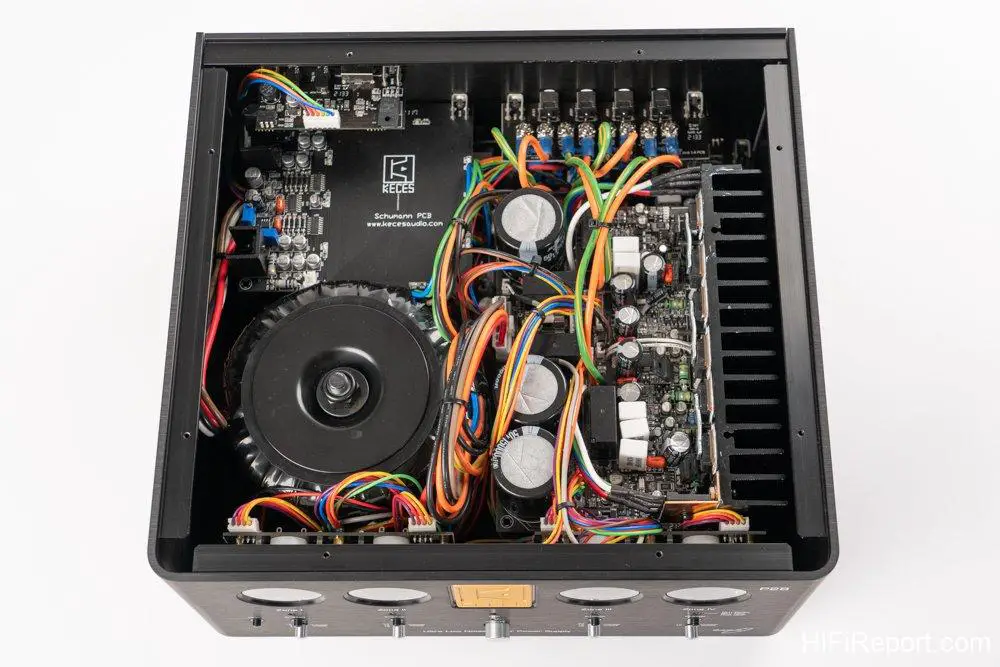
However, the newly launched P28 represents a significant evolution, with a design that is both unique and pioneering in the realm of DC power. Beyond its custom-wound, high-quality toroidal transformer, each output group maintains independent grounding, effectively suppressing ripple noise and hum to imperceptible levels. Internal overload protection circuitry is also implemented. In the event of current anomalies (like surges) or excessive operating temperature, a red indicator light on the front panel illuminates, and the outputs are automatically shut down to protect connected equipment.
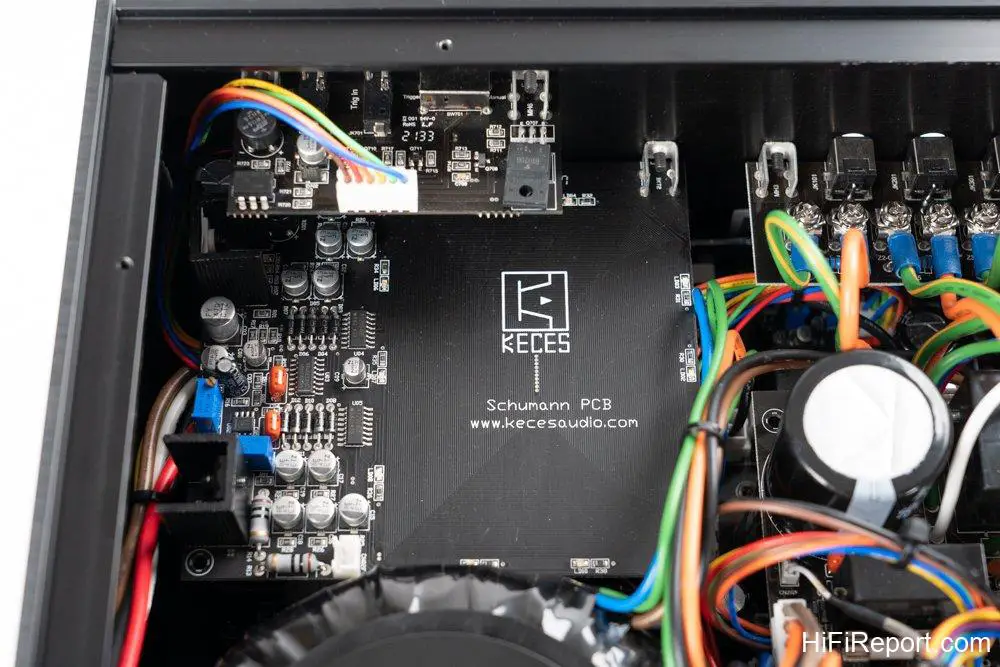
Perhaps the most distinctive feature is the integrated Schumann wave generator. This technology was first introduced by KECES in their Ultimate series IQRP-1500 AC power processor. By emitting an 8Hz frequency Schumann wave, it achieves a quantum resonance effect, harmonizing the vibrations of electronic circuits and components, thereby improving audio performance. KECES has now incorporated this Schumann wave quantum resonance technology into the P28 DC linear power supply.
You could opt for the more affordable P8 or P3, but they lack this advanced technology. Therefore, the P28 is not simply equivalent to three P8 or P3 units; it offers a bonus, an extra advantage, exclusive to the P28.
Six Outputs, Up to 24V/10A
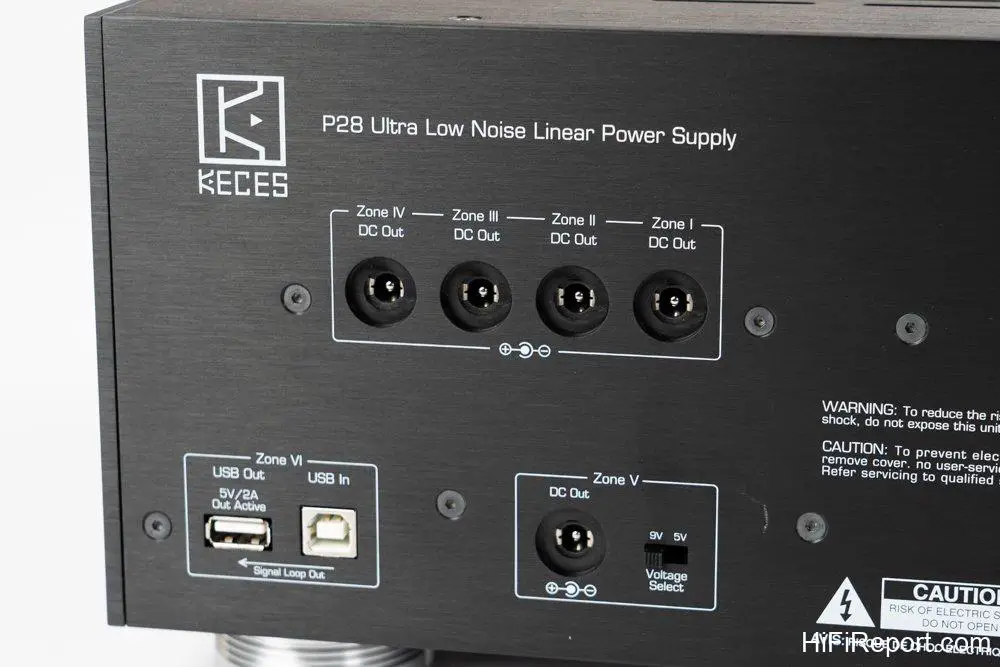
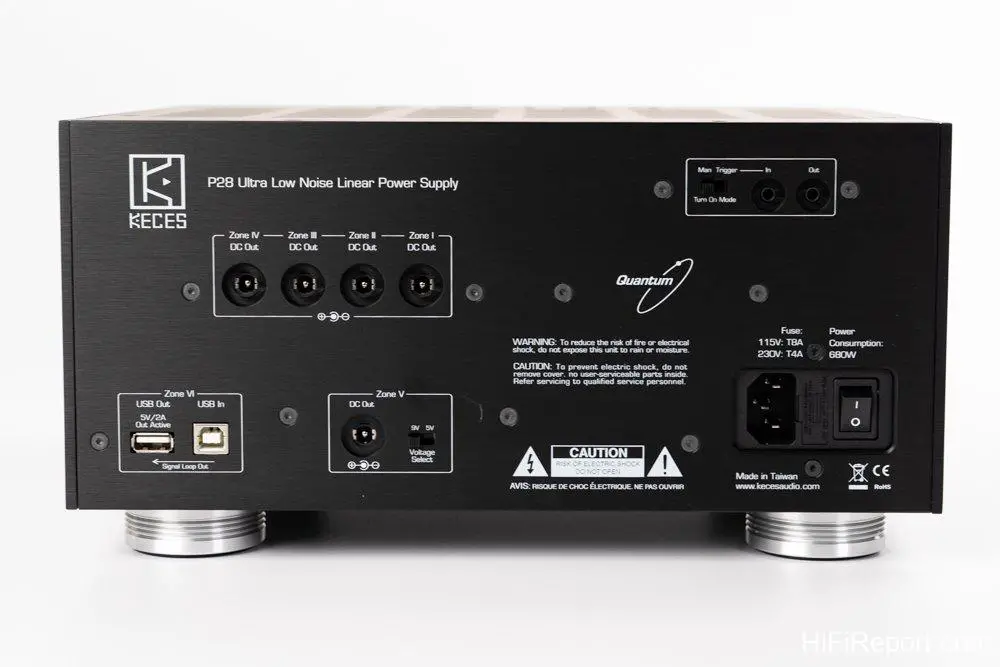
Unlike previous models that typically featured a maximum of two DC outputs (the P8 offered selectable voltage on one DC output and a USB output, while the P3 had only DC outputs), the P28 presents a “family” (family set meal) of connectivity. It boasts a total of six outputs, including Zone 1 to Zone 5 DC outputs and a Zone 6 USB output.
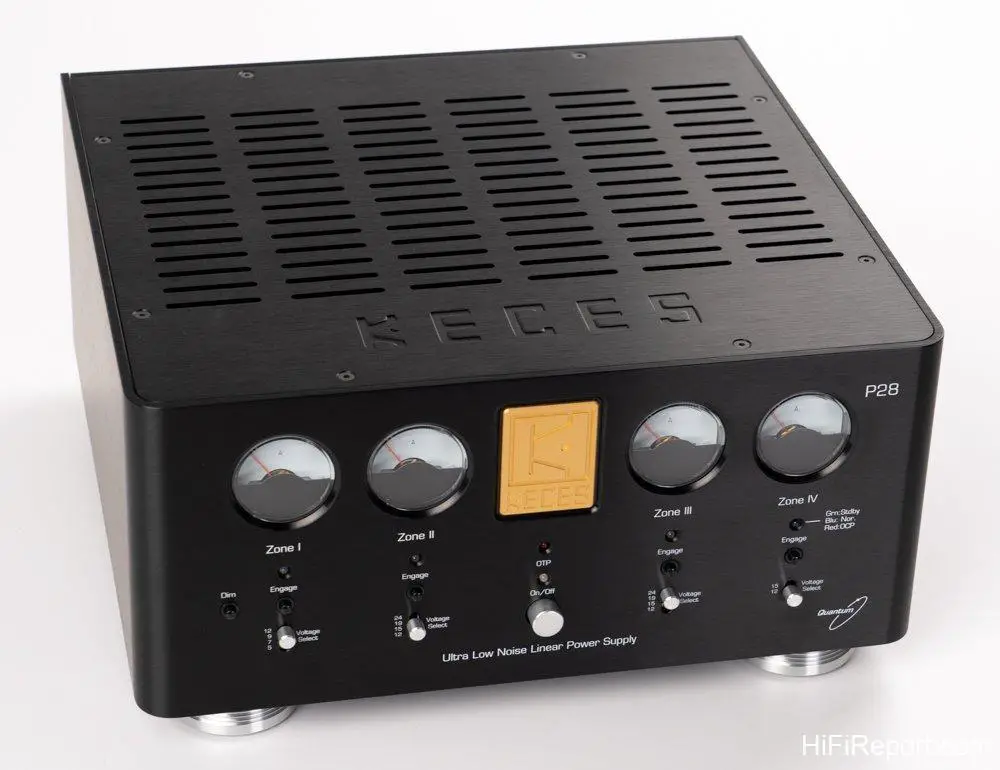
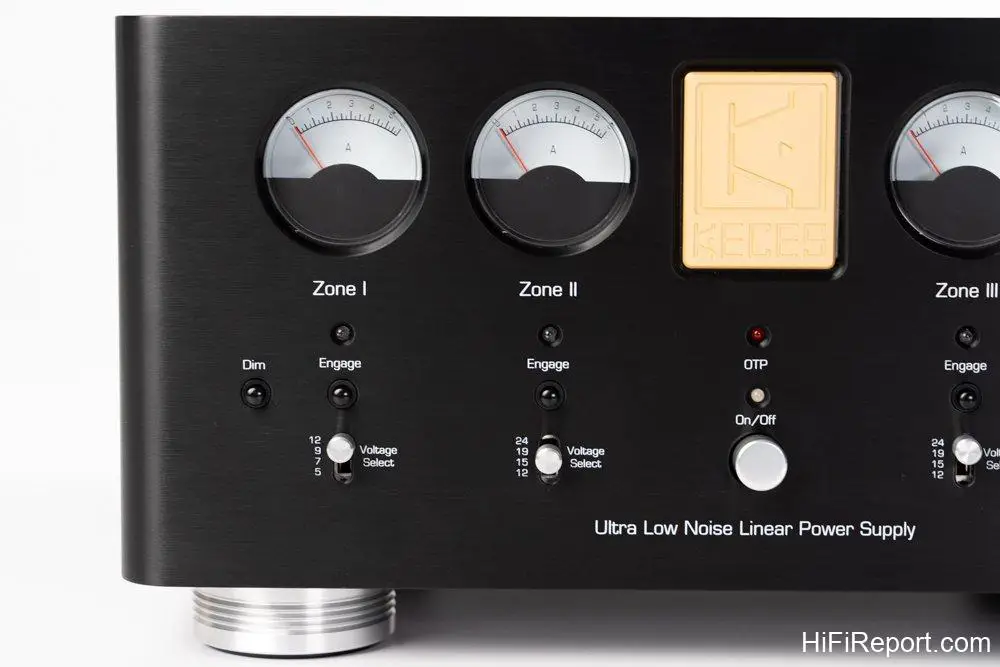
Among these, Zone 1 to Zone 4 each offer switchable voltages ranging from 5V to 24V, with each zone providing 2 to 4 voltage options. The maximum output current for one of these zones reaches 10A. These four outputs are also equipped with monitoring meters, analog needle-type meters located on the front panel. Upon powering up the P28, these meters illuminate with a green backlight and display the current power output status once power delivery commences.
Enjoy the Light Show!
The voltage selection toggle switches for Zone 1 to Zone 4 are conveniently located on the front panel. The aluminum toggle levers offer a more premium feel compared to rocker switches. Zone 5’s voltage selector switch (5V/9V) is positioned on the rear panel. After plugging in the P28 and turning on the rear power switch, the unit enters standby mode. Pressing the power button located centrally at the bottom of the front panel completes the power-on sequence.
At this point, the indicator lights for each output zone illuminate in green, matching the meter backlighting. Between the LED indicator and the voltage selector lever, a small black button labeled “Engage” is present. Pressing this button enables power output for the corresponding zone. If you find the meter illumination and indicator lights too bright, you can press the “Dim” button on the left side to reduce the meter backlight intensity. However, the “Dim” button only controls the meter backlight and not the LED indicators. Furthermore, once powered on, internal green LEDs within the P28 blink, visible through the elongated ventilation slots on the top cover. Essentially, the P28 initiates a light show upon startup. If you find it distracting, simply place it out of sight; otherwise, embrace the visual spectacle!
Gentle Reminder: DC Cables Not Included
Yes, embrace it! However, before you can fully enjoy the P28, there’s one preliminary step: you need to procure your own DC power cables. The previous P8 and P3 models included small black DC cables, even with 2.1mm to 2.5mm adapters, allowing users to unpack and immediately connect them to their equipment. But the P28 is a higher-end model, and KECES likely received market feedback indicating that users considering DC power supplies often prefer to use their own custom cables. Therefore, bundled cables are not included this time.
This is a clear message: since you recognize the importance of power, don’t forget that power cables are also crucial! For this review, I borrowed an Oyaide 510 5N pure silver DC power cable from HiFiReport, with Oyaide gold-plated DC connectors on both ends.
One more reminder: the P28’s DC output connectors are 2.5mm/5.5mm in size. When purchasing cables or DIY components, ensure you get the correct size.
I planned two listening test scenarios for the P28. One involved connecting it to a wireless router to assess its impact on digital streaming quality. The other involved connecting it to an iFi iPhono 2 phono preamplifier to evaluate its effectiveness in powering small, external power supply-dependent audio equipment.
Router Application: Surprisingly Obvious Effect
My home router is a Netgear Nighthawk X4S (R7800), which requires 12V/3.5A. I connected it to Zone 1 of the P28 (4A output). I directly connected the network cable from my Telos EMP streamer to the Netgear router and compared the difference between using the original switching power supply and the KECES P28.
I must say, you may doubt it, but don’t dismiss it with cynical remarks without even trying it yourself, scoffing that it’s all marketing hype. Connecting the P28 to the router resulted in a very noticeable improvement, so significant that within 30 seconds, or even 3 seconds, the very first sound revealed the difference.
When listening casually with the original switching power supply, you might not perceive any issues. No comparison, no problem. But as soon as you switch to the P28 linear power supply, you’ll be astonished by the magnitude of the difference.
Listening to Anne Sofie von Otter’s “Dis, quand reviendras-tu,” with the P28, the vocals became more three-dimensional and solid. Details like vocal articulation, diction, and vocal projection were also more distinct. Piano notes sounded fuller, with clearer note definition. In contrast, with the switching power supply, the sound was diffuse and lifeless, lacking spatial depth and vibrancy.
In short, adding the KECES P28 brought the vocals to life, and the music itself became more alive. Who doesn’t appreciate vibrant music? The bass also exhibited a difference. You might question how a router could affect bass performance. I honestly don’t know either. But the audible result was undeniable. The bass with the P28 became tighter and more controlled, with more defined texture in the low frequencies. Whether it was the bass in Diana Krall’s “All or Nothing at All” or the low strings in “Rey’s Theme” from John Williams’s “Star Wars: The Force Awakens” performed by Anne-Sophie Mutter, the bass exhibited cleaner definition and sharper contours.
I chose these two tracks precisely because of their rich bass content. The former features jazz bass with plucked notes, and the latter orchestral strings, both full-bodied in the low frequencies. The P28’s tightening effect made the music more agile, like the visible fat-loss results after a month of diligent gym workouts.
The most significant difference after connecting the P28 linear power supply was the reduction in graininess. This made vocal details sound smoother, lines more rounded, and violin lines better defined. In comparison, the sound with the switching power supply tended to become grainy at slightly higher volumes, with a sense of unrefined edges, like touching an unpolished wooden board from a lumberyard – slightly rough, fuzzy, and even prickly at the corners. However, a sanded and polished board feels much smoother. The improvement with the linear power supply is analogous to this.
Phono Stage Application: Like a Phono Stage Upgrade
The iFi iPhono 2 phono stage requires 15V/1.5A. I selected Zone 2 of the P28 (4A output), which is suitable for this voltage and offers the lowest current output among the zones. Actually, the stock iFi switching power supply is already quite good, the iPower, which iFi sells as a standalone product, incorporating iFi Audio’s own noise reduction technology. However, switching to the KECES P28 still yielded audible improvements.
Density, fullness, soundstage width and depth, and a seemingly blacker background providing greater dynamic contrast all improved. Listening to Radu Lupu’s piano performance in Schumann’s Piano Concerto, conducted by Andre Previn with the London Symphony Orchestra, the opening fortissimo passages were fuller, more solid, and powerful. Piano notes had palpable weight, without any sense of lightness. The richness of the low strings that followed was also more substantial, and the texture of the strings became more refined and dense. The positioning of woodwind instruments became more precise, and the dimensions of the soundstage expanded. The difference was akin to upgrading the phono stage itself.
Two More Points…
Beyond the primary functions, two additional aspects of the P28 are worth mentioning. Firstly, its USB output. The previous P8 also had a USB output, but it was 5V/1A. The P28’s USB output is 5V/2A, which not only allows for faster charging of devices but can also charge iPads.
Secondly, the P28 incorporates a 12V Trigger connection. Using a 3.5mm jack cable, you can connect various audio components and trigger the entire system with a single button press.
Don’t Doubt, Go Listen!
Whether powering network devices in a digital streaming setup or directly powering DC-powered audio equipment, the KECES P28 delivers clearly discernible improvements. Compared to their own P8 and P3, as well as similar products from other manufacturers, the KECES P28 offers an unparalleled abundance of six outputs with a uniquely versatile range of output voltages and currents.
I reiterate, don’t doubt it; go and listen for yourself. Life is about experiencing, not just talking. I dedicate this review of the KECES P28 to those with open minds, a spirit of experimentation, and a pursuit of improvement.
Specifications
* Type: Linear Power Supply
* Output Voltage Zone 1: 5V / 7V / 9V / 12V, 4A
* Output Voltage Zone 2: 12V / 15V / 19V / 24V, 4A
* Output Voltage Zone 3: 12V / 15V / 19V / 24V, 6A
* Output Voltage Zone 4: 12V / 15V, 10A
* Output Voltage Zone 5: 5V / 9V, 2A
* Output Voltage Zone 6: USB 5V, 4A
* Dimensions: 300 × 279 × 133 mm (Width × Depth × Height)
* Weight: 14 kg