
KEF LSX II Review
When KEF launched the LS50 bookshelf speakers for their 50th anniversary, they became one of the most successful products in the company’s history. Despite being a bookshelf design, the LS50 garnered a large fanbase (including myself) due to their excellent sound performance and accessible price point. Capitalizing on the LS50’s success, KEF subsequently released numerous “derivative models.”
One such model was the LS50 Wireless, which added the convenience of wireless connectivity and streaming capabilities. Later, for consumers with a more limited budget, KEF introduced a scaled-down version named LSX. The LSX was essentially a proportioned miniature of the LS50 Wireless, employing many of the same core technologies but priced at less than half the cost of the LS50 Wireless. It also featured a wider range of attractive color options, capturing the hearts of many more consumers.
The LSX even earned recognition with a 2019-2020 EISA Award.
The primary advantage of products like the KEF LS50 Wireless and LSX is their all-in-one nature. They integrate streaming playback, preamplifier control (source switching and volume), power amplification, and speaker functions into a single system. Consumers don’t have to worry about component matching or cable connections. Everything is controllable via a smartphone app, allowing playback of network streaming music or sources connected via physical cables.
This aligns perfectly with modern preferences for simplicity and minimalism.
Given the continued success of these products, KEF has introduced reinforced second-generation versions. The LS50 Wireless II, the successor to the LS50 Wireless, arrived at the end of 2020. While its exterior remained the same, significant improvements were made internally. The core wireless processing platform was upgraded from W1 to W2, enhancing both sound quality and connectivity. Furthermore, the number of supported streaming functions and platforms significantly increased.
The second generation also gained support for higher-resolution Hi-Res audio files.
As for the second generation of the LSX, the LSX II, it debuted this year (2022). Building upon the design foundation of the first-generation LSX, it follows the upgrade path of the LS50 Wireless II, resulting in a product with richer features and stronger performance – this is the LSX II.
Core Enhancements and Capabilities
Firstly, the core wireless processing platform has also been upgraded to W2, improving both sound quality and connectivity. Secondly, the LSX II incorporates a newly designed DSP (Digital Signal Processor). This DSP has already been implemented in higher-end wireless speakers like the LS50 Wireless II and LS60W, where it has proven its excellent performance and ability to enhance processing power. With these upgrades, the LSX II’s playback capabilities are on another level.
Via the network, it can play MQA, DSD, FLAC, WAV, AIFF, ALAC, AAC, WMA, MP3, M4A, and Ogg files. For PCM format music, the LSX II supports up to 384kHz/24bit. For DSD, it supports playback of high-spec DSD256 files.
The LSX II boasts significantly richer streaming capabilities, supporting AirPlay 2, Chromecast, UPnP, and Bluetooth (version 4.2). The number of streaming platforms the LSX II can play from has also increased dramatically compared to the first generation. It supports Spotify Connect, Tidal Connect, Amazon Music, Qobuz, Deezer, QQ Music, and also internet radio and Podcasts.
Tidal Connect, in particular, is worth noting. It means you can use the official Tidal app directly and switch the playback device to the LSX II seamlessly during playback, just as conveniently as with Spotify Connect. In the past, few audio devices supported this feature; the LS50 Wireless II was among the first, and now the LSX II follows suit.
Furthermore, some audiophiles who use Tidal manage their music using Roon, and the LSX II is a Roon Ready device, allowing it to integrate smoothly into the Roon ecosystem.
New Input Options: USB-C and HDMI ARC
Beyond streaming functions, let’s discuss two significant new features added to the LSX II. First, the LSX II now includes a USB DAC function. A USB Type-C port is located on the back panel, allowing connection to PCs or other digital transports with USB output. This supports playback of high-resolution music files up to 192kHz/24bit.
Second, HDMI ARC functionality has been added. When paired with a television that also supports HDMI ARC, audio from the TV can be sent to the LSX II via an HDMI cable for playback. This effectively replaces the TV’s built-in speaker system with the LSX II, resulting in significantly better sound quality.
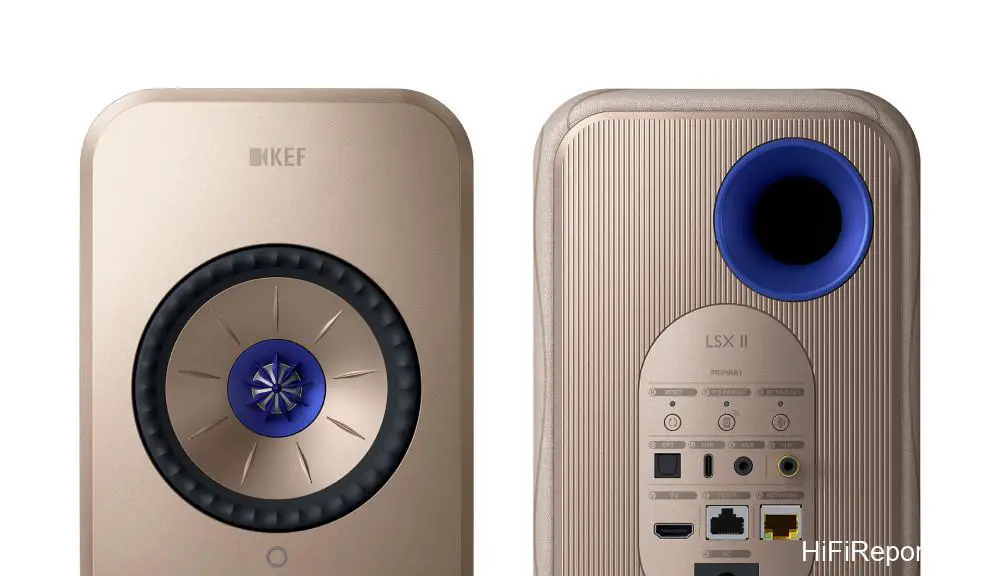
Combining these input options, the LSX II offers a total of five input terminals: HDMI ARC, Optical, USB Type-C, 3.5mm Analog Input, and RJ45 Ethernet (for network). This allows it to connect to various types of sources, including televisions, desktop computers, laptops, gaming consoles, or even turntables (via a suitable phono preamp).
Of course, the most important aspect is its wireless playback functionality, including Bluetooth and UPnP streaming, which enables the LSX II to play music files stored on your local network or stream content from the cloud.
Acoustic Design and Performance Hardware
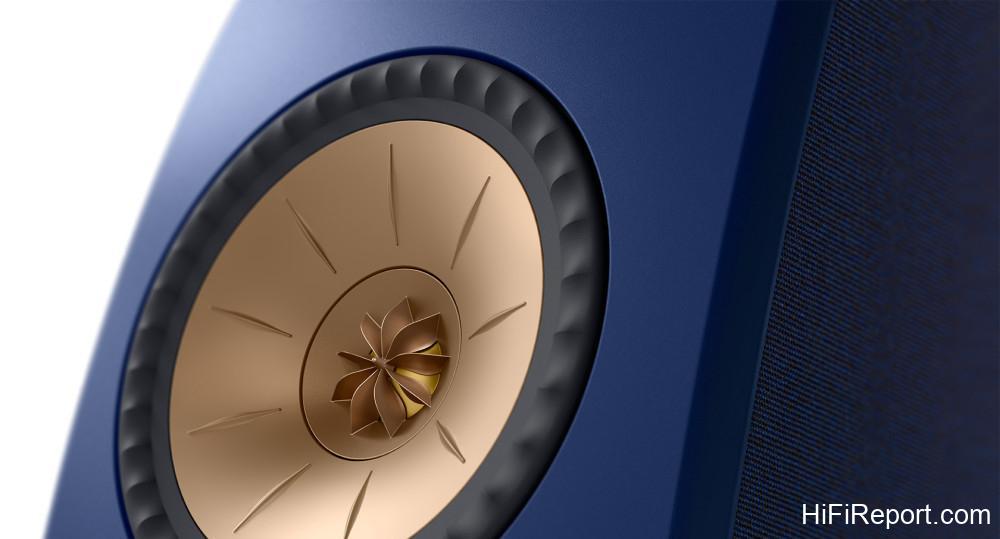
In terms of acoustic design, the LSX II retains many of the excellent features of the first-generation LSX. For instance, it still uses KEF’s signature 11th generation 4-inch Uni-Q coaxial mid-high frequency driver. Internally, the LSX II is equipped with the Music Integrity Engine processing engine. This engine optimizes the Uni-Q driver to ensure precise phase alignment across all frequencies, delivering clearer, more accurate, and better-focused sound.
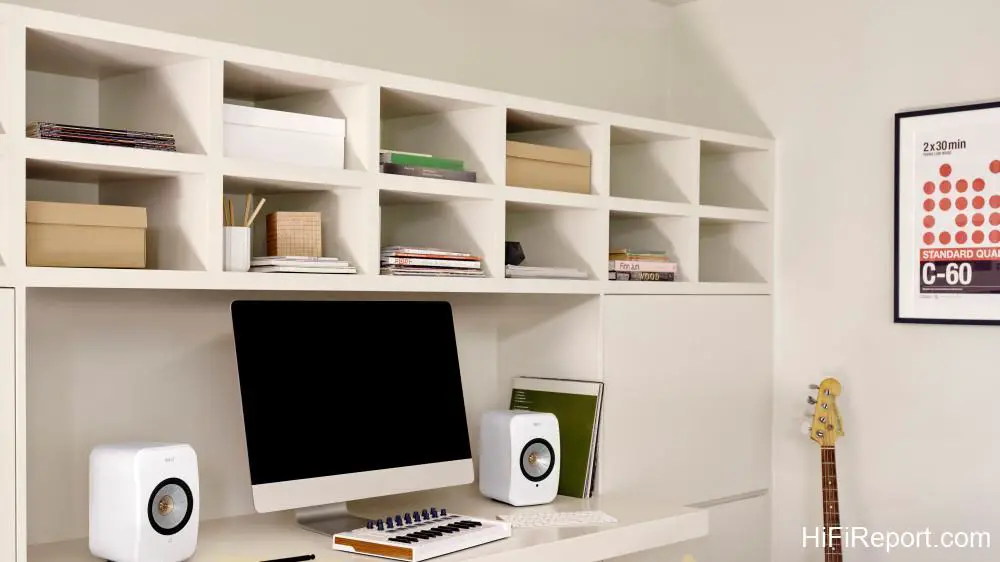
The internal amplifier remains a Class D design with 100 watts of power (30W for the tweeter, 70W for the woofer), but thanks to the new DSP, the sound quality is further enhanced. The LSX II is a compact speaker, measuring only 240×155×180mm. Its low-frequency output naturally has some limitations, which is why the first-generation LSX included a subwoofer output on the rear panel for connecting an active subwoofer. The LSX II continues this feature.
Exterior Design and Aesthetics
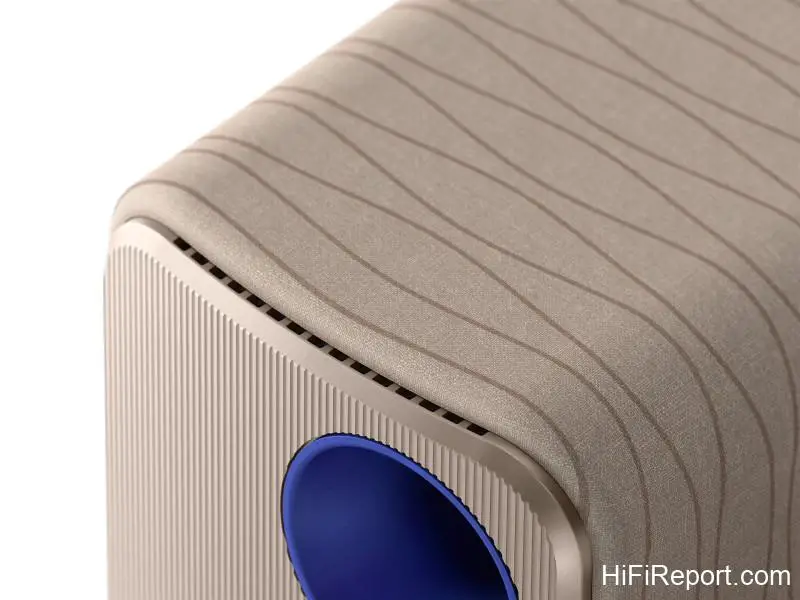
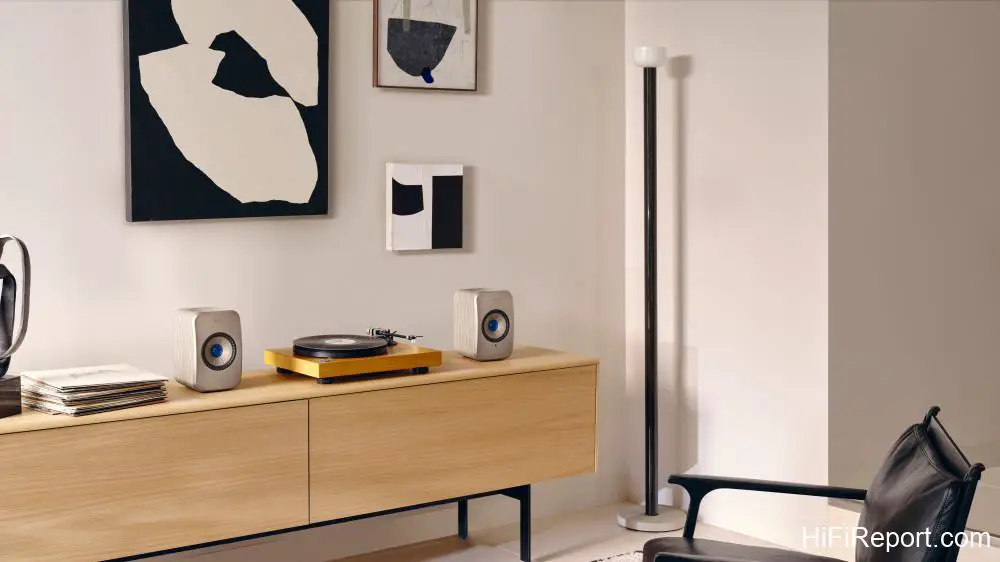
Looking at the exterior, the LSX II is nearly identical to the first generation, preserving the modern, minimalist aesthetic designed by the renowned product designer Michael Young. The front and back panels have a matte metallic finish, while the sides and top are wrapped in woven fabric from Danish textile company Kvadrat. What sets the LSX II apart from the first generation is its wider selection of five color options: Mineral White, Lava Red, Carbon Black, and Cobalt Blue.
Finally, there’s a very special color option: the Soubdwave special edition designed by renowned British designer Terence Conran. This version features a unique “soundwave” pattern woven into the elegant Kvadrat fabric. The tweeter on the front and the bass reflex port on the back are specially finished in Conran’s signature blue, showcasing a truly distinctive design that is visually striking.
User Experience and App Control
Now, let’s discuss the user experience. The LSX II comes with a traditional remote control, but the most convenient way to operate it is using the official KEF Controller App. The initial setup guide recommends using the app, which will direct you to the Google Home App for configuration. This means the LSX II leverages Google’s streaming and sharing technology, ensuring a mature and reliable setup process.
As long as your local network is stable, the LSX II should be quickly recognized, and setup completed.
The homepage of the KEF Controller App allows you to switch between various input sources: Wi-Fi, Bluetooth, TV, Optical, USB, and AUX.
You can also directly select streaming music platforms, with Amazon Music, Deezer, Qobuz, Spotify, and Tidal listed. Additionally, there’s internet radio, Podcasts, and UPnP, the latter allowing you to play files stored on other devices within your local network.
One particularly noteworthy feature within the app is the “EQ Settings.” Unlike typical audio EQ settings that often offer preset sound modes like Music or Movie, the “EQ Settings” in the KEF Controller App are designed to provide compensatory adjustments based on the speaker placement and room environment. This effectively helps mitigate the impact of the room, resulting in more ideal sound reproduction.
The “EQ Settings” in the app are divided into “Normal Mode” and “Expert Mode.” Normal Mode prompts you to set parameters such as speaker placement (on stands or a desk), distance from the wall, room condition (whether the environment is absorbent), room size, left/right channel balance, and whether a subwoofer is connected.
If you choose “Expert Mode,” you can fine-tune additional settings: Treble Trim (up to +3dB, -3dB), Phase Correction (on/off), and Bass Extension (Less, Standard, More).
Furthermore, in the “Subwoofer Out” section, you can configure more detailed settings, including: High Pass Frequency, Low Pass Frequency, Subwoofer Gain, Subwoofer Phase, and whether to use a specific model subwoofer.
Through these adjustments, you can minimize environmental influences and optimize the LSX II’s parameters. For example, in “Expert Mode,” you can directly increase or decrease the amount of bass. While the range of adjustment is not extreme, it does offer a noticeable difference. When listening to pop music, I could simply adjust the settings to make the electronic drum beats sound fuller, which made the music more enjoyable and enhanced the listening experience.
Placement Options and Wired/Wireless Connection
The LSX II offers multiple installation options. For a more integrated look, KEF offers optional color-matched S1 floor stands, P1 desktop pads, and B1 wall brackets sold separately, which enhance the aesthetics. The two LSX II speakers are designated as primary and secondary. They can be connected via a cable or wirelessly. If sound quality is your priority, a wired connection is recommended. When connected via cable, the system supports high-resolution audio up to 96kHz/24bit.
A wireless connection is limited to 48kHz/24bit.
During playback, the KEF Controller App proves very useful, as it can display crucial music specifications. For instance, when playing an MQA format file (whether a local file or Tidal stream), an MQA logo appears on the left side of the app display. A small blue light next to it indicates that the track was produced using MQA equipment from the mastering stage onwards.
When playing files, there are three dots on the right side of the playback screen (representing song information). Tapping these dots reveals detailed information about the track, including: Album Name, Song Title, File Format (e.g., FLAC), and File Resolution (e.g., 192kHz/24bit).
Listening Impressions: Accuracy and Fidelity
Now, let’s talk about the listening experience. I found that the higher the data rate of the playback material, the more the sharp aspects of the LSX II’s sound quality were revealed. For instance, playing via Bluetooth or Spotify felt a bit softer. However, when playing Tidal or high-resolution music files from a NAS, the treble sounded clearer, and the overall sound felt brighter and more expansive.
My initial impression of the LSX II was its incredibly precise imaging. The sonic advantages of KEF’s coaxial Uni-Q driver are still very apparent. By positioning the speakers slightly away from the back wall, you can achieve a deep soundstage with tightly focused images and sharp definition. Dimming the lights makes it feel as though the performer is vividly present before you, playing right in front of your listening position.
This finely focused effect is not diminished despite the LSX II’s smaller size. This quality lends the music a sophisticated and premium feel.
For example, listening to Roger Waters’ “Time” from his Amsterdam concert (Tidal, MQA file), the initial metallic striking sounds unfolded with incredible detail directly in front of the listening position, expanding from the center outwards. This immediately showcased the LSX II’s precision advantage. The subsequent snare drum hits each had clear, distinct placement, appearing in different positions within the soundstage. Closing my eyes, it felt as if the band was right there.
When the lead vocalist entered, they were precisely positioned directly in front of the seat, with excellent body and presence.
This track also contains significant low-frequency elements. Due to its size, the LSX II’s bass is somewhat restrained. At this point, you can use the “EQ Settings” in the app to enhance it. Simply go to “Expert Mode Settings” and select “More” for “Bass Extension.” This boosts the low-frequency performance. While the bass still isn’t overpowering, for the LSX II’s diminutive size, it’s an “oversized” excellent performance.
Especially if your listening space isn’t very large, or if you place the speakers near a back wall or on a desktop, the bass performance is noteworthy, offering a decent sense of weight. And for those who prefer more impactful bass, don’t forget the LSX II can connect to an active subwoofer.
Furthermore, I found the LSX II’s sound to be neutral, refined, direct, and fast. It feels like it doesn’t overly color the music, presenting the information within the track very straightforwardly. Whether a vocalist’s delivery is rich or lean, or an instrument’s texture is soft or hard, the LSX II reproduces it truthfully. The quality of the sound matches the quality of the software (the recording). In other words, there’s no excessive coloration.
This neutrality and fidelity are essential qualities for good audio equipment. If the source material is of high quality, you will hear excellent sound.
For instance, I discovered that using a wired Ethernet connection to play Hi-Res files from a local network produced a very high-quality sound effect. Playing the Haydn-Solberg-Grieg String Quartet (MQA file, 48kHz/24bit), the violin sound was incredibly moving. The LSX II not only reproduced its delicate aspects but also rendered the finest layers of string vibration. The violin sound felt like it had body, not just a thin line. It was never sharp and even sounded sweet and radiant.
When the cello entered, I could clearly hear the texture of the strings being bowed in the lower register. The cello sound, accompanied by clear resonance from the instrument’s body, was full yet warm. This was a very high-quality, superb string quartet performance.
The LSX II’s rendition of vocals is also captivating. While not the largest or most exaggerated type, the vocals possess excellent focus and density, avoiding sounding hollow or thin. Considering its size, this performance is outstanding.
For example, playing the high-resolution album “MAGNIFICATG” (DXD file, 352.8 kHz/24bit) from Norwegian label 2L, the soprano voice sounded soft and beautiful. The vocal presentation wasn’t exaggerated, yet it had a very good sense of body and was deeply moving. When the female choir joined in, I could clearly perceive the spatial arrangement with the soprano in front and the choir behind.
If the soprano’s voice was a point source, the female choir’s voices formed a harmonious and flowing plane, conveying a sense of comfort and solemnity. As the organ joined later in the piece, the spaciousness of the church recording became even more apparent, with the decay and reverberation blending with the soft female voices. Listening for a while, it felt as though one could melt into the sound.
HDMI ARC Experience: A Game Changer
Next, I want to share my experience testing the HDMI ARC feature. HDMI ARC allows the LSX II to connect to a television and replace the TV’s built-in speakers. Some audiophiles might consider the “connecting to TV” function to be rather insignificant. However, I urge you not to think that way, because my HDMI ARC test was nothing short of surprising.
Typically, when people want to replace their TV speakers with an audio system, they often think of using a soundbar. However, the issue with soundbars is that they often employ significant digital processing to expand the soundstage. This can sometimes result in a “digital sound,” or make the sound feel thin or unnatural.
Using the LSX II, I found I could position the left and right speakers quite wide apart. I even placed them near the side walls of my listening room (partially leveraging the side walls to reinforce bass), separating the speakers by about 3 meters – wider than a 100-inch screen (in this setup, the two speakers used a wireless connection). This configuration created a large soundstage directly in front of the listening position.
The LSX II also proved capable enough to produce a stable and sufficiently loud sound pressure level in a room exceeding eight *ping* (approx. 280 sq ft).
In this setup, the width of the soundstage produced by the LSX II rivaled the “virtual surround sound” of a soundbar, but without the excessive digital processing that gives soundbars a “digital sound.” The sound quality remained excellent. For example, even just playing Hilary Hahn’s violin performances on YouTube, I could hear the smooth, delicate texture of the violin, a quality clearly superior to TV speakers and most soundbar systems.
Another example: playing Utada Hikaru’s indoor live recording on YouTube. It created a large soundstage right in front of the listening position. The bass had a deep, powerful pluck, and the saxophone sounded textured. And just like when playing music files, the imaging was excellent; instruments and vocals weren’t blurry or scattered.
Watching Netflix streaming videos with this setup was a significant upgrade. The front soundstage was wider, the background music was more enjoyable, the images were more focused and solid, and the dialogue of the main characters had more body. This was not only superior to TV speakers but also surpassed most soundbar systems. Its bass performance was also better than TV speakers and most soundbars, and remember, the LSX II can even add a subwoofer.
After experiencing the LSX II with HDMI ARC, I genuinely wouldn’t consider a regular soundbar anymore.
Conclusion: Unbeatable Value
In summary, I believe three advantages of the LSX II are most appealing. First is its all-in-one capability. There’s absolutely no need to ponder component matching or system configuration; you get a host of practical features instantly, which is incredibly convenient. Second, it utilizes KEF’s signature coaxial Uni-Q driver, giving it precise imaging and localization capabilities. This alone imparts a sense of high quality to the sound. Moreover, its sound isn’t loose or lacking in impact.
Despite its accessible price, you can already hear key elements of high-end audio – the music sounds enjoyable, moving, and captivating.
Third, when connected to a TV via HDMI ARC, the performance surpasses most soundbars, especially in terms of sound quality and body. This significantly adds to its value and practicality. Finally, the price of the LSX II is very reasonable, not at all expensive. This is a product I would readily recommend to friends and family.
Specifications
* Design: Two-way bass reflex wireless streaming system
* Drivers: 19mm (0.75in.) aluminium dome tweeter, 115mm (4.5in.)
magnesium aluminium alloy cone woofer
* Frequency Response: 54Hz – 28kHz (±3dB)
* Built-in Amplifier: Class D, 30W HF, 70W MF/LF
* Maximum SPL (1m): 102dB
* Wireless Streaming Features: AirPlay 2, Google Chromecast, Roon Ready, UPnP Compatible, Bluetooth 4.2
* Input Resolution: Network up to 384kHz/24bit, Optical up to 96kHz/24bit, USB Type C up to 192kHz/24bit, HDMI up to 1.411Mbps PCM
* Inter-speaker Connection: Wireless: all sources resampled to 24bit/48kHz PCM.
Wired: all sources resampled to 24bit/96kHz PCM
* Input Terminals: HDMI eARC, TOSLINK Optical, USB Type C, Analog 3.5mm AUX, RJ45 Ethernet (Network), RJ45 Ethernet (Inter-speaker)
* Output Terminal: RCA Subwoofer output
* Wi-Fi Network Standard: Dual-band 2.4 GHz / 5 GHz
* Power Consumption: 200W (operating), <2.0W (standby) * Dimensions (H x W x D per speaker): 240 x 155 x 180 mm (9.5 x 6.1 x 7.1 in.) * Weight (per set): 7.2kg (15.9 lbs)