
La Voce S2 D/A Converter Review
aqua (acoustic quality) recently sent their La Voce S2 D/A Converter to HiFiReport for review. This Italian brand, established not long ago, currently offers three products: the La Diva CD transport, the La Scala MKII D/A Converter, and the La Voce S2 D/A Converter we are reviewing today. HiFiReport has previously provided detailed introductions to the first two components.
The La Voce S2 D/A Converter, which is the subject of this review, is positioned as a more entry-level option compared to the La Scala MKII D/A Converter, essentially serving as a stepping stone to the La Scala MKII.
The manufacturer also thoughtfully included a power cable, which appears to be of high quality.
The input terminals on the La Voce S2 D/A Converter are configurable. As shown in the photograph, the first and second input positions can be customized according to user needs and can also be changed in the future. For this review, the unit is configured with BNC and AES/EBU inputs.
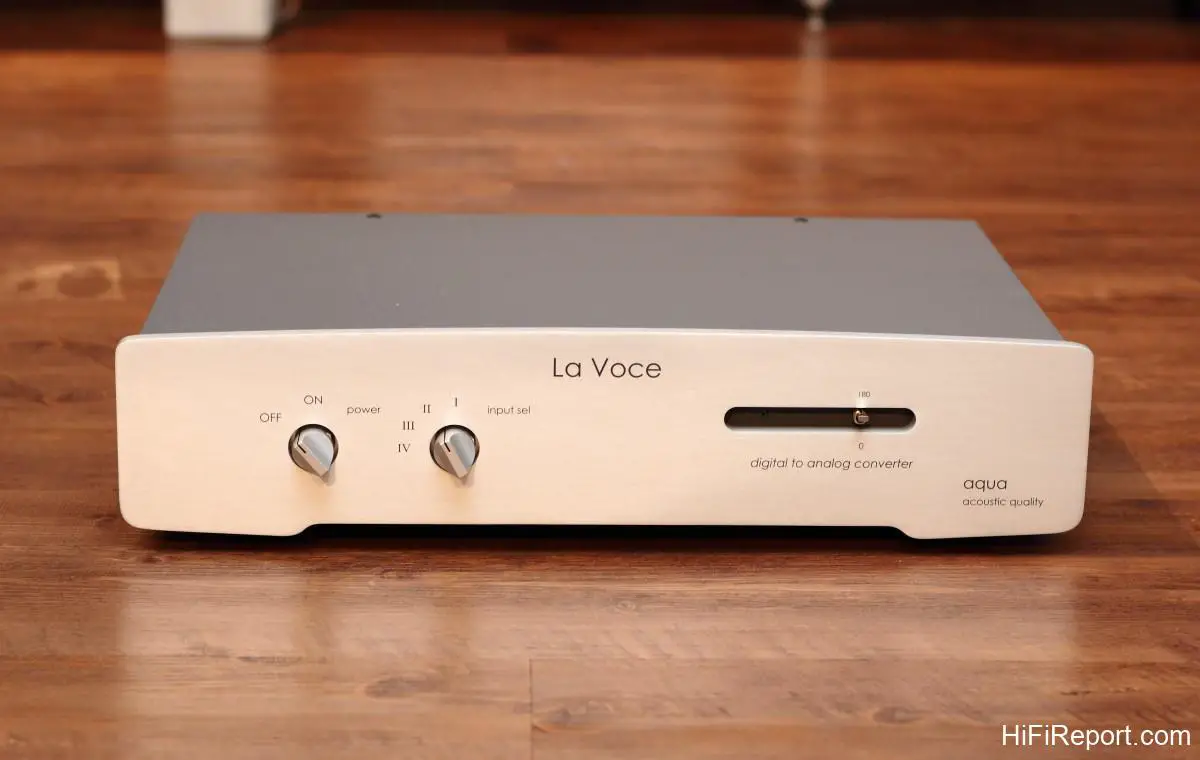
In terms of appearance, it closely resembles the other two products, especially the La Scala MKII D/A Converter, to which it is almost visually identical. The primary difference in appearance is that the La Voce S2 has one less input source compared to the La Scala MKII.
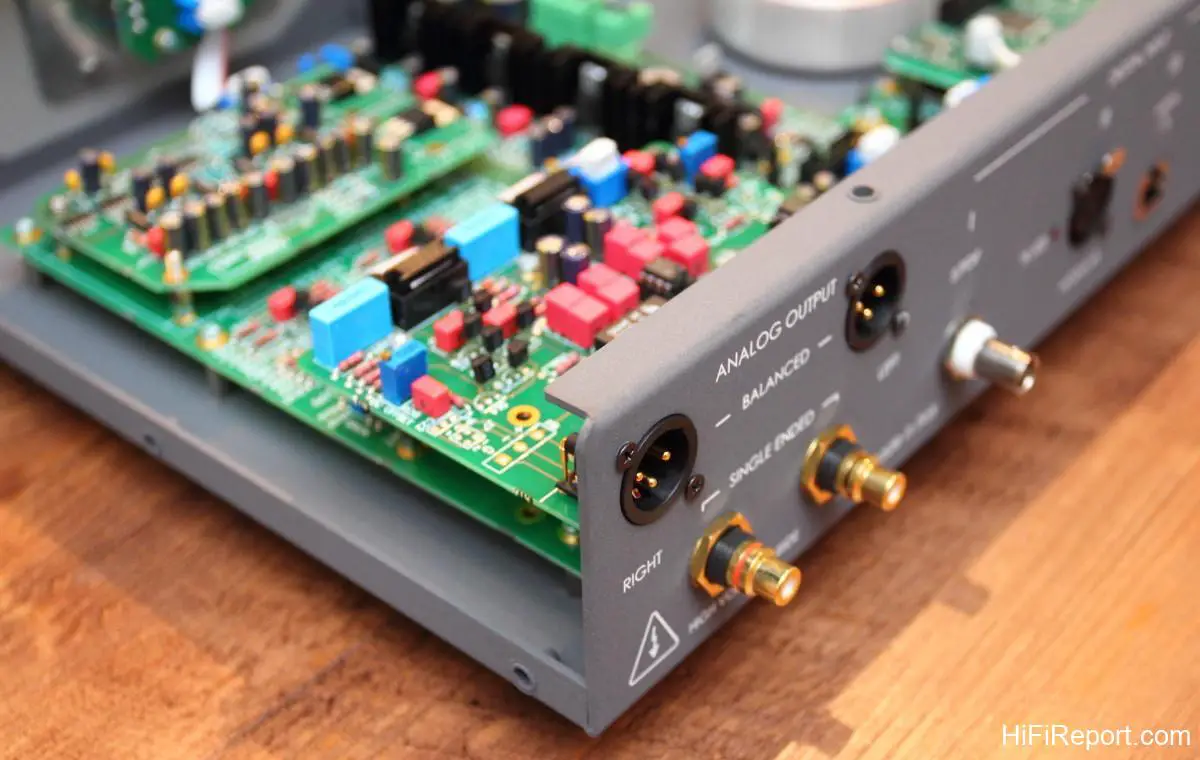
Looking at the rear panel from left to right, the analog output section features both balanced XLR and single-ended RCA outputs. The digital input section starts with the first input, an S/PDIF BNC coaxial (75 ohms) input, supporting music formats up to 24bit/192kHz. The second input is AES/EBU (110 ohms), also supporting music formats up to 24bit/192kHz. It’s important to note that these first two input terminals are interchangeable, with other module options available.
The third input is an RJ45 AQlink (I2S), designed for connecting to aqua’s own La Diva CD transport, and it supports music formats up to 24bit/384kHz. The fourth input is a USB port for connecting to PC audio, supporting music formats up to 24bit/192kHz.
Additional optional input terminals include RCA coaxial (75 ohms), supporting up to 24bit/192kHz; AT&T (ST Fiber), also supporting up to 24bit/192kHz; and optical TOSLINK, supporting up to 24bit/96kHz.
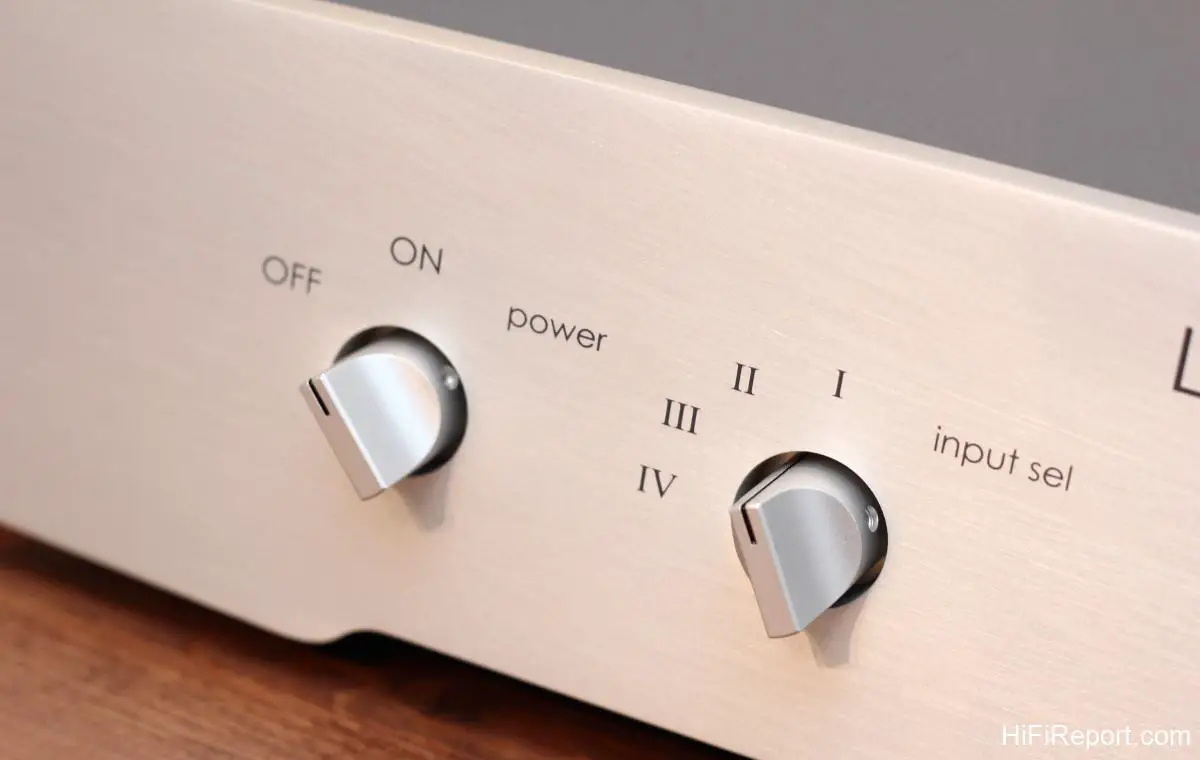
The front panel controls are simple and uncluttered. There is a power switch and an input selector. The input selection is indicated by Roman numerals 1 through 4, corresponding to the rear panel terminal labels.
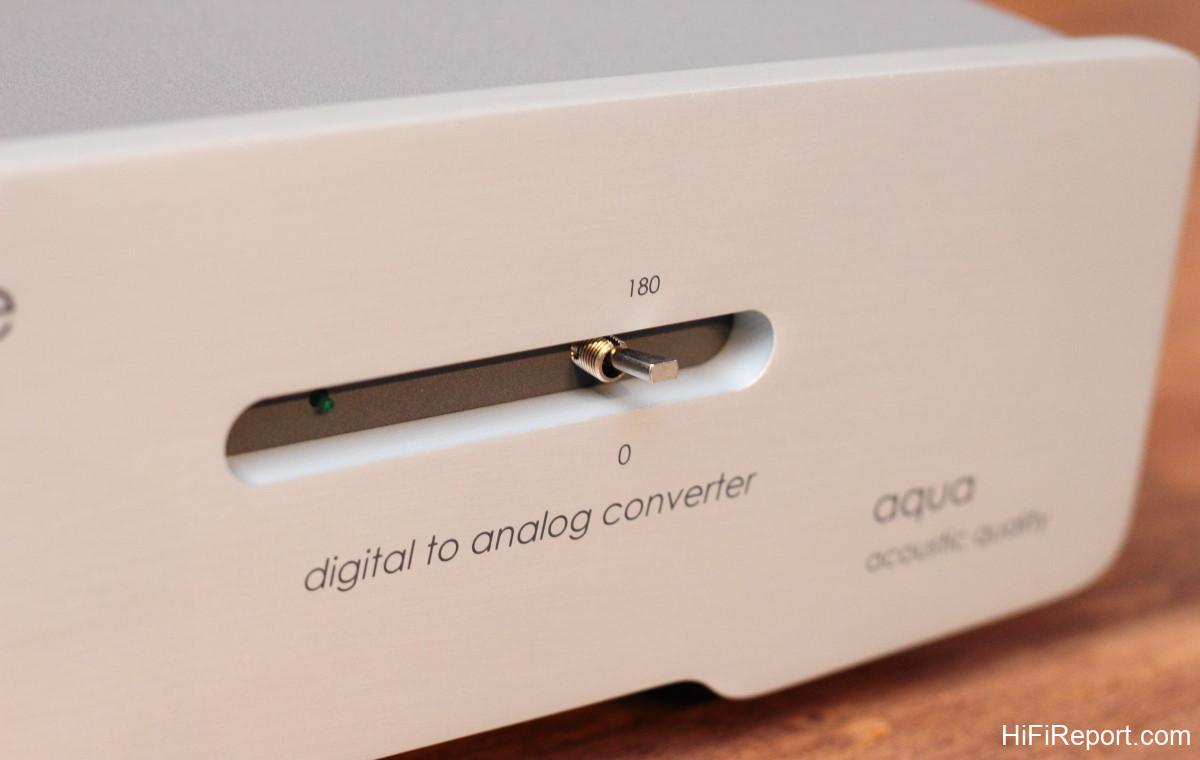
On the right side, there is a phase inversion toggle switch. aqua implements phase inversion in the digital domain rather than the analog stage. The toggle action feels satisfyingly tactile. aqua uses numerous toggle switches on their CD transport, which must be quite enjoyable to operate.
Let’s delve into the internal design of the La Voce S2 D/A Converter while examining its internal photographs and highlighting its key technological aspects. As you can see, the circuit board is composed of multiple modules, reflecting a modular design approach. This is a smart strategy to future-proof the La Voce S2 D/A Converter against rapid advancements in digital technology. When new technologies emerge, only the relevant circuit board module needs to be replaced.
This also explains why two sets of input terminals are designed to be easily interchangeable.
The La Voce S2 D/A Converter utilizes two toroidal transformers for power supply, with one dedicated to the digital circuitry and the other to the analog circuitry.
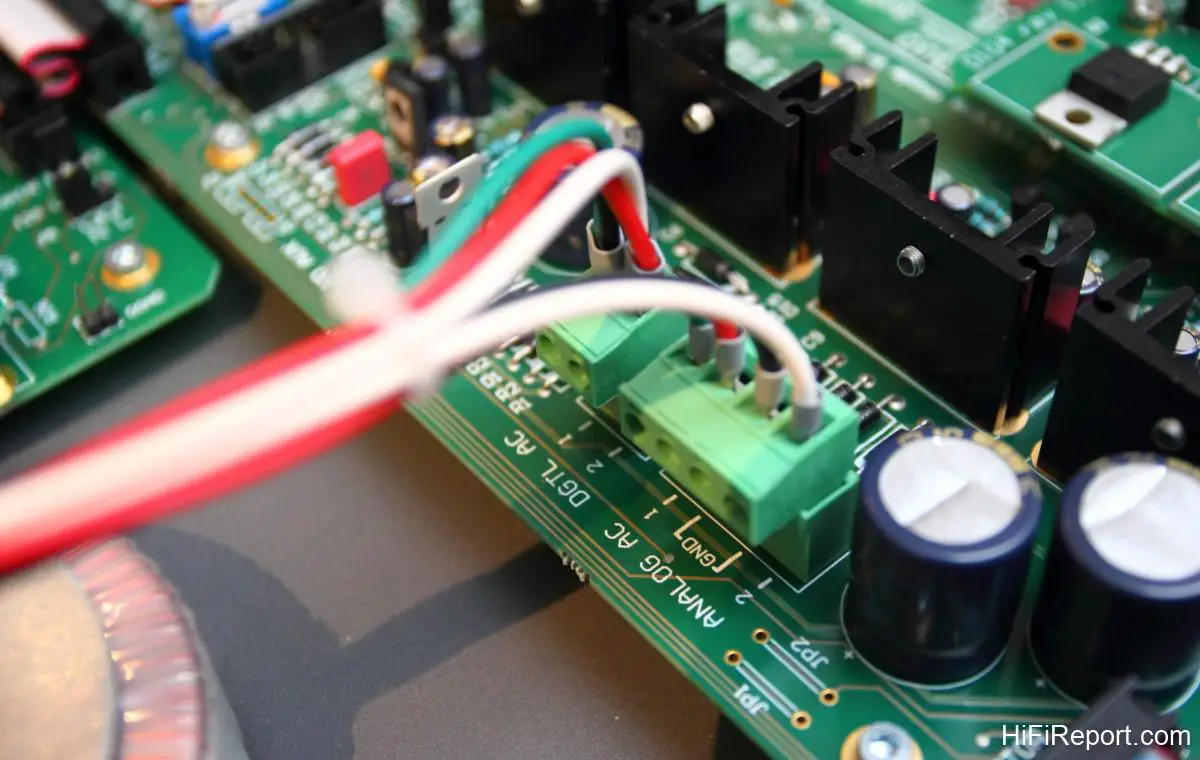
This image shows the power supply section connected to the main board.
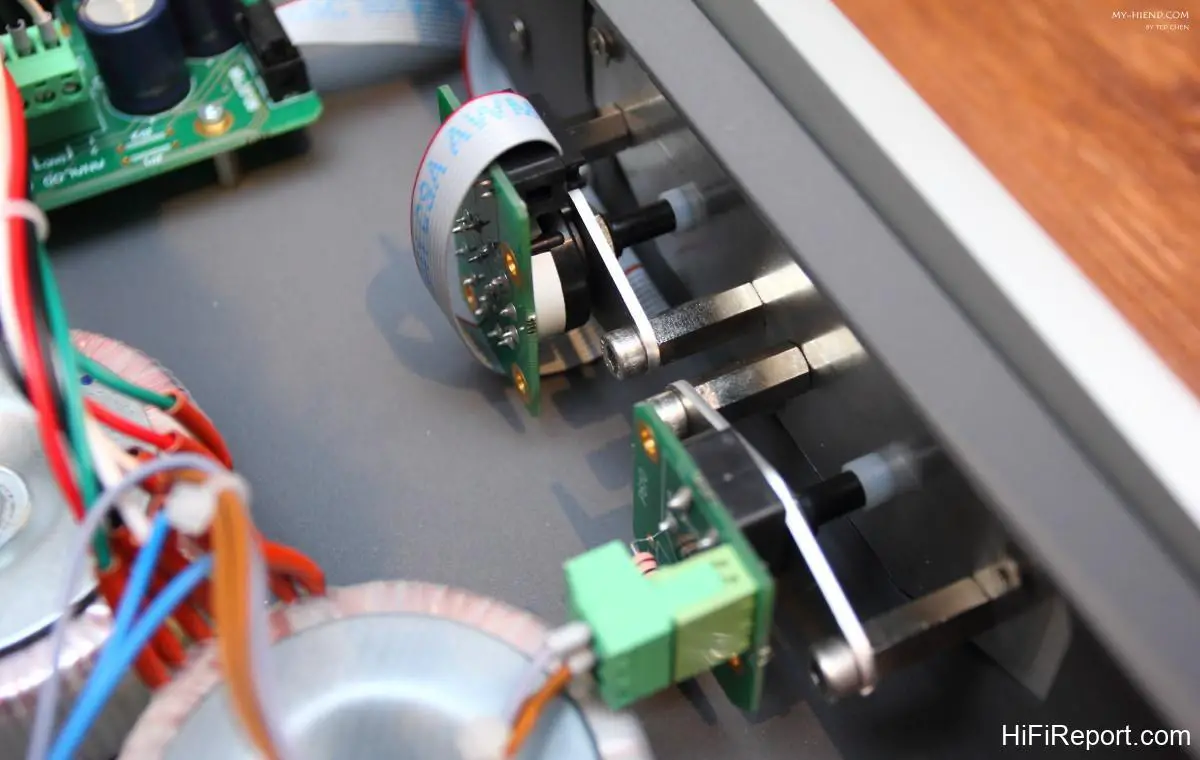
These are the dedicated power supplies for the digital and analog sections respectively.
Here we see the power switch and the input selector switch.
Like the La Scala MKII D/A Converter, the La Voce S2 D/A Converter employs an XMOS chip for DSP digital processing.
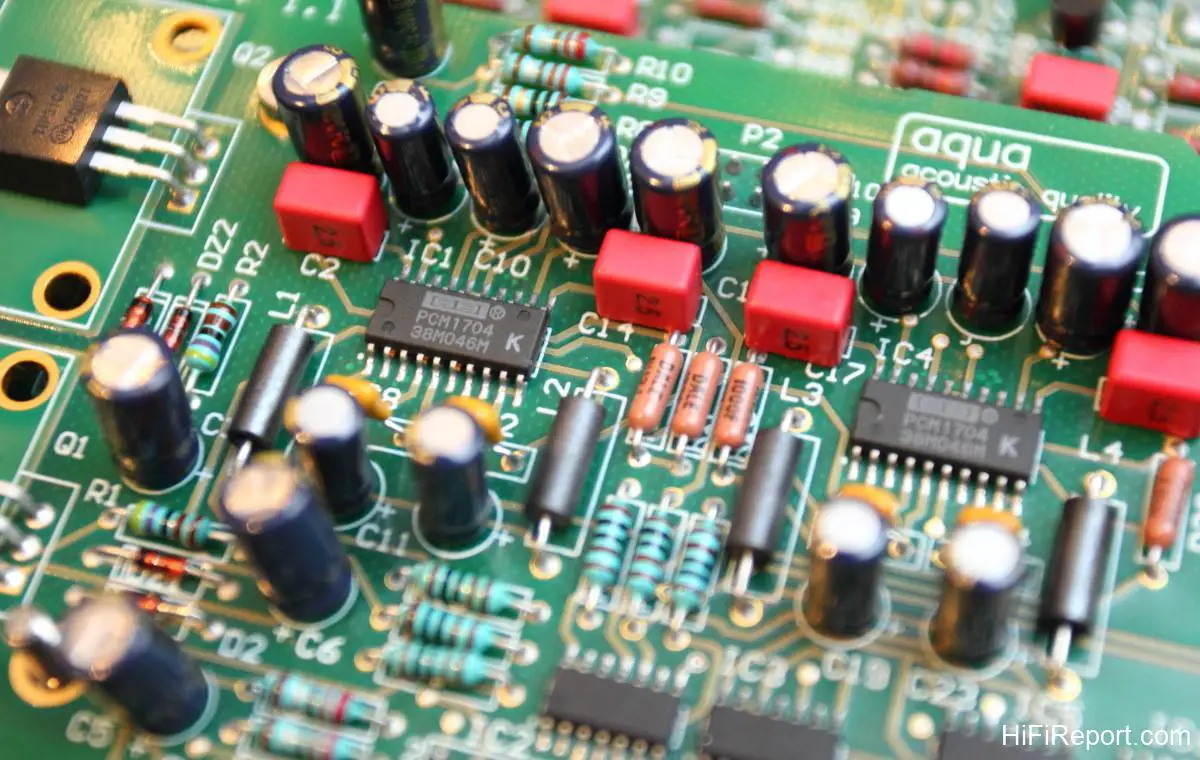
For D/A conversion, it utilizes two Burr Brown PCM1704-K chips in a dual-mono configuration, implementing an R2R ladder DAC circuit. It also employs DFD (Direct From Decoder) technology, eschewing digital filtering to maintain signal purity.
Above the analog output circuitry, we see the balanced output circuit board.
The analog circuit design eschews OP-amps, opting instead for a discrete analog circuit implementation. MOSFETs, J-FETs, and BJTs are used for voltage regulation in both the analog and digital circuits.
This is the AES/EBU input terminal, and to its right, the white connector is the BNC coaxial input terminal. As mentioned, these are interchangeable modules.
The lower-level main board houses the AQlink and USB input terminals.
Using the La Voce S2 D/A Converter as the DAC with the latest Aurender N10 as the source, the pairing proved to be highly synergistic. The sound was exceptionally clear and neutral, exhibiting excellent overall sonic quality. Playing the “Burlesque” movie soundtrack was a thoroughly enjoyable experience. Most of the album is performed by Christina Aguilera, with Cher contributing two tracks.
Christina’s voice is bursting with power and possesses a wide vocal range, while Cher, equally powerful, has a much richer, more grounded voice with more mature emotion in the higher registers. The two complement each other beautifully, with Cher’s vocals balancing Christina’s generally brighter and more energetic songs. In the second track, “Welcome to Burlesque,” Cher fully showcases her vocal artistry.
The arrangement, with drums providing a backdrop, creates an interesting dialogue between Cher’s voice and the violin. The positions of the drums, vocals, and violin are distinctly rendered, with the violin’s embellishments being particularly memorable. This revealed the La Voce S2 D/A Converter’s characteristics of high resolution and clean timbre.
The sixth track, “Express,” features even more complex and contrasting arrangements. Christina’s voice is exceptionally clean and brimming with her signature explosive power. Her vocal performance alone injects dynamism and dramatic contour into the song. Combined with the flamboyant show-tune style and the impactful low-frequency drumbeats, the song’s dynamic contrast is vivid. Throughout, Christina maintains vocal clarity and brightness.
The soundstage evokes a grand stage performance atmosphere, with a brisk musical rhythm. The clarity delivered by the La Voce S2 D/A Converter is notably apparent.
Jack Johnson’s “In Between Dreams” has a distinct personal touch, relaxed and leisurely, using simple arrangements and instrumental accompaniment, consistent with the album’s overall style. In past listening experiences with this album, there have been instances of overly rich tones and bloated imaging. However, with the Aurender N10 and La Voce S2 D/A Converter combination, these concerns were completely absent.
In the eighth track, “Situation,” which is particularly minimalist even within this album of simple style, the guitar sound is exceptionally clear. As no other instruments are used, and the lyrics are simple and repetitive, the guitar sound becomes the sole focus of the song. The tone is very natural, and the subtle details of the playing technique are clearly conveyed.
One can particularly appreciate the resilience and elasticity of the guitar strings when plucked, and the faint resonance of the guitar body, with every minute nuance rendered distinctly.
The 14th track, “Constellations,” is quintessential Jack Johnson. Through music, he depicts an ordinary night and uses music to paint his own starry sky narrative. The vocals are plain yet warm, blending seamlessly with the instrumental accompaniment and lyrics, creating a sense of understated comfort.
I had never seriously listened to Japanese Enka music before, as it predates my generation. This time, I listened to an album by Hibari Misora, a Japanese national treasure. I found it quite enjoyable. Misora, beloved by many audiophiles, passed away when I was just starting elementary school.
I wasn’t familiar with any of her songs, with the slight exception of “Kawa no Nagare no You ni” (のれのように), released in 1989, the year of Emperor Showa’s death, translated into English as “Like the Flow of the River.” Hibari Misora’s voice is resonant and warm. This album compiles songs from 1964’s “Yawara” () to 1989’s “Kawa no Nagare no You ni,” representing the classics of Misora’s entire career.
Although I haven’t listened to much Japanese Enka, many Taiwanese songs are derived from Japanese Enka. There are shared singing techniques and instrumental accompaniment styles, and I know many veteran Taiwanese singers perform Japanese Enka. Hibari Misora’s direct and warm voice, full of emotional delivery, truly gave me a new appreciation for Japanese Enka.
Played through the Aurender N10 and La Voce S2 D/A Converter, the reproduction was unembellished, direct, and clear, prompting me to replay it multiple times.
The captivating Diana Krall, when played through the Aurender N10 and La Voce S2 D/A Converter, becomes irresistible. Diana’s voice is inherently charming and easily captivating on any system. With the La Voce S2 D/A Converter processing the sound, it becomes even more enchanting. The details are exceptionally clear, making every word breathtaking. “Wallflower” is a particular favorite album of mine.
The incredibly quiet background, exemplified in tracks like “Desperado” (track 2) and “Operator” (track 9), combined with Diana’s vocals, is particularly soul-stirring. Similar to Diana’s album cover and back cover, the understated colors enhance the solitary quality of this album.
Throughout this listening session, the combination of the Aurender N10 and La Voce S2 D/A Converter delivered a sound that was thoroughly satisfying. The sonic details were clear and rich, with a remarkably neutral timbre, to a large extent, faithfully presenting the inherent color of the music itself. Hailing from romantic Italy, aqua’s sonic signature is not particularly romanticized but rather faithfully represents the music’s original essence, which is essential for high-fidelity equipment.
The La Voce S2 D/A Converter offers ample flexibility in use, with four input sources available, and customizable options based on personal preference and usage habits. The simple front panel with Roman numeral indicators is the most distinctly Italian design element. As a high-end audio component, the La Voce S2 D/A Converter is not excessively priced. With its features and sonic performance, it is a noteworthy piece of equipment deserving close attention.
Key Features
* High performance proprietary DFD (Direct From Decoder) digital decoding without digital filter for purest digital signal quality
* Galvanic isolated S/PDIF – AES/EBU Digital input
* Jitter free digital interface AQlink (I2S protocol), uncompromising digital connection to La Diva cd transport
* Zero S/PDIF Jitter design, digital receiver stage PLL (phase locked loop) technology
* Precision sign magnitude R2R ladder DAC with 2 Burr-Brown PCM -1704K arrayed in dual mono configuration (PCM1704-K DAC option)
* Passive current / voltage conversion (I / V)
* Discrete Regulator (MOSFET, J-FET, BJT) for analog and digital DAC’s power supply
* RJ45 (AQlink) input connection, employs CAT6 cable
* 2 separate low noise power transformers, one for the analog and one for the digital section
* MODULAR DESIGN with upgradeable multi board system
* Fully discrete analog stage, not even a single Op-Amp is used
* Proprietary USB Firmware / driver : Apple MAC OS – Linux OS : USB asynchronous native support, no need to install drivers software
* Fully upgradeable Bit perfect asynchronous USB module with resolution up to 24 bit and 192 KHz, operates with computers running OSX 10.7 and above, Windows XP, 7 and 8 ASIO – WASAPI bit perfect high-speed
* Digital phase selector on front panel
High-Quality Components
* 105° long life capacitors
* Low noise Metal Foil ultra-precision resistors
* Metallized film pulse capacitor
* Ultra-fast diodes
* Aluminum anti-resonant cabinet with Nextel
* Designed and handmade in Italy
Inputs
* RJ45 AQlink (I2S serial bus) – 24 bit / 384 KHz
* BNC coax (S/PDIF) 75 ohm – 24 bit / 192 KHz
* USB port – 24 bit / 192 KHz
* MODULAR INPUT upgradeable, options:
* AES/EBU balanced 110 ohm – 24 bit / 192 KHz
* RCA coax (S/PDIF) 75 ohm – 24 bit / 192 KHz
* AT&T (ST Fiber) – 24 bit / 192 KHz
* Optical TOSLINK – 24 bit / 96 KHz
Outputs
* RCA single-ended
* XLR balanced asymmetrical (optional)
DAC Options
* cod. D104K – Burr Brown PCM1704-K (2 dac) – sign magnitude R2R ladder DAC 24bit / 192 kHz – DFD MODE
Specifications (Reviewed Version)
* cod. D101 – Philips TDA1541A – R2R 16 bit / 96 kHz – DFD MODE (R1, S1 grade selection on request)
* cod. D165 – Analog Devices AD1865 – R2R 18 bit / 192 kHz – DFD MODE