
LALS Classical 15CT Center Horn Speaker Review
Prior to this review, I had already experienced the LALS Classical 12CT horn center speaker on two separate occasions. The first was in the dedicated listening room at the home of HiFiReport, the principal of LALS, and the second at HiFiReport Audio. Both encounters delivered a truly earth-shattering sonic experience that remains vividly etched in my memory.
The Classical 12CT, with its substantial 35cm wide wooden horn and formidable dual 12-inch woofers, already delivers a sound that can only be described as “wild.” Now, the Classical 15CT I was about to audition takes things even further, expanding the horn to a massive 55cm and upsizing the woofers to 15 inches. “Just how much more intense can it get?” I wondered as I set out for the listening session.
Flagship-Grade Dual 15-inch Woofers
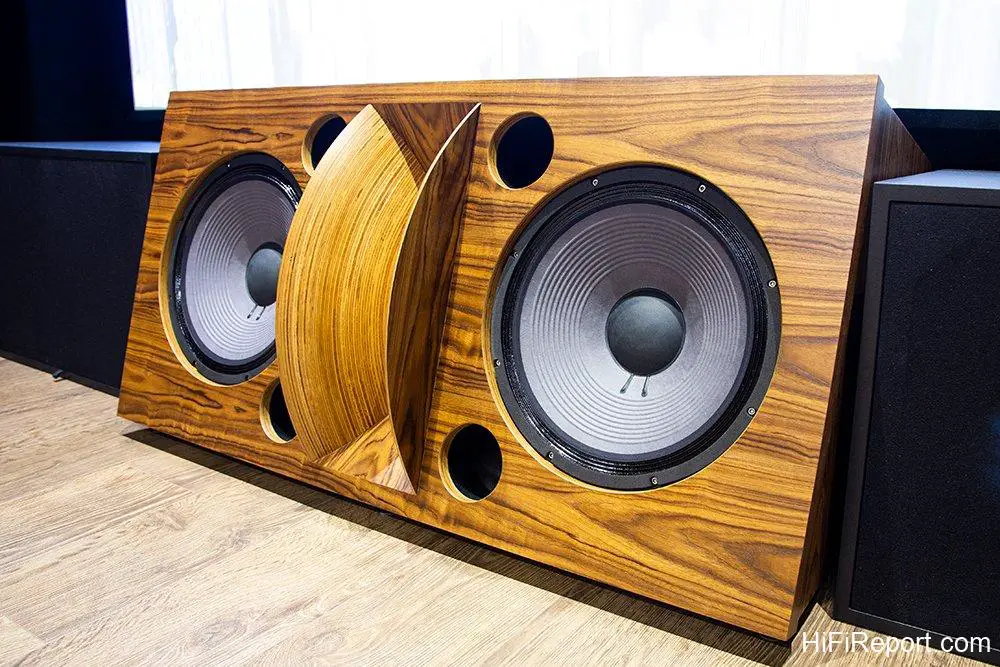
Upon arriving at HiFiReport’s residence and seeing the Classical 15CT in person, I was immediately struck by its sheer size, even before hearing a note. It’s significantly larger than photographs suggest! The Classical 15CT boasts cabinet dimensions of 123cm in width, 63cm in height, and 62cm in depth, tipping the scales at a substantial 80kg. This is undeniably a large speaker. HiFiReport explained that the fundamental architecture of the Classical 15CT mirrors that of LALS’ flagship speaker, the Classical 152. The “152” designation refers to the dual 15-inch woofers, a configuration shared by the Classical 15CT. However, due to its intended purpose as a center channel, the Classical 15CT features a slightly less voluminous cabinet, a smaller horn aperture, and a less elaborate compression driver tweeter compared to its flagship sibling.
The Classical 15CT’s compression driver tweeter employs the “Gold Tweeter,” a hallmark component consistently found in LALS’ high-end offerings. Its metallic, spheroidal housing is finished in a lustrous gold, giving it the appearance of a miniature golden globe.
This “Gold Tweeter” features a 50mm diaphragm, a significant increase in size compared to the 44mm diaphragm used in the Classical 12CT.
Driven by a potent magnetic motor, this “Gold Tweeter” boasts superior low-frequency extension capabilities. Paired with the expansive 55cm horn aperture, it allows the Classical 15CT’s crossover point to be set remarkably low at 800Hz. This low crossover point not only ensures a more seamless integration between the high and mid-bass frequencies but also allows the 15-inch woofers to operate within a narrower frequency band, potentially resulting in a richer and more robust mid-bass performance.
Impressively, the Classical 15CT still manages to achieve a high-frequency extension up to 20kHz, resulting in a remarkably wide overall frequency range.
In the low-frequency domain, the Classical 15CT’s response extends “only” down to 50Hz. HiFiReport clarified that achieving even lower frequencies wasn’t technically challenging, but dipping below 50Hz would necessitate a significantly larger cabinet. For instance, the flagship Classical 152 reaches a subterranean 20Hz, but it’s a behemoth, standing 168cm tall, 82cm wide, and weighing a massive 200kg – larger than a typical refrigerator.
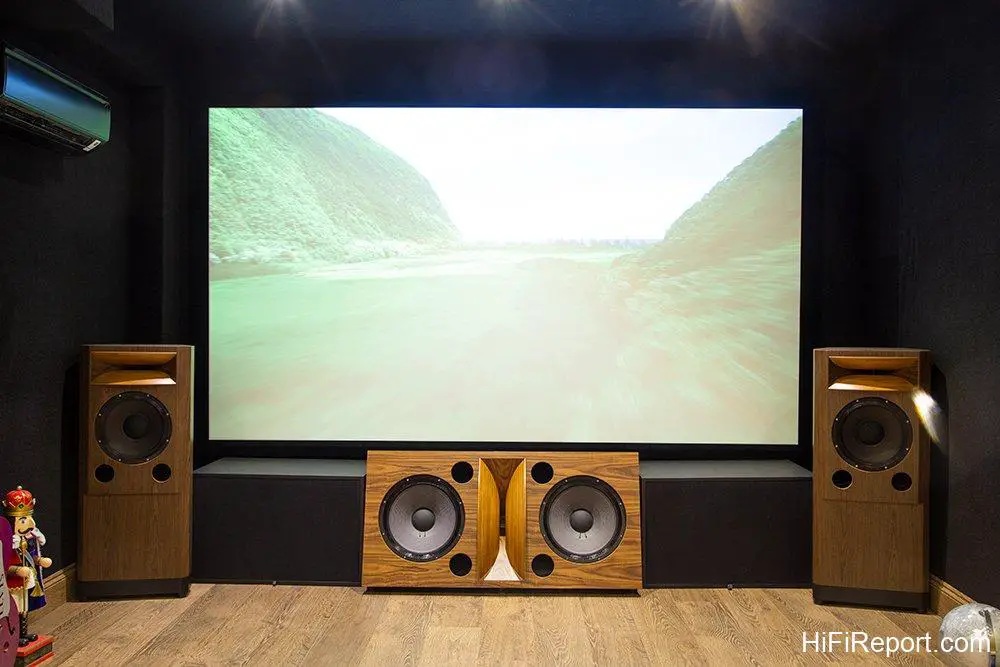
Center channel speakers, however, are constrained by placement limitations, and cabinet volume can’t be expanded indefinitely. The Classical 15CT, in its current form, is already pushing those boundaries. It fits perfectly beneath a projection screen without obstructing the image, but any larger would be impractical.
Is 50Hz adequate for a center channel speaker? HiFiReport assured me that it is indeed sufficient. Center speakers primarily handle dialogue, vocals, and key sound effects, rarely venturing into the realm of extremely low frequencies. For these purposes, 50Hz is more than adequate.
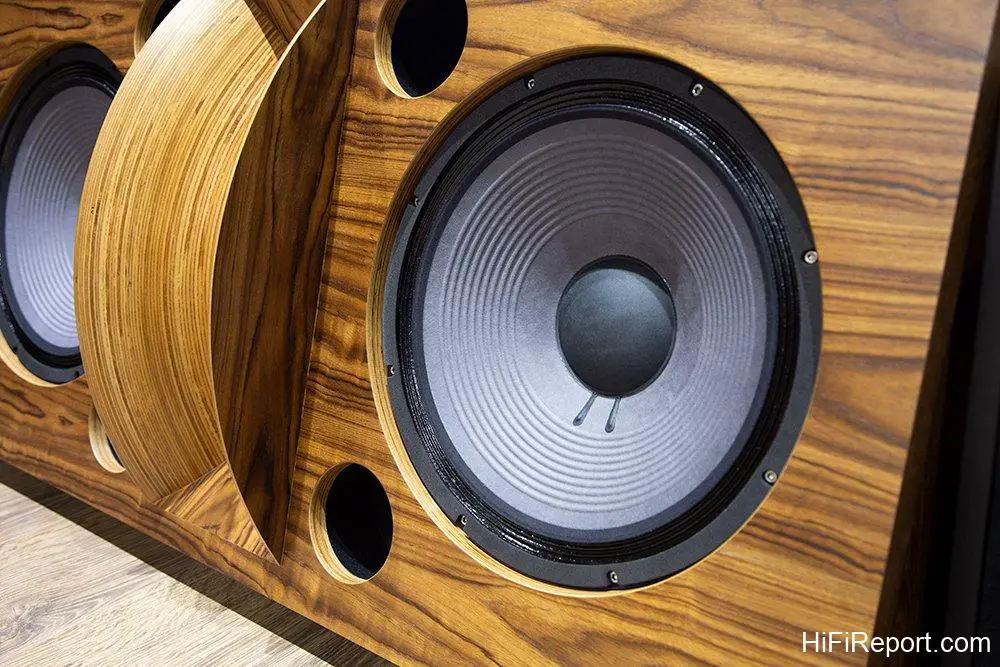
The Classical 15CT’s woofers utilize the same diaphragm material as the flagship model. However, to optimize them for center channel duty, and considering the different cabinet volume and frequency band they are tasked with, the stiffness of the spider, the voice coil, and the magnet assembly have all been meticulously adjusted.
These drivers boast a substantial 4-inch voice coil diameter, mirroring the flagship design, and are coupled with massive magnets. This robust construction contributes to exceptional low-frequency imaging and definition, surpassing the performance of 12-inch driver designs.
Center Channel Importance in Multi-Channel Systems
The Classical 15CT is a genuine compression driver horn-loaded center channel speaker. Its exceptionally high efficiency and remarkable sound projection capabilities make it ideally suited for theater systems employing large projection screens.
The Classical 15CT is specifically engineered for floor placement, eliminating the need for speaker stands or bases.
Its front baffle is intentionally angled upwards, allowing sound waves to project naturally in a slightly upward trajectory, ensuring even dispersion across the listening area.
The height of the Classical 15CT cabinet is precisely calculated, and the enclosure is deliberately designed with a front-high, rear-low profile. This design allows for the projection screen to be mounted as low as possible, with a minimum clearance of just 50cm from the floor, ensuring the speaker never obstructs the visual presentation.
With the screen positioned at this height, viewers enjoy a natural, level viewing angle, eliminating any need to crane their necks upwards.
Furthermore, the speaker’s base incorporates fine-tuning height adjusters, allowing for precise adjustments to the speaker’s tilt angle, optimizing it for various listening positions.
Intrigued, I asked HiFiReport whether, considering that the LALS product line features only two models with dual 15-inch woofers – the Classical 152 and the Classical 15CT – and given the Classical 152’s considerable size and price, it would be feasible to use two Classical 15CTs as main speakers, supplemented by a third Classical 15CT as a center channel. HiFiReport confirmed that this configuration would indeed be excellent for a home theater system. However, he advised against using a pair of Classical 15CTs for a dedicated two-channel music system. Being specifically designed for home theater, its low-frequency response extends only to 50Hz, prioritizing impactful bass over the deepest subsonic frequencies, which are typically handled by a subwoofer. For critical music listening, this might be perceived as slightly lacking in the lowest octaves.
HiFiReport further elaborated that while using identical speakers for the main and center channels is ideal for sonic coherence, budget constraints often dictate compromises. In such cases, he strongly recommends prioritizing the center channel’s performance over the main speakers. Investing in a higher-quality center channel is crucial because it carries the bulk of the sonic information in a home theater system, including dialogue, primary sound effects, and vocals. A weak or sonically inferior center channel can create a disjointed front soundstage, leading to sonic gaps or a constricted presentation. In such scenarios, HiFiReport suggests forgoing a dedicated center channel altogether and routing the center channel signal to the main speakers, allowing them to simulate the center channel effect. This approach, he argues, often yields a better overall sonic experience than a compromised center channel.
HiFiReport recounted instances where customers upgraded their main speakers to larger dual 8-inch or 12-inch horn models but retained their existing center channel speakers with smaller 5-inch or 6-inch woofers. These customers often noticed a recessed and underwhelming center soundstage. Following HiFiReport’s advice, they disabled their center channels and allowed their main speakers to simulate the center channel information. The resulting sound, he noted, was often a significant improvement. They then planned to upgrade their center channel speaker when budget allowed.
In essence, when upgrading a multi-channel speaker system on a limited budget, prioritizing the center channel upgrade yields the most significant sonic improvement, more so than upgrading the main speakers first.
100dB High Efficiency
The build quality of the Classical 15CT upholds LALS’s consistently high standards.
The Classical 15CT enclosure is constructed from Russian birch plywood, rather than the more common MDF (Medium Density Fiberboard). Birch plywood offers superior rigidity and density compared to MDF, effectively suppressing cabinet resonances and preserving sonic purity, making it an excellent material for speaker construction.
The cabinet exterior is then meticulously finished with a high-quality real wood veneer, lending it the aesthetic appeal of fine furniture.
The combination of a compression driver horn and highly sensitive dual 15-inch woofers allows the Classical 15CT to effortlessly achieve a remarkable 100dB efficiency rating. The system at HiFiReport’s home was complemented by LALS Classical 12 SE main speakers (96dB efficiency) and four Classical 8EX bookshelf speakers (92dB efficiency) mounted on the ceiling for surround and rear surround channels. This high-efficiency speaker array allowed HiFiReport to achieve prodigious volume levels and deliver precise, lightning-fast, and expansive dynamics using only a modestly powered Denon surround receiver.
Beyond the crucial center channel, a high-performance subwoofer system is essential for a complete home theater experience. The demonstration system incorporated two LALS 15-inch passive subwoofers, driven by a dedicated subwoofer amplifier, which offered adjustments for volume, crossover frequency, phase, and Q factor.
HiFiReport employed a rather unconventional multi-channel setup approach. The typical configuration involves setting all channels to “Small” with an 80Hz crossover, delegating the LFE channel and all low-frequency content below 80Hz from each channel to the subwoofer.
In contrast, HiFiReport configured all channels as “Large,” allowing each speaker to reproduce its full frequency range, with the subwoofer solely dedicated to the LFE channel.
He believes this configuration minimizes digital signal processing within the surround receiver, allowing for a more complete and faithful reproduction of the original recording, resulting in a more natural and organic sound.
Furthermore, his subwoofer amplifier minimizes DSP processing. The signal is passed through to the subwoofers with minimal alteration, with the exception of a Q factor adjustment centered around 30Hz.
HiFiReport explained that his subwoofers utilize lightweight diaphragms and highly compliant surrounds. The large 15-inch driver diameter is capable of moving substantial volumes of air, while the generously sized cabinet allows for a natural low-frequency extension down to 20Hz. Measurements revealed a remarkably flat frequency response, minimizing the need for extensive equalization to compensate for frequency anomalies. Consequently, the amplifier incorporates only a Q factor adjustment at 30Hz, allowing users to fine-tune the very lowest frequencies to their preference.
Effortless Sonic Nuances
After all this technical discussion, the crucial question remains: how does it sound? HiFiReport initiated the listening session with several familiar Dolby Atmos demo clips, including “Amaze,” “Leaf,” and “Red Bull F1,” as a sonic “warm-up.” Even with these oft-heard clips, the system’s exceptional qualities were immediately apparent. The soundstage was not only remarkably immersive but also possessed a dense sonic texture. This impressive performance is undoubtedly attributable to the horn’s potent projection and wide dispersion characteristics, effortlessly propelling sound waves across the room. The transitions between channels were seamless, creating a natural and cohesive sound field, resulting in a palpably solid sense of envelopment.
Next, we moved on to a racing sequence from the animated film “Ready Player One.” This wasn’t just any race; it was a chaotic, video game-style race packed with visual and sonic elements – rapid motion, explosions, impacts, dinosaurs, King Kong, scoring coins, and much more. The accompanying sound design is incredibly intricate. Yet, through the Classical 15CT, these complex sonic layers were rendered with remarkable clarity and organization. Sound objects were not only precisely positioned within the soundstage but also possessed clearly defined size, shape, and distance, resulting in a presentation that was never muddled or confused.
Furthermore, the sound possessed exceptional weight and density, contributing to a powerfully immersive and impactful sonic experience.
HiFiReport pointed out that this was a key area where the Classical 15CT demonstrably outperformed the Classical 12CT. The Classical 15CT exhibited improved sonic density and weight, creating larger and more clearly defined sound images, all while maintaining a sense of effortless ease.
Another demonstration came from “007: No Time to Die.” The opening scene, where 007 is ambushed by explosives in a cemetery, showcased the Classical 15CT’s prowess. The sudden explosions were not only intensely powerful and dynamically explosive but also possessed a distinct sonic shape and definition, accurately mirroring the on-screen action.
In the ensuing car chase sequence, as 007’s vehicle is besieged and raked with machine-gun fire, the impact of each bullet striking the car’s bulletproof glass was audibly distinct, further highlighting the Classical 15CT’s exceptional resolving capabilities.
Music Enjoyment
The Classical 15CT is not solely confined to home theater applications; it also excels in music reproduction.
Recognizing that many home theater systems are used for more than just movies, with online platforms like YouTube serving as sources for vast music libraries, HiFiReport demonstrated the Classical 15CT’s musical prowess using YouTube content. He highlighted its ability to present music with a grand and intimate scale, clearly revealing every nuance within the recording while maintaining excellent warmth and sonic richness, making even casual YouTube listening a highly enjoyable experience.
As an example, we listened to Vivaldi’s “Winter” concerto from “The Four Seasons,” as presented by the non-profit organization “Voices Of Music” on YouTube. The video revealed the recording venue to be a small church, adorned with wooden columns and paneling, and featuring wooden flooring throughout. Through the Classical 15CT, the acoustic characteristics of this space were readily apparent, with extended reverberation and rich echoes lending a sense of fullness to the overall sound. The violin retained its bright sheen and intricate textures, while the low frequencies were presented with both fullness and satisfying articulation and definition, showcasing the quality of this live recording.
We also sampled “Bad Guy” from the “Postmodern Jukebox” channel, a track featuring female vocals accompanied by piano, accordion, violin, bass, and drums.
Despite the original YouTube signal being only two-channel, upmixed to 5 channels by the surround receiver (without LFE, meaning no subwoofer output), the playback through the Classical 15CT center and Classical 12SE-G main speakers remained remarkably full and rich. The sound exhibited exceptional density, first-rate thickness, and agile, well-defined bass. Vocal nuances and textures were clearly rendered, and the playful and mischievous character of the performance was vividly conveyed, making for an engaging and enjoyable listening experience. Crucially, the system could be played at high volumes without any hint of harshness or listener fatigue, remaining comfortable even during extended listening sessions – a testament to its versatility and refined performance.
Redefining Center Speaker Performance
In reality, this home theater system, anchored by the Classical 15CT center horn speaker, serves not only as HiFiReport’s premier demonstration platform for LALS products but also as the primary entertainment and leisure hub for him and his family – and even doubles as his personal gym.
Behind the listening sofa, HiFiReport has installed an exercise bike, flanked by a set of heavy dumbbells. When he wants to work out, he simply cues up YouTube, and the seemingly endless stream of workout music, played through the LALS horn system, provides a precisely timed and energetic rhythm, solid and impactful bass, and a grand yet balanced sound. This sonic environment provides him with a powerful sense of motivation and drive, contributing to both his physical well-being and his continued business success.
Does this kind of home theater system pique your interest? A visit to HiFiReport is highly recommended; you won’t be disappointed.
Specifications
* Type: 3-driver, 2-way Horn Center Channel Speaker
* Drivers: 1 x 50mm Compression Driver with 55cm Wooden Horn, 2 x 15-inch Paper Cone Woofers
* Efficiency: 100 dB
* Impedance: 4 Ohms
* Frequency Response: 50 Hz – 20 kHz
* Crossover Frequency: 800 Hz
* Power Handling: 800 Watts
* Dimensions (W x H x D): 1230 x 630 x 620 mm
* Weight: 80 kg