
Lals Classical One Bookshelf Speaker Review
Lals is renowned as a horn speaker specialist.
If you’re in the market for horn speakers crafted with traditional techniques, Lals is your go-to.
Planning a multi-channel home theater centered around horn speakers? Lals should be your first call.
And if you happen to possess some NOS vintage paper cone woofers or compression drivers and are seeking custom horn enclosures, look no further than Lals; frankly, I can’t think of anyone better suited for the job.
However, traditional horn speakers tend to be quite large, often overwhelming typical living room spaces. Does limited space mean you have to forgo the horn speaker experience altogether? Fortunately, Huang Rixing has a solution.
While Lals’ lineup includes substantial models with 12-inch and 15-inch paper cone woofers, the Classical 8M and Classical 82, utilizing 8-inch carbon fiber woofers, offer a significantly smaller footprint. Their narrower width and increased depth resemble more conventional speaker designs.
Huang Rixing has also updated the compression driver horns on these models to a round profile. The horn’s layered plywood construction is exposed in its curves, visually evoking sound waves in motion, enhancing the overall musical ambiance.
Notably, despite the prevalence of horn speakers today, many do not incorporate compression drivers. These two Lals models, while appearing aesthetically similar to standard speakers, remain true to the traditional horn speaker approach by employing compression drivers.
The combination of a compression driver and a horn flare allows for greater projection of mid and high frequencies, resulting in more sonic detail and a richer information retrieval at the listening position.
6.5-inch Carbon Fiber Woofer
Stepping down from the Classical 8M and 82, we find the Classical One.
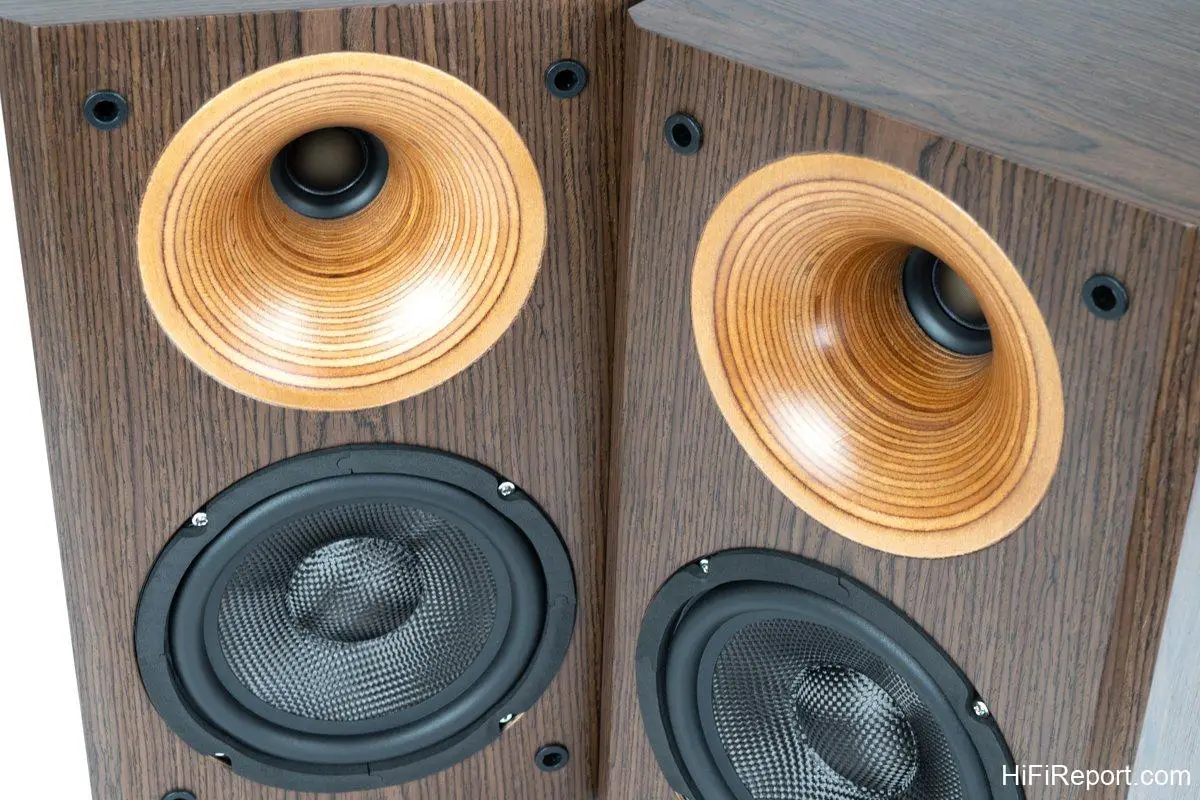
This bookshelf speaker is even more compact than the Classical 8M, featuring a 6.5-inch carbon fiber cone woofer. Like its larger siblings, it uses a carbon fiber pressed cone diaphragm, but opts for a rubber surround instead of the more traditional W-shaped cloth suspension.
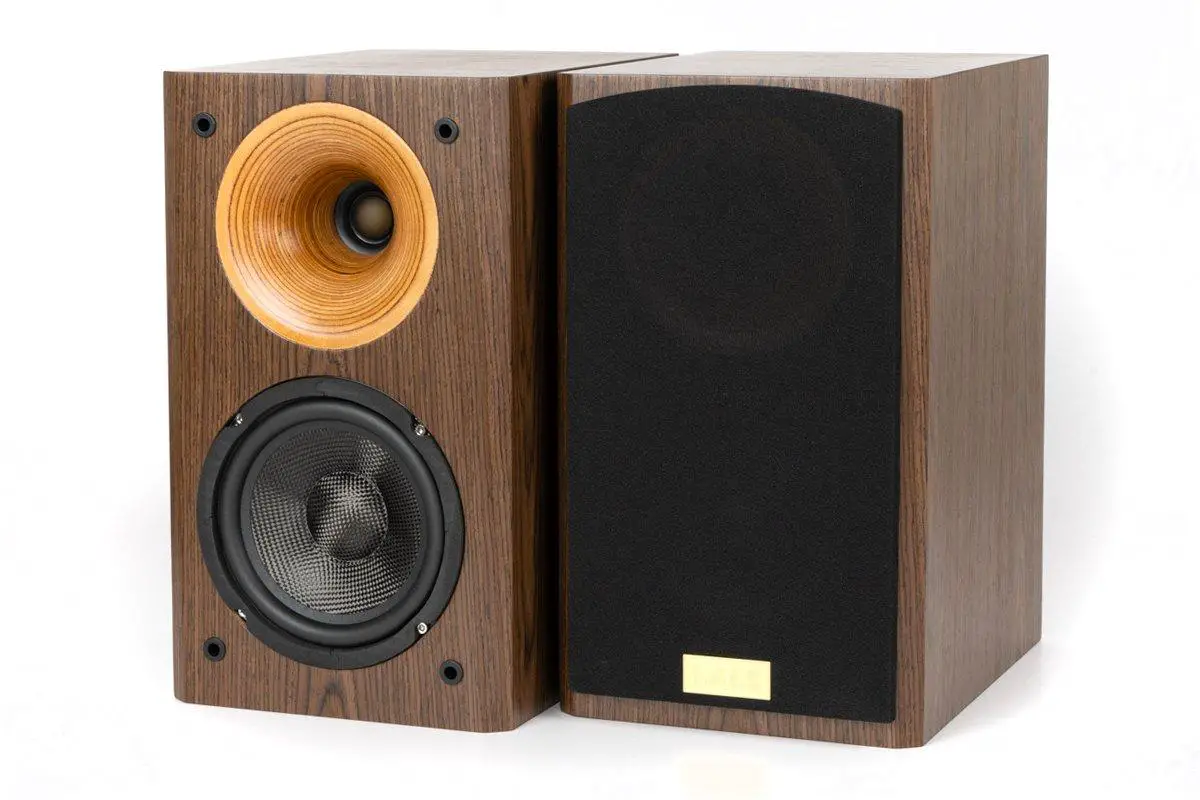
The smaller mid-bass driver allows for a more diminutive cabinet size, classifying the Classical One as a genuinely bookshelf-sized speaker, unlike the larger bookshelf dimensions of the Classical 8M.
So, if the Classical 8M seems too imposing, the Classical One is perfectly tailored for your needs.
25mm Silk Dome Horn Tweeter
To make the Classical One more accessible, Lals aimed to lower its price point, allowing more enthusiasts to experience the allure of horn speakers without a hefty investment. Furthermore, the smaller cabinet necessitated a reduction in horn proportions, precluding the use of a compression driver. Consequently, a conventional tweeter was chosen.
However, Huang Rixing is known for his meticulous nature. If it can be crafted in-house, he avoids outsourcing. This philosophy applies to compression drivers, paper cone woofers, and even the 25mm silk dome tweeter found in the Classical One, which was developed by Lals themselves.
Pairing the tweeter with a round horn not only increases the tweeter’s efficiency but also facilitates improved low-frequency extension through horn loading.
Lals has set the crossover point at 2,000Hz, enabling the tweeter to reproduce lower frequencies effectively via horn assistance without undue strain.
Optimized Crossover Design
In designing the crossover, Lals prioritizes two key aspects: minimal signal loss and high-quality components.
While not solely focused on using exotic audiophile-grade parts, they insist on components with excellent performance characteristics and reliable specifications.
Employing lower-order crossover designs with relatively simple circuit topologies minimizes signal path losses.
This approach maintains speaker efficiency and makes the speakers easier to drive.
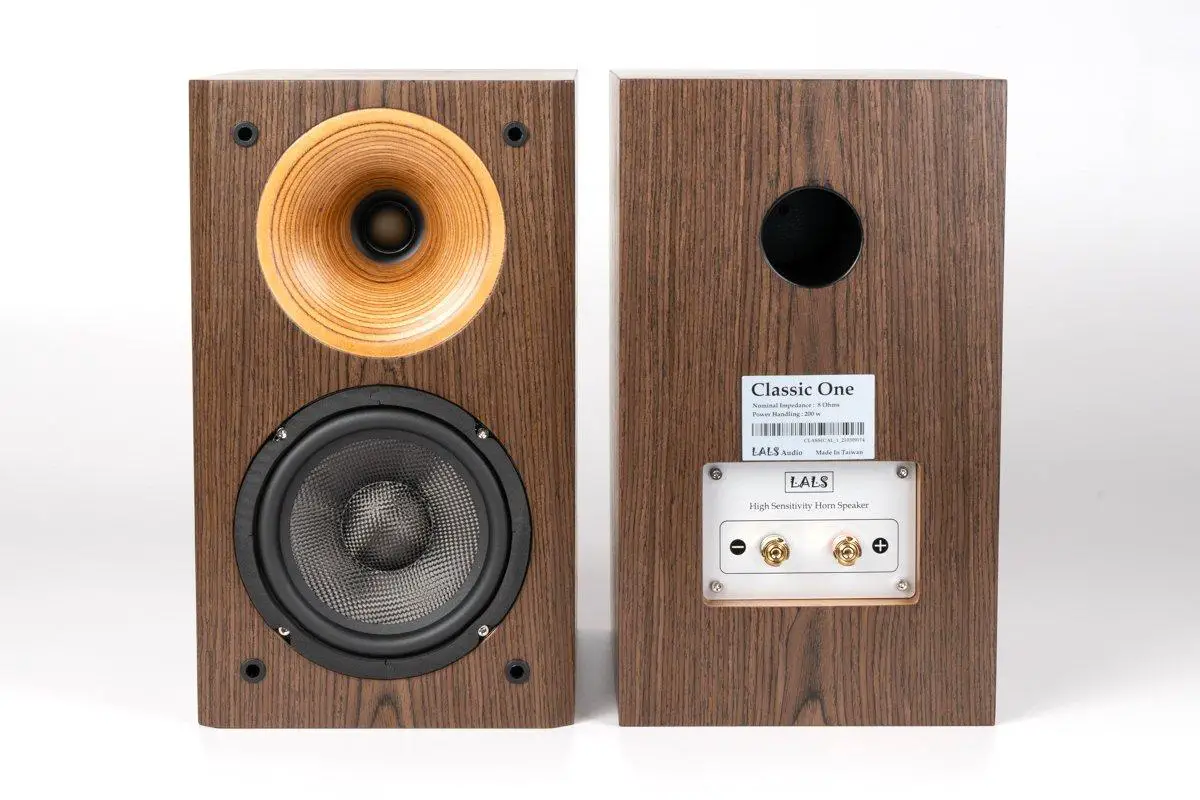
The speaker terminals on the rear panel follow Lals’ recent design trend, recessed within the inner side of the back panel. This prevents the terminals from protruding, simplifying packaging and protecting them from potential damage.
High Sensitivity and Warmth
According to Lals’ official specifications, the Classical One boasts a high sensitivity of 92dB. This is an exceptional figure for a bookshelf speaker, significantly exceeding the sensitivity of typical bookshelf designs by at least 5dB.
This high sensitivity means you can achieve ample sound pressure levels without demanding excessive power from your amplifier.
When Huang Rixing delivered the speakers, he briefly connected them for a quick audition in the listening room.
Paired with a Klimo Merlin preamplifier and an EAR Yoshino 509 power amplifier, the sound was enchantingly sweet and warm, with vocals that were remarkably vivid and lifelike.
From my previous experiences with Lals speakers, I know that high-power solid-state amplifiers can unleash their full dynamic potential. However, for vocal-centric listening, tube amplification provides a satisfyingly synergistic match. Both approaches offer distinct sonic advantages.
Given the horn-enhanced efficiency of the tweeter, it’s advisable to partner the Classical One with amplifiers leaning towards a warmer sonic character.
The source also plays a role. Using DACs available in the HiFiReport listening room, the Moon HAD 230 DAC presented a smoother and more agreeable sound than the North Star DAC32.
Beyond the HAD 230 paired with a Telos EMP running Roon, I primarily used the Denon PMA-A110 as my main amplifier.
Despite its modest size, the Classical One projects a full and substantial soundstage, even when positioned two meters apart.
Remarkably, even at listening distances exceeding four meters, musical details remain clearly audible.
Powerful Drums and Vocals
Taking Jennifer Warnes’ “Famous Blue Raincoat” album as a reference, the opening news report in “First We Take Manhattan” is rendered with clarity and precision, emanating from the right front. As the music begins, the drums strike with powerful impact, interwoven with the electric guitar melody. Jennifer Warnes’ vocals emerge, full-bodied, vibrant, three-dimensional, and palpably present. The slightly forward vocal presentation creates an intimate, performance-like experience.
The saxophone texture at the beginning of the title track “Famous Blue Raincoat” is breathtakingly beautiful and utterly realistic.
During slower passages, as the accompaniment softens, Warnes’ enunciation becomes even more distinct, and subtle nuances like the lingering decay and delicate tremolo of notes are revealed with exceptional clarity.
Remarkably, this level of detail and information is achieved with a silk dome tweeter, not a compression driver, highlighting the effectiveness of the round horn design.
Listening to “Joan of Arc,” a duet by Warnes and Leonard Cohen, the opening electric guitar possesses a warm and luminous tone. The subsequent percussion is crisp and energetic. Warnes and Cohen’s vocals, positioned in the foreground and background respectively, are rich in detail and clarity, resulting in an incredibly lifelike vocal presentation.
The Classical One delivers detail, soundstage, warmth, power, and speed in equal measure.
This single album effectively showcases the speaker’s numerous strengths.
Sensuous Cohen’s Voice
The Classical One excels in male vocal reproduction, leveraging its rich mid-bass to emphasize vocal depth and richness.
For instance, Leonard Cohen’s live performance of “Hallelujah” from his 2009 California concert, as captured on the album of the same name, reveals Cohen’s voice as richly textured and full-bodied. His deep baritone, reproduced through the Classical One, is spine-tingling, complemented by the vibrant flourishes of the electric organ.
The layering of accompanying instruments on stage is also clearly delineated, presenting a complete and immersive sonic picture.
As the song builds to its climax, the audience’s excitement is palpable, punctuated by cheers and culminating in a unified singalong of “Hallelujah” between the stage and the crowd. The Classical One truly excels at conveying atmosphere.
“Suzanne,” another track on the same album, recorded at a 2008 Manchester, UK concert, exhibits a different recording quality.
The acoustic guitar in this track is pristine, with rich string resonance and clarity.
Cohen’s delivery, a blend of singing and spoken word, resembles a poet narrating a story. His warm and expansive vocal presence is exceptionally pleasing to the ear.
In the final phrase, “with her mind,” Cohen’s voice descends, showcasing his signature deep bass tones, akin to a rich, aged wine—intoxicating and captivating.
Solid Imaging at All Volumes
Chris Jones’ “Roadhouses & Automobiles” album, featuring his equally magnetic male vocals, further demonstrates the Classical One’s capabilities.
In the well-known track “No Sanctuary Here,” the speaker handles the expansive and deep bass frequencies with aplomb. Despite being a bookshelf speaker, the Classical One’s low-frequency performance rivals that of many floor-standing models.
The track creates a wide soundstage, which the Classical One effortlessly fills with sound.
The preceding track, “The Last Fallen Leaf,” is an instrumental guitar piece.
In contrast to the intensity of “No Sanctuary Here,” the Classical One meticulously renders each guitar note, capturing subtle details like the sound of fingers sliding across the strings during glissandos – delicate embellishments to the composition.
The overall effect is simply beautiful.
In “Darlin’ Cory,” Chris Jones begins with a cappella vocals, immediately highlighting his distinctive vocal characteristics. Just as Lals’ professional monitor horn speakers are known for their vocal clarity and precision, the Classical One is equally adept at delineating vocal nuances.
During the instrumental interlude featuring mandolin and violin, each instrument is distinctly rendered—solid, tangible, and clearly defined in space.
During the listening session, a phone call interrupted. I lowered the volume to answer.
Upon resuming listening, I discovered another remarkable attribute of the Classical One: it maintains rich detail and precise imaging even at low volumes.
This is a significant advantage, as most home listening is done at moderate volumes to avoid disturbing others.
However, at lower volumes, speakers often lose detail due to insufficient driver excitation.
Additionally, reduced volume levels can lead to significant sound attenuation in the listening area, resulting in a loss of musical information and a blurred sonic image.
The Classical One overcomes these limitations, allowing you to enjoy the full richness of the music even at lower listening levels.
Detailed Sound Reproduction
Listening to Anne-Sophie Mutter’s “Across the Stars” album, starting with “Rey’s Theme” from Star Wars: The Force Awakens, the round horn enhances Mutter’s violin, making it even more prominent. The nuances and emotional depth in her phrasing are further amplified.
The forte passages in the higher registers possess a slight edge of excitement, reflecting the strong personality of the film’s heroine.
In “Yoda’s Theme” from The Empire Strikes Back and “Hedwig’s Theme” from Harry Potter, background instruments like the triangle, harp, and celesta are rendered with exceptional clarity and precise localization thanks to the horn’s magnifying effect.
Even the softest violin passages are rendered with solidity and substance, avoiding any sense of emptiness or weakness. The texture of the bowing is clearly audible.
If you are an audiophile who values sonic detail, the Classical One is highly likely to satisfy your demands.
Excellent for Music and Movies
If you desire a single audio system, a single pair of speakers, capable of satisfying both music listening and movie watching needs, the Classical One is an excellent choice.
Over several days of listening, I was initially captivated by its exceptionally vivid and lifelike vocal reproduction, and subsequently impressed by its detail retrieval capabilities.
However, when I played Hans Zimmer’s “Angels & Demons” soundtrack, experiencing the layers upon layers of dense and weighty sonic textures that Zimmer constructs, I realized: if you purchase the Classical One, be sure to use them for movies as well.
While the Classical One is a bookshelf speaker, to fully reproduce the deep bass weight of Zimmer’s scores, pairing them with a subwoofer is recommended for a more impactful and immersive cinematic experience.
A Pleasant Surprise
The Classical One is the smallest and most affordable Lals speaker I have auditioned.
It embodies Lals’ signature characteristics, utilizing a solid wood round horn to enhance tweeter efficiency, resulting in richer, clearer details, and revealing previously unheard or indistinct musical information.
Every encounter with Lals speakers brings a pleasant surprise, and this time is no different.
Specifications
* Type: 2-driver, 2-way round wooden horn bookshelf speaker
* Drivers: 25mm silk dome tweeter x 1 (with round wooden horn); 6.5-inch carbon fiber cone mid-bass driver
* Frequency Response: 50 Hz – 20 kHz
* Sensitivity: 92dB / W(1m)
* Impedance: 8Ω
* Crossover Frequency: 2000 Hz
* Maximum Power Handling: 200W
* Veneer: Ebony, White Ash
* Dimensions: 210 x 360 x 300 mm (WxHxD)
* Weight: 8kg