
Leak Sandwich 250 Review
Founded in 1934, Leak Audio is celebrating its ninetieth anniversary this year.
In its early days, the company dedicated itself to public address systems, coinciding with the golden age of radio in the 1940s. Born for professional purposes, Leak continuously pursued technological breakthroughs.
At one point, they created the “Point One Amplifier,” boasting distortion levels of merely 0.1%. Their TL/12 amplifier was even adopted as standard equipment by the BBC. Leak was also an early pioneer in transistor amplifier development, a fact underscored by the Leak Stereo 30.
A truly revolutionary product emerged in 1961 with the Leak Sandwich speaker, featuring a diaphragm made of polystyrene foam sandwiched between two layers of aluminum foil.
Leak Audio transitioned from the professional realm into home audio, moving from broadcasting studios into ordinary homes. Their product range expanded from radios to amplifiers and then speakers, steadily building a comprehensive business empire.
Yet, at its peak, a turning point arrived, changing everything.
In 1969, founder Harold Joseph Leak sold the brand, retiring at the height of its prominence. Without H. J. Leak at the helm, the company seemed to lose its driving force. Facing the globalization of the audio market at the time, in a flood of competition focused on lowering costs and prices, Leak lost its competitive edge and faded from the stage.
Even facing wartime bombing raids in the 1940s that completely destroyed their factory, Leak had managed to bounce back.
This decline, however, felt like an endless descent. It continued until 1996 when the Leak factory in Downham Market was leveled and redeveloped into a road as part of urban planning.
It seemed as though Leak’s legacy was confined solely to “what once was,” its story apparently concluded.
Unexpectedly, in 2020, the IAG Group announced the relaunch of the Leak product line. Once again, Leak rose from the ashes.
Having written reviews for three Leak components now, I feel compelled to mention this history every time.
I once knew absolutely nothing about this brand. Today, I find myself recounting their story, a dramatic past indeed.
A Brand’s Dramatic History, New Chapter
Leak began its resurrected journey by reintroducing amplifiers and CD transports. Following the release of the Stereo 130 and CDT, they launched the more powerful Stereo 230.
Now, they welcome back the classic 1961 Leak Sandwich speaker.
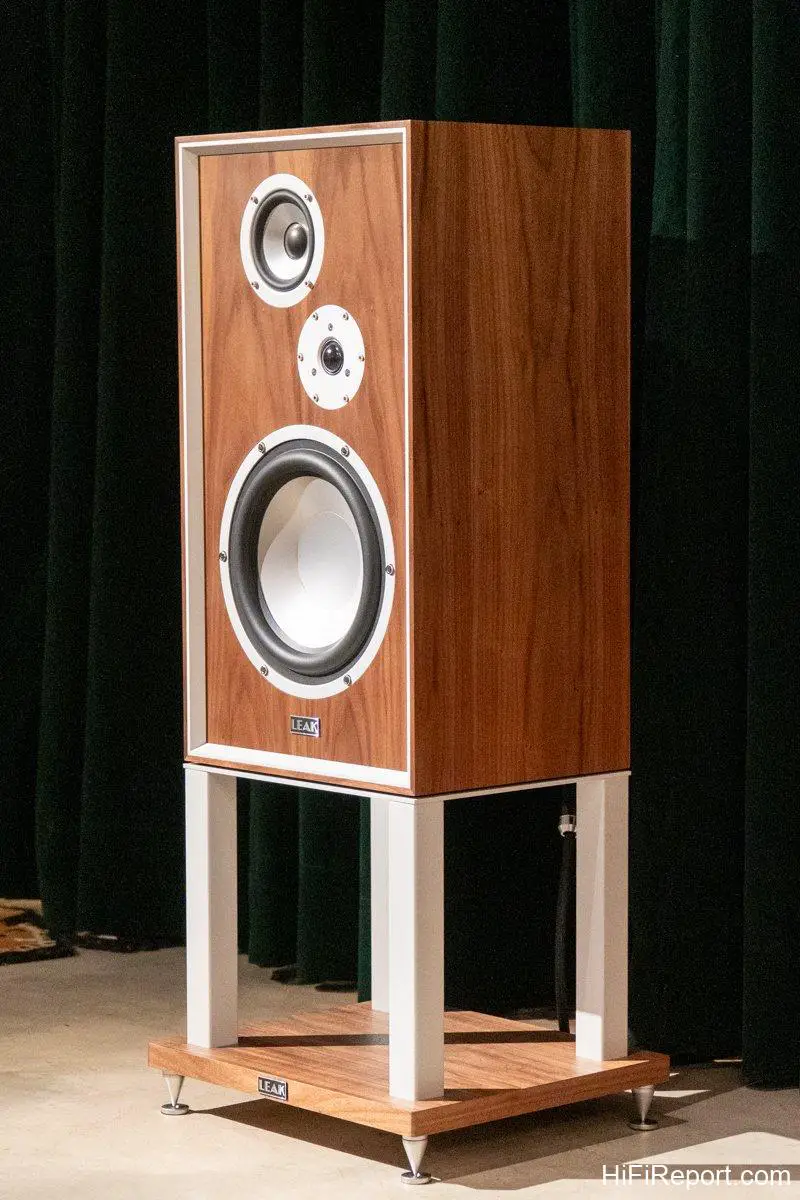
There are two models in the new Sandwich range, both larger bookshelf designs, the prevalent speaker style of that era. One is the Sandwich 150, a 2-way, 2-driver model, and the other is the Sandwich 250, a 3-way, 3-driver design.
The Sandwich Diaphragm
As early as the 1960s, Leak conceived of creating speaker diaphragms using materials different from traditional cones. They believed conventional materials lacked sufficient rigidity and were prone to cone breakup distortion.
This led them to develop the sandwich structure, using two layers of aluminum foil with a polymer core in between. Today’s “new Sandwich” speakers employ the same principle, utilizing rigid aluminum on the front and rear surfaces, which withstand greater pressure, and a thicker core layer of PMI (polymethacrylimide) foam in the middle.
Known for its high-temperature and high-pressure resistance, PMI is a material widely used in the aerospace industry, chosen for its ability to endure thermal and mechanical stress.
Leak states that the new generation Sandwich diaphragm is manufactured with greater precision and boasts improved material characteristics. The company is confident that this driver completely avoids cone breakup distortion within its operational range.
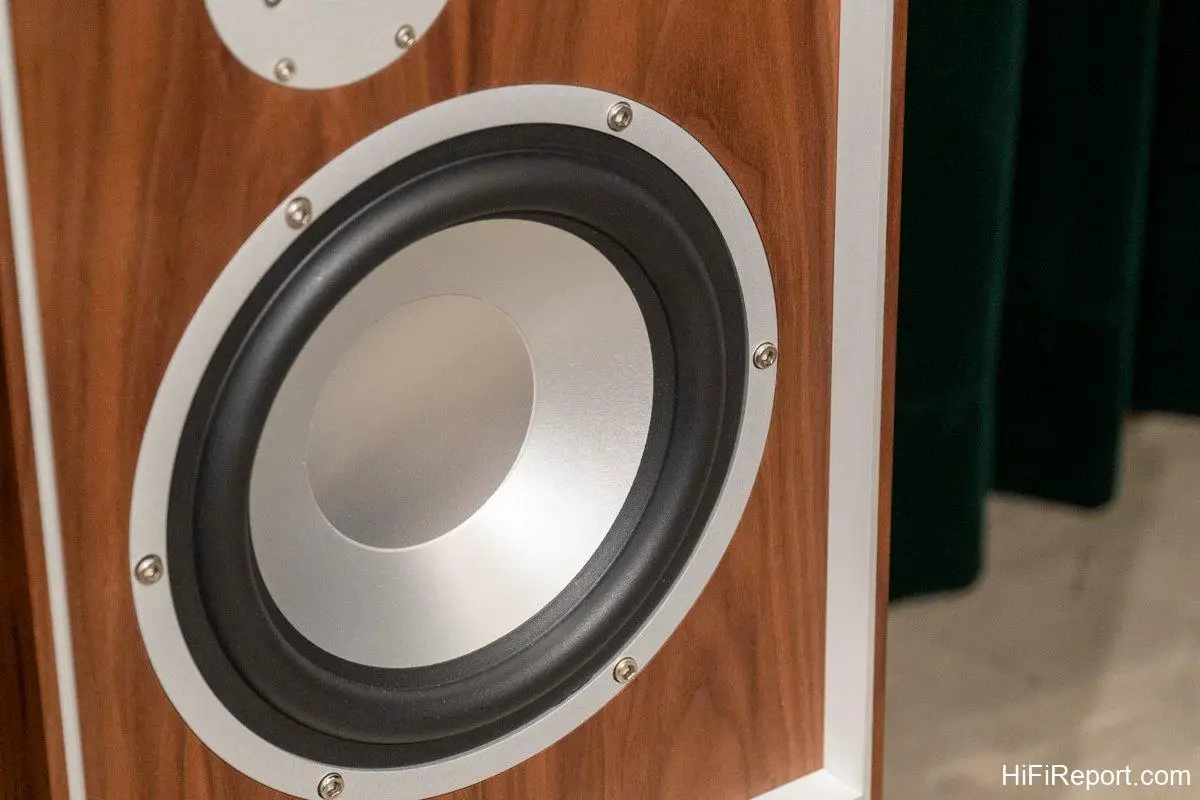
Both the 108mm midrange driver and the 280mm woofer in the Sandwich 250 utilize this sandwich diaphragm technology. Just as it propelled Leak’s business to new heights in the past, this innovative material application continues to showcase Leak’s clever engineering approach.
Treble with Independent Chamber
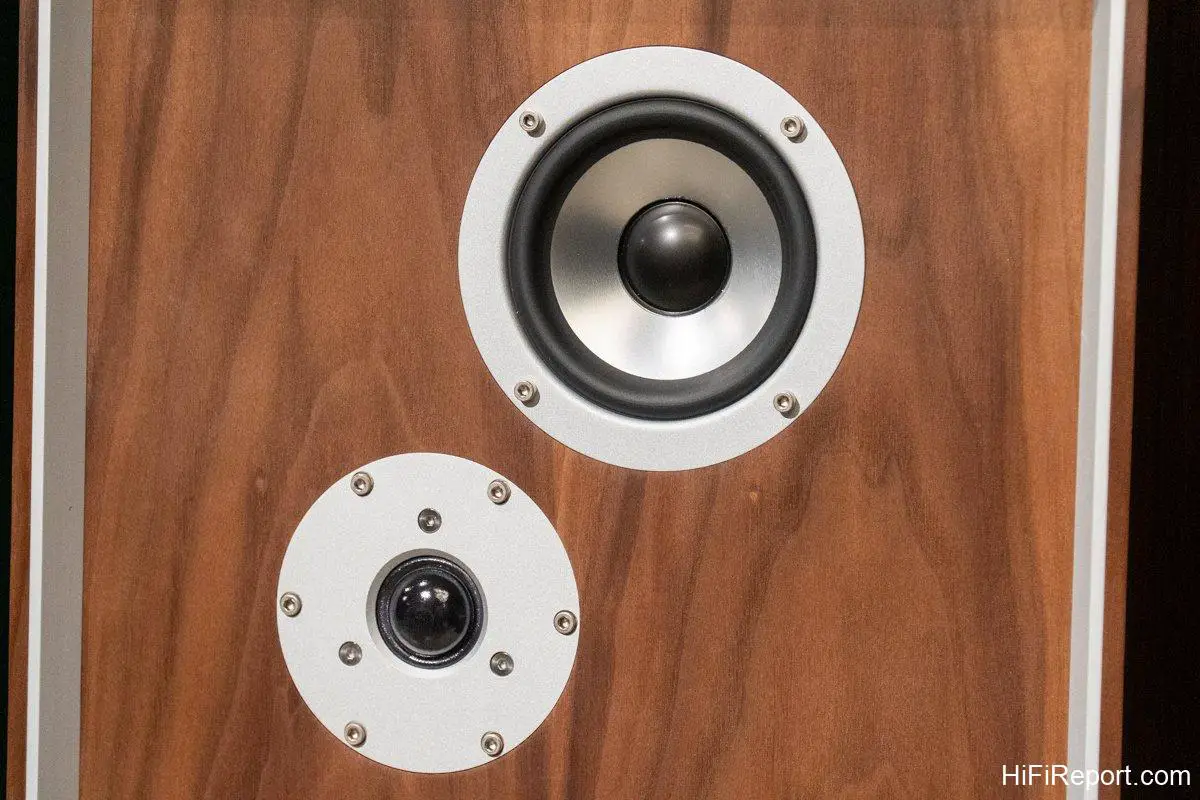
The treble is handled by a 30mm soft-dome tweeter, whose diaphragm surface is treated with a special damping coating. At 30mm, or about 1.2 inches, this tweeter is noticeably larger than the more common 1-inch size.
However, driver size isn’t the sole determinant of sound quality; reaching high frequencies up to 20kHz is generally sufficient. Furthermore, this slightly oversized 1.2-inch (30mm) tweeter is specified by Leak to extend up to 26kHz.
The more direct impact of driver size is on mass. A larger diaphragm is heavier, making it more demanding for an amplifier to drive. Leak has put effort into the Sandwich 250’s tweeter design. Not only does it reach high frequencies, but it also features an independent rear chamber.
This chamber serves multiple purposes: it absorbs the backwave from the tweeter, reduces interference from the energy of the midrange and bass drivers within the cabinet, and lowers the tweeter’s inherent resonance, pushing it below the crossover point.
Sandwich Cabinet Design
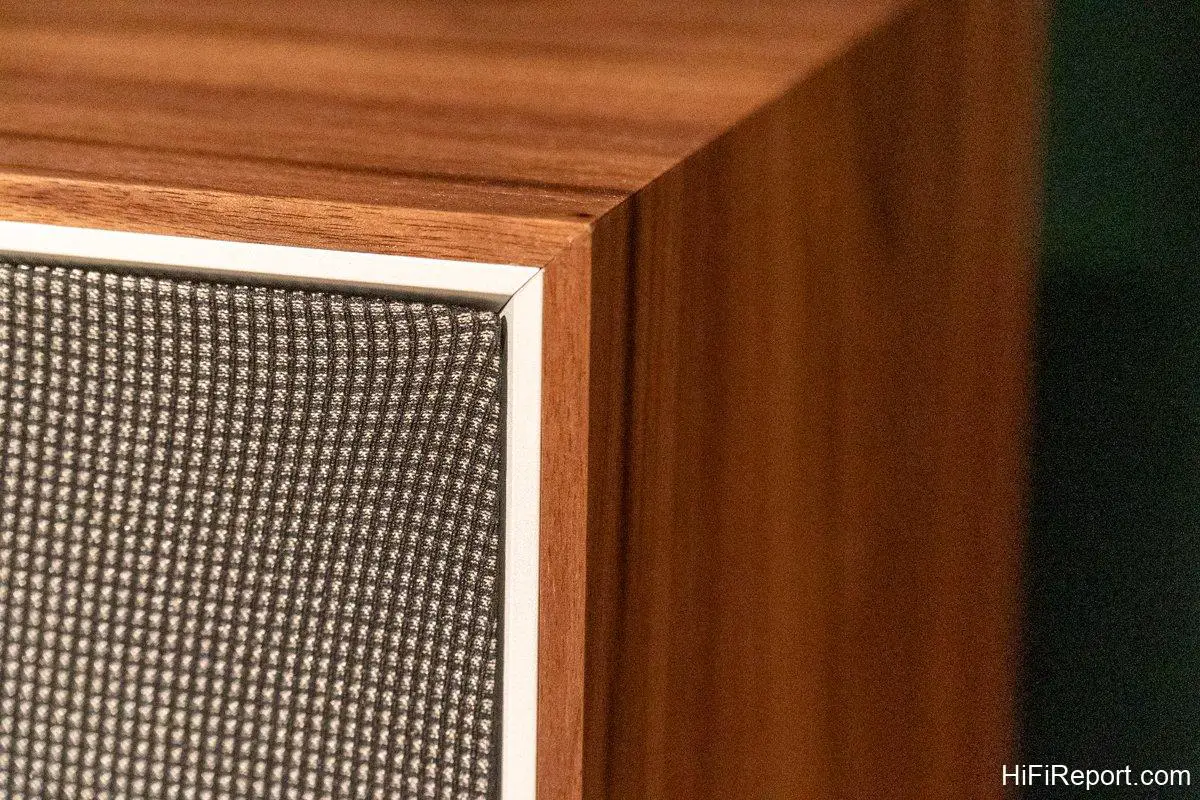
Leak states that not only are the driver diaphragms a sandwich design, but the cabinet itself also employs a sandwich structure. The Sandwich 250’s enclosure is built upon an MDF base combined with other composite panels, thus forming its own “sandwich.”
Additionally, they have taken two further steps. Firstly, to minimize resonance between the drivers and the cabinet, the mounting rings for the drivers are made of aluminum alloy. This is both aesthetically pleasing and effective in reducing vibration.
Secondly, to lessen front baffle vibration, an aluminum frame has been added around the classical recessed front panel. These design choices not only serve acoustic purposes but also pay homage to the design of the original 1961 Sandwich speakers.
Visiting HiFiReport: By Appointment
The listening session took place at HiFiReport Audio, located on Fujin Street in the Minsheng Community, near Minquan Park and Jieshou Junior High School. There’s no sign at the entrance, making it look more like the door to a cafe or restaurant, which might make some hesitant to enter.
To the right of the door, a stand on the ground clearly states: “HiFiReport is by appointment only.”
HiFiReport Audio is situated in the basement, so even though it’s close to Songshan Airport, it’s unaffected by aircraft takeoffs and landings. The ground floor space belongs to a top-tier domestic hip-hop music production company, whose principal is a good friend and former schoolmate of HiFiReport’s owner, Jack Lee.
“Won’t my listening session downstairs disturb the people working upstairs?” I asked. “Not at all,” Jack replied. “This is a music castle!” If you plan to visit HiFiReport Audio for a listen, please call ahead to make an appointment. While walk-ins are welcome, booking in advance ensures the best possible service.
I had an appointment and had been here before, so I knew the routine and layout. Pushing open the door, the people working on the ground floor didn’t even look up, saving me any potential awkwardness. Descending the stairs, I found HiFiReport Audio’s space, arranged like a comfortable lounge.
Passion for Leak: A Classic Radio
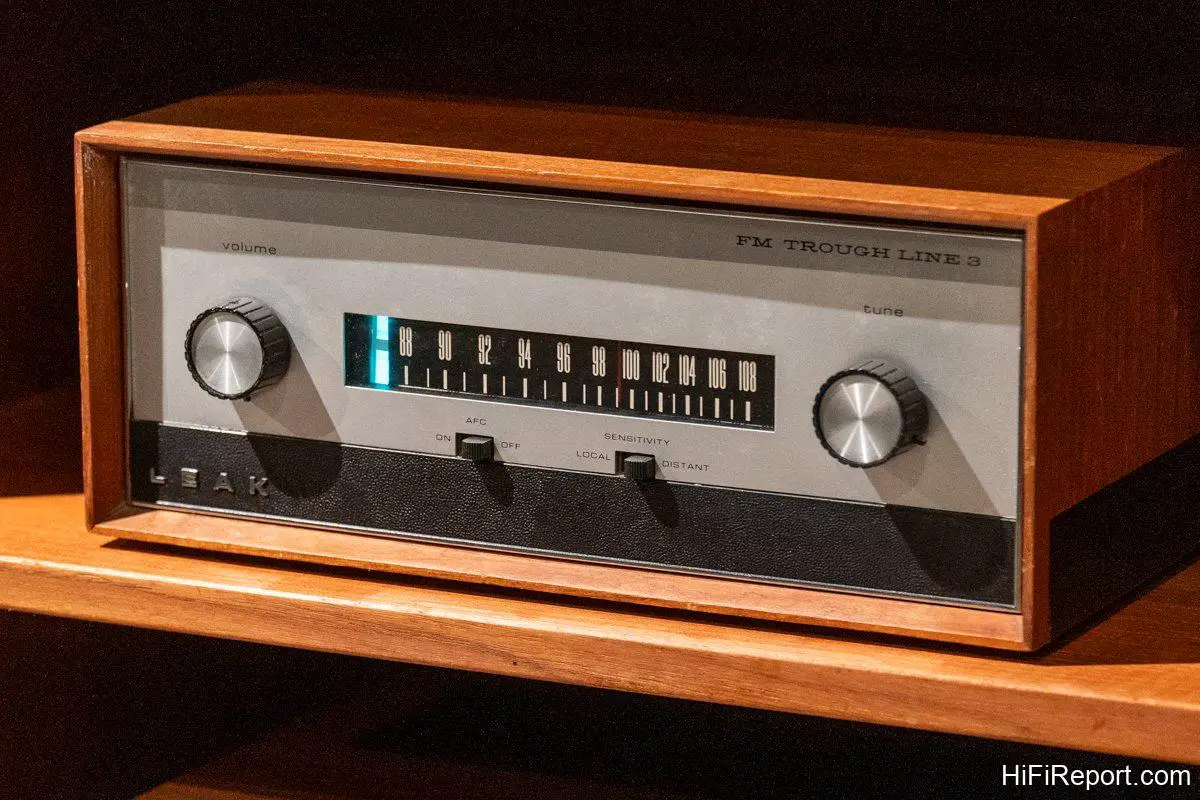
Seeing me arrive, Jack Lee greeted me warmly and immediately pulled me over to show me something special. “Did Leak make radios? This one looks so retro.” Displayed in the audio cabinet was a Leak Through Line 3 FM tuner. Its external condition was excellent; neither the wooden case nor the metal faceplate showed significant damage.
What was clearly visible was the “Leak” logo, not printed but in raised lettering, giving it a sense of premium quality. “I bought this,” Jack explained, saying he had a strong desire for this tuner and had been looking for one for a long time until he finally found one in good condition and imported it directly from the UK.
“No voltage issues?” I asked. “It was actually designed for international voltage from the start. Pretty clever, right?” Jack was more excited than anyone to acquire a piece of equipment he desired. He showed me the antenna location, simply mounted on the wall near the staircase entrance on the first floor. “But the sound is great!” He tuned into the HiFiReport radio station, and the sound was incredibly rich and pleasing.
I personally love this kind of character, which is why I spent a good amount of time experimenting with Magnum Dynalab tuners in the past. Hearing that warm, solid radio voice again brought back wonderful memories. Comparing it with the antique unit immediately highlighted the effort Leak put into replicating the details of their classic equipment for the modern reissues. The wooden cabinet frame, metal faceplate, print colors, and the feel of the knobs on the resurrected Leak CDT, Stereo 130, and Stereo 230 genuinely capture the essence of the originals.
System Setup: Leak and Custom Cables
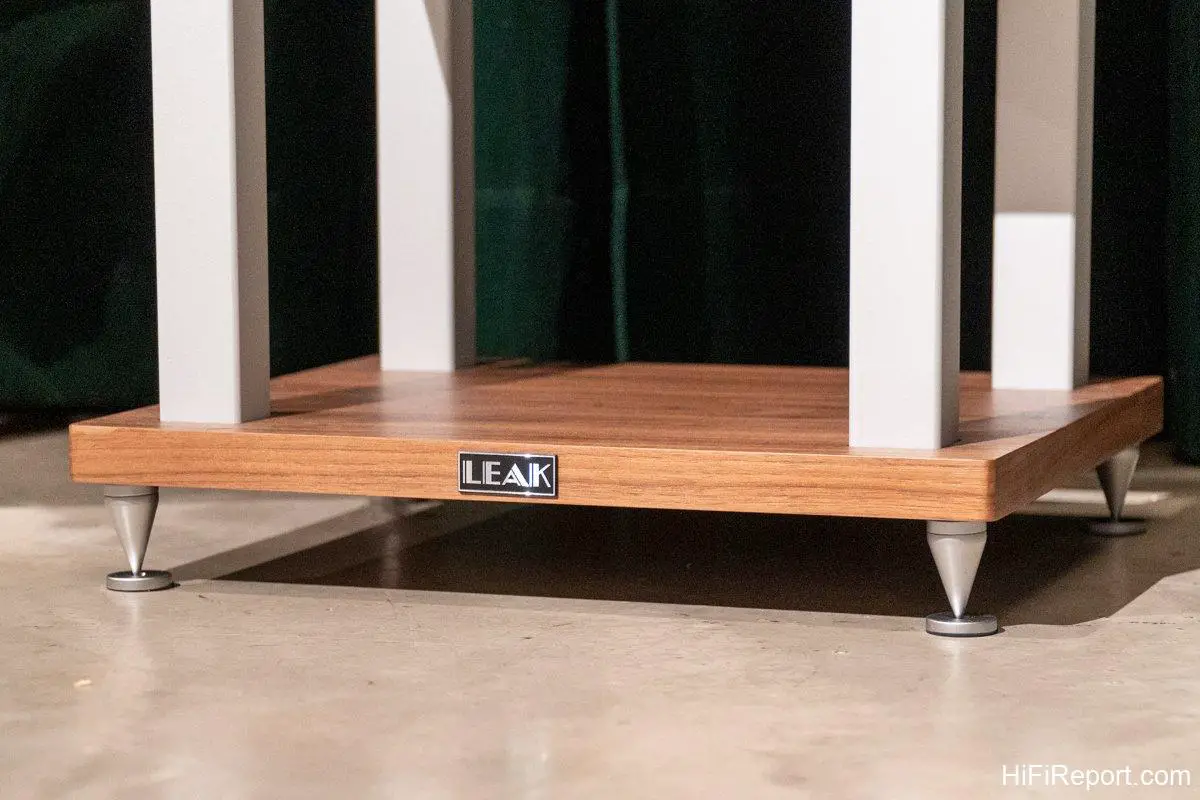
The Sandwich 250 speakers were placed on their dedicated stands, which provided a cohesive look. The stands fit the speaker dimensions well and, with their real wood veneer and white metal columns, share a similar design concept with the Sandwich 250 itself.
Naturally, the listening setup utilized Leak’s own system, including the CDT transport, connected via coaxial digital cable to the digital input of the Stereo 230, which handled decoding and amplification. Jack mentioned that the digital coaxial cable was one he made himself, based on Apogee’s 75-ohm coaxial cable. The speaker cables, power cables, and grounded power strip used on-site were also handcrafted by him.
The speaker cables were oxygen-free copper from Italian brand Tasker, with separate cables for positive and negative terminals to ensure complete isolation. Power cables included the InAcustik AC-2502 and a single-strand crystal copper cable customized by HiFiReport. These cables are available for sale at HiFiReport; during my audition, a customer came in to buy a phono stage and also picked up some power and speaker cables.
Achieving Balance: EQ and Controls
I noticed that the “Channel Balance” and “Bass/Treble” controls on the Stereo 230 were not centered. Jack explained that most modern amplifiers, in pursuit of pure sound, have unfortunately eliminated balance and EQ functions. He pointed to his listening space, noting that the speaker placement here is semi-open, with varying reflective surfaces causing the soundstage to shift. The channel balance control helps resolve this issue.
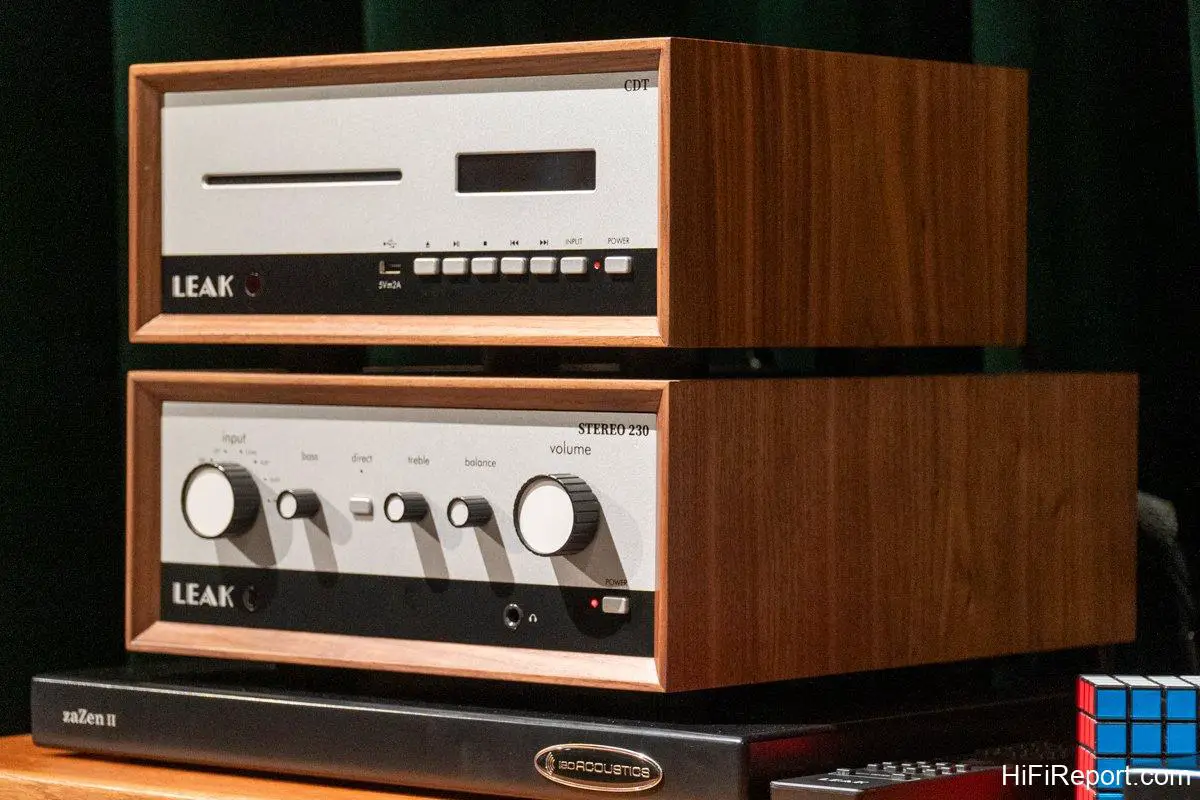
Regarding EQ, he added that everyone has different sonic preferences, and each recording has its own characteristics. Even one’s mood while listening can change. With the aid of EQ, the listening experience can be more enjoyable. He was pleased that Leak retained the bass, treble, and balance adjustments on the Stereo 230 and 130, stating, “I think this design is wise.”
Sound Signature: Balanced and Refined
The sound of the Sandwich 250 leans towards clean and fast, without any sluggishness or noticeable coloration. The overall tuning aims for a natural, balanced character, making the speakers very listenable over long periods. The treble is bright yet not harsh, the midrange is dense and textured, and the bass is controlled and not boomy.
Despite the Sandwich 250’s considerable size, its sound still feels more like a larger-voiced bookshelf speaker, maintaining a refined demeanor.
Jazz Performance: Refined and Expressive
Oscar Peterson Trio’s “We Get Requests” is a universally loved jazz album, and reproducing it shouldn’t be particularly difficult for an audio system. However, there are differences in how systems reproduce it. Just as “Understanding” sounds different sung by Xin Xiaoqi compared to Jonathan Lee, audio systems also differ – not necessarily in quality, but in flavor and personality.
When playing “Quiet Nights of Quiet Stars” through the Leak Sandwich 250, the initial strumming of the piano strings was crisp and brilliant, direct and well-defined – quite intriguing. The music’s development confirmed my initial impression. The piano notes were rounded with a shimmering sheen, yet that brightness was entirely free of harshness; it was a warm, comfortable, and rounded sound.
The plucked bass notes came across a bit more restrained than my imagination for an 11-inch woofer might suggest; there wasn’t the kind of full, rich bass volume I expected. Was there not enough bass? Honestly, it wasn’t deficient, but it felt as though the depth stopped at a certain point. In the large space at HiFiReport Audio, this bass felt slightly wanting. However, considering playback in a typical living room, this cleaner, crisper bass character would likely minimize standing wave issues.
This bass characteristic was also evident in the bowed bass on “You Look Good to Me.” Compared to the nearby JBL speakers (L100), whose specifications for bass response are similar on paper, the JBLs still sounded more expansive and generous. In contrast, the Sandwich 250’s bass was tighter and more controlled.
EQ or Direct? A Matter of Preference
During my audition, I initially pressed the “Direct” button on the Stereo 230 to bypass the EQ path, aiming for the purest sound. However, as I listened, I did notice the soundstage leaning slightly to the right, feeling that the energy on that side was stronger. Indeed, the right speaker was closer to the side wall, while the left side was open space, resulting in asymmetrical sound.
I turned off “Direct,” which engaged the channel balance control, and the soundstage centered. Jack had added a little boost to both the treble and bass, turning the knobs to roughly the “one o’clock” position for increase. I then adjusted the treble and bass slightly according to my own preference. Eventually, I accepted Jack’s suggestion, at least adding a bit more bass to give the music a firmer foundation.
Rock & Roll Soul: Unexpected Grit
Listening to Dire Straits’ “Love Over Gold” album through this Leak system revealed another impressive characteristic. Although the complete system is not prohibitively expensive, the wide speaker placement resulted in a broad soundstage. With the sound given space to expand, the individual instruments became more distinct and separated. This created a clearer sense of the stage.
The drums here sounded full and elastic. The 11-inch woofer is larger than the bass drivers on many floorstanding speakers, and it delivered drum sounds with a characteristic large-driver impact. The weight of the kick drum and the tactile feel of the tom-tom hits were palpable. I don’t know if the original Leak Sandwich speakers were this dynamic, but here, the drum sound was undeniably rock and roll.
As for the electric guitar, the lines were clear, paired with good tonal brightness. The Sandwich 250 exhibits excellent tonal color. Despite its British heritage and classical appearance, it delivers satisfying brightness and expressiveness – without which, electric guitars just wouldn’t sound right! Mark Knopfler’s vocals were distinct and clear, tight and detailed. I particularly enjoyed Knopfler on “Private Investigations,” where, against the atmospheric backdrop created by guitar, keyboards, and synthesizers, he sounded like a storyteller, recounting a weary past.
Room Acoustics: The Need for a Solid Wall
The specific location chosen for the Leak system at HiFiReport has thick fabric curtains directly behind the speakers, with a staircase leading to the first floor behind the curtains. This stairwell is used by Jack for storage, and there’s a solid wall on the other side of the stairwell. To say the system has no solid wall behind it isn’t entirely accurate, but if the speakers had a solid rear wall directly behind them instead of curtains and a stairwell passage, perhaps the speed, solidity, and bass response would be even better.
I discussed this possibility with Jack, and he agreed. This suggests that if this system were moved into a typical home with a solid rear wall, the sound would likely be more powerful than what I heard this afternoon.
Vocals: Intimate and Textured
Having listened to Dire Straits and having heard Jack play his treasured antique Leak radio earlier, featuring the “HiFiReport Radio” program with its textured yet smooth vocals, I was prompted to further explore the Sandwich 250’s vocal performance.
I put on Julie Su’s “20 Year Special Selection.” On “Please Come With Me,” from a live stage production version, before Julie Su and Fan Yi-Chen enter, the beautiful piano and string intro offered a comfortable listen with its luster and silkiness. As I mentioned before, the Sandwich 250 provides excellent vocal density, clear and focused imaging, and reveals texture and detail in the singing without any harshness.

A speaker under ~$3,300, a transport under ~$1,000, and an integrated amp under ~$2,000 – the total system costs less than ~$6,600 USD, yet the sound demonstrates remarkable refinement. This rarity is worth noting here.
“Selling Empty Bottles,” the song that propelled Julie Su into the ranks of top-tier vocalists, matches the tragic tone of the film it’s from. Her singing often includes vibrato at the end of phrases and a calling quality at high notes. These vocal characteristics and expressions, the techniques used, were clearly audible on the Sandwich 250. The 1983 production created a deep sense of space, with percussion layers, strings, and harmonies building up, evoking a strong sense of sadness.
Similarly, “The Same Moonlight,” another song from the movie “Papa, Can You Hear Me?”, carries sorrow and regret but also, due to its more rock-oriented character, offers critique and introspection. The powerful, forceful drum beats, the explosive, crashing electric guitar, and the backing vocals surrounding Julie Su’s cries of protest created incredible emotional tension. Perhaps it’s my own emotional connection, or perhaps it’s true, but after listening to Dire Straits, hearing Julie Su’s songs felt like the Sandwich 250 truly understood the sound of the 1980s.
Vocal Emotion: Conveying Feeling
Since I listened to Julie Su, why not some Jonathan Lee? Jonathan Lee’s “Since Youth Cannot Be Kept – Still Good to Be An Uncle” concert recording features him interpreting his own works. Many songs were newly arranged, increasing musical variation and richness, and including improvisations that gave the songs more vivid personalities.
“What’s The Logic of Love?” begins the album with a strong, stable rhythm, blues-style accompaniment, and verses delivered with a spoken-word quality – a distinctive opening. The Sandwich 250 clearly and brightly unfolds this opening track. Even with the lively, colorful, and layered accompaniment, Jonathan Lee’s vocal line remained clear; this speaker’s midrange is clean enough, clear enough, and renders well.
“Spirit in My Life,” like a love poem, starts as a monologue, then builds with rich accompaniment, and Jonathan Lee’s singing gradually increases in intensity, lifting the music’s emotion. The ability to convey this feeling is excellent! In “Don’t Care Who I Am,” Jonathan Lee’s singing is utterly captivating. This spoken-word-style interpretation, combined with numerous improvisations in tempo, gives the song a completely different character from Sandy Lam’s original version. The inclusion of a string interlude adds a refined theatrical quality to the song.
The same sense of transformation is present in “Understanding.” Xin Xiaoqi’s classic hit is sung by Jonathan Lee, and the flavor is entirely different. While Xin Xiaoqi is gentle, deeply emotional, and evokes sympathy, Jonathan Lee sings with the sensibility of a rock poet, the line “Don’t suffer for love anymore” sounding like advice from a relationship expert urging a breakup. Jonathan Lee’s vocal characteristics were fully revealed on the Sandwich 250, and the speaker’s lively, brisk nature made the live concert recording feel even more passionate and immediate.
Instrumental Texture: Vivid Clarity
Astoria, the Belgian tango orchestra playing Piazzolla, has always been one of my favorite versions. They capture both the classical beauty and the wildness of nuevo tango, perfectly embodying the essence of the tango style Astor Piazzolla pioneered.
Listening to “Michelangelo 70,” the violin’s whimsical glissandi had vivid, crisp lines; the colorful percussion added a sense of lively intrigue; and the reed texture of the bandoneón accordion was distinct and clear. Considering Leak’s amplifiers were once BBC reference equipment, while I haven’t heard of the Leak Sandwich speakers receiving similar acclaim, their dedication to driver and cabinet design was clearly aimed at reducing distortion. Today’s “reissue” not only replicates the original techniques but also reproduces that intention to achieve low distortion.
On the Sandwich 250, I feel I can sense the spirit and intention inherited from H. J. Leak – the pursuit of truth, innovation, and progress. Amidst the intense and passionate playing in the music, the texture of the instruments is presented with vivid clarity.
In “Otono porteno,” the strong rhythmic accents, played by the piano, strings, and accordion together, are rendered by the Sandwich 250 with a somewhat more classical flavor. I know this piece can be played with more wildness, but for a first listen, this level of intensity is acceptable. At least Jack didn’t see an issue, stating, “If you pair these speakers with a better amplifier, the sound will be even better.” The Leak 230 provides 75W per channel, Class AB amplification; in terms of wattage, it’s quite capable. Jack has been using these speakers for several months and has a good grasp of their capabilities, knowing the Sandwich 250 can perform even better with higher-end amplification. However, I found myself thinking: “Could someone give me a solid rear wall?”
In the lyrical, slow melody of “Oblivion,” beginning with the piano’s progression, leading into the accordion, then repeating, the strings build layer by layer. Once the emotion reaches a peak, the theme shifts. When tango slows down, instrumental texture is not just about being accurate but also about being beautiful. Beauty lies in whether your emotions are stirred; if they are, it is beautiful.

The piano in “Adios Nonino” is much more powerful; the same deep emotion is expressed differently. When the piano plays strong chords, I again thought about the rear wall. However, I can tell you that the Sandwich 250 can clearly resolve the texture of the bass chords, the sounds produced by the vibrating strings are very clear. With controlled, non-exaggerated bass that still offers resolution and detail, the Sandwich 250’s trade-offs make sense.
Soundstage: Open and Layered
When playing large-scale orchestral music, the Sandwich 250 benefits from the wide speaker placement and its clear, direct, and natural sound quality. Reproducing John Williams conducting the Vienna Philharmonic’s “Flight to Neverland” from the Hook soundtrack posed no difficulty.
The structure of this piece is not complex, featuring two main themes that alternate, depicting the story’s adventure and journey. While the themes are prominent, different orchestration techniques and variations between repetitions create complex changes, building diverse layers that shift and transform like a kaleidoscope. This is the challenge of performing the piece and the test for audio reproduction.
The Sandwich 250 unfolds this journey on a broad stage, with clear separation between sections. In the turbulent, flowing music, surprises are revealed layer by layer. Perhaps because “sandwich” means layers, the Sandwich 250 somehow intuitively understands how to deliver that layered pleasure. Percussion and brass are key elements adding color to the piece, while the timpani and bass drum are the vanguards driving the music forward. Each time the drums strike, the music gains renewed momentum.
In the “Devil’s Dance” from the movie “The Witches of Eastwick,” Anne-Sophie Mutter’s solo violin, accompanied by the orchestra, tells this fantastical story with its tight tone. I specifically used the adjective “tight” to describe the violin sound I heard. The beginning of the piece features over a minute of unaccompanied violin solo, making it impossible not to notice the violin’s tone quality. This quality is tight, with clearly defined lines, making the melodic contours especially distinct. When the orchestra joins in, the music gains thickness and emotion, and the variations become more numerous. Hearing Mutter freely perform rapid passages and short tremolos, her precise playing—in terms of pitch, rhythm, and technique—fully demonstrates her mastery that has kept her at the forefront of the music world for years.
A Final Listen: The Allure of Vinyl
Just as I was about to leave, Jack Lee brought over two vinyl records and asked with a smile if I’d like to listen. “I recommend music based on the person, understanding the customer through their musical taste. Music also helps bridge the gap between me and the customer,” Jack explained. In addition to selling audio equipment, he also sells records, specifically new releases. He sources new records from overseas, calculates costs like shipping and taxes, and sells them at a reasonable price. His order volume isn’t high enough to significantly reduce the cost of goods, naturally limiting the profit margin. “This is my way of making friends,” he said. He allows music lovers to experience the sound of good audio equipment and lets audio enthusiasts discover the charm of good music.
Vinyl’s Magic: The Golden Age Sound
What did he “feed” me? The 1966 soundtrack to the movie “Alfie,” featuring music led by Sonny Rollins. The turntable used was merely a Pro-ject entry-level RPM 1 Carbon, paired with the included Ortofon 2M RED MM cartridge, connected to the Leak Stereo 230’s built-in phono stage.
The sound of vinyl is indeed different. That richness and fullness brought out all the beauty of the analog golden age of 1966. Sonny Rollins’ saxophone had a beautiful metallic sheen, just like the Leak Sandwich 250 displaying its charm under the warm yellow track lighting at HiFiReport—warm and bright, warming the heart and shining so brightly it’s hard not to notice.
This was my first time hearing this album. When I got home, I found the file on TIDAL and played it. Oh my, what a difference! My home system costs significantly more than the full Leak system I auditioned at HiFiReport, but the effect of reproducing the music from different media was completely different. That analog, warm, full, dense texture was severely diminished, leaving only a dry, flat sound.
Leak chose to include a phono stage in both the affordable Stereo 130 and 230 integrated amps, and there’s a reason for this. If you want to revisit not just the “retro” or “reissue” appearance, but also the beautiful sound of that analog era, engaging the MM phono stage is essential.
The other record he shared also opened my eyes. It was Donald Fagen’s first solo album, “The Nightfly.” The songs are steeped in the atmosphere of the 1980s, and the recording quality is superb. The sound is focused, with clear lines that still retain elasticity. The mixing layers are clearly presented, without any blurriness or looseness. A single track like “I.G.Y.” is enough to get you energized.
Verdict: A Delectable British Sandwich
It was truly time to leave. Jack Lee had another appointment at 6 o’clock. I departed with a joyful heart, not just because the Leak system provided a comfortable and enjoyable listening experience, but also because the comfortable space and free listening atmosphere at HiFiReport Audio contributed to the pleasant mood.
“Finally, what’s your evaluation of these speakers?” Jack asked for my conclusion. My answer was simple: “What other speaker offers more yet costs less?” At the most affordable price point, you get classic British speakers with the most exquisite appearance, the most comprehensive performance, and a history to reminisce about.
Currently, only HiFiReport offers the Sandwich 250 for audition (the smaller bookshelf model, the Sandwich 150, is also displayed at HiFiReport Audio). If you’re interested, go listen for yourself, and you’ll discover that Leak’s sandwich is truly delicious!
Specifications
* **Type:** 3-way, 3-driver, bass-reflex bookshelf speaker
* **Drivers:** 30mm soft dome tweeter x1, 108mm sandwich midrange driver x1, 280mm sandwich woofer x1
* **Frequency Response:** 44Hz~26kHz
* **Crossover Points:** 470Hz, 3.1kHz
* **Sensitivity:** 88.5dB
* **Impedance:** 6 ohms
* **Recommended Amplifier Power:** 25-250W
* **Dimensions (WxHxD):** 655 x 370 x 300 mm
* **Weight:** 27.3 kg