
Little Dot LD H1 Review
The old adage “silk is not as good as bamboo, and bamboo is not as good as meat” speaks volumes, not about food, but about music. Silk represents string instruments, bamboo signifies woodwinds, and meat embodies the human voice. In the realm of audio, we also seek sonic richness, the ability to reproduce that luscious ‘meatiness’. My experience reviewing the Little Dot LD H1 tube-solid state hybrid headphone amplifier constantly brought this idea of rich musical texture to mind.
Voicing a Unique Sonic Identity with Vacuum Tubes
In the world of audio design, we often encounter the pursuit of “neutral and uncolored” sound. Yet, every time I ponder “neutral and uncolored,” I question, what truly defines neutrality? Even after years in audio reviewing, I haven’t fully grasped it. Instruments themselves possess distinct timbres. Recording processes further shape these sounds, influenced by recording equipment, becoming the recorded instrument’s sound. Subsequent mixing and mastering culminate in digital music files, delivered through physical CDs or digital streaming, then reproduced by the listener’s home audio system. Considering the numerous stages of processing, how can we definitively define neutrality? Often, when I use “neutral and uncolored,” I’m referring to equipment with a transparent sonic character, relatively free from coloration introduced by amplification components.
However, the LD H1 presents a distinctly voiced sound, boldly declaring its tube heritage with two prominent 6SN7 tubes. It’s a hybrid design, with the 6SN7 handling the first stage of amplification, followed by solid-state amplification in the output stage. While the solid-state components remain hidden beneath heatsinks, the use of LM317 and LM337 voltage regulators suggests NE5532 or NE5535 op-amps might be in play. This hybrid approach aims to harness the driving power of solid-state with the sonic refinement of tubes. So, where does “neutral and uncolored” fit in? Perhaps, the LD H1 leverages the inherent characteristics of vacuum tubes to craft a rich, warm listening experience. It’s a sonic signature with a strong personality, seeking kindred spirits who appreciate its unique character.
A Newly Introduced Audio Brand
This was my first encounter with Little Dot equipment and headphones. Mr. Wu of Yang Sheng, the distributor, is also a new acquaintance. Previously a devoted headphone and audio enthusiast and a Little Dot user himself, he transitioned into distribution after the factory inquired about his interest in managing the market.
During the LD H1 review period, several dealers and consumers expressed interest in listening, indicating significant market curiosity. As a newly introduced brand, many are eager to experience Little Dot’s offerings.
Despite being recently introduced locally, Little Dot is not a newcomer. Founded in Shenzhen in 2006, they boast over a decade of history. Little Dot’s origin story echoes the early days of many audio brands. Founder Yang Yuquan’s passion started with crystal radios, fostering an interest in audio circuit design. Through dedication and accumulation of loyal users, the brand was eventually established.
The Chinese brand name “” (Lì Tè Duō) seems to be a phonetic translation of “Little Dot,” suggesting the English brand name came first. This implies Little Dot’s ambition from the outset was to compete internationally, not just domestically, adopting an English-centric brand identity from the start.
Yet, the name “Little Dot” carries a humble, almost self-deprecating tone, suggesting modesty rather than grandiosity. Alternatively, given their beginnings in headphones and headphone amplifiers, products often small in size, “Little Dot” could also refer to their compact form factor.
In essence, Little Dot isn’t a new player in the audio market, just a relatively recent entrant to this particular market, hence the fresh impression.
6SN7 Tube-Solid State Hybrid Circuitry
The LD H1’s industrial design leans towards classic elegance. The black chassis exudes a traditional feel, complemented by a natural wood front panel, reminiscent of Italian brand Unison Research, though thankfully not a direct copy, maintaining its own distinct style.
Dominating the top panel are the prominent 6SN7 vacuum tubes. The factory thoughtfully includes NOS (New Old Stock) Sylvania 6SN7 tubes, long out of production. The supplied 6SN7s arrived in their original packaging, suggesting they are from early retail tube inventories, rather than bulk industrial packaging.
These NOS vacuum tubes have seen prices soar in recent years, driven by scarcity. Original manufacturers have ceased production, and older tubes, built without modern environmental concerns, are remarkably durable.
Little Dot’s ability to provide NOS 6SN7s likely stems from early procurement, amassing inventory before prices escalated, otherwise, the LD H1 might be even more expensive. The pair of NOS 6SN7 tubes alone could fetch several hundred dollars on the online market.
If you acquire an LD H1, consider preserving the included NOS Sylvania 6SN7s, opting for readily available current production 6SN7s for daily use. The NOS tubes could appreciate in value over time.
Generous High-Quality Components
Beyond the premium signal tubes, Little Dot has incorporated high-quality components throughout the LD H1.
Opening the chassis reveals a clean, well-organized layout, clearly showcasing a dual-mono symmetrical design with dual transformers, providing independent power supplies for each channel to enhance channel separation.
The circuit board is populated with numerous red capacitors – easily recognizable to seasoned audiophiles as German WIMA MKP capacitors. Japanese Sanyo OS-CON and Mundorf EVO capacitors are also present. For filtering, renowned Philips BC filter capacitors are employed.
This selection of audiophile-grade components demonstrates Little Dot’s commitment to quality, striving to utilize the best available parts in their design.
Functionally, the LD H1 offers both RCA and XLR balanced inputs, and also features a set of XLR balanced outputs. This indicates the LD H1 can function not only as a headphone amplifier, but also as a preamplifier.
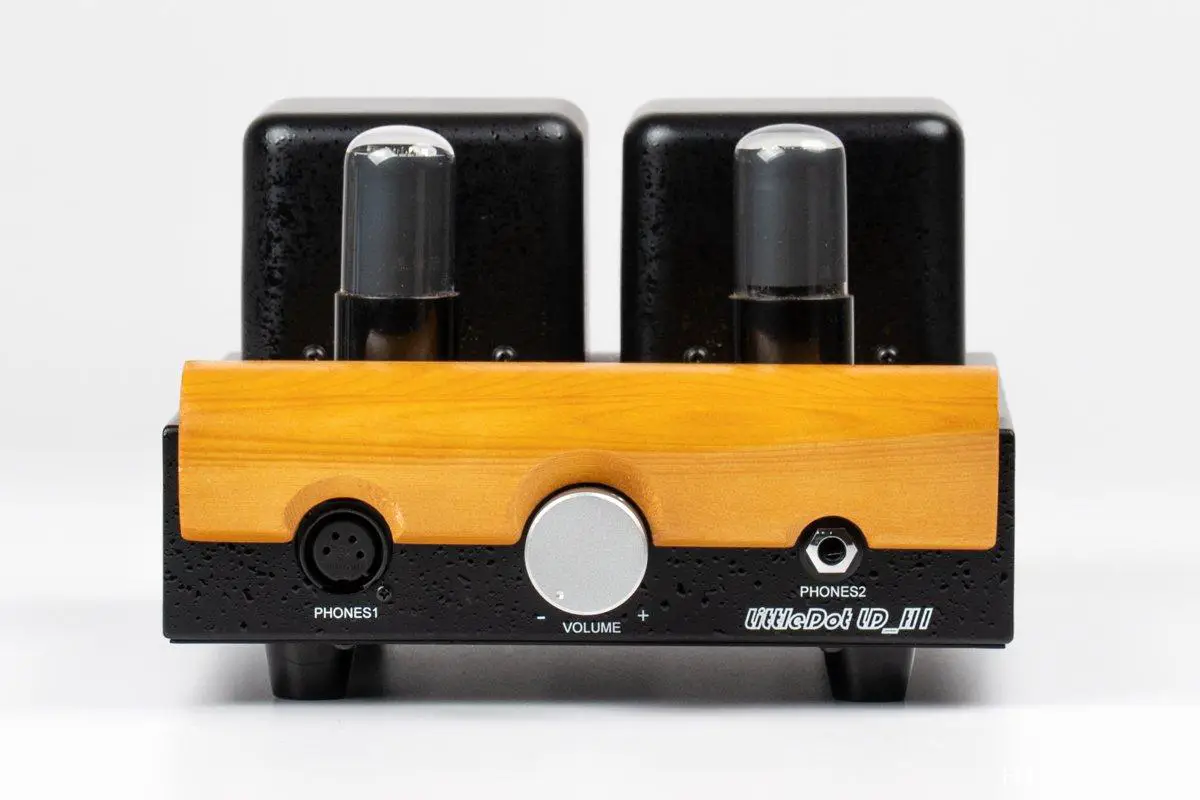
Headphone output jacks are discreetly placed beneath the wood trim on the front panel, one on each side, including a 4-Pin balanced and a 6.3mm single-ended headphone jack. A central volume control completes the minimalist front panel, offering intuitive operation.
Internal Gain Adjustment via DIP Switches
For initial listening, I paired the LD H1 with Little Dot’s own Cu-GYFU over-ear headphones, using the factory 4-Pin balanced cable, with an iBasso DX220 Max serving as the source.
Initially, I used a MacBook Pro with a Geek Out V 2.0 DAC. Perhaps due to the DAC’s high output level, I encountered overdrive and distortion, even after adjusting gain settings. However, using the MacBook Pro’s headphone output directly resolved the issue. But such a simple setup felt inadequate for a proper review. So, I borrowed a DX220 Max from headphone editor Cai Chengrong, also utilizing his Tidal account to evaluate the LD H1.
This DAC compatibility issue led me to discover another adjustment feature, almost overlooked: the LD H1’s gain setting. It offers switchable high gain (9x) and low gain (4.5x) options. Initially seeking to adjust gain to match the DAC’s output level and avoid overload, I couldn’t find external gain switches. Upon inquiry, I learned that gain switching requires opening the chassis. Two sets of DIP switches are located on the circuit board. “On” represents low gain, and “Off” signifies high gain. You can adjust the gain according to your headphone impedance. With the 33-ohm impedance Cu-GYFU headphones, low gain was suitable. For higher impedance headphones, high gain may provide better drive.
Warm, Rich, and Meaty Sound Signature
As the title suggests, the LD H1 is a headphone amplifier with a warm, rich sound, capable of rendering musical “meatiness.” Its sonic character is distinct, far from being transparent or sterile, instead possessing a pleasingly rich tonal density.
Take “La Vie En Rose” from the “A Star Is Born” soundtrack as an example. The opening piano chords are immediately full-bodied and substantial. Piano notes are clearly defined and rich, contrasting with Lady Gaga’s distinctive vocals. Her throat tones are articulate, adding a touch of nasal resonance characteristic of French chanson. Subtle ambient sounds from the film’s setting remain in the background, behind the vocals. During spoken word sections, the dialogue is weighty, while audience cheers recede into the background, creating a sense of space. The mid-range richness draws Lady Gaga and the piano closer, enhancing the intimacy of the listening experience.
After “La Vie En Rose,” my thoughts drifted back to the movie, to “Shallow,” the protagonist’s debut performance. Acoustic guitar arpeggios accompany the male lead’s voice, singing “Tell Me Something girl…”. The LD H1’s mid-range warmth makes his vocals prominent. When the female lead enters, her clear voice contrasts with his raspy tone. During the duet, the LD H1 renders their vocal lines distinctly, without sacrificing sonic detail due to the rich mid-range. As the chorus swells with the full band, the low-frequency rhythm of drums and bass is both substantial and impactful.
Rich Mids, Detailed Lows
Switching to more energetic music, Guns N’ Roses’ “Sweet Child of Mine,” the iconic Slash chord arpeggios are full and articulate, capturing the true tone of Gibson humbucker pickups. While I perceive the LD H1’s mid-range as rich, the low-frequency range is not excessive, instead leaning towards clarity and impact.
On classic rock tracks like “Sweet Child of Mine,” equipment that overemphasizes bass can easily become muddy and overwhelming. The LD H1 avoids this pitfall. Instead of excessive low-frequency emphasis, it offers clear and impactful bass alongside a rich mid-range. It avoids excessive low-frequency coloration, focusing on speed and clarity. This is a commendable trait. Some headphone amplifiers that emphasize mid-range warmth often compromise low-frequency control. The LD H1 demonstrates a careful balance across the frequency spectrum. While the mid-range is rich, low-frequency clarity and detail are well preserved.
Natural and Engaging Musicality
For further low-frequency evaluation, I listened to “Looking For A Home” from “Blue Coast Collection,” a simple song with guitar and vocals. The low-frequency test comes from the guitarist’s foot tapping on the floor while playing.
Some bass-heavy headphone amplifiers can make these foot taps sound like extraneous noise. However, the LD H1 handles them naturally, as the realistic sound of foot tapping rhythmically accompanying the guitar playing, subtly present without overshadowing the vocals. These subtle recording details enhance the realism and immediacy of the music.
Pairing a headphone amplifier with a distinct sonic character like the LD H1 with music that shares that personality can amplify the emotional impact.
Consider Li Zongsheng’s “Hill.” This introspective song by a middle-aged artist, reflecting on life’s journey, is inherently personal. The LD H1 brings the music closer, as if Li Zongsheng is singing directly in your ear. His vocals sound direct and sincere, with clear nuances in his delivery. The background acoustic guitar strums chords with a bouncy energy. The electric bass adds further depth to the music. The characterful LD H1, when playing Li Zongsheng, adds an extra layer of poignant depth.
Enhancing Romantic Music’s Romanticism
Switching to classical music, I listened to Anne-Sophie Mutter’s solo performance of “Carmen Fantasy” with the Vienna Philharmonic conducted by Levine. The introduction begins with powerful fortissimo passages. The LD H1’s rich mid-range showcases the orchestral weight. The violin possesses a pleasing richness and brilliance. The detail of the bow on strings, combined with the resonant body of the instrument, conveys the violin’s alluring character. Even in the violin’s highest registers, the tone remains substantial, avoiding any harshness.
Instead, it reveals a pleasant musical sheen. Subtle shifts in tone and dynamics showcase Mutter’s youthful romanticism. Perhaps Mutter’s current rendition of this piece might lack this youthful allure. These romantic, gypsy-infused melodies, when heard through the LD H1, gain an extra layer of mid-range richness, making the music even more romantic.
However, being a tube amplifier, the LD H1 is sensitive to vibration. For example, while listening, lightly tapping the wood trim on the front panel will transmit tube vibration noise into the headphones. Placing the LD H1 on my desk while writing and listening, keyboard vibrations also slightly affected the sound. Using vibration isolation pads or placing the LD H1 away from vibration sources would likely improve its sonic performance further.
A Hybrid Amplifier with a Distinct Sonic Identity
Spending time with the LD H1, I found it to be a headphone amplifier with a strong sonic identity. The key isn’t just the tube-solid state hybrid design, but its tonal expression. It possesses the rich density of classic tube amplifiers, yet retains the detail retrieval of modern solid-state designs.
If you’ve experienced many solid-state headphone amplifiers and found them lacking in musical engagement, despite their detail, the LD H1 might be your ideal choice. It combines the best of both tube and solid-state worlds. Furthermore, the 6SN7 tube stage offers opportunities for tube rolling. Different brands of 6SN7 tubes offer varying sonic flavors. You can treat the LD H1 as a platform for sonic exploration, experimenting with different 6SN7 signal tubes to discover interesting tonal variations. This is part of the fun of tube amplifiers – “tube rolling, not amp rolling,” allowing you to refresh the sound without replacing the entire unit, a key aspect of the joy of audio.
Specifications
* Type: Headphone Amplifier
* Inputs: XLR 3pin x2, RCA x2
* Outputs: XLR 4pin x1, 6.35mm x1, XLR 3pin x2
* Input Impedance: 10k ohms
* Distortion: 0.001% (2Vrms 1kHz)
* Signal-to-Noise Ratio: 108dB
* Frequency Response: 10Hz ~ 50kHz (-0.1dB)
* Output Power: 3.5W (32 ohms), 1.8W (120 ohms), 0.8W (300 ohms), 0.4W (600 ohms)
* Gain: 9 (High), 4.5 (Low)