
Marantz Cinema 70s Review
As home theater systems have evolved, AV receivers have become increasingly feature-rich, leading to bulkier chassis designs and, often, higher price tags. However, for many general consumers, not all these features are necessary. A significant portion simply needs core home theater functionality, coupled with budget constraints. For this group, products offering a streamlined design, practical features, and an affordable price point represent much better value.
This is precisely why, for several years now, Marantz has allocated a slot in its AV receiver lineup for slimline models. These receivers provide the essential home theater features while omitting flashy or rarely used functionalities, offering consumers a more accessible price. The NR1711, released in 2020, was a prime example. At the end of 2022, Marantz launched its new generation of AV receivers, the Cinema series.
True to form, the series includes an entry-level slimline model: the Cinema 70s, which is the subject of this review and serves as the successor to the NR1711.
Design and Aesthetics
Before diving into the features of the Cinema 70s, I must commend its exterior and overall design. In recent years, Marantz has clearly aimed for a more refined, almost boutique aesthetic. Earlier two-channel audio components, such as the CD 60 player and the Model 40n integrated amplifier, showcased this new design language with their slim profiles, distinct protruding front panels, and beautiful diamond or wave-like patterns on the sides.
This approach certainly helps Marantz stand out in a crowded market.
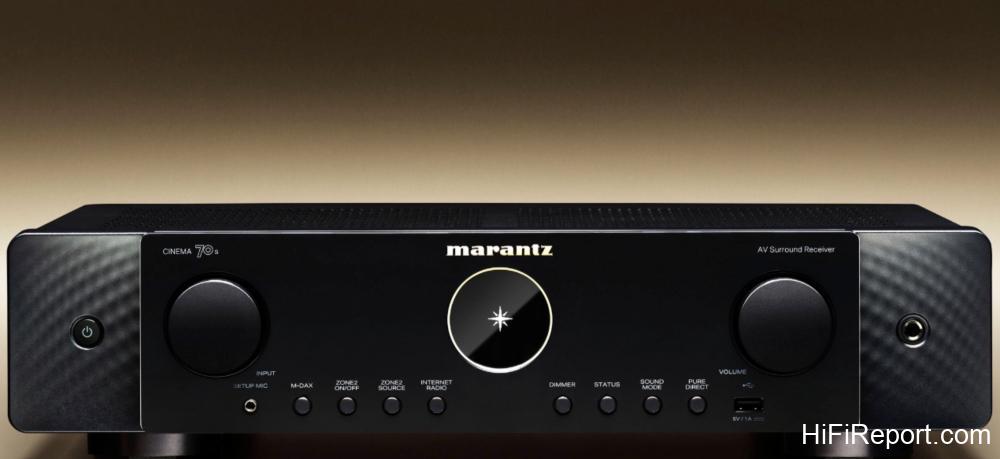
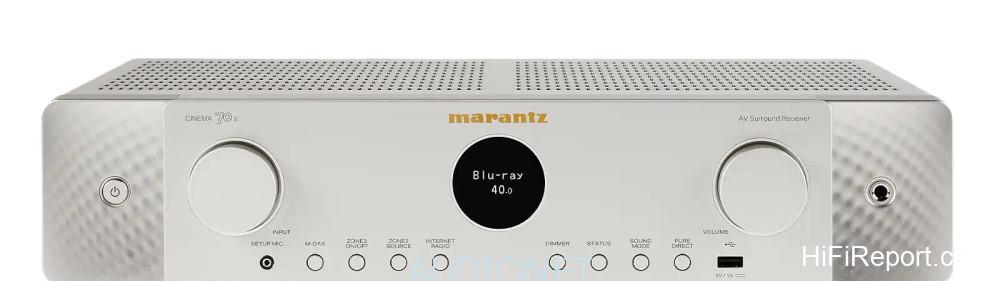
The Cinema series inherits this design ethos. It features a prominent, distinct front panel with elegant diamond patterns on the sides, complemented by the signature circular porthole display on the front face. The overall look is quite sophisticated. Among the Cinema series models, the Cinema 70s possesses a particularly strong sense of premium quality due to its height, which is less than half that of many conventional AV receivers. It looks remarkably attractive when placed in a system.
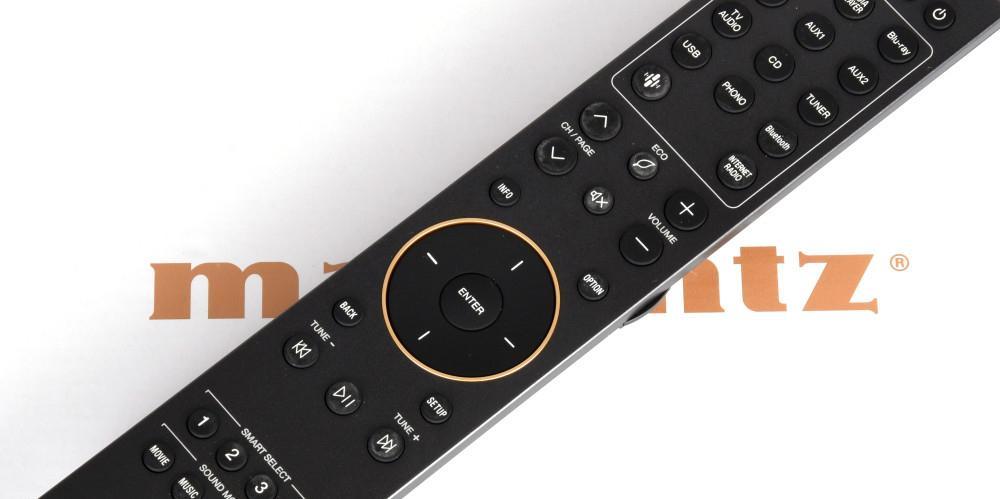
Furthermore, during the unboxing process, I noticed that the Cinema 70s comes with a newly designed remote control, and even the accessory box packaging is fresh and thoughtful. This attention to small details truly makes unboxing feel like opening a high-end luxury item, which is quite satisfying.
Features and Functionality
Turning to the functional design of the Cinema 70s, although it’s the entry-level model in the Cinema series, it still adopts a 7.2-channel configuration. It supports decoding for Dolby Atmos, DTS:X, and Auro-3D, unlike some earlier entry-level models that only supported traditional 5.1 channels. This is a significant point, as supporting 7.2 channels means you can build a 5.2.2 configuration home theater system.
This allows you to install two height channels in the ceiling, creating immersive 3D surround sound with vertical dimension. Additionally, it can accommodate two subwoofers, providing richer, more powerful low-frequency reproduction. For entry-level or budget-conscious consumers, these features are almost luxurious, and the Cinema 70s delivers them directly.
If limitations imposed by décor or budget prevent you from installing ceiling speakers, you don’t have to abandon the pursuit of 3D immersive sound. The Cinema 70s supports virtual height effects through Dolby Atmos Height Virtualization and DTS Virtual:X. This means it can simulate the effect of overhead channels using only floor-level speakers, allowing you to experience surround sound with a sense of height and greater spatiality.
In this scenario, the two extra channels can be utilized in two ways: either configure a 7.2 system by adding a pair of “rear surround” speakers to enhance the sense of envelopment behind the listening position, or leverage the unit’s Zone 2 function to power speakers in another room, ensuring no channels are wasted.
Performance and Power
Regarding driving capability, the Cinema 70s is positioned as an entry-level product, so its power output specifications are not particularly standout. The official ratings are 50 watts per channel (8 ohms, 20Hz~20kHz, 0.08% THD, 2 channels driven) and 100 watts (6 ohms, 1kHz, 10% THD, 1 channel driven).
However, if you are setting up a system in a typical small to medium-sized living room, this power is generally sufficient, provided you aren’t pairing it with particularly difficult-to-drive speakers.

Given the inherent limitations of an entry-level model, many consumers are concerned about future expansion or upgrade possibilities. Just because there’s a budget constraint today doesn’t mean there won’t be a higher budget in the future. Equipment with future expandability allows for a more economical path to gradually achieving better performance. The Cinema 70s addresses this by featuring 7.2 channels of pre-out terminals.
When you have the budget in the future, you can pair it with a 7-channel power amplifier. This guarantees a significant step up in audio performance, ensuring your system isn’t limited by the built-in amplification capabilities.
To facilitate this usage, the Cinema 70s includes a “Speaker Connect” menu option that allows selecting a “Pre-Out Only” mode for each set of channels. When this mode is enabled, the Cinema 70s shuts down the power amplifier circuitry for that channel and only utilizes the pre-out circuit. This can improve sound quality. This level of thoughtful design, offering such a feature, is quite generous for an entry-level consumer.
Connectivity and Streaming
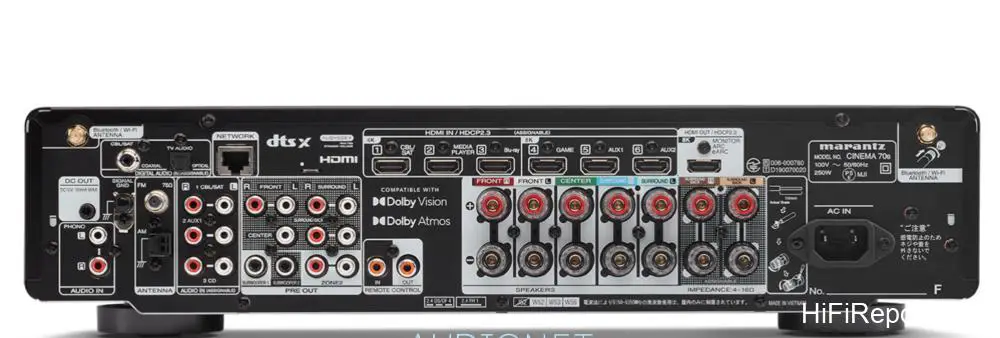
In terms of video capabilities, the Cinema 70s is equipped with 6 HDMI inputs and 1 output. Crucially, 3 of the inputs and the single output support 8K video pass-through (the previous generation NR1711 only supported 1 input). On the HDMI output side, the Cinema 70s supports eARC audio return, allowing it to receive and play audio transmitted from the TV. For High Dynamic Range formats, the CINEMA 70s supports HDR, HLG, Dolby Vision, HDR10+, and Dynamic HDR.
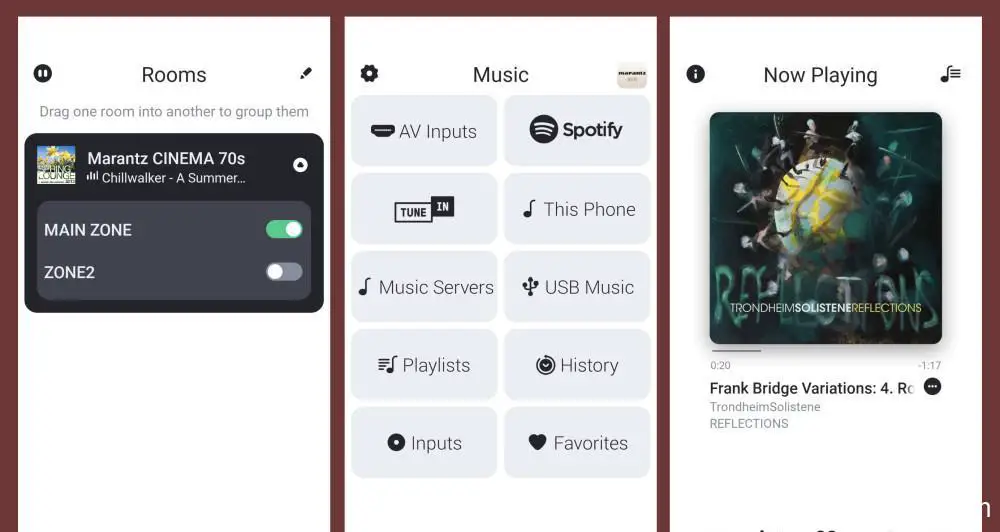
Beyond its home theater functions, the Cinema 70s also offers network streaming music capabilities. It incorporates Marantz’s recently favored HEOS streaming playback interface. This allows you to access internet radio, streaming platforms, and AirPlay 2. Furthermore, it can integrate with other HEOS-enabled audio equipment to form a multi-room music system.
Listening Impressions
Now for the actual testing experience. For this review, I used our internal reference speakers to set up a 5.2.2 system for listening tests. I initially expected the 50 watts per channel output to sound somewhat soft, but the results were better than anticipated. In an approximately 8-ping (roughly 280 sq ft) listening space, it could still achieve substantial sound pressure levels without feeling weak.
I did notice that the mid-range had a more restrained thickness, but this can be partially addressed through system tuning. By pairing the system with capable subwoofers to ensure sufficient energy in the extreme low frequencies, the system’s sound will feel adequately full to the ear, retaining clear impact. Watching movies remains thoroughly enjoyable.
Throughout the testing, I found that the Cinema 70s excelled at reproducing fine details. It could unearth subtle elements within movie soundtracks and present them fully. This excellent performance enabled it to create a very clear sense of space, which in turn built a strong feeling of surround envelopment.
For instance, when playing the first episode of the fourth season of Netflix’s “Stranger Things,” the opening scene features a young boy delivering newspapers on a bicycle in suburban America. This system effortlessly established the atmosphere of the scene, and the sound objects had excellent dimensionality. As the boy rode his bike from behind and to the left of the listening position towards the front, throwing newspapers at houses, each impact had precise localization.
With eyes closed, you could easily imagine the relative positions of the bicycle and the houses. The overall soundstage was large, not only extending beyond the physical location of the speakers but even giving a sense of breaking through the walls. It felt as if you were moving along the wide suburban road with the camera. Even this brief opening sequence showcased the excellent audio performance capabilities of the Cinema 70s.
Another example is playing the 4K Blu-ray of “Ready Player One,” specifically the scene where the male and female leads go on a date at a virtual nightclub. The moment the protagonist steps into the club, you immediately perceive a vast sense of space. Not only did the sound field extend beyond the sides of the listening position, but the presence of height channels also established a clear sense of verticality, combining to create a massive 3D immersive soundstage.
As the characters jump into the floating dance floor and dance suspended in the air, the feeling of sound swirling around and enveloping the entire seating area becomes even more pronounced. When the Sixers army crashes through the nightclub roof to attack, you can hear distinct impact sounds coming from overhead, as if the ceiling itself has been breached.
When the leads and the Sixers exchange gunfire, you can hear muzzle blasts and impact sounds appearing in different locations within the listening space, demonstrating clear localization and movement, making the soundtrack rich, dazzling, and captivating.
Conclusion
In the past year or two, inflation and rising prices have meant that building a home theater system requires a higher budget than before. At times like these, being budget-savvy and choosing products with high cost-performance ratios is key to saving money. The Cinema 70s is precisely such a piece of equipment. While we repeatedly emphasize that it is the entry-level model in the Cinema series, you’ll find that the features it offers are by no means basic.
Not only does it include all the essentials, but it is also thoughtful in many areas. Although its power output has certain limitations, it is likely sufficient for entry-level consumers. Furthermore, the Cinema 70s has paved the way for future upgrades. Given these factors, I highly recommend this equipment to home theater enthusiasts with limited budgets, limited space, or those just starting out.
Specifications Summary
* Slimline design, less than half the height of conventional models
* 7.2 channel design, capable of setting up a 5.2.2 Atmos system
* Supports decoding of Dolby Atmos, DTS:X, and Auro 3D
* Includes Audyssey MultEQ XT automatic room calibration
* Provides 6 HDMI inputs and 1 output, output supports eARC
* 3 HDMI inputs and 1 output support 8K video pass-through
* Offers 7.2 channel pre-outs for future upgrades
* Supports HEOS streaming interface for streaming music
* Supports Spotify Connect and AirPlay 2
* Includes a high-quality Pure Audio mode
* Design: Slimline, 7.2 channel AV receiver
* Output Power: 50 watts per channel (8 ohms, 20Hz~20kHz)
* Supported Dolby Technologies: Dolby TrueHD, Dolby Atmos, Dolby Atmos Height Virtualization, Dolby Atmos Music, Dolby Surround
* Supported DTS Technologies: DTS HD Master, DTS:X, DTS Neural:X, DTS Virtual:X
* Supported Hi-Res Audio Files: 192/24 (FLAC, WAV, ALAC), DSD (2.8MHz/5.6MHz)
* Inputs/Outputs: 6 HDMI in, 1 HDMI out, 3 RCA analog audio inputs, 1 RCA Phono input, 1 optical audio input, 1 coaxial digital audio input, 1 set of 7.2 channel pre-outs, 7 sets of speaker terminals, USB Type-A, FM/AM antenna, Network port, 1 set of remote control inputs/outputs
* Dimensions (W.H.D): 442×109×384mm
* Weight: 8.7 kg

- Sound Master tuned: Hand-tuned in Shirakawa, Japan by Marantz’s Sound Master, CINEMA 70s delivers the warm, enveloping sound that defines The Most Musical Sound in an elegantly slim profile
- Slimline design, timeless style: At just over four inches tall, CINEMA 70s fits beautifully into any space. Carefully considered elements include aluminum controls, diamond-cut knobs, and the iconic Marantz porthole
- Immersive audio: Dolby Atmos and DTS:X place you at the center of a three-dimensional sound experience that brings every scene to life
- Refined power: With 7.2 channels and 50 W per channel, CINEMA 70s delivers the characteristic Marantz warmth and dynamic presence in a remarkably compact form
- Effortless connectivity: Six HDMI inputs — three 8K-compatible — plus analog, digital, and phono connections welcome virtually any source into your entertainment universe