
Yamaha RX-V4A Review
Every autumn is the most anticipated time for home theater enthusiasts, as this period marks the release of new AV receiver models by manufacturers, often introducing various new specifications and features. However, this year, due to the impact of the pandemic, many home theater companies have slowed down, leading more consumers to opt for alternative products like SoundBars and wireless speakers.
Friends eagerly awaiting entry-level traditional home theater components have had to simply wait for the market to recover.
Nonetheless, Yamaha, a leader in the home theater industry, recognized consumer demand and went against the grain during this shortage of AV receivers by launching two brand-new models: the RX-V6A and the RX-V4A. These support 7.1 and 5.1 channels respectively. You might ask, aren’t these channel counts quite basic by current AV receiver standards? Exactly.
They are designed specifically for entry-level users, streamlining complex features of past receivers and retaining only what the manufacturer deemed suitable for beginners. Furthermore, these new models feature a radical departure from traditional AV receiver aesthetics, with a more streamlined, minimalist chassis design.
This not only eliminates the cold, “equipment-like” feel but also makes them more visually appealing in a living room and significantly lowers costs, making them more accessible for entry-level consumers.
Yamaha RX-V4A Overview
This article focuses on the most affordable model in the series, the RX-V4A. It supports 5 channels of speaker output and can connect two subwoofers (though only one crossover setting is available), allowing for a 5.2 channel system configuration. For two-channel listening, it can utilize the extra channels for Bi-amp connection, a benefit typically not found in standard integrated amplifiers. This also means it does not support Dolby Atmos or DTS:X object-based audio formats.
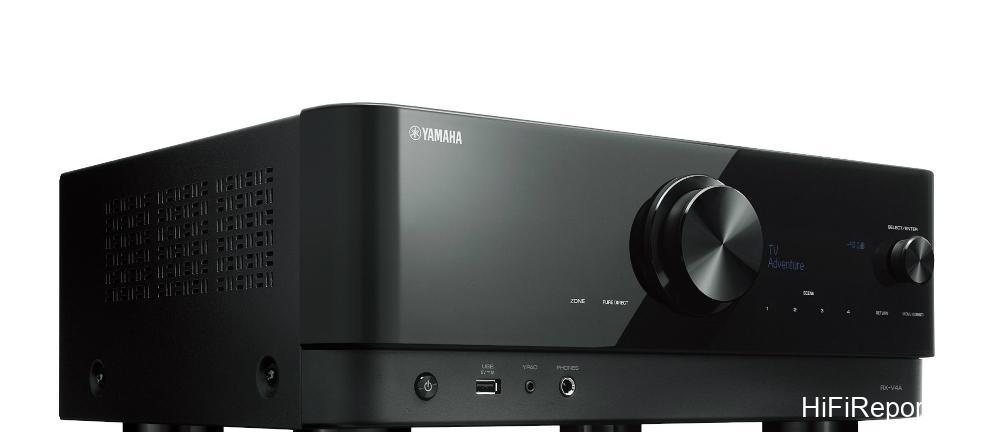
However, you can still enjoy lossless movie sound quality through basic Dolby TrueHD and DTS HD MA. Additionally, this unit offers 80W of power output per channel, which is respectable power among entry-level AV receivers. This extra headroom means you have more flexibility to pair it with better home theater speakers to enhance the overall sound quality.
Video and Audio Connectivity
The unit’s biggest selling point is actually its video capabilities. Since 2019, 8K displays from Japanese and Korean manufacturers have been gradually entering the market, but AV receivers from the same period have been slow to update, remaining largely at the 4K/120p specification. A major reason for this delay was waiting for stable supply of HDMI 2.1 chips and the corresponding redesign of digital circuit boards to support 8K/60p video specifications.
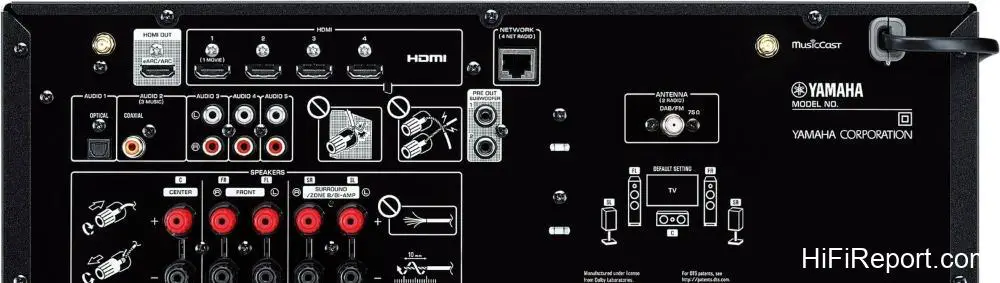
Although the RX-V4A is an entry-level model, it is among the first of the new generation to support 8K/60p and 4K/120Hz. It features 4 HDMI inputs and 1 output, with the output also supporting eARC/ARC audio return function, making it easy to improve the sound performance of streaming video content.
In terms of audio, digital inputs include one optical and one coaxial, allowing connection of digital transports or music servers. There are also three sets of RCA analog inputs for connecting equipment like CD players or game consoles. If your space is limited, it’s also very suitable for setting up a 2.1 channel audio system.
Network Features and DSP Functions
Furthermore, this unit includes wired network and Wi-Fi capabilities, and built-in support for popular streaming music services like Spotify and Tidal. It can also play music files from NAS or PCs on your local network via the UPnP protocol, supporting high-resolution audio formats up to PCM 192kHz/32bit and DSD 11.2MHz. If you are an Apple user, you can utilize the AirPlay 2 function to directly stream music from your phone to the receiver.
When playing compressed music formats like MP3, you can use the built-in “Music Enhancer” feature. This uses digital signal processing to restore lost musical information, allowing you to hear sound quality comparable to CDs. Additionally, for both movies and music, you can use Yamaha’s renowned “Cinema DSP 3D” function. This feature incorporates acoustic field modes from various concert halls and clubs around the world.
Each virtual soundstage is distinct and can enhance your enjoyment of music and movies.
MusicCast and Wireless Surround
Moreover, this unit supports Yamaha’s MusicCast function. You can control receiver playback directly via a smartphone app and link it with other MusicCast-enabled audio products in your home for multi-room music listening. If setting up traditional wired speakers is inconvenient in your space, the unit also supports MusicCast Surround.
This allows you to connect Yamaha MusicCast 50, MusicCast 20 wireless speakers, or the MusicCast SUB 100 wireless subwoofer, eliminating all cable connections to create a wireless home theater system.
Performance Testing
For testing, I paired the unit with Sonus faber Lumina multi-channel speakers and our in-house M&K X10 subwoofer. First, I tested the two-channel performance using the “Pure Direct” mode. Although this is an entry-level model, the sound resolution is quite good. The overall style is clean and refreshing, with excellent high-frequency extension and high density in the mid-range. The bass is solid and fast-paced.
Starting with small-ensemble music, I listened to “Pour Valia” from the “Lakatos” violin performance album. From the opening piano solo, I could hear clear, transparent note articulation. Each key press had good dynamics, and the performance space’s reverberation was rendered realistically. From this, I could discern the unit’s clean background, completely free from the common problems of muddiness or insufficient resolution often found in entry-level receivers.
The violin’s soundline was bright and lustrous without feeling tense or oppressive. Even during fast, heated passages, the sound remained full and hydrated. Between phrases, I could hear the texture of the bow on the strings and the wood’s resonance. This level of delicate instrumental timbre is rare in entry-level AV receivers.
Next, listening to the album “Eric Clapton & Wynton Marsalis – Play the Blues,” the opening brass section delivered a grand sense of energy. The brass sounds were solid and tight, with a golden shimmer in their cutting tone. The piano’s key presses had good weight, and the plucked bass notes were very clear, exhibiting excellent speed without any lag or excessive, boomy energy.
Most importantly, within the large musical arrangement, the instrument positioning was very distinct, completely free from clutter or blurriness.
This unit’s fast, distinct sound signature is also its strength when interpreting movie soundtracks. For example, when watching the “2019 DTS Demo” test disc, during the volcanic eruption scene from “Jurassic World BD,” I could feel the unit’s excellent spatial effects. It created a vast 3D cinematic landscape. Running dinosaurs on the plains and flying birds in the sky were clearly positioned. The layers of environmental sound effects, moving from far to near, were very three-dimensional.
Although the sound density wasn’t as solid as with high-end receivers, the forms were clear, and details were rich. Even the background score had good sound quality, effectively enhancing the movie’s tense atmosphere!
Furthermore, during the volcanic eruption sound effects, aided by the subwoofer, this unit also demonstrated good dynamic performance and bass envelopment. I could feel the immense energy constantly surging from behind, accompanied by the falling rocks that erupted. I could hear their clear movement trajectories sweeping around me, completely free from any blurring or lack of fluidity. Both the channel integration and the surround envelopment were noteworthy.
It’s worth noting that since this unit’s mid-high frequency resolution and speed are exceptionally good for an entry-level model, it is highly recommended to pair it with a subwoofer that has better transient response. This will not only supplement the lower-end energy but also ensure better sound integration.
Conclusion
After testing the RX-V4A, I found it to be a genuinely commendable AV receiver. As an entry-level model, while its features and connectivity are streamlined, there are few compromises in sound quality. It retains Yamaha’s characteristic natural, high-resolution sound.
It performs very well for pure music listening, and for home theater beginners, at a cost of around $560, you get a certain level of audio quality that allows you to focus your budget effectively on the speakers and experience the purest charm of home theater!
Specifications
* Type: 5.1 Channel AV Receiver
* Maximum Output Power Per Channel: 115 W (6 ohms, 0.9% THD)
* Speaker Terminals: 5 sets
* Subwoofer Output: 2 sets
* Headphone Terminal: 6.3mm headphone output × 1
* HDMI Terminals: 4 In, 1 Out
* Preout Terminals: 1 set
* Analog Input Terminals: RCA terminals × 3 sets
* Digital Input Terminals: Optical × 1, Coaxial × 1, FM/AM antenna terminals × 1 each, Ethernet × 1
* USB Power Supply: 5V/1A × 1
* Wi-Fi: 2.4/5GHz
* Home Theater Audio Support: Dolby TrueHD, DTS HD Master Audio
* Audio Format Support: MP3 / WMA / MPEG-4 AAC up to 48kHz/16bit, ALAC up to 96kHz/24bit, FLAC up to 192kHz/24bit, WAV / AIFF up to 192kHz/32bit, DSD up to 11.2 MHz
* Weight: 8.8 kg