
Marantz Horizon Wireless Streaming Speaker Review
If you consider yourself a “serious listener” who prioritizes absolute sonic accuracy, you might be tempted to skip this review. However, if you’re searching for an audio system that is stunningly beautiful, effortlessly user-friendly, and boasts an aesthetic that will instantly win over your spouse, then the Marantz Horizon wireless streaming speaker demands your attention!
Audible Artistry
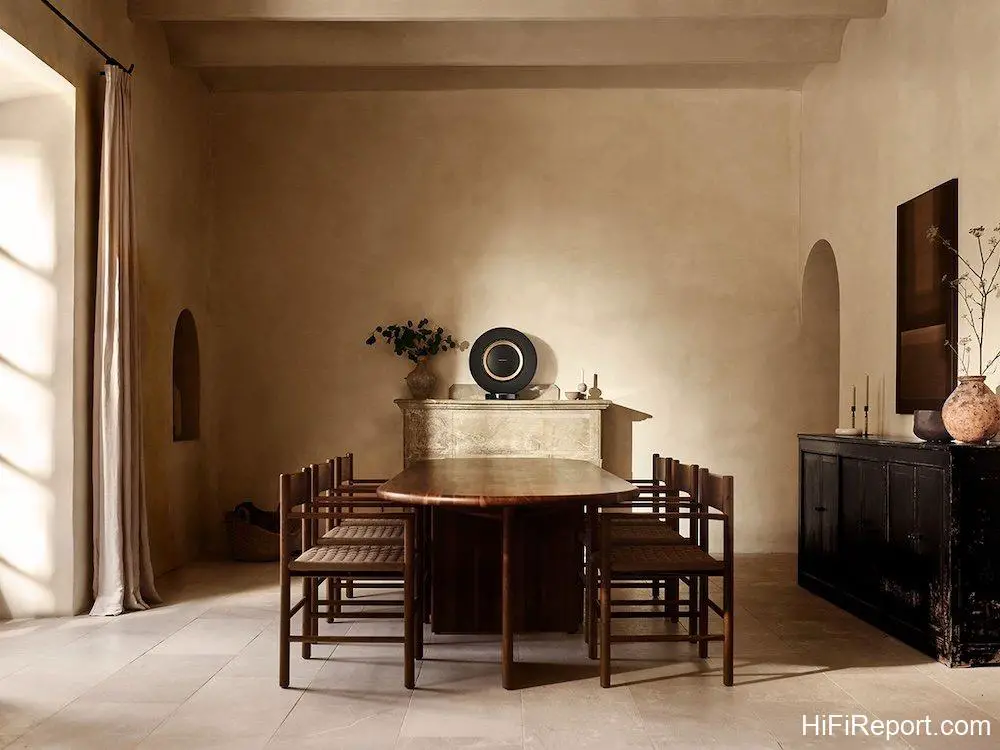
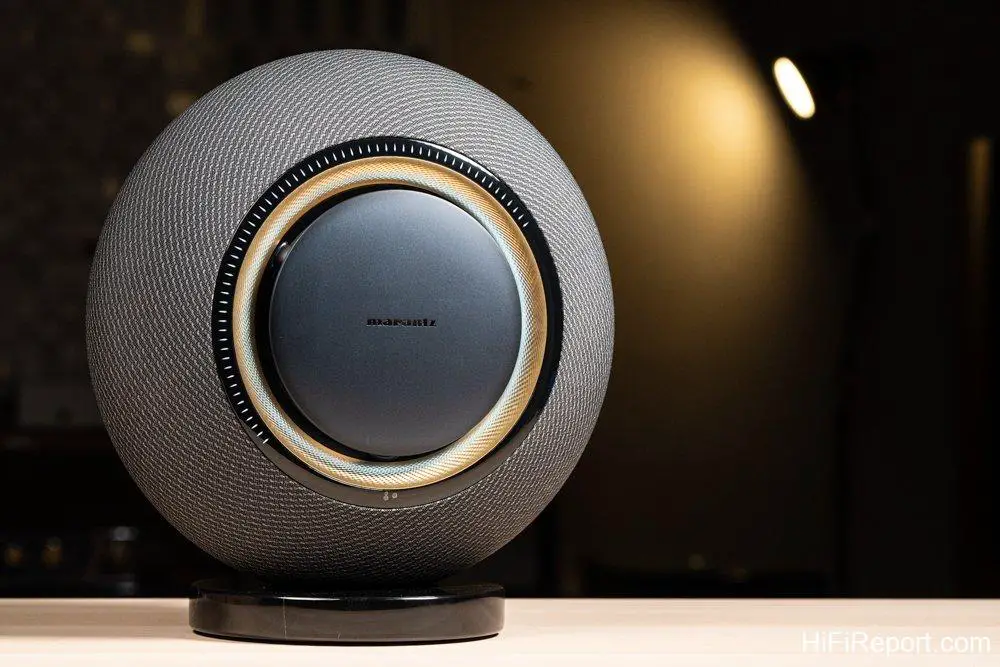
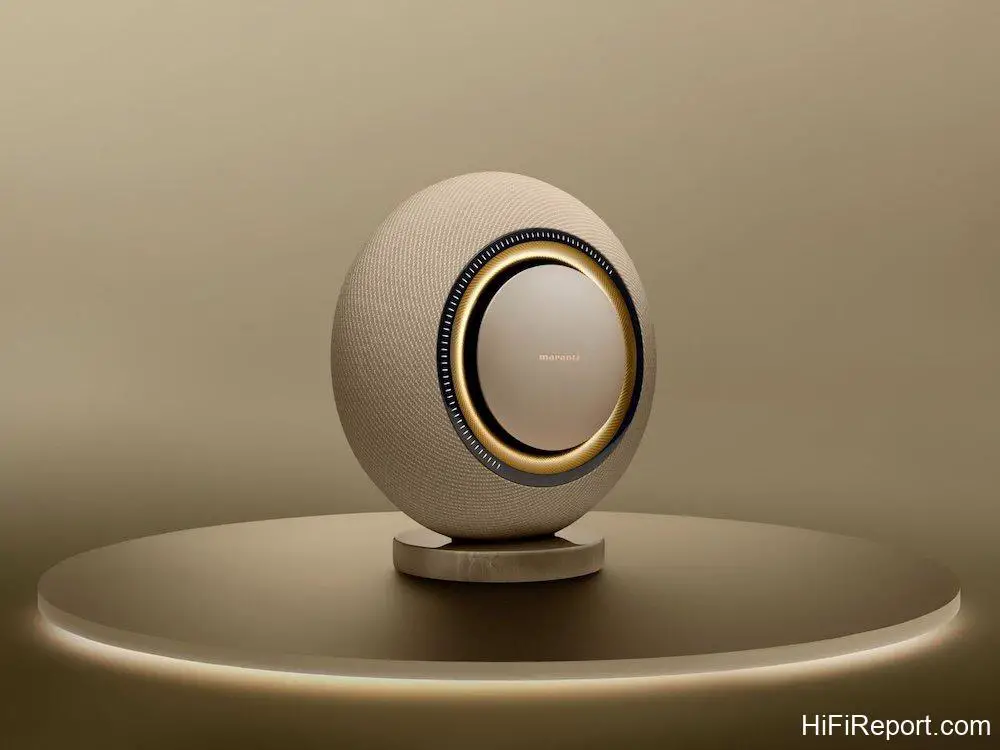
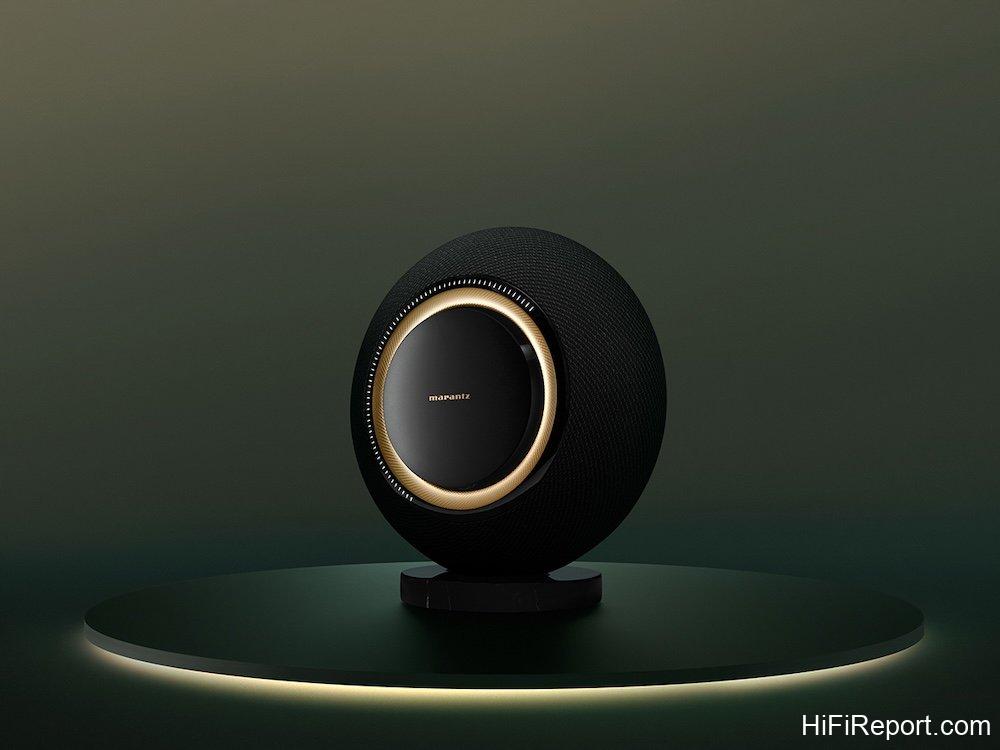
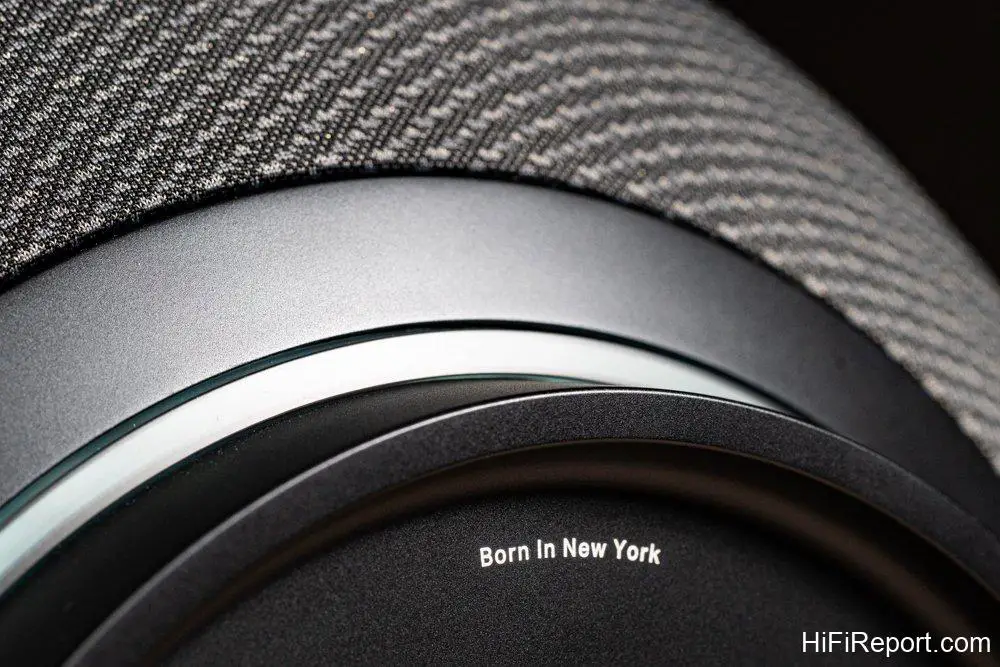
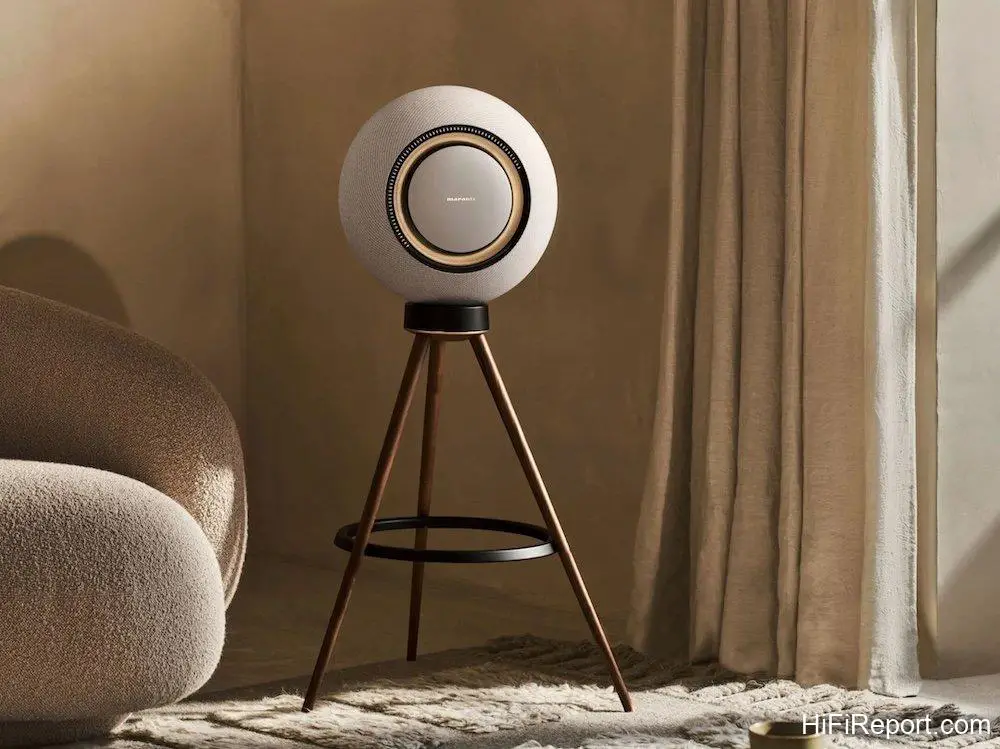
Marantz unveiled the exquisitely designed Horizon, along with its larger sibling, the Grande Horizon, in Q4 2024. Both are distinctive circular speakers, featuring a gorgeous LED halo at their concentric core. They are, in essence, “sound-producing decorative pieces” – a testament to remarkable design creativity.
My first encounter with the Horizon and Grande Horizon was at the 2025 audio show. While the CosmosLingo booth wasn’t typically within my direct purview for filming and interviews, I had a sneak peek beforehand. Initially, my eyes were drawn to Linn, McIntosh, and Sonus Faber. When I finally turned to see three Horizons lined up, my attention was momentarily diverted. All I noted was, “The Horizon’s craftsmanship and texture are truly impressive; it looks even better in person.” Then, I quickly moved on to prepare for my interviews.
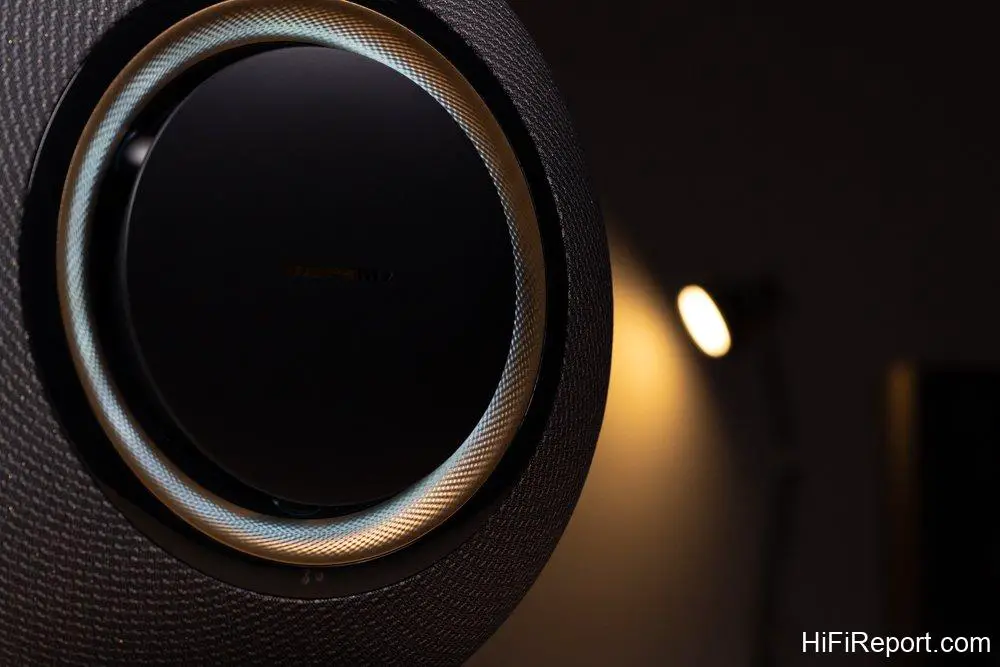
Integrated Audio System
So, why borrow the Horizon for a listen if it didn’t immediately grab my attention at the show? The truth is, the audio market’s recent evolution extends far beyond just high-end audiophile gear. Increasingly, there are products prioritizing convenience and ease of use, which are crucial for broader audio adoption.
Designs like the Horizon, where a single speaker functions as a complete audio system, have become favorites among younger demographics. Similarly, in commercial spaces that require music playback, such as trendy coffee shops, you often spot active wireless Bluetooth speakers from brands like Marshall or Fender. They integrate seamlessly into commercial environments, requiring no complex installation – just plug them in, and the music starts.
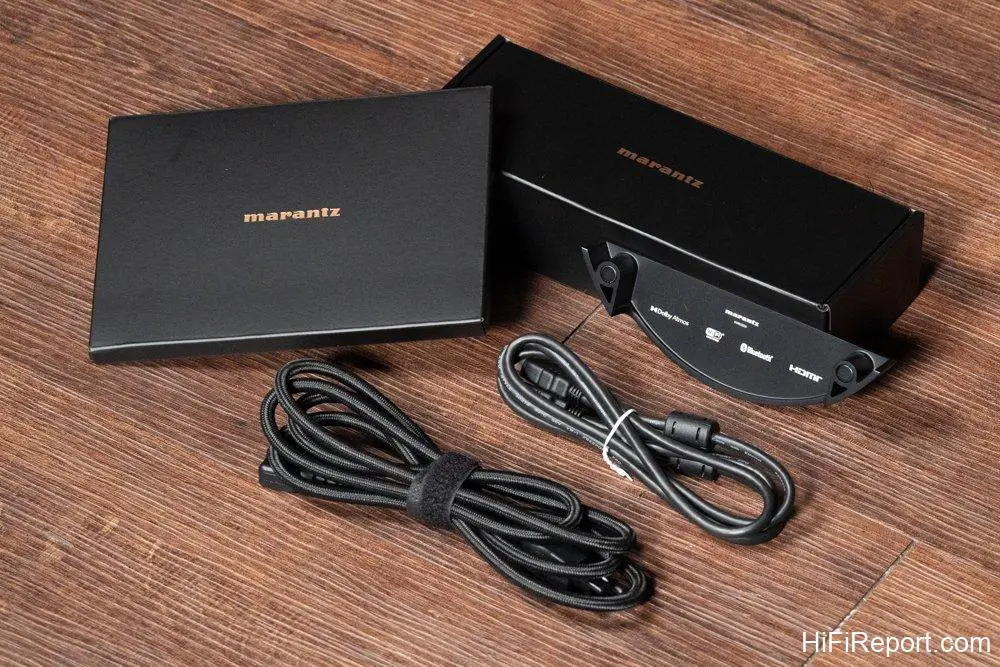
Premium Price Point
Where does the Horizon fit into this landscape? It’s certainly in the same category as Marshall and Fender, but there’s a significant differentiating factor: the price! The Horizon speaker itself has a suggested retail price of approximately $4,000, and its dedicated tripod stand is around $900. Combined, it feels like an extra zero has been added to the price tag. Why is the Horizon so expensive? Firstly, it carries the Marantz brand, renowned for its musicality. That badge alone likely commands a brand premium. Secondly, the Horizon’s industrial design is truly extraordinary; it’s hard to imagine the genius who conceived of combining a simple circle with a marble base to create such a beautiful device. Its Red Dot Design Award is richly deserved. Thirdly, Marantz has integrated numerous “black technologies” into the Horizon, ensuring it’s not just pretty but also delivers high-performance audio.
Kilowatt Power On Tap
The Horizon’s first “beyond expectations” specification is its output power. Marantz officially states that the Horizon’s built-in power amplifier, called the MarantzRise Amplifier, delivers an impressive 310 watts according to FTC specifications. That’s unusual, isn’t it? FTC specifications typically refer to the maximum power output at 8 ohms impedance, within a 20 Hz to 20 kHz bandwidth, with total harmonic distortion below 1%. If not tested under FTC regulations, the peak output power increases to 745 watts. And if distortion is completely disregarded, pushing the power transistors to their absolute maximum, it can reportedly reach 1,160 watts. What kind of advanced technology is this?
Uncommon GaN FET Amplification
Indeed, it’s truly cutting-edge technology! How can a compact Horizon house a kilowatt of power? The answer lies in Gallium Nitride (GaN) FETs. Yes, the same technology you might find in your phone’s fast charger. GaN devices are typically faster, offering low voltage operation and high efficiency, with output capacitance far lower than traditional MOSFETs or FETs. Their performance looks outstanding, yet very few audio manufacturers currently use them for power modules. Marantz, once again, is blazing an innovative trail in research and development.
Why aren’t these high-performing GaN FETs more commonly used in audio amplifiers? Because the gate threshold voltage for driving GaN is relatively low, and their switching speed is extremely fast. This necessitates precise drive circuitry to accurately control GaN FET switching, preventing distortion. Furthermore, their high-speed switching makes them highly sensitive to parasitic capacitance within the circuit layout, which can lead to high-frequency oscillation or noise. Lastly, due to their low on-resistance, protection circuits must react even faster to prevent overload or short circuits. In summary, GaN FETs are currently less common in audio amplifiers primarily due to design complexity. However, their high efficiency, low heat generation, faster switching frequencies, and smaller size truly represent a promising direction for future Class D amplification, even if their higher cost and challenging circuit design mean less widespread adoption at this stage.
Gravity Woofer & Dolby Atmos
So, what drivers are being powered by Marantz’s claimed kilowatt GaN FET output? The bass is handled by a 6.5-inch driver, dubbed the Marantz Gravity woofer. Mid-range frequencies are managed by three 2-inch full-range drivers, complemented by two tweeters. The official specifications boast a frequency response of 30 Hz to 20 kHz, a maximum sound pressure level of 104 dB, and a peak SPL of 114.5 dB – by any measure, it’s a powerhouse.
The Horizon’s six internal drivers are arranged with the 6.5-inch woofer at the center. The three full-range drivers are positioned in a pattern resembling a three-pointed star, with two angled diagonally downwards and one facing upwards. The tweeters are positioned to the left and right. Why this circular arrangement of mid-high frequency drivers? You guessed it – the Horizon is designed for immersive listening and supports Dolby Atmos.
Marantz’s Core Technologies
The computational heart controlling these six drivers and the MarantzRise amplifier is the proprietary MarantzMirage DSP. This works in conjunction with Aura Control and a built-in HEOS interface. The Mirage DSP handles room acoustic optimization and offers various sound equalization modes. Aura Control adds an element of fun to Horizon operation with its changing LED light effects, while HEOS allows you to connect to major global digital music streaming platforms via your smartphone, tablet, or computer.
For wireless playback, the Horizon features Bluetooth 5.4, a newer version than the common 5.3 or 5.2. However, for those prioritizing sound quality, it’s best to use network transmission via AirPlay 2 or the built-in Spotify Connect.
Comprehensive Streaming Support
Regarding network music streaming services, popular options like Spotify and Tidal are supported, along with Pandora, SiriusXM, Amazon Music, Deezer, QPlay, SoundCloud, and more – the list is extensive. However, Qobuz, which has targeted audiophiles in recent years, is notably absent.
The HEOS app, available for iOS, Android, and even Kindle Fire, controls the Horizon’s network connectivity. It supports both wired and wireless network connections and can integrate with home automation systems like Crestron, Control4, and AMX.
Dolby Atmos Focus
The Horizon offers a comprehensive array of input interfaces, both analog and digital. For analog, there’s one RCA input. Digital inputs include optical, USB, and HDMI eARC. For two-channel music, it decodes both PCM and DSD, with PCM supporting up to 24-bit/192 kHz and DSD up to 5.6 MHz. As mentioned earlier, the Horizon features simulated multi-channel capabilities, supporting Dolby Atmos, Dolby TrueHD, DSD Dolby Digital, Dolby Digital, and LPCM for multi-channel decoding.
Frankly, many of the listed formats are merely padding the specification sheet. The most crucial immersive listening format today is Dolby Atmos. With Dolby’s vigorous promotion and Apple’s support, millions of Dolby Atmos Music tracks have emerged in recent years, including new recordings and remastered classics. By choosing an audio system that supports Dolby Atmos decoding, any recording can gain a new sense of freshness, adding significant enjoyment to music listening.
Functional Elegance
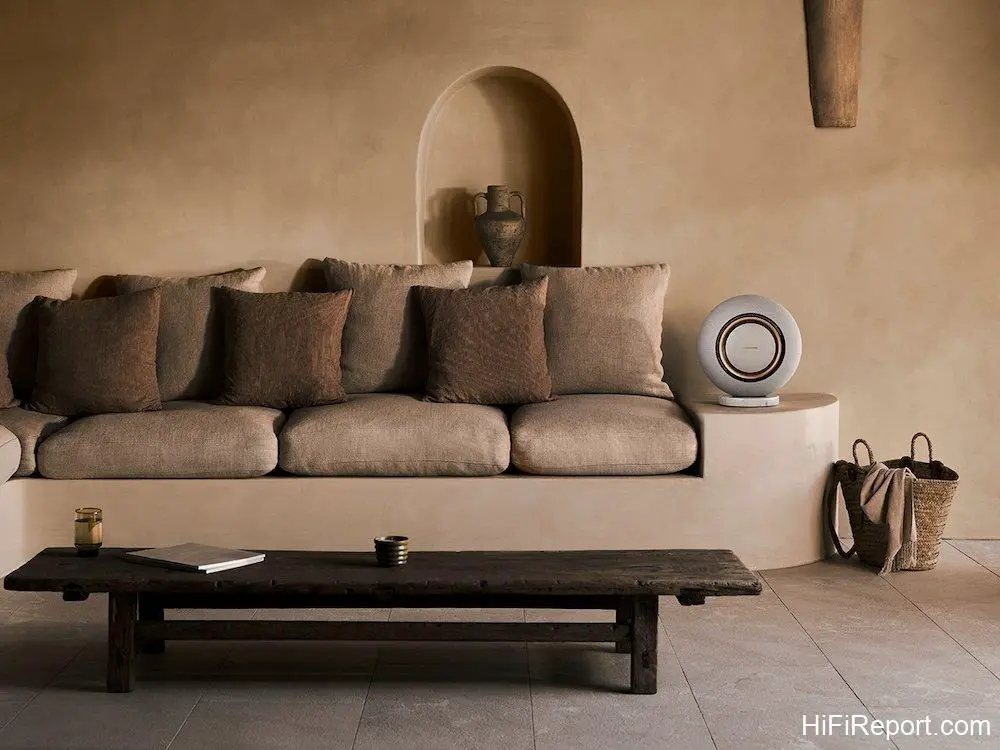
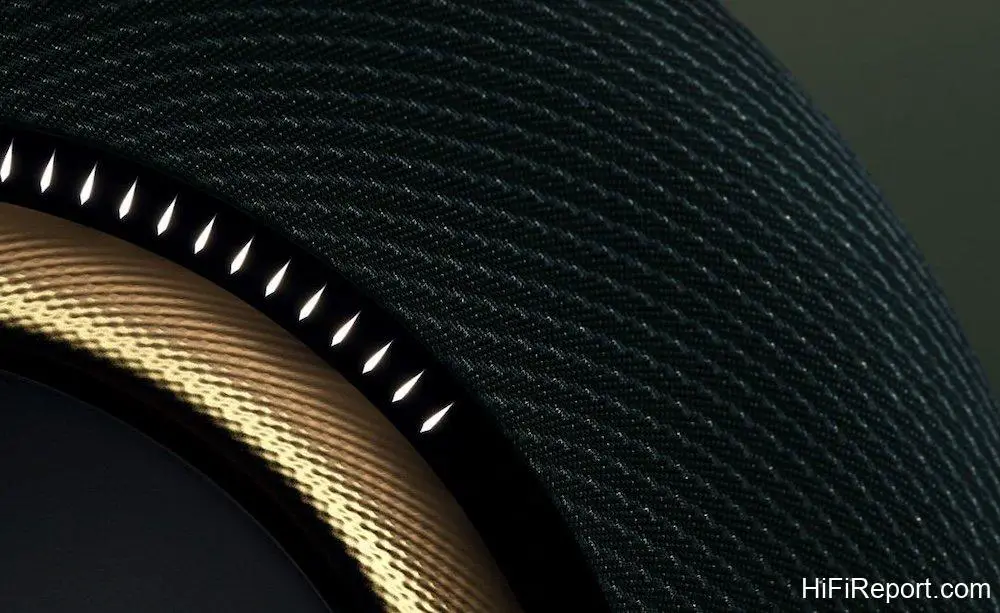
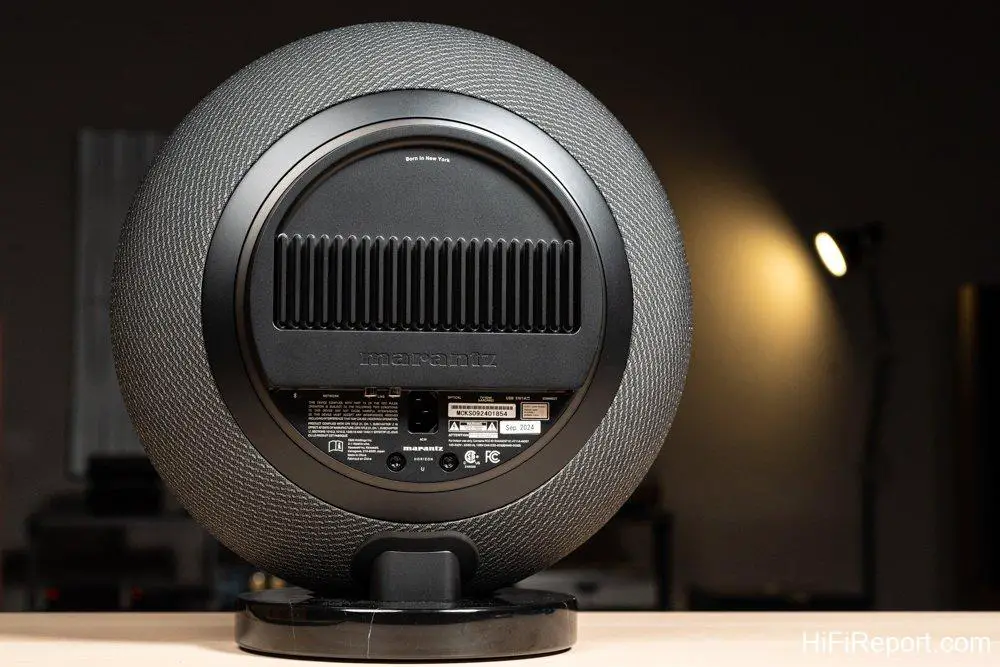
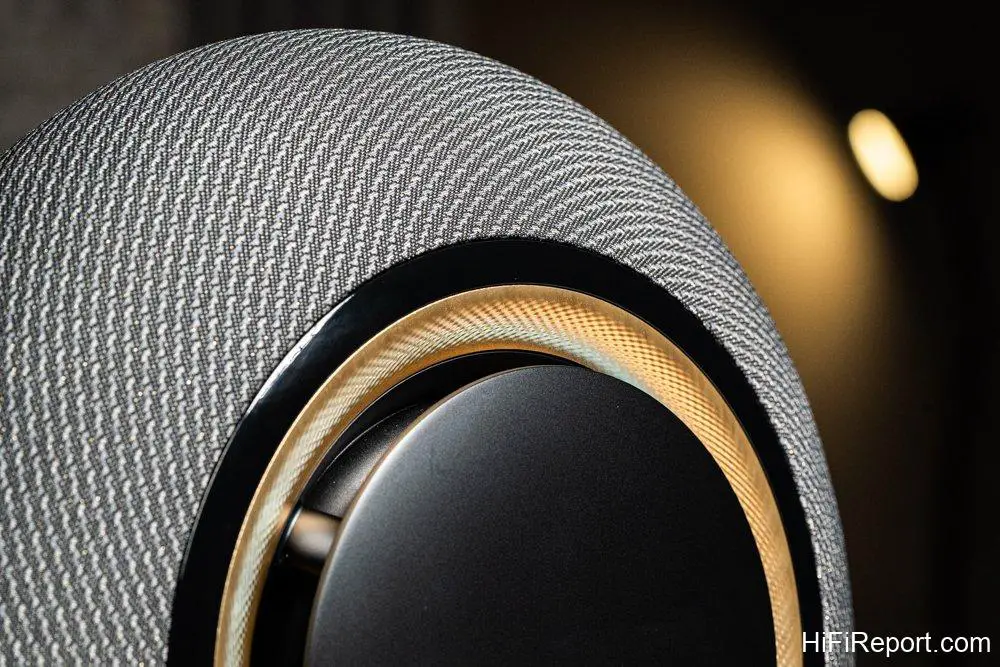
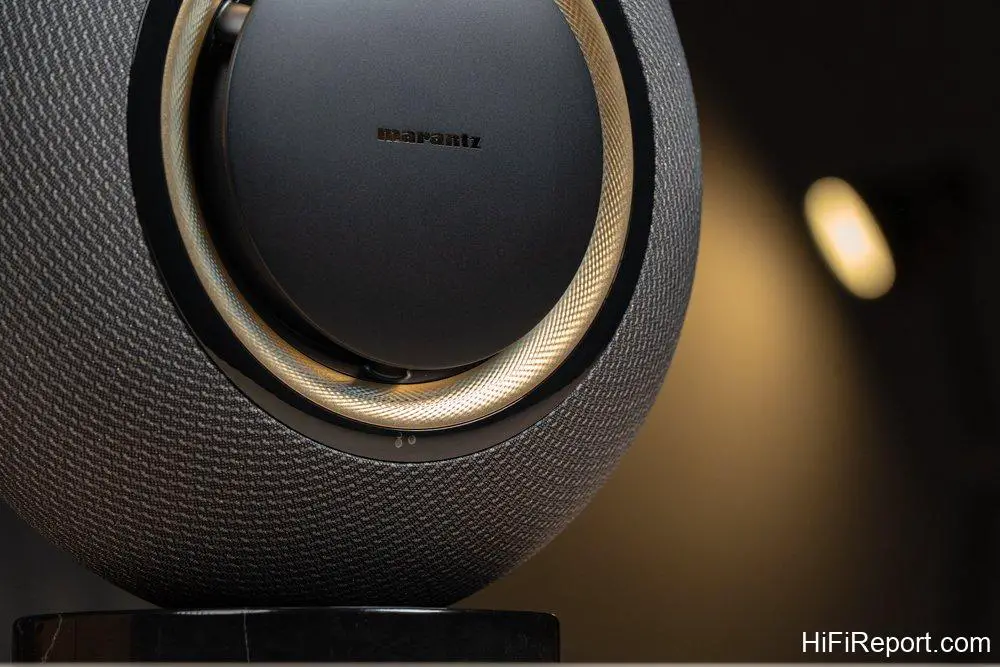
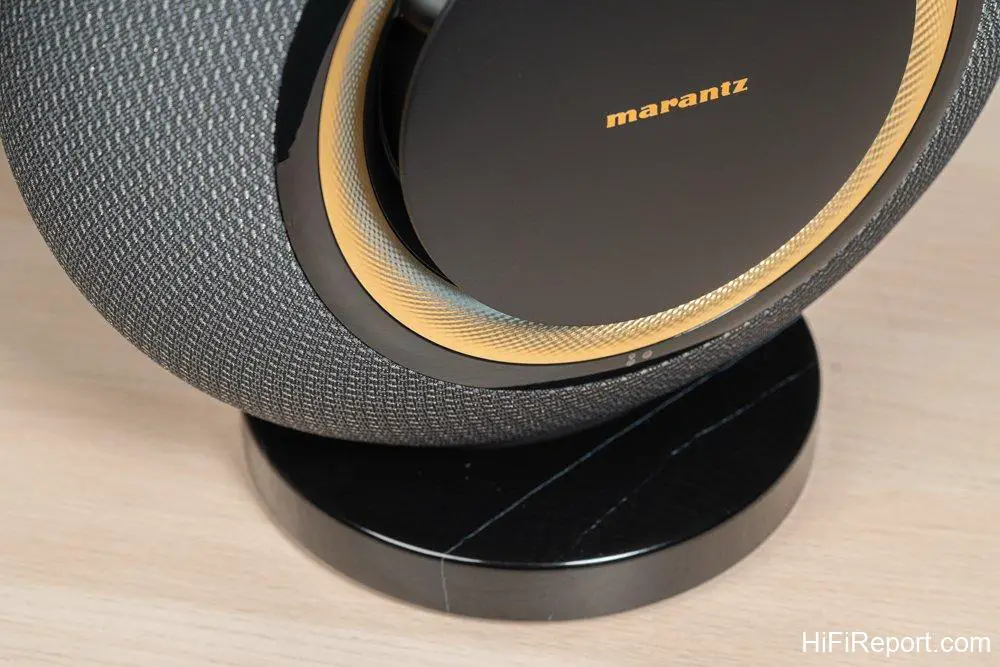
Paired with its marble base, the Horizon is surprisingly heavy to lift. The circular periphery is enveloped in MarantzRadiance 360 seamless eco-friendly fabric, and the quality is simply impeccable. Marantz also offers a specially designed tripod stand for the Horizon, featuring a retro-chic and elegant design that enhances its overall aesthetic.
The marble base isn’t just for looks; it’s functional, too. It serves to stabilize the Horizon’s center of gravity. With this heavy piece of marble, the Horizon would need to be tilted at a 45-degree angle before it would topple, eliminating worries about it falling over during an earthquake or accidental bump.
Seamless HEOS App Control
Setting up the Horizon speaker using the HEOS App is remarkably quick and straightforward. It had been a while since I last used the HEOS App, and configuring it with the Horizon this time, I found the interface to be much more intuitive and operationally fluid. From unboxing the Horizon to powering it on, positioning it, connecting via the App, automatically sharing the wireless network, and then graphically asking how you’ve placed the Horizon (e.g., in a corner, free-standing, or against a back wall), setting the speaker name, you’re ready to start listening to music.
The HEOS App can control many supported devices. If you have several Horizon units in your home, they can all be controlled within the same HEOS App, with multi-room control also supported. With built-in TuneIn, you have access to countless internet radio stations. For online music platforms like Tidal and Spotify, once you’ve set up and logged into your accounts within HEOS, there’s no need to open their separate apps; you can operate everything directly from within HEOS.
AuraControl & Touch
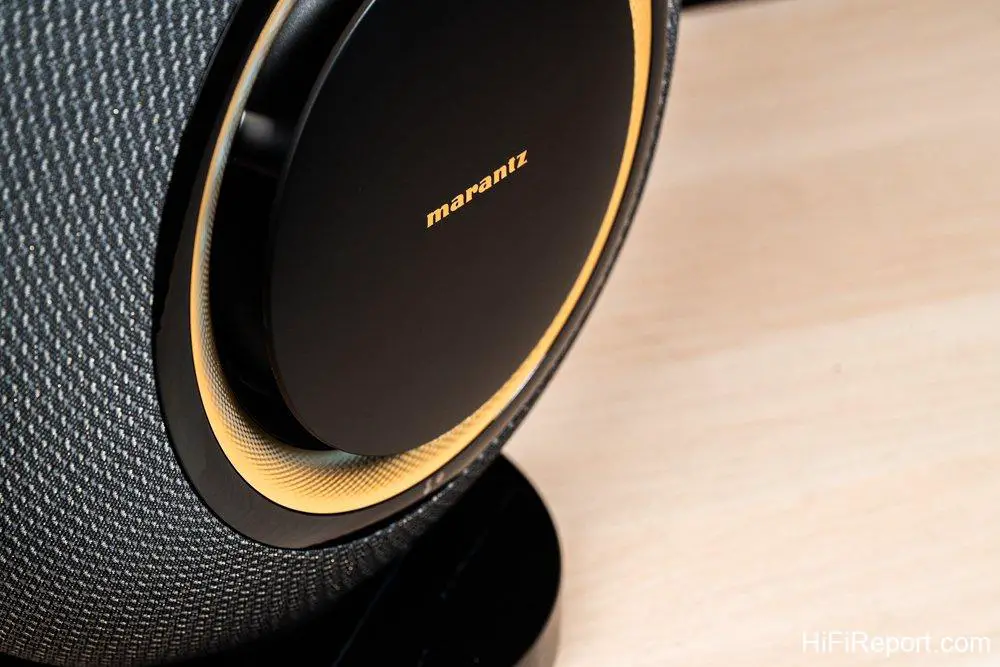
If you prefer not to use the HEOS App for remote control, the Horizon can be operated via what Marantz calls Aura Control. This refers to the 100 circular LED lights and backlighting surrounding the center of the Horizon. The HEOS App includes a Proximity Sensor; when enabled, the beautiful LED lights illuminate as soon as someone approaches the Horizon. Of course, if you disable this setting, the Horizon will not react to people approaching.
Aura Control’s circular lights display the volume level. The bottom circular section can be touched to play, pause, or skip to the next track. However, in practice, it felt a bit unresponsive. Without clear icons, touching with a finger was somewhat sluggish. While you can precisely tap to set the volume, your intuition makes you want to drag your finger, and this also proved a bit slow. Despite my minor complaints about Aura Control, I believe most users will primarily rely on the HEOS App for control, making the Horizon’s touch controls a less frequently used feature.
Critical Sound Modes
Finally, I want to discuss the most important function for using the Horizon: setting the Sound Mode. There are three modes in total: Auto, Sound Master, and MyMirage. These modes leverage the MarantzMirage DSP to fine-tune the sound quality and timbre, allowing the Horizon’s sonic presentation to better match individual preferences.
You can find the Sound Mode settings on the music playback screen, by tapping on the album cover. The default setting is Auto. You can then tap Sound Master, which represents Marantz’s sound engineer’s preferred settings. At the bottom is MyMirage; tapping this opens the MyMirage settings page.
The parameters for MyMirage are quite interesting. Instead of standard frequency equalization, it allows you to adjust Warmth, Spaciousness, and Clarity. The center point is zero, with 50 increments up and down for each parameter. You can adjust these while listening. A small icon in the top right of the MyMirage settings page, when activated, will play a preset music track for you to use as a reference for setting MyMirage. When deactivated, it returns to your own music playback.
In practical use, I found the Auto setting to be quite good. Sound Master felt a bit rigid to my taste, though I’m not challenging the Marantz sound engineers, just expressing my personal preference. As for MyMirage custom settings, the Warmth and Clarity adjustments were relatively easy to dial in. However, the Spaciousness aspect, which I consider a strong suit of the Horizon, truly shone when properly adjusted, significantly enhancing the immersive listening effect.
Immersive Sonic Landscape
Does the beautiful Horizon sound as beautiful as it looks? As I mentioned at the outset, if you are a “serious listener” seeking precise 3D soundstage imaging, then you can skip the Horizon – it’s definitely not your cup of tea. However, if you desire a “music immersion that fills the entire space,” then the Horizon is absolutely worth a dedicated audition.
Especially when listening to Dolby Atmos on the Horizon, its immersive capabilities truly shine. For instance, listening to Jacky Cheung’s 2024 single “A Faraway Place,” available in Dolby Atmos on Apple Music, the sense of space and height in the recording is significantly more expansive compared to his 2023 single “Let the Streetlights Sleep at Sunrise” (released in Apple Digital Master format). The Horizon’s ability to disappear into the room is much stronger with Dolby Atmos. While the Apple Digital Master offers better image focus, the Horizon’s “disappearing act” is clearly superior with Dolby Atmos.
Similarly, A-Mei’s “Same Name, Same Last Name” from her 2017 album, also available in Dolby Atmos on Apple Music, demonstrates the Horizon’s spatial audio advantage over CD listening. Compared to traditional two-channel formats, playing Dolby Atmos on the Horizon imbues familiar recordings with a fresh new feel. The echo and delay effects in the recording, in particular, are rendered with even greater dramatic flair.
Atmos for Classics
Dolby Atmos isn’t just for new releases; many classic albums have been re-mixed and re-issued in Dolby Atmos versions. For example, The Beatles’ “Here Comes the Sun” is available in both two-channel and Dolby Atmos versions on Apple Music.
Listening to the two-channel format evokes a sense of the recording’s era, with the Horizon beautifully reproducing that classic feel. However, switching to the 2019 Remix Dolby Atmos version immediately brings a fresh perspective. The Horizon renders the guitar intro with greater depth and expanse, and the electric bass feels less prominent, more natural. Yet, many subtle embellishments are amplified by the mix, lending a modern touch to the recording.
Surprising Bass Impact
Given the Horizon’s ample driving power, its central 6.5-inch woofer delivers quite a punch. When listening to electronic dance music, the bass hits are full and punchy, far exceeding what you might expect from a speaker of the Horizon’s size.
In our 200-square-foot listening room at HiFiReport, playing EDM on the Horizon had colleagues on the first floor involuntarily tapping their feet. This illustrates just how impactful the electronic bass energy from the Horizon can be, despite its compact dimensions – it’s genuinely startling.
Classical Ambiance
For classical music, Marantz’s inherent tuning provides excellent tonal quality. With some fine-tuning via MyMirage, it sounds quite refined. For instance, listening to Xuefei Yang’s guitar arrangement of Satie’s “Gymnopédie,” the Dolby Atmos effect presented by the Horizon offers not only great spatiality but also a beautifully rounded guitar timbre, resulting in a comfortable and relaxed listening experience.
Similarly, with Kent Nagano conducting the Hamburg HiFiReport Orchestra in Brahms’ Third Symphony, specifically the slow third movement, the emphasis again is on Dolby Atmos. The Horizon naturally disappears into the space, creating a broad orchestral soundstage. Of course, demanding pinpoint accuracy and crystal-clear orchestral dynamics would be asking too much of the Horizon. But for an immersive Dolby Atmos listening experience, the Horizon creates a truly excellent musical atmosphere.
Who is the Horizon For?
In summary, the Horizon listening experience centers around Dolby Atmos spatial audio. If you desire an all-in-one solution for immersive listening, the Horizon guarantees ease of use and simplicity. Its MyMirage fine-tuning offers significant flexibility in sound color and adjustment, making it quite enjoyable to experiment with. While a single speaker cannot provide precise soundstage imaging, for setting an atmosphere, the Horizon is a master, effortlessly creating an immersive listening experience.
And, as mentioned at the beginning, the Horizon scores full marks for wife acceptance factor. If your budget for audio equipment has been consistently rejected, take your spouse to see the Horizon – it might just change their mind!
Specifications
* **Type**: Wireless Active Speaker
* **Output Power**: 310 watts total (1,160 watts peak)
* **Frequency Response**: 30 Hz – 20 kHz (+/- 3 dB)
* **Maximum SPL Output**: 104 dB
* **Drivers**: 1-inch tweeter x 2, 2-inch mid-range x 3, 6.5-inch Marantz Gravity woofer x 1
* **Input Terminals**: RCA, Optical, USB, HDMI e.ARC/ARC
* **Supported Music Formats**: 24-bit/192 kHz PCM, Multi-channel 24-bit/192 kHz (7.1 channels), DSD 5.6 MHz
* **Wireless Support**: Bluetooth 5.4, AirPlay 2, Spotify Connect
* **Dimensions**: 364 x 210 x 387.5 mm (H×W×D)
* **Weight**: 12.5 kg