
Marantz M-CR612 Review
Since December 2008, Marantz’s M-CR series has seen five generations. The fourth-generation M-CR611 held the top sales spot in Japan for an impressive 30 consecutive months. The first four generations were released roughly every two years, but the M-CR612 launched in Japan a full three years and eight months after the M-CR611.
This wasn’t due to the M-CR611 selling *too* well to rush a replacement, but rather a testament to the more rigorous approach taken in the design and development of the M-CR612.
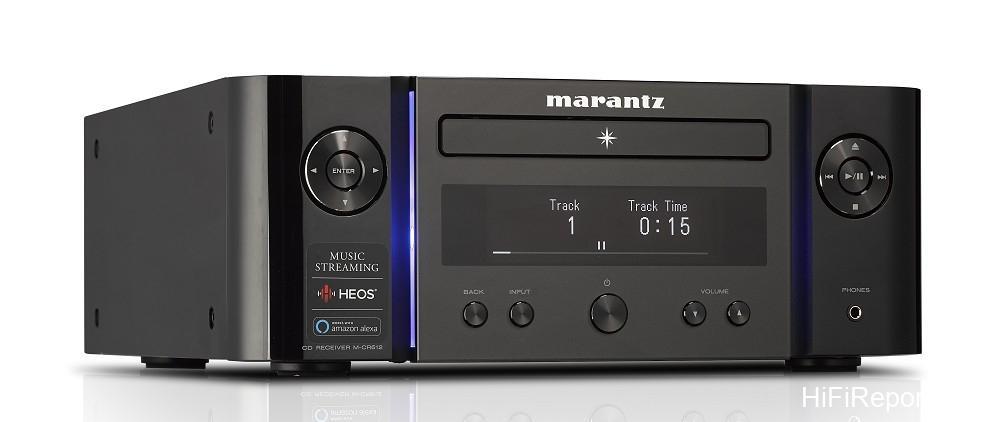
The M-CR612 boasts a compact and exquisite design, yet it packs the functionality of a complete audio system (minus speakers). The digital source section acts as both a CD player and a network streamer, capable of playing music files pushed or shared from smartphones, NAS drives, and PCs over the network. Compatible file types include WMA, MP3, WAV, MPEG-4 AAC, FLAC, Apple Lossless, and DSD. Lossless multi-bit files support up to 192kHz/24bit, while DSD supports both DSD64 and DSD128.
Connectivity & Usability
Beyond network playback, the M-CR612’s rear USB port can accommodate USB flash drives or hard drives. The front display can show not only English but also Chinese and Japanese album and track names. This means even in a completely offline environment, you can directly use the remote control to select and play tracks stored on a USB drive, without needing a smartphone or tablet.
When connected to the internet, it provides access to internet radio (like TuneIn) and online music streaming services (like Spotify).
Japanese manufacturers have always excelled at designing and producing precise, slim, compact, and feature-rich equipment. The M-CR612, integrating so many functions into a “micro audio main unit,” came as no surprise. My keen interest in this unit before its release stemmed mainly from two factors. First, its “driving power.” The M-CR612’s output power is greater, even doubled, compared to most micro amplifiers of similar size.
Its output power approaches that of standard-sized entry-level integrated amplifiers, offering more flexibility in speaker matching. Second, the M-CR612 incorporates unique implementations utilizing new technologies. It’s not just special; it reflects the manufacturer’s “dedication to sound quality” and possesses distinctive, highly practical features.
Pure Digital Amplification
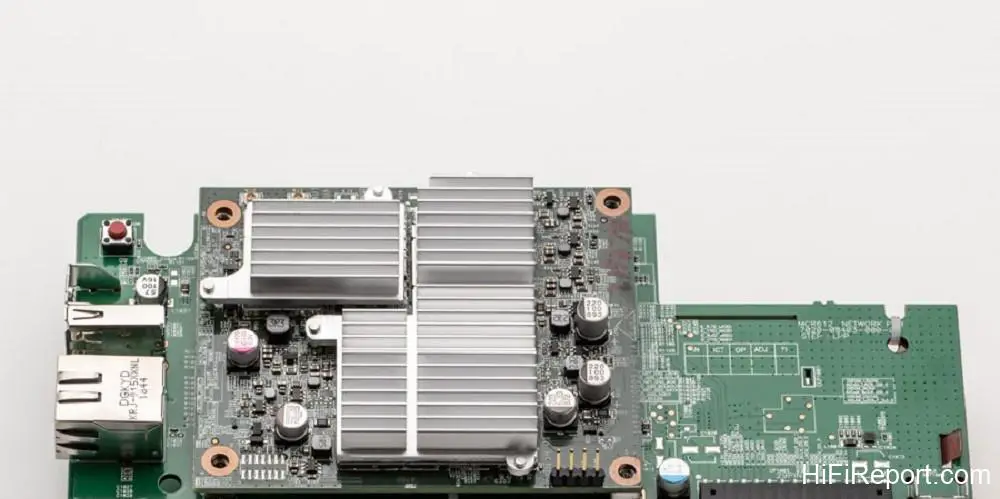
Let me start by detailing the unique aspects of this unit. The M-CR612 is a “pure digital” amplifier. After digital audio input, it uses a TI TAS5558 chip for digital audio processing, including sample rate conversion and volume control, outputting “8 channels” of PWM signals. Following the TAS5558, two TAS5142 chips are used as the output stage for the digital power amplifier. Each TAS5142 can amplify 4 channels of PWM signals.
These PWM signals are then converted into linear audio signals to drive the speakers via a low-pass filter (LPF) composed of inductors and capacitors. This is a pure digital amplification circuit, directly converting digital signals and amplifying them to drive the speakers. Throughout the process from digital input to speaker output, no DAC chip is used for digital-to-analog conversion.
Consequently, it is almost entirely immune to “analog audio being contaminated by noise,” giving it an inherent advantage of low noise.
Flexible Output Configurations
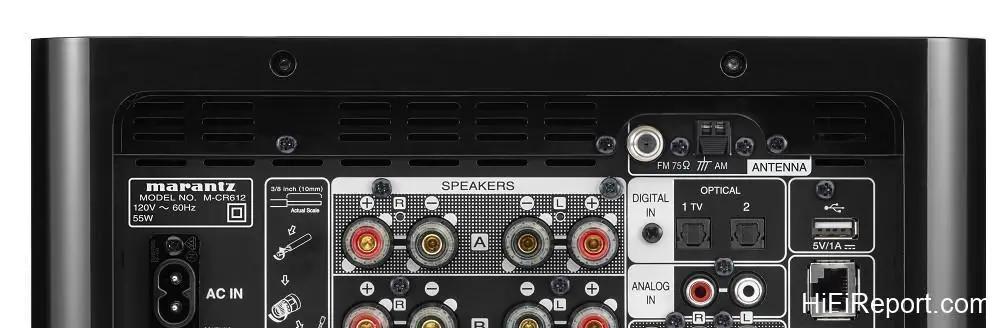
The manufacturer cleverly uses the internal 8-channel configuration to create “two sets of dual-mono fully balanced amplification circuits.” It offers two sets of speaker outputs, Speaker A and Speaker B. Most units with two speaker outputs share a single set of single-ended amplifiers for both A and B. However, the M-CR612’s Speaker A and Speaker B are “independent balanced amplification circuits.”

By navigating to the “Speaker Configuration” menu in the settings, you can select one of three “Amplifier Mode” options:
Standard Mode
Uses one set of balanced amplifiers to output a standard 2-channel signal.
Parallel BTL Mode
Combines two sets of balanced amplifiers into one, effectively doubling the output current capacity. This mode utilizes Speaker A terminals only and is suitable for driving a single pair of speakers with more power.
Bi-Amp Mode
Uses two sets of balanced amplifiers independently, one for Speaker A and one for Speaker B. This allows bi-amping speakers that support this configuration, connecting the high-frequency drivers to one set of terminals (e.g., Speaker A) and the low-frequency drivers to the other (e.g., Speaker B).
Refined Engineering
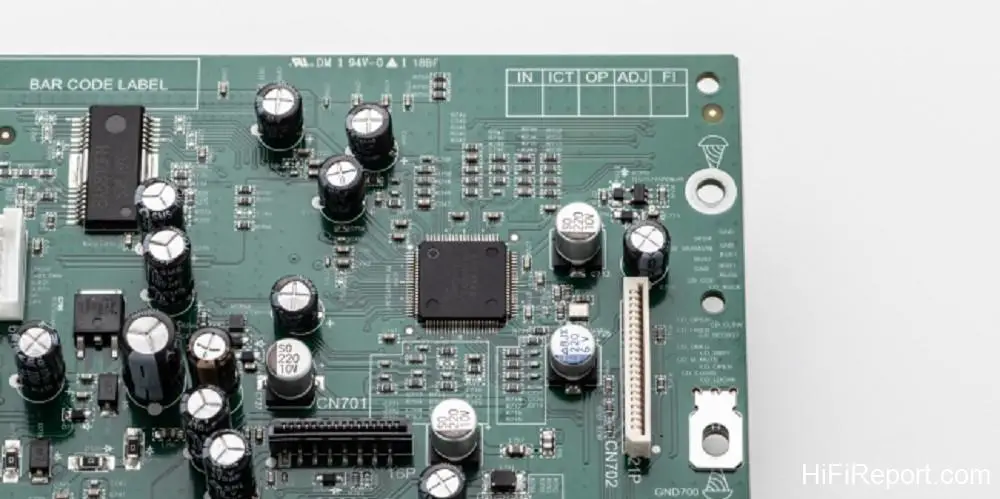
Having covered the “special” aspects of the M-CR612, let’s discuss its “refinement.” Circuits using PWM modulation or 1-bit processing are very sensitive to the quality of the reference power supply. In the M-CR611, this was shared with other digital circuits. For the M-CR612, an independent reference power supply was implemented with improved voltage regulation performance, significantly reducing noise, especially in the 10 to 30kHz range.
The power supply circuits for various sections use low ESR/ESL polymer electrolytic capacitors for fast load response and stable performance. The manufacturer even used three different brands of electrolytic capacitors in five locations across the main board, network board, and CD circuit board. These choices were made through extensive listening tests, trying different capacitors to fine-tune the sound based on what sounded best.
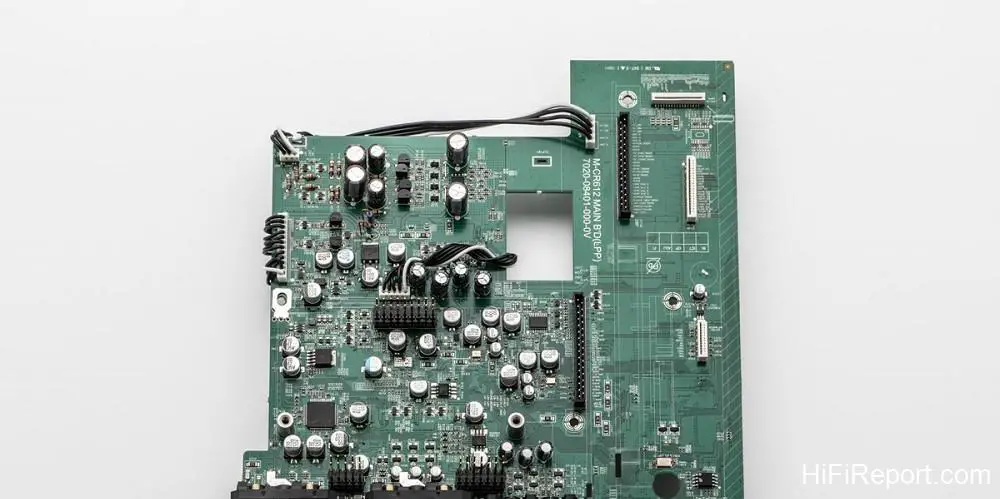
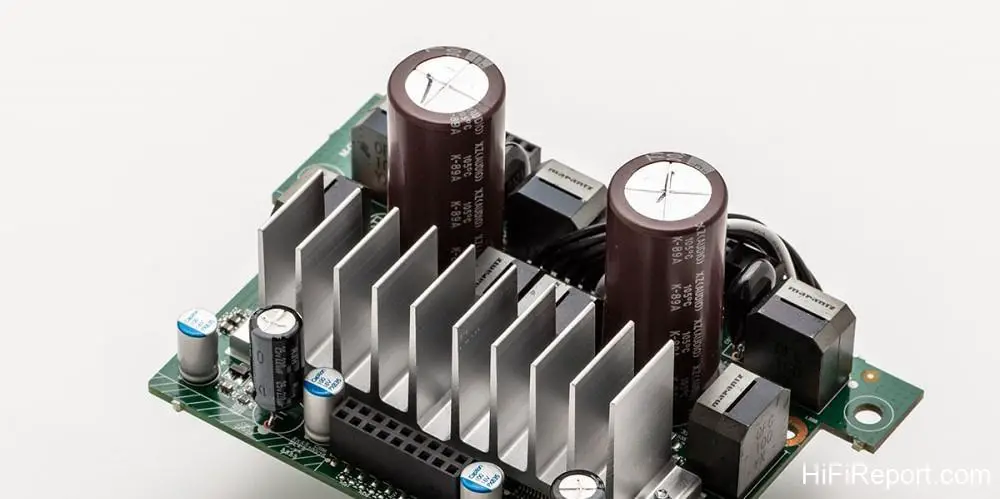
In the digital amplification section, the output stage uses high-quality film capacitors and oxygen-free copper wound manganese-zinc core inductors for the low-pass filter circuit. It is truly rare to see oxygen-free copper inductors used in such an affordable PWM amplifier. The CD playback circuit mirrors the precision of Marantz’s SACD/CD player “SA-12” (priced at over NTD 80,000, roughly $2500 USD), equipped with a high-precision oscillator to reduce jitter.
The headphone amplifier uses Marantz’s proprietary HDAM-SA2 structure (a high-speed, wide-bandwidth amplification circuit built with discrete components, not an OPA chip) for the buffer amplifier. Users can select between “High, Medium, and Low” gain settings based on their headphone impedance and requirements.
Putting It to the Test
Marantz in Japan arranged listening sessions for reviewers, pairing the unit with various speakers, a key pairing being the B&W 707 S2. This is a significant step up, as the 707 S2 costs roughly three times the price of the M-CR612. Clearly, the M-CR612 is no ordinary unit. For my test, I used the Pioneer S-1EX floorstanding speakers, which are about 20 times the price of this unit.
While I wouldn’t recommend this pairing for a buyer, I wanted to push the M-CR612 to its absolute limit using the S-1EX.
Standard Mode Impressions
I began by listening in Standard mode. To be frank, this unit still has limitations in terms of sheer power. While more capable than most micro systems, it’s not “brutally powerful.” However, for “normal music listening,” it performs flawlessly, delivering sufficient sound pressure with moderately sensitive speakers. “Power” isn’t this unit’s main strength, but its performance in “sound quality” is outstanding.
It boasts a strikingly quiet background, allowing details in music recordings to fully emerge at normal and even lower volumes. The bass control is excellent, offering fast and agile response. The midrange is warm, full-bodied, and liquid. The treble has a natural sheen, providing ample detail yet remaining remarkably smooth.
Parallel BTL Mode Impressions
Next, I switched the Amplifier Mode to Parallel BTL. Compared to the Standard mode, Parallel BTL doubles the current output capability, resulting in a richer, more “concentrated” sound. The bass becomes fuller and gains more weight, the midrange density increases, and the overall sound becomes thicker and more textured, brimming with more character. After listening to both modes consecutively, the M-CR612 left me genuinely surprised.
It is a pure digital amplifier employing PWM amplification, yet its sound completely lacks the typical stiffness often associated with PWM amplifiers (mostly Class D). Based purely on listening experience, its natural, refined sound could easily be mistaken for a Class AB streaming amplifier with a very well-implemented DAC chip.
Bi-Amp Performance & Verdict
I then removed the jumpers between the HF and LF terminals on the speakers and connected two pairs of speaker cables to Speaker A/B, switching the unit to Bi-Amp mode. Re-listening to the same tracks I had played in the previous two modes, I can confidently state that for speakers equipped with bi-wire/bi-amp terminals, this is the mode where the M-CR612 truly shines. The sound purity is exceptionally high, completely free of any haze. A remarkably transparent soundstage unfolds before you.
You don’t need to increase the volume to perceive a clear sonic image. Even listening to older recordings (like Carole King’s Carnegie Hall concert), the sound remains exquisitely detailed and realistic, with powerful penetration. Listening to piano solos, you can effortlessly hear rich harmonic content and the subtle, sensitive response to playing technique that shapes the piano’s tone.
Based on the M-CR612’s performance in Bi-Amp mode, I believe it has achieved a level of “sound quality dislocation,” truly punching far above its class. For normal listening volumes (without pushing it to extremes), I think even audio reviewers would agree that the M-CR612’s sound quality approaches that of a combined “digital source + integrated amplifier” setup costing around NTD 100,000 (approximately $3100 USD).
It has reset my personal benchmark for evaluating the sound quality of entry-level audio equipment. Within the realm of affordable audio, I consider this a truly audacious creation, absolutely deserving of our Best Recommendation award.
Specifications
* Type: Network CD Receiver
* Rated Output Power: 50W + 50W (6 ohms)
* Practical Maximum Output Power: 60W + 60W (6 ohms)
* Compatible Speaker Impedance: 4 to 16 ohms
* Total Harmonic Distortion (1kHz, 5W, 6 ohms): 0.1%
* Signal-to-Noise Ratio: 90 dB
* Frequency Response: 10Hz – 40kHz (±3dB)
* Input Terminals: 2-channel analog x1, Toslink optical x2, Network terminal x1, USB x1, FM/AM antenna terminal x1 each
* Output Terminals: 2-channel analog signal (RCA) x1, Subwoofer signal output terminal x1, 2-channel speaker terminals x2
* Dimensions (W x H x D): 280 x 111 x 303mm
* Weight: 3.4 kg