
Marantz MODEL M1 Review
For the past decade, Marantz has utilized both Class D and Class AB amplification in parallel. Far from neglecting Class D, they’ve even gone so far as to design and produce top-tier Class D amplifiers for their flagship models, maintaining an open and active attitude towards new power amplifier circuit technologies. The genesis of the MODEL M1 dates back to 2020.
Marantz R&D engineers prototyped circuits using Dutch company Axign’s solution and presented them to Marantz’s “Sound Master,” Yoshinori Ogata, for evaluation. He immediately recognized the excellent sound quality. Their primary reason for adopting the Axign technology was that their previous implementations using ICEpower and Hypex Class D amps required analog input, whereas Axign uses fully digital amplification.
This allows for size reduction, enabling them to create an amplifier that is “small in size, big in power,” simple, easy to use, and capable of delivering high-quality, authentic sound. This approach aims to satisfy not only audio enthusiasts but also reach beyond, particularly targeting younger demographics.
Deep Dive into the Amplification Circuitry
I believe the foundation of his statement, “high-quality, authentic sound,” lies in the newly developed amplification circuit. This circuit is what I’ve recently been focusing on: the Power DAC. Simply put, it’s a “digital-to-analog conversion circuit that can directly drive speakers.” Various digital audio signals enter the MODEL M1 through the HEOS network card and various digital input interfaces.
They are then sent to the amplification circuit board, where they are first processed by an Analog Devices 32-bit SigmaDSP Digital Audio Processor chip, the ADAU1452. This chip primarily handles digital audio processing, including volume control, bass management, treble and bass adjustment, as well as additional processing like virtual spatial sound, dialogue enhancement, and night mode.

Therefore, Marantz essentially uses the ADAU1452 to create an “all-digital preamplifier” that takes digital in and outputs digital.
After the digital audio processing, Marantz combines the Axign digital audio conversion and amplification control chip with their proprietary MMDF (Marantz Musical Digital Filtering) digital filter technology. The Axign chip converts the digital audio into PWM (Pulse Width Modulation) – this is where the digital-to-analog conversion happens. Following this, similar to Class D, the Axign chip controls the switching action of the output stage power MOSFETs to amplify the PWM signal.
Finally, the PWM is converted back into an audio signal using LC components (inductors and capacitors) in a low-pass filter to drive the speakers. From digital audio input to speaker output, absolutely no dedicated digital-to-analog converter (DAC) chip is used in between.
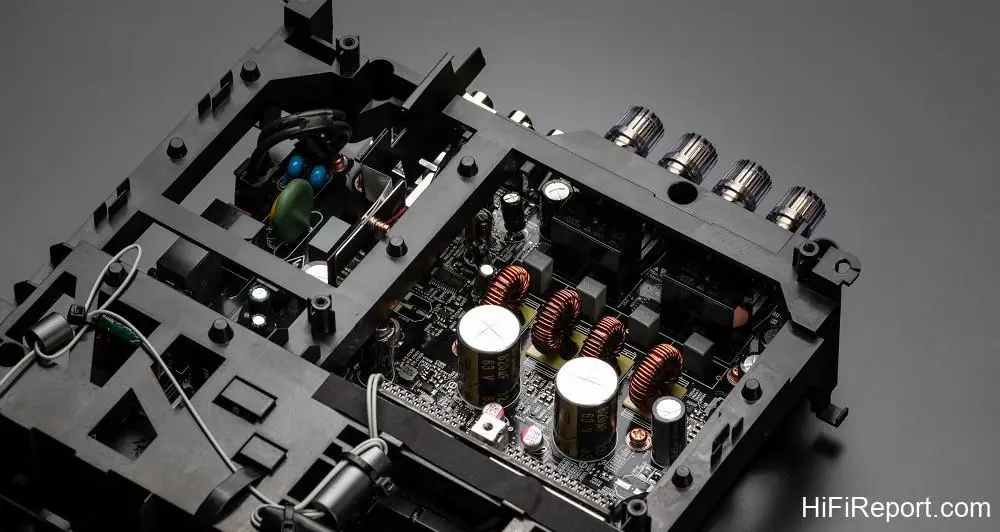
Observing the structure of the output stage, it is evident that it bridges four channels of amplification circuitry into two channels. The purpose, of course, is to achieve higher power output. The rated power is 100 watts per channel into 8 ohms and 125 watts into 4 ohms. This significant output power surpasses most “standard size” integrated amplifiers, while the MODEL M1’s front panel width is only half of theirs.
This makes it not only suitable for urban living room environments, capable of fully driving most speakers (including floorstanders), but also perfectly fine for use as a “desktop” amplifier in a personal audio system.
Implementing Feedback in the Digital Domain
PWM-based amplifiers share the characteristics of high power and low heat generation. The sound quality of Class D amplifiers is starting to gain recognition among audio enthusiasts not only because of increased modulation frequency but also crucially due to the use of negative feedback technology to reduce high-frequency harmonic distortion, achieve wider bandwidth, and correct non-linear distortion caused by the final low-pass filter.
Therefore, for high-quality Class D amplifiers, negative feedback applied from the output back to the input is necessary. However, Class D is inherently “analog,” and it’s relatively straightforward to apply feedback from the analog output to the analog audio signal at the input stage. But the MODEL M1’s amplification circuit handles digital audio in its initial and intermediate stages, with only the output being an analog signal. How is negative feedback applied here?
The only way to implement “similar negative feedback” in a digital amplifier is to take the analog signal from the speaker output, convert it to digital using an ADC, and then feed it back to the digital audio processing circuit for distortion correction. This is how previous DDFA (Direct Digital Feedback Amplifier) pure digital amplifiers worked.

Axign’s relative advantage lies in integrating a low-latency ADC and the feedback circuitry directly into the Axign digital audio conversion and amplification control chip. The low-latency ADC converts the analog audio into a 25MHz/1bit digital audio signal, which is then sent to the digital audio processing circuit to be compared with the input signal.
At this point, the digital audio processing circuit can act as a “digital compensation filter” to suppress the non-linear distortion from the LPF at the end of the power amplifier stage and the effects caused by “frequency/impedance” loads. It can also remove high-frequency noise from the PWM modulation, resulting in purer sound quality. I should slightly refine my earlier statement: referring to Axign’s feedback method simply as “negative feedback” isn’t entirely accurate.
It corrects distortion using a “digital compensation filter” in the digital audio processing. Axign refers to this technology as Post-Filter Feedback.
Performance and Manufacturing Quality
The application of this advanced technology endows this unit with quite impressive performance. Under an 8-ohm load and at “full power” output across the “full frequency range,” the total harmonic distortion is merely 0.05%. This is significantly different from the specifications of typical amplifiers, which often only state capabilities at “1 watt, 1kHz” or “half power, 1kHz.” The signal-to-noise ratio reaches an impressive 105 dB, a figure comparable to preamplifiers!

This also highlights how pure digital amplification is less affected by noise and can therefore be more “silent.”
Yoshinori Ogata regards the MODEL M1 as the culmination of Marantz’s decade of experience and technology in Class D amplification since 2015. From a product hierarchy perspective, the MODEL M1 is merely the successor to the M-CR612. Yet, surprisingly, it is manufactured at Marantz’s production base in Japan, the Shirakawa factory. This makes it the most affordable product produced at the Shirakawa factory in many years, indicating the significant importance the manufacturer places on this unit.
The build quality of the MODEL M1 is indistinguishable from Marantz’s flagship models. All printed circuit boards are produced in-house. Component mounting, soldering, assembly, quality control inspection, and packaging are all completed at the Shirakawa factory. The circuit board cleanliness is high. Naturally, it also incorporates components selected and matched by the “Sound Master” through extensive listening tests.
The inductors used in the output stage LPF are the same model as those in the flagship multichannel power amplifier AMP 10. The capacitors used are Bevenbi metallized film PE capacitors from the same series as those found in B&W crossovers. Furthermore, Marantz’s consistent practices, such as careful layout to minimize internal electromagnetic interference, using low-noise switching power supplies, and reducing vibration, are all evident.

Key Features and Functionality
Having discussed the circuitry and technology, let’s move on to the practical functions and applications. Compared to most integrated amplifiers, the MODEL M1 boasts two unique features. The first is the inclusion of an HDMI eARC terminal, allowing it to support digital audio return. This enables the audio system the MODEL M1 is part of to replace the TV’s built-in speakers.
Simultaneously, it activates the CEC linkage control function, allowing you to adjust the MODEL M1’s volume using the TV remote and have the MODEL M1 power on and off with the TV. Two-channel amplifiers and streaming speakers equipped with eARC are still relatively rare, and most I’ve used only support two-channel PCM output from the TV.
The MODEL M1, however, is even compatible with multichannel encoded Dolby Digital Plus, converting it to two channels (I have tested it with streaming video Dolby Atmos and it worked). This eliminates the issue for users who may not know how to set their TV’s ARC audio output correctly, leading to incompatibility with the audio system’s digital audio input.
The other unique feature, I believe, is desired by many users: bass management. While integrated amplifiers with a subwoofer output and support for a 2.1 channel system are not uncommon nowadays, a significant proportion of them lack bass management capabilities. They cannot perform crossover filtering between the left/right channels and the subwoofer.
For most people who do not use measurement tools to assist in testing and adjusting crossover points, tuning the subwoofer’s low-pass frequency to seamlessly blend with the low-end roll-off of the left/right speakers “by ear” is extremely difficult. Furthermore, they often set the subwoofer’s crossover point too high because they “want to feel the effect of adding the subwoofer,” causing overlap with the lower frequencies of the left/right speakers.
This results in excessive bass energy in the overlapping frequency range, potentially even causing booming. This is one of the primary reasons why adding a subwoofer to many two-channel systems fails.
The MODEL M1’s bass management function is configured via the HEOS App. The adjustable range for the high-pass filter frequency for the left/right speakers is from 40Hz to 250Hz, while the low-pass filter frequency for the subwoofer is from 40Hz to 120Hz. This makes crossover point adjustment much simpler for most users. By setting the High Pass Filter and Wired Subwoofer settings to the same frequency, the left/right channels and the subwoofer will blend seamlessly.
Afterward, you simply need to adjust the subwoofer’s volume while listening. I recommend bookshelf speaker users set the crossover point to 80Hz, while floorstanding speaker users can try setting it between 50 and 80Hz. This prevents the left/right channels from reproducing frequencies below the crossover point, reducing distortion and effectively taking the load off the MODEL M1, preserving greater dynamic headroom.

HEOS and Streaming Capabilities
Equipped with a HEOS network card, the MODEL M1 can access various streaming music services via the internet, including Spotify, Tidal, and TuneIn. It also features DLNA functionality, allowing it to play music files shared on your home network from a NAS or PC. You can also use the HEOS App on your phone to push music files to the MODEL M1 for playback.
Users can even connect a USB hard drive as a music library by inserting it into the USB port on the rear panel (I have tested NTFS formatted USB drives, and they work fine). Give it a little time to organize the files, and you can then select albums for playback within the HEOS App.
Regarding the various methods of playing music files mentioned above, the compatible file types include WAV, AAC, WMA, FLAC, ALAC for multi-bit encoding, and DSF, DFF for DSD formats. Multi-bit music files are compatible up to 192kHz/24bit, while DSD is compatible with 2.8MHz and 5.6MHz.
Listening Impressions
At the beginning of my audition, I first used the MODEL M1 to drive the Pioneer S-1EX floorstanding speakers in full-range mode. Seriously, it’s no joke; it can drive these speakers to very high sound pressure levels, and the tight, fast bass demonstrates its excellent control over the speakers. Subsequently, I integrated a Monitor Audio Anthra W15 subwoofer into the system, making it a 2.1 channel setup (with the crossover set at 80Hz).
As long as the subwoofer is fast enough and its volume is properly adjusted, the bass transition between the 2.1 channels is incredibly smooth. Frequencies below 40Hz, including organ notes and electronic bass, are clearly audible with distinct intensity and pitch variations. I believe the MODEL M1’s sound signature is realistic, neutral, fast, and youthful. It has absolutely no coloration.
If paired with speakers of similar characteristics and sufficient resolution, it can deliver a very high degree of sonic purity to the listener. The soundstage provides a very clear sense of visual placement, without restraint or embellishment. It is very close to the listening experience of flagship monitoring headphones, allowing the listener to hear the music closer to its original form.
Sound Adjustments and Virtual Sound
The MODEL M1 also offers some sonic adjustments. It provides a choice of two digital filter (DAC Filter) modes. The default, Filter 1, is a short delay slow roll-off type, exhibiting Marantz’s traditional “flavorful” sound. However, compared to most of their previous integrated amps, this unit is still relatively more dynamic and direct. Filter 2 is a typical sharp roll-off, which I believe leans towards a “resolution-focused” approach.
Even more interesting is the MODEL M1’s behavior with external sources, especially when paired with a smart TV using eARC digital audio return. There are three Sound Modes to choose from: Direct, Stereo, and Virtual. Stereo is the default. Direct is slightly softer than Stereo but sounds a bit more distant. I strongly recommend using Virtual for everyday viewing and streaming movies, regardless of whether the native audio is two-channel or multichannel.
The virtual spatial sound effect is quite pronounced. Switching from Stereo to Virtual immediately creates a sense of increased height in the soundstage, with the front soundstage becoming wider and extending to the sides and even slightly behind. The central image (such as dialogue) in the front is clear and focused, almost as if there were a center channel speaker playing. The sense of presence within the overall soundstage space is noticeably enhanced, and the bass quantity is increased.
Coupled with the convincing bass from the subwoofer, the overall audio performance surpasses all soundbars I have heard. The “immersion” into the scene during streaming movies is definitely something most two-channel audio systems cannot achieve.
What more can I say? Based on its sound quality relative to its price, I believe the Marantz MODEL M1 would still be excellent value even if it sold for double the price. It has completely rewritten my benchmark for the highest price-performance ratio in streaming amplifiers under $1,500 USD. It absolutely deserves our highest recommendation.
I strongly advise practical consumers with purchase needs and a modest budget to put this unit at the top of their audition list because I’m unsure if the Shirakawa factory will continue producing the M1 at such an affordable price indefinitely. Made in Japan, if it’s in stock, buy it quickly!
Specifications
* Type: Wireless Streaming Amplifier
* Rated Output Power: 100W per channel (8 ohms, 20 Hz – 20 kHz, THD 0.05%), 125W (4 ohms, 1 kHz, THD 0.05%)
* Signal-to-Noise Ratio: Digital Input 105dB, Analog Input 91dB
* Frequency Response: 20Hz〜40kHz (-3dB), 20Hz〜20kHz (±1dB)
* Compatible Speaker Impedance: 4 to 16 ohms
* Input Terminals: HDMI eARC ×1, RJ45 Network Port ×1, USB (Type A) ×1, Toslink Optical ×1, Stereo Analog Input (RCA) ×1
* Output Terminals: One pair of Speaker Terminals, Left/Right Channel Pre-out (RCA) ×1, Subwoofer Output ×1
* Dimensions (W×H×D): 217 × 84 × 239mm
* Weight: 2.2kg

- Sound Master tuned: At Marantz’s Shirakawa Audio Works facility in Japan, every MODEL M1 is designed and built to a standard shaped by decades of audiophile engineering
- True Marantz power: 100 W per channel of high-quality, low-distortion amplification delivers pristine sound in any space, with a dedicated subwoofer output for a full 2.1 system
- Stream your way: Powered by HEOS, MODEL M1 supports high-resolution music up to 24-bit/192kHz PCM and DSD over streamed services, your network, or USB, with support for AirPlay 2, Spotify Connect, and Bluetooth
- Authentic musicality: Marantz Musical Digital Filtering (MMDF) preserves the natural warmth, detail, and spaciousness of every recording, drawing on unique oversampling techniques developed for Marantz reference-grade audiophile products
- TV sound, enhanced: With HDMI eARC and onboard Dolby Digital+ decoding, MODEL M1 radically improves your TV viewing experience, with a wide range of audio adjustments and volume control from your existing TV remote