
Marantz Model 50 Review
Look around the audio market today, and you’ll mostly find all-in-one sound systems that combine sources, amplifiers, and speakers. Even traditional amplifiers now typically include streaming capabilities, and even digital inputs like HDMI, allowing you to build a complete audio system with just a pair of speakers. “Function integration” is undeniably a major trend in audio products.
Why Separates Matter
However, if you have some understanding of audio, you’ll know that all-in-one systems aren’t always the most ideal for sound quality. The digital circuits within the source component are highly sensitive and easily disturbed by even tiny vibrations or noise. Conversely, digital noise can readily creep into the audio circuits. Furthermore, in pursuit of convenience, all-in-one units often feature very small chassis.
If you were to open one up, you’d find these products are frequently packed to the brim to support their extensive features, leaving little adequate space for adjacent circuits. Additionally, most all-in-one products are entry-level, with relatively rudimentary shielding and vibration damping designs, which further exacerbates the negative impact on sound quality.
This is why I recommend that players just starting out consider a configuration of “integrated amplifier + digital source.” This approach, on one hand, separates the digital and analog circuits, reducing signal interference. On the other hand, it provides more room for future upgrades, increasing the flexibility of component matching.
Marantz’s Philosophy
The Japanese audio brand Marantz has always placed great importance on the traditional pursuit of excellent sound, and their recent two-channel releases emphasize a separates-based design philosophy. They haven’t just launched the CD 50n, a CD player with streaming capabilities, but also the integrated amplifier featured in this article, the Model 50.
Design and Features
Positioned as the successor to the PM8006, the Model 50 shares a design aesthetic with the CD 50n, adopting Marantz’s new generation visual language. The chassis finish has shifted from the previous black to a gunmetal grey, and the brand logo features a bronze-colored treatment. The front panel’s sides are adorned with a pattern of small indentations, which catch the light beautifully, creating a shimmering effect.
A signature circular display has been added to the center, and the knobs feel more refined than those on the PM8006.
The left knob controls source selection, the right controls volume. Centered between them are EQ knobs for treble and bass, and a knob for switching between A and B speaker outputs. Another feature I particularly appreciate is the Balance control. Since most listening spaces are asymmetrical open-plan living rooms, this function allows for fine-tuning the gain of the left and right channels, saving you the headache of room treatment issues.
Finally, the Model 50 also includes a 6.3mm headphone output, driven by an HDAM-SA2 discrete headphone amplifier circuit, offering another compelling reason for headphone users to consider it.
Connections
Turning to the rear of the Model 50, the terminal support is largely consistent with the PM8006. First, there are two sets of speaker terminals, A and B, allowing you to switch between two pairs of speakers. If your speakers have bi-wire terminals, you can even use the A+B setting for a bi-amp connection, enhancing the speaker’s driving capability. In my experience, this often results in improved transparency in the mid-high frequencies.
For analog inputs, there are five sets of RCA terminals for connecting CD players or streamers, as well as a Phono input, indicating built-in MM phono stage functionality for connecting a turntable. What’s more unique is the inclusion of a Power Amp In terminal, which allows you to bypass the preamplifier section and use only its power amplifier. This is useful when building a multi-channel system, allowing the Model 50 to drive the main speakers for better control.
For analog outputs, there’s a Pre Out, so you can use the Model 50 as a preamplifier if you have a superior power amplifier. Finally, the biggest difference between the Model 50 and the PM8006 is the addition of a Sub Out terminal. If you feel the bass isn’t quite satisfying enough, you can connect an active subwoofer.
This is very practical for those with smaller spaces, allowing them to opt for a 2.1 channel system with bookshelf speakers and a subwoofer to achieve more complete bass response in a compact environment.
Internal Engineering
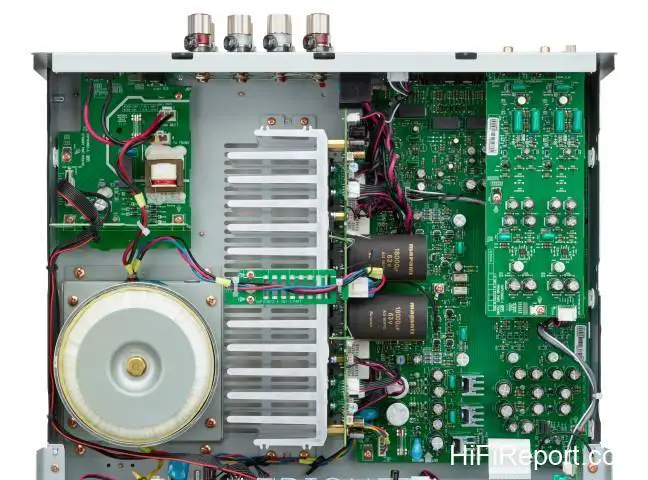
The Model 50 isn’t just a cosmetic refresh; the internal circuitry has undergone significant evolution. The circuit layout inherits designs from higher-end models, featuring a fully balanced structure for the left and right channels to ensure optimal music separation and soundstage performance. The preamplifier circuit, of course, utilizes Marantz’s proud HDAM discrete amplification modules.
Through long-term evolution, the HDAM modules in the Model 50 have achieved approximately 40% lower distortion compared to the preamplifier circuits used in previous integrated amplifiers of the same class – a truly impressive figure!
Unlike typical volume controls that use variable resistors, the Model 50 employs a high-performance linear volume control circuit comprising a volume control IC paired with proprietary HDAM and HDAM-SA2 modules. This enhances musical dynamics and avoids the potential degradation of sound quality due to aging variable resistor components.
Furthermore, the Model 50’s volume control features an automatic gain adjustment design. When listening at low to moderate volumes, the signal bypasses the volume control circuit, with volume adjustments handled solely by the power amplifier’s voltage gain. The preamplifier’s signal amplification engages only when you turn up the volume, ensuring the preservation of the fullest detail and dynamic range at lower listening levels.
According to Marantz, this technology contributes to a remarkable 7dB reduction in signal-to-noise ratio compared to the PM8006, which is certainly a key factor in this unit’s excellent sound quality.
Regarding the power amplifier circuit, the Model 50’s specifications might not seem particularly outstanding on paper, with 70 watts per channel into 8 ohms and 100 watts into 4 ohms. However, this unit employs Marantz’s latest HDAM-SA3 fully discrete current feedback amplification circuit. Rather than brute force, it prioritizes characteristics like high transient response, high signal-to-noise ratio, and low distortion.
Each channel of the Model 50 uses one set of HDAM-SA3 modules configured in a balanced push-pull Class AB structure. This not only increases the separation between the left and right channels but also boosts the Model 50’s instantaneous current supply capability to 66 amperes, a 45% increase over the previous PM8006, resulting in better dynamics and control for the speakers.
To ensure a more stable current supply to the audio circuitry, the Model 50 pays great attention to its power supply. It features the largest toroidal transformer in its class, weighing 16% more and with a 15% larger diameter than the PM8006’s transformer. Below the transformer, a 1.0mm thick, three-layer steel plate chassis is used to minimize resonance.
To prevent leakage flux issues, the transformer is enclosed in double shielding and surrounded by silicon steel rings, paired with two Marantz-customized 18,000µF filter capacitors, providing a continuous, abundant current supply.
But they didn’t stop there. To enhance instantaneous current delivery, the power amplifier circuit features painstakingly optimized shortest power supply paths. The power amplifier’s power supply circuit and output stage are integrated directly. Conductors leading from the main power supply to the output stage, previously 0.035mm copper foil, have been upgraded to 1.0mm copper rods, significantly reducing transmission impedance and resulting in improved musical dynamics.
Listening Impressions
Having recently experienced the capabilities of the CD 50n player, I was impressed not only by its transparent sound quality but also by the surprising dynamic range achieved with the aid of the proprietary HDAM volume control, even from a source component. This left me even more eager to hear the performance of the Model 50 integrated amp from the same series, undoubtedly a product that showcases the full potential of HDAM technology.
For this listening session, I used our Room 1, pairing the Model 50 with the CD 50n as the source to create a complete Marantz system. The speakers used were Pioneer S1-EX floorstanding speakers. This Model 50 integrated amp, while simple in features, has a distinct sound character. Unlike the CD 50n’s transparent style, it sounds very warm, with a character that is soft, beautiful, and full-bodied.
It doesn’t overly emphasize resolution to the point of sounding lean, yet it never feels sluggish. The contours of voices and instruments are appropriately smoothed, making them sound more rounded and flowing, consistently maintaining a sense of lightness and softness.
I started with the jazz album “Sonny Rollins – Way Out West,” playing the first track, “I’m An Old Cowhand.” The opening saxophone solo was less direct and aggressive, sounding more feminine and elastic, with the brass exhibiting a warm, smooth timbre. Although the Model 50 is rated at only 70 watts on paper, it drove our large S1-EX speakers with ease.
During the continuous chromatic passages, the full energy seemed to flow out endlessly, conveying the sheer lung capacity of Sonny Rollins’ performance.
The accompanying cymbal work lightly brought out the swinging rhythm. The high frequencies had a clean, soft texture, without excessive emphasis on resolution that would make them sound overly sharp or bright. When the double bass and drums entered the arrangement, the Model 50’s strengths immediately shone through. The plucked bass had a rich, large, and elastic quality, with slightly extended decays that enriched the resonance of the instrument’s body.
The thump of the kick drum also had significant weight, each strike delivering a solid impact. Even with only three instruments, the system immersed you in a rich and dense energy.
Pure Musical Pleasure
The Model 50’s soft and relaxed character also lends itself beautifully to classical music. For example, when playing Joshua Bell’s performance of Barber’s “Violin Concerto No. 1,” the violin’s tone was sweet and flowing. Under the Model 50’s interpretation, the wood resonance became warmer, and the bowing felt full of moisture. The slower passages felt like a gentle caress, with turns of phrase sounding subtle and captivating.
Even in the highest registers, it never sounded harsh or piercing, like polished edges completely without aggression.
During passages with full orchestral tutti, the power of the Model 50’s HDAM modules was on full display. It effortlessly conveyed the majestic sweep of the strings while maintaining clean and precise dynamic control. Even under powerful dynamics, the sound never became overly aggressive at the expense of beauty; it retained the soft, relaxed elasticity of the strings. The rich mid-bass energy never obscured instrumental details; the localization of instruments was clear.
Strings had a full-bodied, defined quality, and the brass exhibited a soft, glowing sheen. This kind of comfortable, natural sound allows you to focus more on the music itself, drawing you in unconsciously until you find yourself wanting more.
Modern consumers often choose audio equipment based on a multitude of features, gradually losing the pleasure of gradually achieving excellent sound piece by piece. While the Model 50 is simple in features, it focuses intently on perfecting the “integrated amplifier.” You can feel Marantz’s dedication to pursuing perfection in every aspect, from the power supply and preamplifier to the amplification circuit, resulting in the most comfortable and listenable musicality.
If you feel overwhelmed by the feature-laden audio products on the market, this Model 50 integrated amp will rekindle that purest joy of simply enjoying music!
Specifications
* Product Type: Integrated Amplifier
* Color: Black, Silver
* Power Output: 70 watts (8 ohms), 100 watts (4 ohms)
* Power Consumption: 220 watts
* Signal-to-Noise Ratio: 125 dB
* Frequency Response: 5Hz–100kHz
* Total Harmonic Distortion: 0.02 %
* Damping Factor: 100
* Analog Inputs: RCA×5, Power Amp In×1, Phono×1
* Analog Outputs: 6.3mm×1 (Headphone), Pre Out×1, Audio Out×1, Sub Out×1
* Dimensions (W×H×D): 442x431x130mm
* Weight: 14.2 kg