
Mark Levinson No 5101 Review
As is well known, Mark Levinson was originally founded by Mark Levinson himself in 1972. Subsequently, the company was acquired by Madrigal in 1984. A court ruling prevented Mark Levinson from using his own name to establish a new company, leading him to found Cello instead. Later, Madrigal was acquired by Harman International in 1990, and finally, in 2017, the South Korean conglomerate Samsung Group purchased Harman International. Mark Levinson is now a brand under the Samsung Group umbrella.
In October 2020, Mark Levinson unveiled four new products simultaneously via an online presentation: the No 5105 turntable, the No 5206 streaming preamplifier, the No 5302 stereo power amplifier, and finally, the No 5101. These four new additions, combined with the No 5802 and No 5805 integrated amplifiers introduced at the Munich High End show in 2019, complete the current 5000 series lineup.
Mark Levinson’s current product range is streamlined and notably “clean,” having shed less essential components. In the digital source category, they offer the No 519 and No 5101. Analog sources include the No 515 and No 5105. Preamplifiers feature the No 523, No 526, and No 5206. For power amplifiers, there are the No 534, No 536, and No. 5302. Integrated amplifiers comprise the No 585.5, No 5802, and No 5805.
Observing the model numbers, we can infer that the three-digit models were generally introduced earlier, starting around 2010, and tend to be higher priced. The four-digit models, introduced after 2014, are more affordably priced. One could say the 500 series represents the high-end tier, while the 5000 series is the more accessible range. Thus, you’ll find both a 500 series and a 5000 series option available for most product types, allowing buyers to choose accordingly.
It makes sense, for instance, to build an entire system using either exclusively 500 series or exclusively 5000 series components for system synergy.
No 5101 Overview and Features
The No 5101 first made its appearance in October 2020, branded as a Streaming SACD Player. It consolidates four key functions into one unit: SACD/CD playback, streaming (from services like Tidal or Qobuz), local file playback (from USB or network), and external DAC functionality via digital inputs. I believe many audiophiles’ attention will be drawn to the SACD/CD playback feature, as quality mid-range SACD/CD players are increasingly difficult to find.
While many enthusiasts may purchase fewer physical discs nowadays, they often possess vast existing collections and still require a capable CD player.
It’s worth clarifying what Mark Levinson means by “Streaming” in this context. It refers to playing streaming music through their proprietary Harman MusicLife app or third-party players (such as BubbleUPnP, MConnect, etc.). It also includes playing music files from a computer or NAS via an Ethernet network cable. If you prefer not to use a wired Ethernet connection for NAS playback, you can select Wi-Fi in the Settings menu.
I recommend going into Settings initially and selecting Ethernet; it will automatically connect (the display will show “Connected”), which is generally more convenient.
Design and Build Quality
The aesthetic of the No 5101 differs from the 500 series; it is less massive and heavy. I believe this is a deliberate design choice to distinguish the more budget-friendly 5000 series from the premium 500 series. The No 5101 features a substantial 25mm-thick front panel with curved edges on both sides. The center section is visually divided into three equal parts, housing the display window, five control buttons, and the disc slot, creating a balanced look.
The No 5101’s display window is small, capable of showing only two lines of orange text. You’ll need normal eyesight to clearly read the text from your listening position. Below the display are five buttons: the central one is Standby, the leftmost is Previous, followed by Next; the two on the right are Stop/Eject and Play/Pause. These text labels appear to be a recent change, as I’ve seen panels where these controls were indicated only by simple icons.
Moving to the rear panel, you’ll find one set each of XLR and RCA analog outputs, one RCA coaxial and one optical digital input, and one each of coaxial and optical digital outputs. There are also Ethernet and USB Type A ports. Notably, the No 5101 lacks the common USB Type B (square) port often used for connecting to a computer as a DAC; it only has a Type A port suitable for USB flash drives.
Additionally, there are connections for the Wi-Fi antenna, an RS232 port, and 12V Trigger input and Infrared remote input ports.
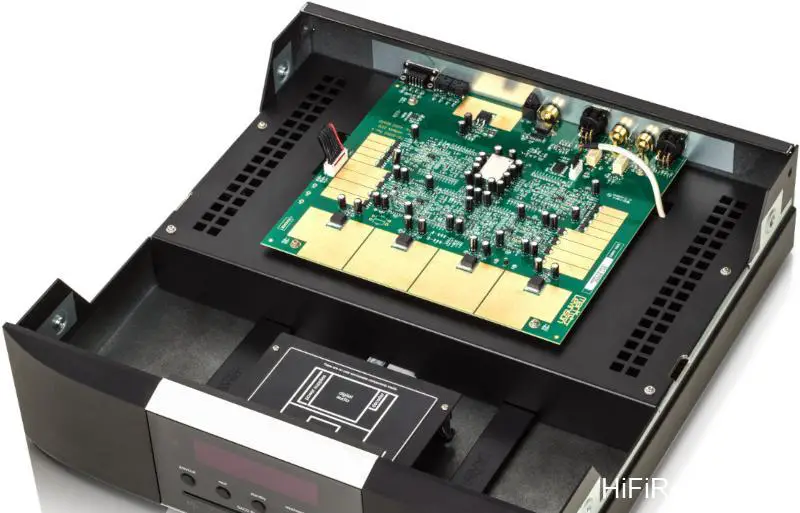
Lifting the vented top cover reveals a surprisingly “clean” internal layout. You see a large main circuit board and, towards the front, a metal-enclosed disc mechanism, separated by a significant distance. What’s peculiar is the absence of visible power supply circuitry. It turns out the power supply is tucked away underneath that large circuit board.
This design is quite unusual, as the metal-sealed compartment beneath the board appears very shallow, likely unable to accommodate a conventional toroidal transformer or even upright filter capacitors.
Unless the metal box separating the power supply from the main board offers exceptional isolation, the power supply circuitry could potentially interfere with the digital circuits. However, given Mark Levinson’s reputation, I assume they are highly confident in their shielding effectiveness to adopt such a design. The No 5101 manual states it uses a linear power supply, but this is the most “flat” linear power supply I have ever encountered.
The main circuit board houses the digital input stage, the DAC, and the analog output stage. You can spot five LM337BD2T voltage regulators on the board – four at the front and one at the rear. A large metal-sealed area sits in the center of the board; I suspect the ESS Sabre 32-bit Pro DAC chip is enclosed within, as it’s not visible elsewhere.
The DAC circuit in the No 5101 is referred to as Precision Link II DAC, and the analog amplification stage utilizes a pure Class A discrete design called Pure Path. These are established signature circuits known for achieving very low noise and THD.
The slot-loading disc player in the No 5101 uses a Sony BD-ROM mechanism, model KEM-48AAA. This is a common model, even suggested for replacement in certain Sony PlayStation 3 or 4 consoles if faulty. When loading SACDs or CDs, be gentle; don’t force the disc in. Lightly inserting it will trigger the mechanism to automatically draw it in. Forcing it can cause it to get stuck.
Furthermore, if the No 5101 becomes unresponsive or “hangs,” the simplest troubleshooting step is to disconnect the power cord, wait a moment, and then plug it back in to reboot. This usually resolves such issues.
Setup, Control, and Usage
To control the No 5101, besides the four buttons on the front panel for SACD/CD playback, you can use the included remote control or download the Mark Levinson 5Kontrol app from the App Store. I found the app to be the best control method, essentially replicating the remote control’s functions. Additionally, you can download Harman’s own MusicLife App to control streaming music playback.
To access the Menu for settings, you must use the remote control. Press the Home button on the remote; the No 5101’s display will show “Settings Menu” on the first line. Press Enter to enter, and the second line will display the settings item (e.g., “DAC SACD Filter”). Remember, when navigating through the settings options, you can only use the Up arrow key; other arrow keys won’t work for this purpose. Once you find the desired setting item, press Enter to select it.
Then, use the Up/Down arrow keys to change the setting value. After making your change, press Enter again to confirm; the setting will be saved, and you’ll automatically return to the options list page.
What options are available in the menu? There are over a dozen options, but not all require adjustment; most can be left at their factory default settings. Below are a few that I believe warrant attention:
The Auto Standby setting allows you to configure automatic power off after 5, 10, 15, or 20 minutes, or set it to Off to prevent automatic standby. If you listen frequently, I recommend setting Auto Standby to Off.
There are options for PCM Filter and DAC SACD Filter. PCM offers seven filter choices: Fast Minimum Phase, Slow Minimum Phase, Apodizing Fast, Hybrid Fast Minimum Phase, Brickwall, Fast Linear, and Slow Linear. These seven options look familiar, possibly sourced from pre-made firmware. Essentially, they relate to how quickly high frequencies roll off, the symmetry of pre-ringing and post-ringing, favoring post-ringing only, blending filtering types, or minimizing ringing.
The Brickwall filter, for instance, aggressively attenuates unwanted aliased signals in the high-frequency range. Which filter sounds best? That ultimately depends on your personal sonic preference.
SACD filtering is simpler, allowing you to set a high-frequency cutoff point from a few frequencies: 47kHz, 50kHz, 60kHz, and 70kHz. Finally, there’s a Digital Output setting to limit the digital output sample rate. Three options are available: 48kHz Max, 96kHz Max, and No Downsampling.
The options menu also includes Wi-Fi and Ethernet network choices. You can only select one at a time for streaming music or playing files from a computer/NAS. You cannot have both enabled simultaneously. When playing music files, FLAC, WAV, AIFF, and OGG are supported up to 24/192; AAC is supported up to 24/96; MP3 is supported up to 320kbps/48kHz; and WMA up to 192kbps/48kHz. The display window shows the file format (e.g., WAV or FLAC) and the bitrate (e.g., 1,411kbps or 4,608kbps).
How do you play music from a USB flash drive? Insert the flash drive into the USB port on the rear panel. Once “USB” appears in the display window, press Enter. Then, use the Up/Down arrow keys to select the folder you want to browse and the Left/Right arrow keys to select the specific track within that folder. Once selected, press Enter to start playback.
How do you play music from a NAS over the network? Press the Home key, then use the Up/Down arrow keys to select “Media Browser” in the display window. Once you find Media Browser, press Enter. The unit will then connect via Ethernet. Next, use the Up/Down arrow keys to find your hard drive or NAS. For example, my NAS is named “Jacklius.” Once your drive or NAS name appears in the display, you’ll then need to use your existing NAS playback app (on your tablet or phone) to control music playback.
If you’re using an iPad, pay attention to the green square-with-arrow icon at the bottom of the iPad page; tapping it will show you the available playback devices (which should include the 5101). Select the 5101 and then start playing the music you want to hear from your NAS library.
When playing music files, the display shows the file type (like WAV) and the bitrate in kbps. For instance, when playing a high-resolution Dvořák Cello Concerto, the display showed “6,144k.” Other high-res files showed bitrates like 3,072kbps. For CD quality (16/44.1), it’s 1,411kbps. For DSD, it supports up to DSD128; higher resolutions will show “Not Supported” in the display.
For playing streaming music, again press the Home key to enter the menu. Find “Network Setup,” press Enter, and choose between Ethernet or Wi-Fi. If you select Ethernet and press Enter, “DHCP On (Auto)” will appear. Press Enter again, and the display will show “Connecting,” quickly followed by “Connected” and “Enter to Exit.” Press Enter to exit the network setup page. Finally, press the Home key to exit the main menu, and you can now play streaming music.
As mentioned earlier, you can use Harman’s own MusicLife App or third-party players. I tested both MusicLife and MConnect with Tidal, and both worked well with smooth page navigation and operation. To play an SACD or CD, simply “gently” insert the disc into the slot; it will be automatically drawn in. Then, press the “Disc” button on the remote control to begin playback.
Listening Impressions
I auditioned the No 5101 in my open-plan living space. The distributor also provided a Mark Levinson No.5802 integrated amplifier for pairing. My primary test setup involved the No 5101 paired with the No.5802 driving AER Momentum speakers. For comparison, I also connected the No 5101 to a Spectral DMC30SS preamplifier feeding directly into ATC SCM100 ASL active speakers.
Comparing the two setups, the AER system leaned towards a more delicate, refined sound: fine and soft treble, balanced midrange, and full bass. The overall impact was less forceful, resulting in a non-aggressive presentation that I believe most listeners would find appealing – a sound characteristic of feminine grace.
The ATC setup, while also exhibiting fine and soft treble, balanced midrange, and full bass, possessed significantly greater power and larger instrument scale. Listening to Shostakovich symphonies, the forceful impact, intense dynamics, and wide dynamic range were far superior to the AER pairing. This demonstrates that the No 5101 is not merely a delicate scholar but a gentleman with six-pack abs – leaning towards masculine power while retaining some feminine grace.
Furthermore, the ATC speakers allowed me to discern the No 5101’s sonic characteristics more clearly, so my final assessment is based primarily on the ATC setup.
The first aspect of the No 5101 that impressed me was its abundant bass quantity. This differed slightly from my previous experiences with Mark Levinson products; while they never lacked bass, I don’t recall it being as rich as with the No 5101. The No 5101’s bass is quite plentiful, though it’s not the kind of explosive, punchy bass, but rather a more relaxed and ample quality.
While listening to Leonard Cohen’s “Ten New Songs,” I immediately noticed the No 5101’s rich bass within the first track. Although this album is known for having somewhat exaggerated bass in the recording, older Mark Levinson gear would have presented it with a cleaner quality. The No 5101, however, renders it more like “Dongpo pork” – rich and satisfying.
Listening to Lisa Batiashvili perform Prokofiev’s “Romeo and Juliet” on violin, the opening drum hits were also very full-bodied, with a significant, ample presence. On Jiang Hui’s “Sorrowful Inn,” the combination of the foot-drum “thump” and electric bass sounded captivating, also evoking that “Dongpo pork” fullness.
However, despite the No 5101’s abundant bass quantity, it is neither bloated nor does it obscure details. The soundstage layering remains clear. In other words, the No 5101’s “Dongpo pork” bass is like lean-cut pork belly – the fat-to-lean ratio is balanced, so the lean parts aren’t dry, and the fatty parts aren’t greasy.
My second impression of the No 5101 was its gentle and approachable nature. By “gentle,” I mean the treble is clear but not biting, the midrange is just right without being overly full, and its character is not explosive but still reacts quickly. For example, listening to Bob Dylan’s “Man in the Long Black Coat,” his typically prominent, rough voice lost about a third of its edge, and the slightly aggressive accompanying instruments were softened by about a third.
When listening to “The Brothers Four Renewal,” the slightly over-emphasized vocals and accompanying guitar also sounded gentler.
To put it another way, this album previously sounded like a photograph with a high color temperature, but the No 5101 lowered the color temperature. It’s important to emphasize that “gentle” does not mean blurry or lacking definition; it means all elements are still present, but the overall presentation is more comfortable to listen to.
My third impression of the No 5101 is its excellent sound quality, surpassing my expectations based on its internal appearance. Why do I say this? Because upon opening the top cover, I didn’t see massive power supply components or the dense through-hole circuitry of older units, and the disc mechanism is just a Sony BD-ROM. Looking at that seemingly sparse circuit board, could you envision truly excellent sound quality?
Yet, after listening to the No 5101, I found its sound quality exceeded my expectations. While it couldn’t match the Aurender N30 I had just reviewed, it possessed ample sweetness, luster, and moisture, along with characteristics of purity and mellowness. These qualities were evident when listening to violin, cello, and piano performances.
For instance, listening to Itzhak Perlman’s “Selected Highlights,” the violin’s beautiful tone was fully realized, with distinct, prominent lines that brought out the instrument’s woody texture. Hilary Hahn’s “Paris” also delivered a lovely violin sound. Her “Virtuoso” demonstrated pleasing violin luster, sweetness, and moisture while maintaining clear bowing texture without becoming aggressive.
The No 5101 renders the cello beautifully. Its lines are focused yet have a relaxed quality, not overly thick, and the bowing texture isn’t too coarse, preserving an elegant, sweet, and rich tone. For example, on “The Essential Yo-Yo Ma,” even with some movie scores, the cello’s beautiful, resonant quality was undiminished. In the instrument’s highest registers, it didn’t become thin or hard, retaining the warm characteristic of a wooden instrument.
Listening to Janos Starker’s “Romantic Cello Favorites,” the exquisite tone and soft, warm sweetness of Starker’s cello would appeal to anyone.
The No 5101’s piano sound is also beautiful, though not of the highly solid, hard, percussive type. Instead, it has a substantial yet slightly soft quality, allowing you to clearly feel the tactile sensation of keys or hammers striking the strings, but without sounding like hitting a metal xylophone. When listening to the Fujita Piano Trio, the piano tone was more refined than rough. On Keith Jarrett’s performance of Mozart’s “Piano Concerto No.
20,” the piano’s rounded, warm feel was just right, with individual notes that weren’t overly large. Listening to Valentin Silvestrov’s “Bagatellen II,” the string resonance in the lower keys was excellent, descending naturally, while the higher notes were clear and rounded, not overly rigid. Overall, the No 5101’s piano reproduction follows a middle-ground path, not emphasizing percussive hardness, but presenting piano notes with a touch of softness.
The No 5101’s vocal presentation is neither too forward nor too large or rough; it also sits in a balanced, middle position. Listening to Jiang Hui sing, her voice didn’t sound too young (implying less midrange) or too old (implying more midrange), but rather squarely in the middle. Listening to Leonard Cohen, his voice wasn’t artificially roughened or excessively magnetic. This kind of vocal sound comes across as natural and unexaggerated.
While it might not immediately stun, extended listening reveals its natural and enduring quality. Another sonic characteristic of the No 5101 is its sense of quietness, which prevents listening fatigue. The transparency is clear like water, not a bright transparency, but a warm, pleasing kind of clarity.
During my listening sessions with the No 5101, I unexpectedly encountered something that contradicted my previous experience. When listening to Barenboim, Mutter, and Yo-Yo Ma’s performance of Beethoven’s “Triple Concerto,” I found that playing the music file sounded noticeably thicker and warmer, a significant step up from the CD playback.
This was strange – not only was the volume higher, the soundstage wider and deeper, the scale of the music grander, and the sound quality better, but the orchestral layering was also superior. In short, playing the music file was significantly better than playing the CD, an experience I hadn’t encountered before.
Previously, comparing a 16/44.1 music file to its CD counterpart typically yielded only minor differences. However, this time, I inadvertently discovered the music file was considerably better. The display showed the music file format as WAV 1,536kbps, which corresponds to 16-bit/48kHz resolution. The CD is 16/44.1. The specifications differ only slightly, so why was the sonic performance so different? Could it be that the No 5101 simply performs exceptionally well when playing music files?
Conclusion
The Mark Levinson No 5101, in terms of both functionality and design, appears intended to pair with their No 5802 and No 5805 integrated amplifiers, as it does not have volume control itself. As a fully featured source, it can play SACDs, play music files from storage, stream music, and even function as an external DAC via its digital inputs.
Considering the Mark Levinson brand image, the No 5101’s price point, and its comprehensive feature set, it is undoubtedly one of the most competitive digital sources currently available.
Specifications
* Type: Four-in-One Digital Source
* Supported Functions: SACD/CD playback, local music file playback, streaming music playback, external DAC functionality
* Digital Audio Support: Up to DSD128, PCM up to 192kHz
* Inputs/Outputs: One coaxial digital input, one optical digital input, one coaxial digital output, one optical digital output, one balanced analog output (XLR), one unbalanced analog output (RCA).
Analog output levels: 3.0VRMS (unbalanced), 6.0V (balanced). * Total Harmonic Distortion: Less than 0.002%
* Signal-to-Noise Ratio: Greater than 106dB (balanced output)
* Dimensions (WHD): 466 × 126 × 438 mm
* Weight: 16.2 kg