
MBL N11 Preamplifier Review
In my previous review of the MBL N21 power amplifier, I mentioned the extensive fine-tuning MBL undertook during the New Noble Line development, striving for the optimal design. This meticulous approach, unfortunately, led to repeated delays in the product launch.
From a manufacturer’s perspective, an earlier release translates to quicker profits and a faster return on development costs. However, for Chief Engineer Jurgen Reis, sound quality reigns supreme, and he wouldn’t approve a product until it met his exacting standards. Driven by a pursuit of perfection, the N11 preamplifier within the New Noble Line series became the last piece to be finalized.
Unique Unity Gain Circuit
The most significant distinction between the New Noble Line and its predecessor, the Noble Line, lies in the comprehensive adoption of LASA 2.0 amplification circuitry. For the preamplifier specifically, the most notable advancement is the incorporation of Unity Gain technology.
For details on LASA 2.0, please refer to the MBL N21 review. But what exactly is Unity Gain? MBL has released a white paper elucidating their findings regarding preamplifier gain and the rationale behind their Unity Gain design.
MBL explains that a preamplifier, positioned between the source and power amplifier, must receive signals from the source components and then transmit them to the power amplifier for amplification. Early source devices, such as turntables, radios, and tape decks, typically had low output voltages, rarely exceeding 0.5V or 0.75V. Therefore, preamplifiers were crucial to boost the signal by around 12dB (approximately four times) to reach the desired 2V level for the power amplifier.
However, modern digital sources often output at 2V, matching the power amplifier’s input voltage requirement. This begs the question: what role does a traditional preamplifier play in this scenario? A preamplifier with a 4x gain would amplify a 2V signal to 8V, far exceeding the power amplifier’s optimal input. Consequently, the preamplifier must then attenuate the signal by 25%.
This is the paradox of using a conventional preamplifier today – employing volume attenuation to compensate for excessive gain. We might assume that we have ample headroom because the volume knob can still be turned up, but this is a misconception. When a signal is amplified and then attenuated, it introduces distortion and noise, limiting dynamics and obscuring detail. This directly contradicts the pursuit of high fidelity, wide dynamic range, and high resolution in audio reproduction.
Enhanced Dynamics, Reduced Distortion
Unity Gain is designed precisely to address this issue. This gain control technology allows the full dynamic range of the incoming signal from the source to be preserved, without introducing additional noise that degrades the signal-to-noise ratio. MBL provides test graphs illustrating this point, clearly showing that Unity Gain significantly expands dynamic range by approximately 8dB weighted value and reduces distortion.
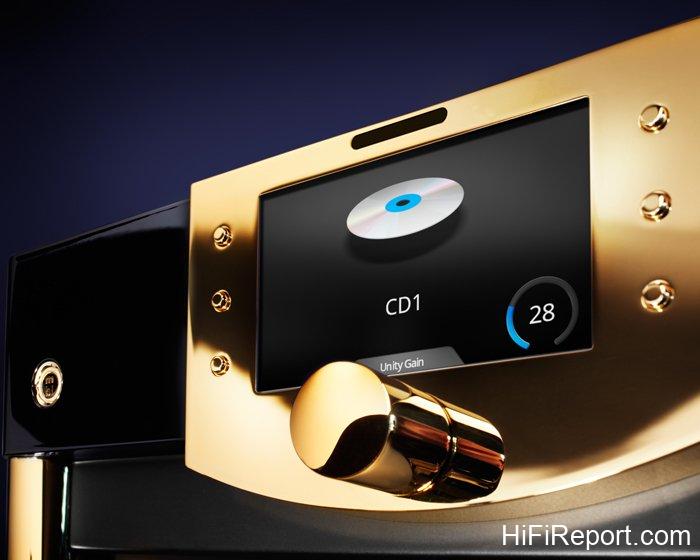
Crucially, MBL has not eliminated conventional gain amplification entirely. They set the standard gain of the N11 preamplifier at 8dB, while Unity Gain operates at a mere 1.4dB. Users can seamlessly switch between these modes, effectively enabling or disabling Unity Gain. The white paper emphasizes that the Unity Gain and Regular Gain circuits are entirely independent. Furthermore, the sophisticated stepped motor on the volume potentiometer ensures imperceptible volume changes when switching gain modes.
When should you use the regular gain mode? MBL suggests that the 8dB gain mode is beneficial in situations requiring higher volume levels, such as parties.
The Unity Gain circuit is undeniably the core innovation of the MBL N11 preamplifier. Without it, the N11 might simply be considered a high-quality MBL product. But with Unity Gain, you gain a tangible advantage: wider dynamics, lower distortion, richer detail, and more complete musical information.
Versatile Inputs and Outputs
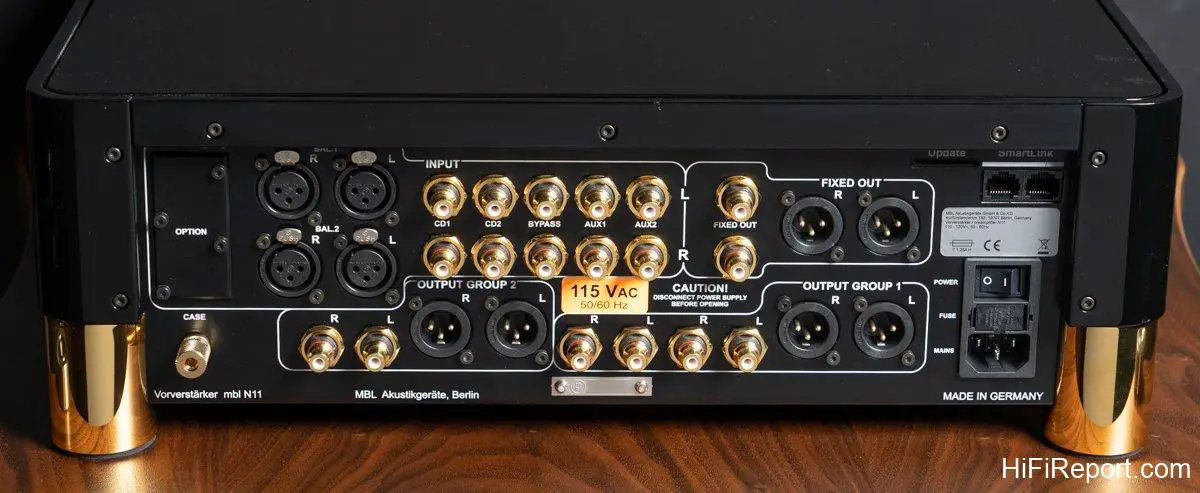
The N11 offers an extensive array of inputs and outputs, catering to diverse system configurations. It features two XLR balanced inputs and five RCA single-ended inputs, with one RCA input designated for bypass, accommodating surround sound processors.
Output options are equally generous, divided into two groups. Group 1 includes one XLR and two RCA outputs, while Group 2 provides one XLR and one RCA output. Additionally, dedicated fixed-level XLR and RCA outputs are available. A further expansion slot allows for the installation of an optional balanced input phono stage module. This comprehensive input and output configuration ensures the N11 can seamlessly integrate into virtually any audio system.
The rear panel also incorporates an RJ45 SmartLink V2.0 connector, enabling synchronized power on/off with other MBL components in a complete system. An SD card slot is provided for future firmware updates.
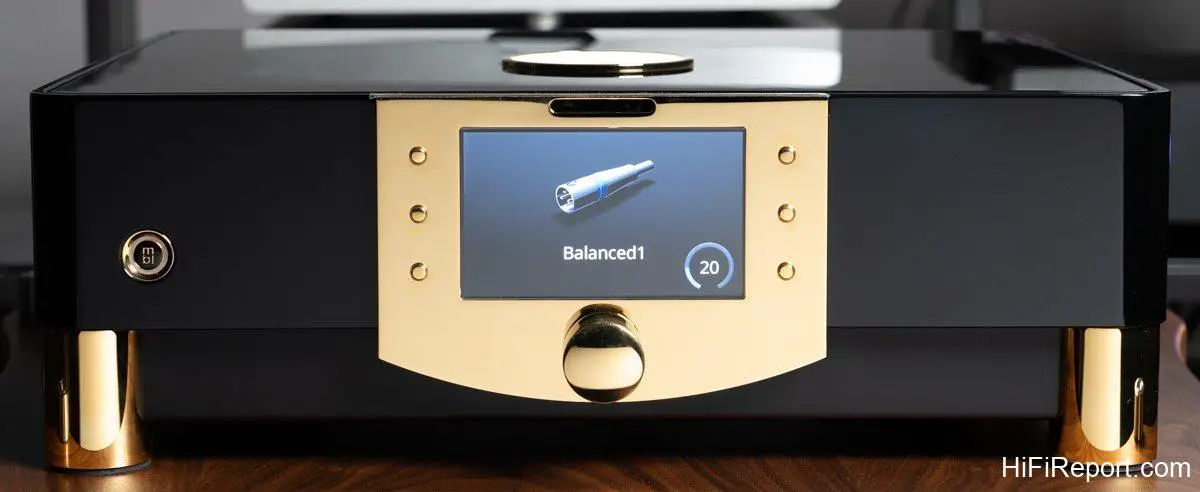
The N11’s chassis design upholds MBL’s signature luxurious aesthetic. Available in black or white with a mirror finish, both options are accented by gold trim panels and footers machined from solid brass, offering distinct visual styles. Compared to its Noble Line predecessors, the New Noble Line exhibits a more youthful and vibrant design language.
TFT Screen and Gesture Control
The front panel is dominated by a 5-inch TFT color display flanked by six small circular buttons on each side. Button functions are clearly displayed on the screen, ensuring intuitive operation. Below the screen sits a smooth, stepless volume knob.
A particularly intriguing feature is the gesture control system. Above the N11’s screen is a horizontal sensor strip. As you approach the unit with your hand, intending to interact, the screen automatically switches to the main menu, anticipating your touch and facilitating operation.
While gesture control might be considered a non-essential feature in a high-end preamplifier, it undeniably adds a touch of user-friendly sophistication and playful interaction. The prolonged development of the N11 was partly attributed to the complexities of perfecting this TFT screen and gesture control interface.
Refined and Detailed Sound
So, how does the N11 perform sonically? In short, exceptionally well. Whether paired with its companion N21 power amplifier or with power amplifiers from other manufacturers, the N11 consistently delivers a refined and detailed sonic character, boasting remarkable resolution.
The listening evaluations were conducted in the HiFiReport listening room. The source components consisted of a YBA CDT450 CD transport and a Merging NADAC. Speakers were Wilson Audio Alexia 2s. Power amplification primarily involved the MBL N21, with an EAR Yoshino 509 MK2 used as a reference. For preamplifier comparisons, the EAR Yoshino 868 and Electrocompaniet EC 4.8 were utilized.
Let’s address the most intriguing aspect: the effectiveness of Unity Gain. You’re curious, and so was I. After extensive listening, I can confidently state that Unity Gain is the N11’s standout feature. While the N11 possesses numerous strengths, Unity Gain stands apart as a truly unique and valuable technology. Subjectively, I would even argue that Unity Gain alone is a compelling reason to choose the N11. In a market saturated with preamplifiers, the N11 offers something genuinely distinct and beneficial that others lack.
Unity Gain Effectiveness
Switching between Unity Gain and regular gain is straightforward, requiring just a press of the top right button for A/B comparisons. The difference, while not dramatically seismic, is definitely discernible. It’s akin to distinguishing between Scotch whiskies from Speyside versus Islay – easily noticeable – versus discerning whether a whisky has undergone worm tub condensation, a more subtle but perceptible characteristic. The latter, contributing a slight sulfurous note and a fuller body, can be appreciated upon closer inspection.
Unity Gain operates similarly. Careful listening reveals subtle but significant improvements. You’ll notice a tightening of the sound. With Unity Gain disabled, the sound is comparatively looser and more diffuse. Engaging Unity Gain brings a heightened sense of focus and three-dimensionality, smoothing out sonic edges and eliminating a sense of superficial roughness.
Listening to Liza Ferschtman and Inon Barnatan’s Beethoven Violin Sonata No. 10 (HiFiReport), activating Unity Gain deepened the soundstage and enhanced the three-dimensionality and roundness of the instrumental timbres. Challenge Classics recordings are known for their fullness and high signal levels, making them “listener-friendly” and easily engaging. Yet, Unity Gain further enriched the already luscious violin and rounded piano tones, making them even more captivating. Upon closer listening, the violin’s subtle harshness diminished, revealing more nuanced expressions, and improving overall image focus.
Initially, I considered using the word “refined” to describe the effect, but “polished” seems more apt. It’s akin to applying makeup – powder or concealer – to mask imperfections. However, MBL attributes Unity Gain’s benefits to reduced distortion and noise, resulting in expanded dynamic range. In this context, the perceived “looseness,” “diffusion,” or lack of sonic smoothness, and flatter soundstage when Unity Gain is off, can be understood as distortions and noise imposing limitations. Unity Gain eliminates these hindrances, allowing the music to truly open up.
Effortless Dynamics, Rich Details, Orchestral Bliss
While the improvements are noticeable with a simple violin and piano duo, the transformative effect of Unity Gain is even more profound with large-scale orchestral works, offering a truly revelatory listening experience.
Take, for instance, Louis Fremaux’s Birmingham City Symphony Orchestra performance of Saint-Saëns’ “Danse Macabre.” The piece opens with a harp and double bass establishing an unsettling atmosphere. Death then enters, with the violin summoning the “dance of death” theme. Listening to the violin’s “Death’s Intreaty” theme, the chromatic passages create an eerie mood. The two themes then intertwine, developing and building towards a rich orchestral climax. The N11 meticulously delineates these interwoven musical lines, allowing effortless and immersive engagement with Saint-Saëns’ imaginative world.
Similarly, with the same ensemble performing Saint-Saëns’ Symphony No. 3, the N11’s expansive soundstage, abundant detail, and clear resolution, combined with its masterful control and vibrant timbral palette, rendered the symphony absolutely captivating. The first movement’s initial section, essentially a standalone movement in sonata form, features the first theme repeated multiple times, alternating between strings and woodwinds, culminating in a climax before transitioning to a gentler mood and the second theme.
Saint-Saëns’ masterful orchestration demands exceptional performance. Fremaux and the CBSO’s rendition is a recognized classic. And with high-fidelity playback, the emotional impact is amplified. Paired with the N21 power amplifier, the N11 system showcased immense power during crescendos and revealed the exquisite nuances of Fremaux’s interpretation during quieter passages. Pay attention to dynamics and detail. This N11 and N21 pairing excels in these aspects. They deliver effortless and expansive dynamics while meticulously sculpting and organizing rich musical information into a detailed and vibrant sonic picture, full of nuance and expression. The vividness of the woodwind solos is particularly striking.
The latter half of the first movement shifts to a poco adagio tempo. The deep, resonant organ chords emerge like a rising tide or encroaching mist. The N11 skillfully separates the smooth, silky high-frequency strings from the low, sustained organ notes, clearly delineating the sonic layers.
The second movement’s scherzo section tests the orchestra’s ensemble precision and the conductor’s skill. Fremaux leads the CBSO forward with unwavering momentum, maintaining clarity amidst complexity. This highlights the N11’s strengths: its high transparency, distinct layering, and superb control, allowing the intricate interplay of instruments and the relentless musical drive to be clearly perceived. The fugue in the latter part of the movement evokes a sense of sacredness. Following the fugue, the music gradually subsides, with the peaceful, soothing violin ensemble showcasing the delicate, silken texture of the strings.
The N11’s musicality is truly exceptional. Is this the sound Jurgen painstakingly refined over years? If so, the wait was undoubtedly worthwhile! The second movement’s latter half, a prelude, commences with the organ’s majestic and powerful chords, followed by the strings in a fugal structure, adding to the grandeur. The double pianos’ arpeggiated chords further embellish the music’s magnificence. Saint-Saëns, himself an organist, possessed first-rate fugue composition skills. The three-part string fugue in this section is truly transcendent, lifting the listener towards heavenly realms. The subsequent brass fugue resembles a chorale, as if opening the gates of paradise. Finally, the movement concludes triumphantly with a resounding orchestral and organ interplay.
The N11 not only provides clear resolution, revealing the complex structure and organization of the music, but also recreates the grandeur and scale of orchestral music with substantial weight and texture. To truly appreciate the beauty and brilliance of Saint-Saëns’ symphony and the excellence of Fremaux and the CBSO’s rendition, you need a system capable of revealing it. While I can’t vouch for other systems, the MBL N11 and N21 combination playing this piece is simply – bravo!
Clarity in Complex Music
Continuing with large-scale orchestral works, I turned to French composer Alberic Magnard’s “Hymne à la Justice.” Magnard composed this piece to celebrate the triumph of justice after the Dreyfus affair. The music is filled with intense conflict and turmoil, yet also imbued with beautiful, romantic melodies, reflecting the clash between justice and human nature – a battle in progress.
The piece begins with an explosive orchestral fortissimo, a sonic detonation. The strings play heavy, forceful passages, creating tension and unease through chromaticism. The N11 maintains unwavering control throughout, exuding a confident stability (undoubtedly aided by the N21 power amplifier).
Then, the music transitions to a gentle, serene theme, representing a yearning for freedom, happiness, and the brilliance of humanity. The clarinet’s mellow and tender voice, accompanied by the violin’s soft tremolo and occasional woodwind harmonies, fills the music with a sense of blissful serenity.
Whether depicting the wild “Justice” theme or the peaceful and beautiful latter theme, the N11 articulates the Dreyfus story with nuanced richness. It renders the intricate musical textures with remarkable clarity and transparency, painting a vivid and detailed sonic picture.
Piano Performance
I particularly appreciate the N11’s ability to reproduce piano with exceptional realism. This is achieved through a combination of rich information retrieval, abundant detail, wide dynamic range, transient speed, natural timbre, and full-bodied texture.
Listening to Denis Pascal’s performance of Liszt’s Hungarian Rhapsody No. 2, the opening introduction, with its slow tempo and seemingly steady rhythm, showcases freedom through ornamentation. The strong, resolute piano notes convey conviction. After a brief, calming introductory phrase, the first section of the rhapsody begins. The music maintains a slow tempo, carrying a sense of subdued emotion beneath its solemnity – a feeling of sorrow, resentment, and desolation.
Here, the N11 reveals high levels of contrast in dynamics and register. The chords in the lower register resonate deeply, while the main melody develops in the mid-to-high range. Listening to the leaping ornamentation, the N11’s rendition of Hungarian Rhapsody No. 2 is remarkably vibrant, bringing the piano to life.
The first section, “Lassan,” is slow and emphasizes stability and harmonic color. The second section, “Friska,” is fast and provides more opportunities for virtuosic display. In the “Friska,” the MBL N11 and N21 combination reveals truly stunning piano timbre. Words like “crystal clear” and “radiant” barely suffice to describe the brilliance and splendor emanating from the piano notes. The N11’s exceptional information retrieval ensures every nuance of the piano sound is clearly resolved. The intricate mechanics of the piano, from the pianist’s touch to the complex action of the instrument, are vividly conveyed by the N11.
The less frequently discussed Hungarian Rhapsody No. 3 is a personal favorite for evaluating piano reproduction. Playing both No. 2 and No. 3 from this album back-to-back reveals a system’s piano performance capabilities comprehensively. Rhapsody No. 3 features thunderous low-frequency chords, even more profound and untamed than No. 2, juxtaposed with delicate, crystalline high-frequency descending passages, offering a captivating blend of contrasting qualities.
The N11, with its precise and refined articulation, delivers high-fidelity texture and captivating, alluring color across the entire frequency spectrum, from the lowest to the highest notes. MBL’s New Noble Line is truly impressive. Both the N21 power amplifier and N11 preamplifier, whether used as reference components for critical listening or for immersive music enjoyment, perform admirably.
High-End Sound Quality
Switching to jazz, the N11 not only captures the nuances of small ensemble recordings but also renders vocals with a vibrant and three-dimensional presence.
Take, for example, Sarah Vaughan’s 1985 live concert recording in Paris. The opening track, “Hi-Fly,” serves as a warm-up piece by Vaughan’s accompanying trio. As I’ve repeatedly emphasized, the N11’s sound is exceptionally refined. It not only reveals subtle details but also presents them with delicacy, elegance, and meticulous precision – a hallmark of “high-end sound.” True high-end sound transcends mere sonic density, tightness, and transparency.
The distinction between high-end and hi-fi audio lies not solely in price or chassis aesthetics, but fundamentally in the elevated level of sonic performance. The N11 unequivocally resides within the high-end realm. Its inherent refinement is readily apparent in this simple trio performance. The piano, drums, and bass each possess a delicate and intricate beauty.
Sarah Vaughan takes the stage after the trio’s brief instrumental interlude and launches into an a cappella rendition of “Summertime.” With no accompaniment, the focus is entirely on Vaughan’s voice. The N11 presents a sharply focused, clearly defined, and vividly three-dimensional vocal image. The dynamic swells, building from soft to loud, and her exceptional vocal techniques – nasal resonance, throat articulation, and masterful manipulation of vocal cavity resonance – are all revealed with breathtaking clarity.
Exceptional vocal performance requires equally exceptional system reproduction to truly shine. The N11 possesses this capability. It meticulously resolves these nuances and textures, making this short song not only captivating but utterly mesmerizing. Following the upbeat “Just Friends,” “Wave” is even more remarkable. Vaughan showcases her versatile vocal artistry, effortlessly and masterfully navigating her vocal range.
The N11’s ability to sculpt sonic images is truly exceptional – sharp, three-dimensional, clear, and smooth. Its ability to recreate a live performance is so compelling that you can almost visualize the spotlight illuminating her on stage. This is, of course, a figurative exaggeration, but it conveys the sense of delight I experienced listening to “Wave” and Sarah Vaughan through the N11.
Direct to the Music’s Core
Compared to the Reference series, the New Noble Line sounds younger, more vibrant, brighter, and more transparent. The Reference series might offer a more relaxed and expansive soundstage, but the New Noble Line provides almost microscopic resolution and refined sonic architecture.
The N11’s Unity Gain is a relatively novel concept, but its effectiveness is undeniable. The sonic improvements brought by engaging Unity Gain are clearly audible. If you are willing to sit down for critical listening, the MBL N11 preamplifier will help you bypass sonic detours and connect directly with the heart of the music.
Specifications
* **Model:** MBL New Noble Line N11 Preamplifier
* **Type:** Preamplifier
* **Inputs:** RCA x 5 (By Pass x1), XLR x 2
* **Outputs:** Variable Output: Group 1/ RCA x2, XLR x1; Group 2/ RCA x1, XLR x1; Fixed Output: RCA x1, XLR x1
* **Dimensions (W x D x H):** 450 x 450 x 150 mm