
McIntosh RS250 Review
I was quite fond of the RS200, but it has now been superseded by the RS250, the subject of this review. To be honest, my initial feeling was one of skepticism. The driver configuration, cabinet dimensions, weight, and built-in amplification are all the same. The RS200 featured the D’Arsonval galvanometers (pointer meters) that I really liked.
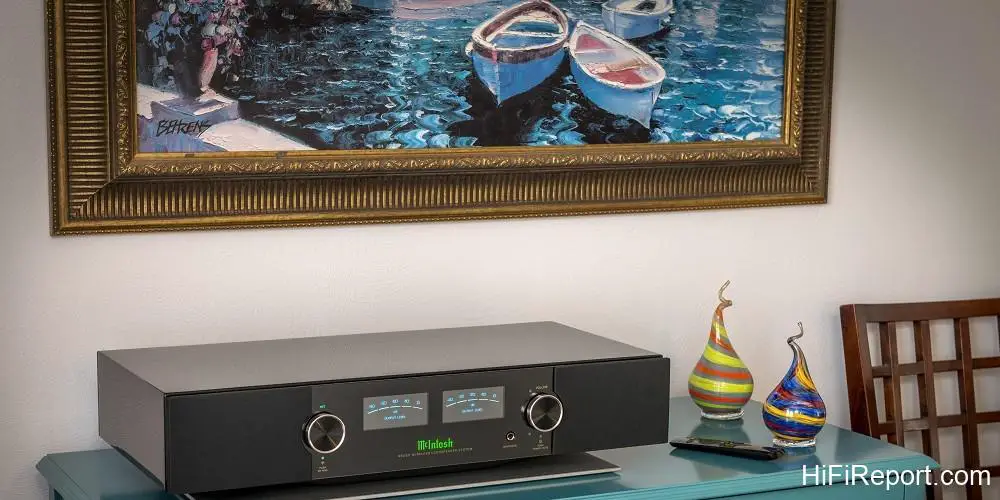
The new RS250 replaces them with a new fast-reacting LED digital display that mimics the meter look, with five arc-shaped light segments replacing the original needles. Was this really an improvement? However, after actually spending time with the RS250, I’ve completely overturned my initial prejudice. This revision is indeed a significant evolution.
Beyond a Soundbar: Unique Driver Arrangement
From the RS200 to the RS250, McIntosh consistently refers to them as “Wireless Speaker Systems” rather than Soundbars (although their proportions in terms of length, width, and height are quite similar). In fact, their speaker driver arrangement is very different from typical soundbars. Most soundbars place a center channel driver directly in the middle of the front face, and the drivers for each channel in the soundbar body usually employ a two-way design or even just full-range drivers.
The McIntosh RS250 is completely different. To put it simply, it’s like condensing two three-way active stereo speakers into a single cabinet.
Detailed Look at the Speaker Drivers
The compact RS250 cabinet houses a total of 8 speaker drivers (four for each stereo channel). The mid-range and high-frequency drivers are mounted on the front. Clearly, McIntosh considered tonal consistency, as both of these frequency bands utilize titanium diaphragm drivers. The color of the titanium diaphragms isn’t their original shade; they are black. I suspect they have undergone a micro-arc oxidation treatment to form a titanium oxide film on the surface.
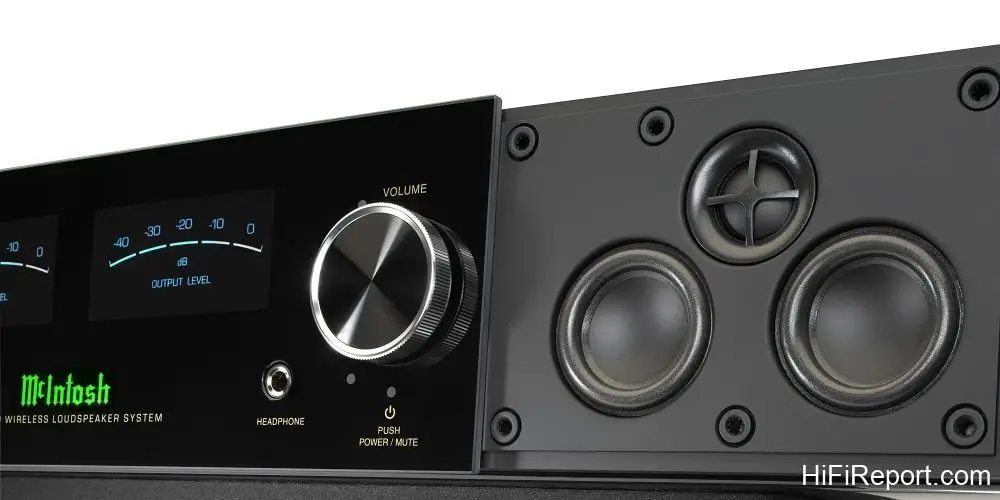
Besides looking good, this treatment prevents deterioration and discoloration and also helps suppress resonance by combining titanium and titanium oxide in the cone, thus reducing coloration.
Each channel of the RS250 is equipped with one 20mm tweeter and two 5cm mid-range drivers positioned symmetrically on either side of the tweeter. The most awkward frequency range for most two-way designs is typically between 2kHz and 3kHz. Most tweeters aren’t adept at handling frequencies this low, and mid-woofers aren’t good at frequencies this high.
Consequently, there’s often significant distortion near the two-way crossover point, and this happens to be a frequency band our ears are particularly sensitive to. The aforementioned awkward frequency band is precisely the working range that a mid-range driver in a three-way speaker excels at. The RS250’s mid-range drivers handle frequencies from 275Hz to 4kHz effortlessly, leaving everything below 275Hz to the bass drivers.
The RS250 features two 4×6-inch stadium-shaped long-throw bass drivers mounted on the bottom of the cabinet, firing downwards towards the base. This arrangement utilizes downward reflection and diffusion to enhance low-frequency energy. The first improvement in the RS250 compared to the RS200 lies in the cabinet structure for the bass section. The manufacturer states that the new design provides better control over the bass drivers, resulting in lower distortion.

The RS250 boasts a frequency response of 40Hz to 20kHz, which is equivalent to the low-end extension of medium-sized floorstanding speakers. Traditionally, a cabinet this small shouldn’t be able to extend to such low frequencies.
However, designers of some modern streaming speakers understand the trick: as long as the bass drivers can handle significant power, and proper use is made of bottom or rear wall reflection for low-frequency gain, combined with DSP for low-end compensation and equalization, these conditions can produce compact speakers that sound like floorstanders.
The RS250 is designed precisely this way, with 200 watts of amplification driving the mid-range and high-frequency drivers for each channel, while the two bass drivers are driven by 250 watts of amplification.
Bass Performance and Control
The second improvement in the RS250 compared to the RS200 also relates to the bass. The previous RS200 offered three EQ settings (Free, Table, and Wall) for adjusting bass output based on placement. The RS250 refines the bass level adjustment further. By pressing and rotating the right-hand knob and observing the arc-shaped light segments on the “meters,” you can adjust the bass level.
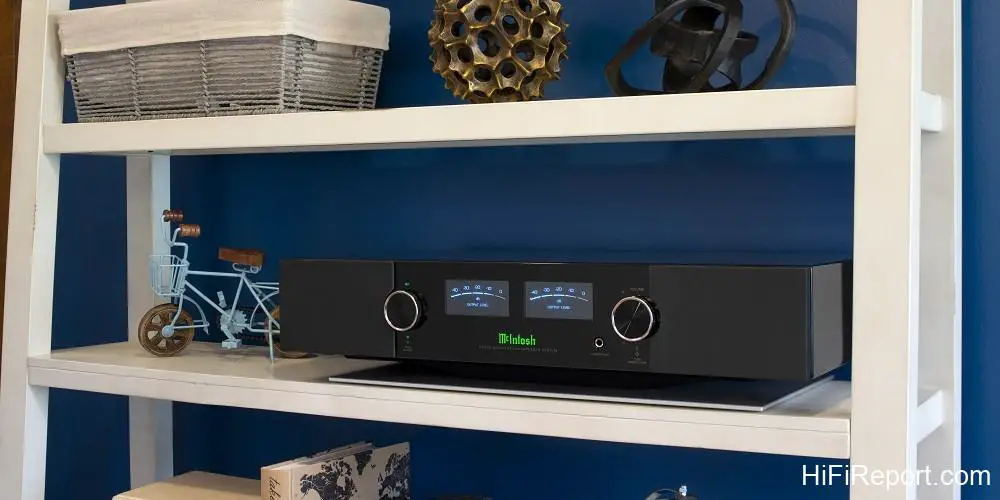
I counted them briefly, and there are a total of 13 steps from minimum to maximum bass, allowing users to dial in their preferred bass balance.
If you desire even deeper sub-bass frequencies (especially when watching streaming movies via a smart TV), the RS250 also includes a subwoofer output terminal, allowing you to connect an active subwoofer. When the RS250 detects that a subwoofer is connected to this terminal, it automatically applies a high-pass filter to the main body’s output, rolling off frequencies below 100Hz.
The subwoofer output signal, on the other hand, covers the range from 20Hz to 500Hz, so the manufacturer’s manual recommends setting the crossover point on the external active subwoofer to 100Hz.
Wireless and Wired Connectivity
The RS250 has built-in Wi-Fi and Bluetooth. Previously, the RS200 lacked an Ethernet port and could only connect wirelessly. The RS250, however, features an RJ45 network port, allowing for wired network connection – this is its third improvement. The RS250’s Bluetooth version is 5.0 and supports aptX, aptX HD, aptX Low Latency, A2DP, and AVRCP. In terms of streaming capabilities, the unit supports Apple AirPlay 2, Google Chromecast, Spotify Connect, Tidal Connect, and Roon.
It is also one of the very few streaming speakers currently supporting Tidal Connect.
The RS250 supports UPnP, so it can be controlled using third-party apps like mConnect or Bubble UPnP. This allows it to access and play music files shared from computers or NAS drives on your home network or streamed directly from mobile devices. Compatible music file types include MP3, AAC, FLAC, ALAC, WMA, Ogg Vorbis, WAV, M4A, and AIFF, with support for lossless music files up to 192kHz/24bit.
Input Terminals: A Notable Change
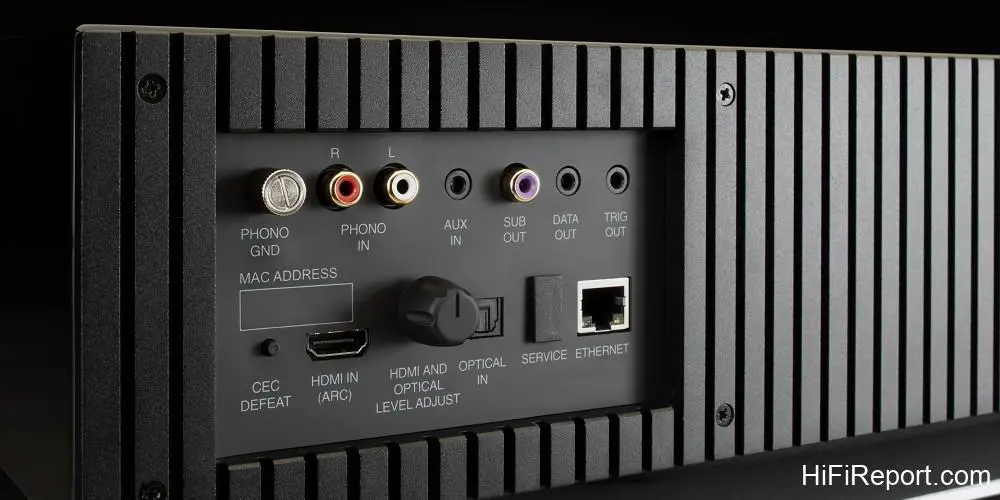
Another change in the RS250 compared to the RS200 is in the input terminals. The RS200 originally had a USB Audio input, allowing it to be used as an “active speaker with a built-in USB DAC” when connected to a computer. However, the RS250 removes the USB Audio input and replaces it with a “PHONO IN” terminal for connecting MM cartridge turntables. Regarding this change, I personally consider it an “improvement.” Given the RS250’s price point, it is fundamentally a “High-End All-in-One Speaker.”
It looks beautiful and elegant in a living room, and a typical person wouldn’t use it as a USB computer speaker connected to a desktop computer in a room, right? The RS250 can play streaming music on its own without needing a computer’s help. The inclusion of an HDMI ARC terminal and the ability to connect a subwoofer further solidifies its primary target as being in the living room. Listening to vinyl records in the living room is quite natural, isn’t it?
Therefore, I believe removing USB Audio and adding Phono In is an improvement.
Listening Impressions and Sound Characteristics
In terms of sound performance, I believe the RS250 has three particularly notable characteristics. Firstly, the sound is warm and pleasant. I think this is certainly related to McIntosh’s brand sound signature. The company is most beloved by seasoned audiophiles for its vacuum tube amplifiers.
Even when they produce solid-state amplifiers or streaming speakers like the RS250, they retain that warm tonality, with a soft, smooth, and remarkably textured mid-range that bears some resemblance to tube amps. Even when deliberately turned up to a high volume, even pushing the power meters on the RS250’s front panel to “full scale,” it still feels like it has plenty of headroom, maintaining excellent three-frequency balance without any tendency towards harsh highs.
The second characteristic, which I also mentioned in my RS200 review, is the “unexpectedly wide soundstage.” During my listening tests, I was positioned about 2.5 meters away from the RS250. The RS250’s physical width is only about 63 centimeters, but the actual listening experience felt like I was hearing a pair of speakers spaced two meters apart. Interestingly, the soundstage seemed even wider when listening from a slightly greater distance.
This characteristic doesn’t just benefit music; it also applies to movie sound effects, especially when playing Spatial Audio content presented in two channels via Netflix. The RS250 provided a remarkably good sense of envelopment from the sides, even extending towards the side-rear.
The third characteristic is bass depth and convincingness. McIntosh has a fine tradition of “maintaining ample headroom,” which contributes to the longevity and reliability of their products. The RS250 is no exception. Even when turned up to maximum volume, with the meters hitting the top, it’s not easy to induce distortion.
While this is a positive point, I must also be honest: because of this characteristic, it cannot produce the same sheer volume as mercilessly driving floorstanding speakers with a powerful amplifier. However, if you’re concerned about bothering the neighbors, this isn’t really a drawback.
When listening to music at normal volume levels, it sounds like a medium-sized floorstanding speaker, including the thickness and low-end extension of the bass. With the two improvements in cabinet design and bass level adjustment, the RS250’s bass doesn’t sound quite as heavy as the RS200. Its bass sounds more articulate and can be adjusted to a more neutral level, feeling a bit more solid.
As for whether you need to pair it with a subwoofer, I don’t think it’s necessary for a typical urban living room space. I recommend getting the RS250 first, listening to it *in situ*, and then deciding.
Conclusion and Recommendation
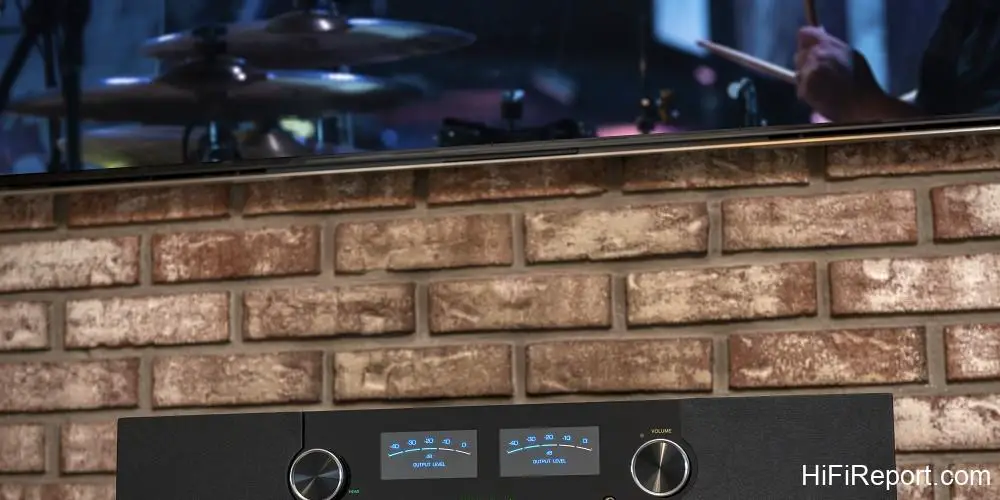
In urban areas with high housing prices, the average living space per person is shrinking, which is a very realistic concern for consumers considering buying audio equipment, and it’s why many people buy soundbars. The McIntosh RS250, a top-tier three-way streaming speaker with built-in HDMI ARC, occupies similar space and is used in much the same way as a soundbar.
Not only can it function as a soundbar, but it also allows users to enjoy the sound quality expected from a “proper two-channel audio system.” Given its sound performance, rich features, and practical functions, I have decided to give it my highest recommendation, especially for music lovers residing in urban homes.
Specifications
* Type: Wireless Digital Speaker System
* Speaker Type: 2-channel, 3-way Bass Reflex
* Built-in Amplification: 650 watts (Bass 250 watts, Mid-range and High-frequency combined 400 watts)
* Tweeters: 20mm Titanium Dome ×2
* Mid-range: 50mm Titanium Cone ×4
* Bass Drivers: 4×6 inch Cone ×2
* Frequency Response: 40Hz – 20kHz
* Crossover Points: 275 Hz, 4 kHz
* Wireless Inputs: Bluetooth (5.0), Wi-Fi (2.4 GHz / 5 GHz)
* Wired Inputs: HDMI ARC ×1, Toslink Optical ×1, 3.5mm Stereo Analog (AUX) ×1, RJ45 Network Port ×1, Phono ×1
* Outputs: Subwoofer Signal Output (RCA) ×1, 6.3mm Headphone Jack ×1
* Dimensions: 62.99 × 14.48 × 32 cm (WHD)
* Weight: 13.3 kg