
M&K V12+ Review
When I reviewed the MX-250 back in 2009, I noted that the primary reason so many discerning enthusiasts became loyal M&K users was their signature “Fast, Fierce, and Accurate” performance. More specifically, this translates to outstanding transient response, high dynamics, powerful energy output, and exceptionally low distortion. My experience reviewing M&K products dates back to the 1990s. M&K’s origins in the 1970s were rooted in the needs of professional recording studios.
Founder Ken Kreisel was commissioned by studios to create monitor speakers and, famously, the world’s first active subwoofer. His unwavering focus has always been on faithful reproduction, prioritizing transient accuracy above all else.
Last year (2022), M&K unveiled their latest flagship “X+” series alongside the mid-range “V+” series. Initially, I felt a slight pang of disappointment. I’ve always been a huge fan of the original V8, the smallest (8-inch driver) and fastest model in the old V series. To my surprise, the V+ series evolution didn’t include a V8+, but instead added a 15-inch driver subwoofer, the V15+, something M&K historically avoided (believing larger drivers inherently slowed things down).
However, under the leadership of CEO Per Becher over the past decade, M&K has invested heavily in custom drivers and power amplifier design, significantly widening the performance gap from earlier generations. When I reviewed the V10+, I found that this 10-inch subwoofer possessed the speed of the old V8, while delivering power beyond the original V10.
Design and Build
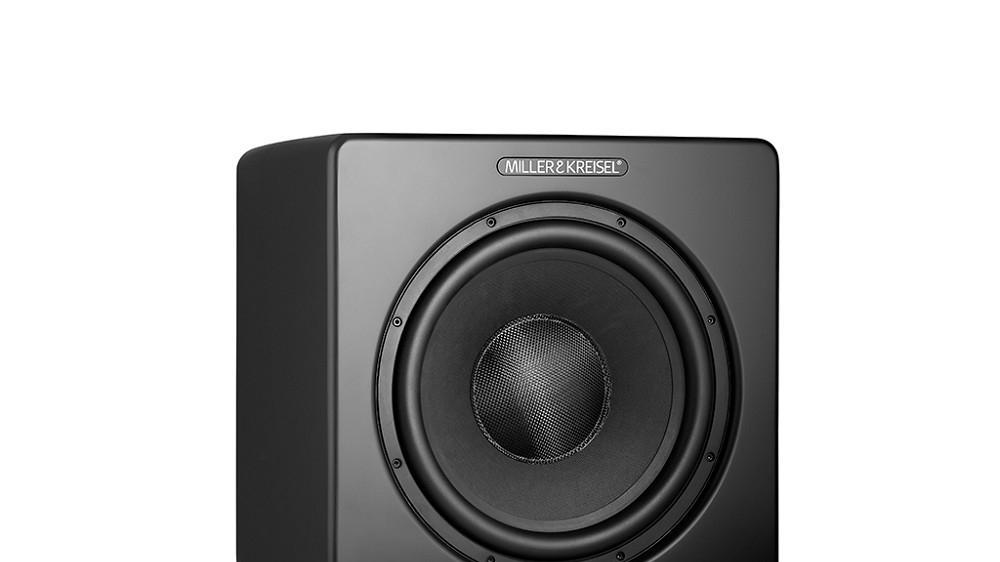
The star of this review, the V12+, is absolutely not a minor update compared to the V12; it’s a completely new design and build. The V12+ is actually smaller than the original V12. The V12 measured 466×360×400 mm, while the V12+ is a compact 395×395×395 mm.
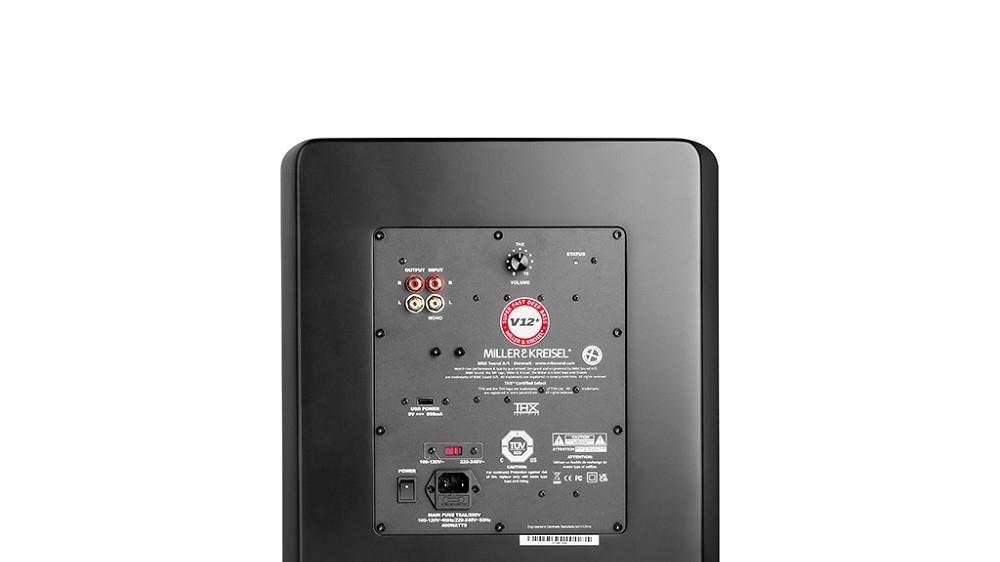
While close to a perfect cube, the V12+ is subtly shaped with a wider front baffle and a narrower rear panel, featuring gently curved side panels. The new V+ series cabinet shape isn’t just for aesthetics, giving it softer lines; intentionally making the side panels non-parallel and reducing parallel surfaces between the front and rear baff helps minimize internal standing waves and cabinet resonance, thus lowering coloration.
Experienced users know that M&K subwoofers exclusively use sealed (acoustic suspension) cabinet designs. This design utilizes the difference and balance in air pressure inside and outside the cabinet as an “air spring.” After the driver cone moves forward and backward, it’s not only returned to a still state by its own spider but also by the air pressure, allowing the cone to stop moving faster.
Avoiding unnecessary vibration enables the subwoofer to more accurately respond to subsequent dynamic shifts in low frequencies. Enhanced control is key to a subwoofer’s ability to exhibit faster speed.
Compared to ported designs, sealed cabinets also have the advantage of being easier to compensate for low-end roll-off. Although sealed cabinets begin their roll-off at a slightly higher frequency than ported designs, the roll-off slope is gentler. Savvy users can leverage room boundary gain with proper placement to effectively lift the low-end extension.
In terms of electronics, recent M&K V+ series models incorporate electronic compensation in the amplifier circuit. When testing the V12+’s frequency response, I observed that at lower output levels, the amplifier circuit compensated the response, with significant roll-off only becoming apparent around 20Hz. At medium to high output levels, the roll-off didn’t start until around 24Hz. Achieving such deep low-end extension from such a small cabinet is truly impressive.
DSP and Connectivity
M&K is deeply rooted in tradition and places great importance on users in the film and music production professional fields. This is why, historically, M&K aimed to make their subwoofers as high-performing yet simple as possible. Over ten years ago, Ken Kreisel told me he had considered using servo amplification or built-in DSP (Digital Signal Processing) but ultimately decided against it due to the potential for time delay.
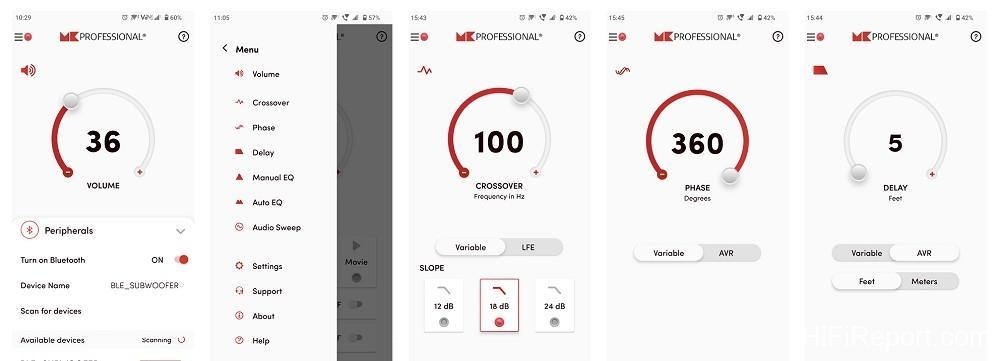
However, with the V12+ and V15+, M&K has made a new foray: these are the first M&K active subwoofers ever to be equipped with DSP. By installing the “M&K Professional” app on your smartphone from the Apple App Store or Google Play Store, you can control the V12+ and V15+ via BLE (Bluetooth Low Energy).
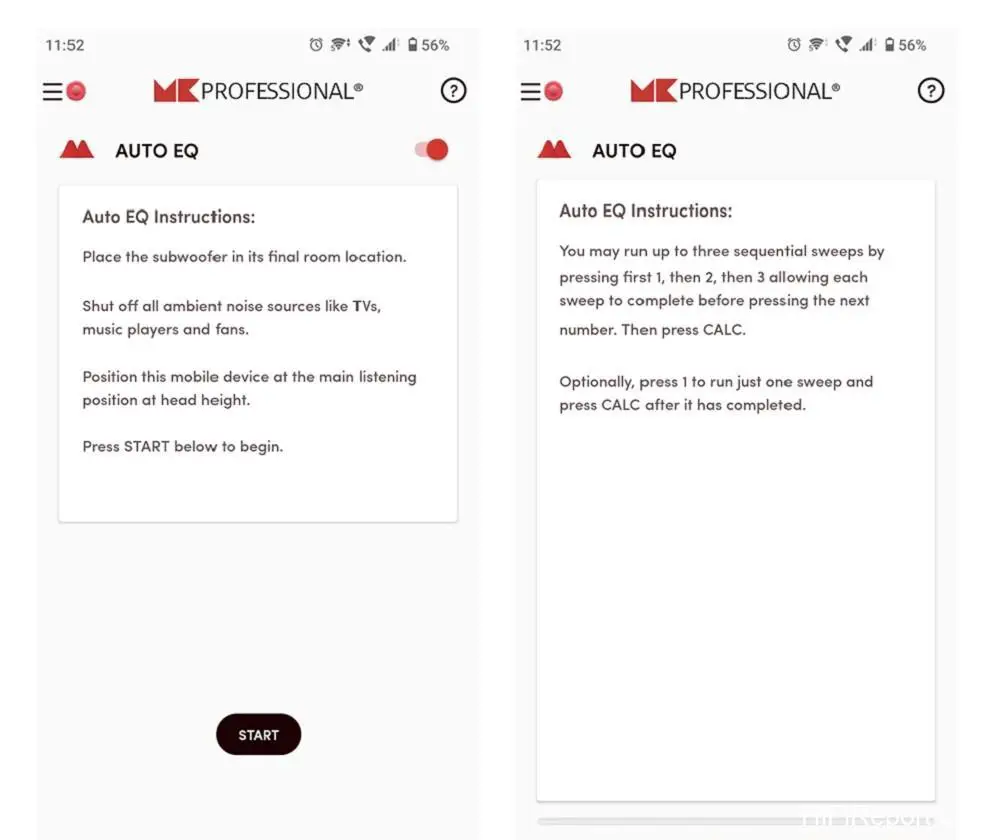
Control options include standard subwoofer adjustments like Volume, Crossover Frequency, and Phase, but also Auto EQ, Manual EQ, and Delay. Auto EQ allows you to calibrate the V12+’s low-frequency response using just your phone’s built-in microphone. Manual EQ provides four PEQ (Parametric Equalizer) Filters, allowing users to customize the center frequency, Q value, and gain (adjustable from -12dB to +3dB).
The V12+ also allows users to set a Delay time. This isn’t necessary in a multi-channel system where you’d set it to “AVR,” letting the surround receiver handle all timing. If using the V12+ in a two-channel system, most integrated amplifiers (with the exception of a few capable of room correction) and “active speakers with subwoofer outputs” cannot set delay. The V12+’s delay setting range starts from 5 feet (152 cm).
For example, setting a 5-foot delay is suitable if the V12+ is 5 feet closer to the listening position than the left/right main speakers. Setting the delay in this scenario ensures that the sound from the closer V12+ arrives at the listener’s ears simultaneously with the sound from the more distant left/right speakers.
So, if M&K avoided DSP before, doesn’t implementing digital audio processing in the V12+ introduce time delay? Of course, computation requires time. However, with today’s powerful processing chips, and since M&K hasn’t implemented servo control but is purely processing subwoofer signals, the computation time is extremely short (undetectable by ear).
Furthermore, even if there were a delay of 1ms, 2ms, or more, for subwoofers primarily targeting the home market, especially when used with a surround receiver, the initial system setup and room calibration (which measures speaker distances) compensate for the delay introduced by the digital audio processing. Every 1ms of delay corresponds to approximately 34 cm of distance, so the auto-calibration effectively compensates for any processing latency.
Regarding the amplifier circuit, M&K hasn’t explicitly stated whether the V12+ uses a pure digital or PWM amplifier. I believe the former is likely. Regardless, it’s certainly highly efficient (low heat) with low distortion even close to maximum output. Comparing output power, the previous V12’s built-in amplifier had a rated power (RMS) of 300 watts and peak power of 500 watts.
The V12+ amplifier is boosted to 400 watts RMS (with total harmonic distortion below 0.5% at 400 watts output) and a significantly increased peak power of 800 watts. Its output power already surpasses the amplifier in M&K’s own X10 (rated 350 watts, peak 650 watts).
Performance and Tuning
Before every equipment review, I devise a strategy and make on-the-fly adjustments to ensure the tested equipment’s performance is fully realized. For testing the V12+, my primary goal was to maximize energy and dynamics. I deliberately placed the V12+ in the corner closest to the listening position (behind and to the side of the seat), positioning its driver face-to-face with the corner boundary.
This wasn’t just to fully exploit boundary gain (each adjacent reflective surface can nearly double the sound energy), but also because by placing the V12+ close to three planes of the room (floor, rear wall, and one side wall), the “direct sound” from the V12+ and the reflections from these three planes in the corner are almost perfectly time-aligned. This significantly increases dynamic impact, making the subwoofer’s inherent “fast start, fast stop” characteristic very evident.
My placement prioritized sound energy over a perfectly flat frequency response, of course, because the V12+ has equalization adjustments! I used REW software to measure room modes, simulated EQ filters, and finally applied the calculated filter parameters (frequency, Q value, gain) using the M&K Professional app to the V12+. A final frequency response measurement confirmed that I had achieved “the state I wanted.”
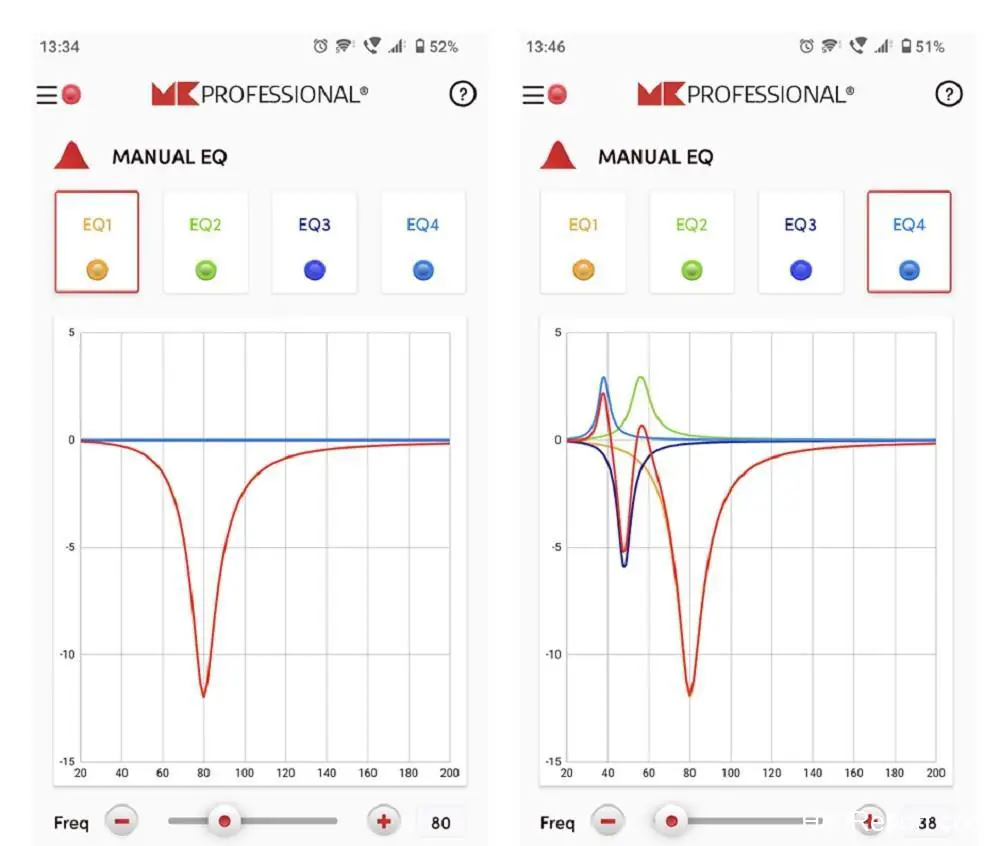
You can see the difference before and after manual and automatic EQ correction in the accompanying images.
The system used for this review primarily consisted of a Denon AVR-A1H surround receiver and Pioneer EX series speakers. I intentionally set the Pioneer S-1EX floorstanders to “Small” and the subwoofer crossover point to 100Hz. Initially, playing music files on the AVR-A1H in “Pure Direct mode,” as soon as the bass from YOASOBI’s “Monster” kicked in, something felt off. Did I set it wrong? Was the Pure Direct mode bypassing my settings and sending full range to the mains?
Turning towards the V12+, I confirmed my settings were correct; the V12+ was indeed handling the frequencies below 100Hz as configured.
It was incredible! Even I was fooled. The V12+ was clearly reproducing the low frequencies below 100Hz, taking over from the S-1EX, and generating sound from the corner behind and to my right. Yet, it sounded entirely as if all the sound was emanating from the S-1EX speakers. The V12+’s “audible low frequencies” extend 5Hz to 10Hz lower than most large floorstanding speakers.
Moreover, no matter how hard I tried, even using REW spectral analysis to aid in positioning the left and right speakers, the frequency response below 100Hz when the S-1EX played full-range still had an audibly noticeable difference in flatness compared to the V12+ after manual EQ calibration.
When the V12+ is properly tuned using standard procedures, it not only eliminates the booming caused by bass nodes but also appropriately compensates for dips in the frequency response. When the bass becomes clean and balanced, reducing low-frequency coloration and overhang, the overall perceived resolution increases. Listening to Samara Joy – *Linger Awhile*, the bass felt incredibly clean, without the slightest blur, fully expressing the music’s vitality.
The V12+’s extremely fast speed and utterly undetectable coloration allow it to blend with neutral, highly transient-capable speakers to a degree of near “invisibility.” Users truly forget the subwoofer is even there, until they hear the deep and ultra-deep frequencies from a pipe organ or electronic bass in pop music, and are astounded: “This subwoofer’s low end is seriously powerful!”
Listening to Lizzo’s “You’re Special,” the bass is full and meaty, with a distinct “elasticity” unlike most others. Blasting Ado’s “Odo,” the deep, incredibly fast, and super impactful bass is absolutely exhilarating! Perfume’s “Fusion” delivers strong, heavy bass punches. The V12+’s performance in high dynamics, transients, and control is absolutely top-tier, making me feel like I was listening to a professional recording studio monitor subwoofer costing three times its price.
Movie Performance
I must also highlight a key point: although the V12+ is physically small, using the right method (like the corner placement technique I mentioned earlier), it’s far more than just a “small” powerhouse. Watching “All Quiet on the Western Front,” when the tank army approaches, you can physically feel the energy of the low and ultra-low frequency shockwaves. The weight and impact of artillery fire and machine guns had the feel of their previous generation X10 model.
Playing “Top Gun: Maverick,” the powerful, clean, and fierce low and ultra-low frequencies made the jet engine sounds even more thrilling. The excellent transient response showcased greater instantaneous power. When playing action and war films, the raw, intense bass creates a stronger sense of tension for the listener.
Conclusion
Last year, I initially focused on the V12+ because M&K finally broke tradition by including built-in DSP for equalization. What I absolutely did not expect was that its performance would reach such a level. The degree of “Fast, Fierce, and Accurate” has broken through its price category and is no less impressive than our reference subwoofer for the past few years, the M&K X10.
If I had to compare, I’d say the X10 has a slight edge in ultra-low frequency extension, but the V12+’s speed is *surprisingly* slightly faster than the X10, which I didn’t anticipate at all. Furthermore, the V12+’s Bluetooth app control and equalization capability make it one of the most technologically advanced active subwoofers available today. In terms of overall performance, I believe the V12+ has no real competitors under approximately $3,000 USD.
The closest competitors in terms of performance are priced significantly higher. Without a doubt, it deserves our highest recommendation.
Specifications
* Type: Active Subwoofer
* Cabinet Structure: Sealed
* Built-in Amplifier Rated Output: 400 Watts (800 Watts Peak)
* Amplifier Total Harmonic Distortion: Below 0.5% (400 Watts, 4 Ohms)
* Driver: 12-inch Long-Excursion Subwoofer Driver × 1
* Frequency Response: 20Hz–200Hz ±3dB
* Low-Pass Filter Crossover Points: 43Hz–300Hz
* Adjustable Delay, Crossover Slope, and Phase
* Input Terminals: RCA × 2
* Output Terminals: RCA × 2
* Dimensions: 395 × 395 × 395 mm (HWD)
* Weight: 21.2 kg