
Modern Sculptures Review
The Vivid Kaya 90 is truly a pair of modern sculptures that fill the room with music!
The new Vivid Kaya series made its debut in August 2019 at the TAA Yuanshan Hotel Audio Exhibition. The Taiwanese distributor was incredibly swift! I had just seen them at the Munich High End show in Germany in May, and less than three months later, they were already in Taiwan. The Kaya series is another eye-catching creation from Vivid, following their celebrated Giya series. Currently, their lineup includes the Oval, Giya, and Kaya series.
You might be curious about the naming convention for the Kaya series, which differs from the previous Oval and Giya lines. What do the numbers signify? They represent the internal cabinet volume. Kaya 25 has a volume of 25 liters, the 45 has 45 liters, and the 90 has 90 liters. And what does “Kaya” mean? It’s the Zulu word for “Home.”
Vivid Audio’s Origins and Design Evolution
Vivid Audio’s story traces back to 1996. Robert Trunz, the owner of B&W at the time, sold his company and emigrated to South Africa. There, he met Philip Guttentag, a local audio dealer who was considering manufacturing loudspeakers. Robert suggested they collaborate and enlist Laurence Dickie to design the drivers. Who is Laurence Dickie? He was the principal engineer behind the iconic B&W Nautilus loudspeaker.
Dickie decided to use drivers originally designed for professional loudspeakers in Vivid’s speakers and oversaw all aspects of the design. Initially, he remained based in the UK, flying to the South African factory every four months to meet and strategize with Philip.
This endeavor proceeded privately for several years until Vivid was officially founded in 2001. However, their first product, the B1, wasn’t launched until 2004. In those first four years, Laurence designed the B1, K1, and C1 – the Oval series. These speakers featured distinctive oval-shaped cabinets, reminiscent of an olive.
This form factor was drastically different from typical rectangular speaker cabinets, not because Laurence was trying to be eccentric, but because he had already understood the profound impact of cabinet shape on sound during the Nautilus development.
He realized the ideal cabinet shape is actually spherical, a finding documented in research reports by RCA engineer Harry Olsen sixty or seventy years prior. However, spherical cabinets are difficult to manufacture, so his olive shape was essentially a practical variation of the sphere.
When developing the Giya series, Laurence went further, transforming the Nautilus’s aesthetic and tapered tube design. The key difference was placing the bass drivers on either side, with their loading tubes forming the striking loop at the top. The loading tubes for the tweeter and midrange drivers were concealed inside the cabinet. Although the Giya cabinet drew inspiration from the Nautilus, it was a highly clever and successful reinterpretation.
Vivid’s speaker cabinet shapes are a lineage tracing back to the Nautilus, and the drivers, strictly speaking, are as well. You might have noticed that among all B&W speakers, only the Nautilus exclusively used aluminum-cone drivers. Other models did not adopt similar technology. Why didn’t B&W trickle down the aluminum-cone drivers developed for the Nautilus to other models?
I’ve never seen a detailed explanation for this, only mentions that these aluminum-cone drivers were specifically suited to the Nautilus and not other models.
Despite B&W not adopting aluminum cone drivers across the board, Laurence used this aluminum cone technology in Vivid speakers and further improved upon it. Right up to the latest Kaya series, they continue to utilize exclusively aluminum-cone drivers. Don’t dismiss these aluminum-cone drivers as ordinary; Laurence Dickie refined the Nautilus’s aluminum-cone drivers, increasing sensitivity by 10dB, enhancing power handling, and improving the cone shape for even better performance.
Take the D26 tweeter, for example. Its magnetic field reaches 2.4 Tesla (using what they call a Radial Magnet), whereas a typical tweeter is considered good at around 1.3 Tesla. This D26 tweeter can produce sound pressure levels 9dB higher than the renowned diamond tweeter.
This tweeter also boasts a unique design not found elsewhere: a carbon fiber ring added to the base of the dome diaphragm. This “carbon fiber ring” effectively dampens residual vibration of the diaphragm, reducing unwanted movement. Finally, the voice coil of this tweeter is the same diameter as the diaphragm, connected directly to the base of the dome, which explains the significant increase in sensitivity.
As for the C100se midrange driver, its dust cap appears to be part of the diaphragm, and its size hints at how large the voice coil is. The C125L bass driver’s cone also features high magnetic force and low residual vibration. These drivers are all creations Laurence Dickie takes great pride in.
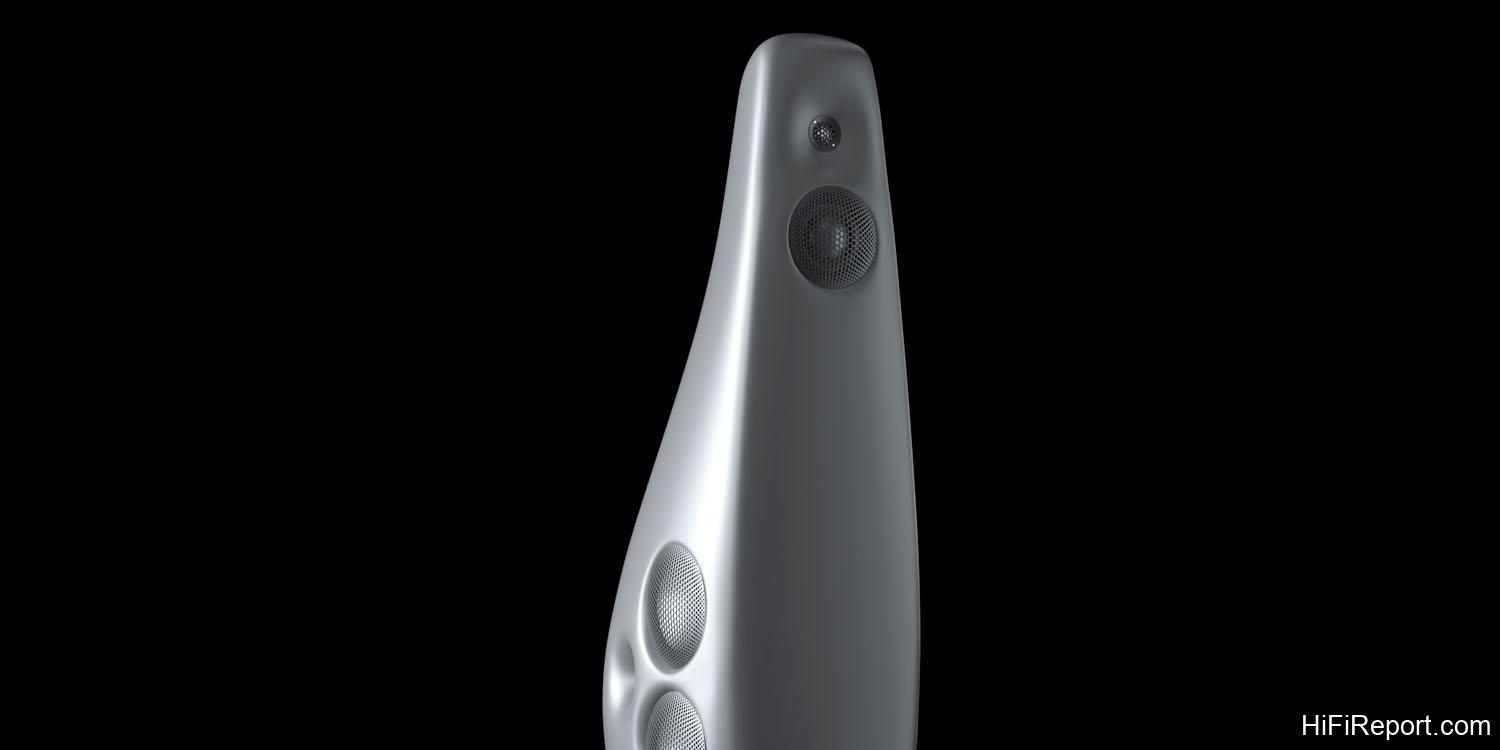
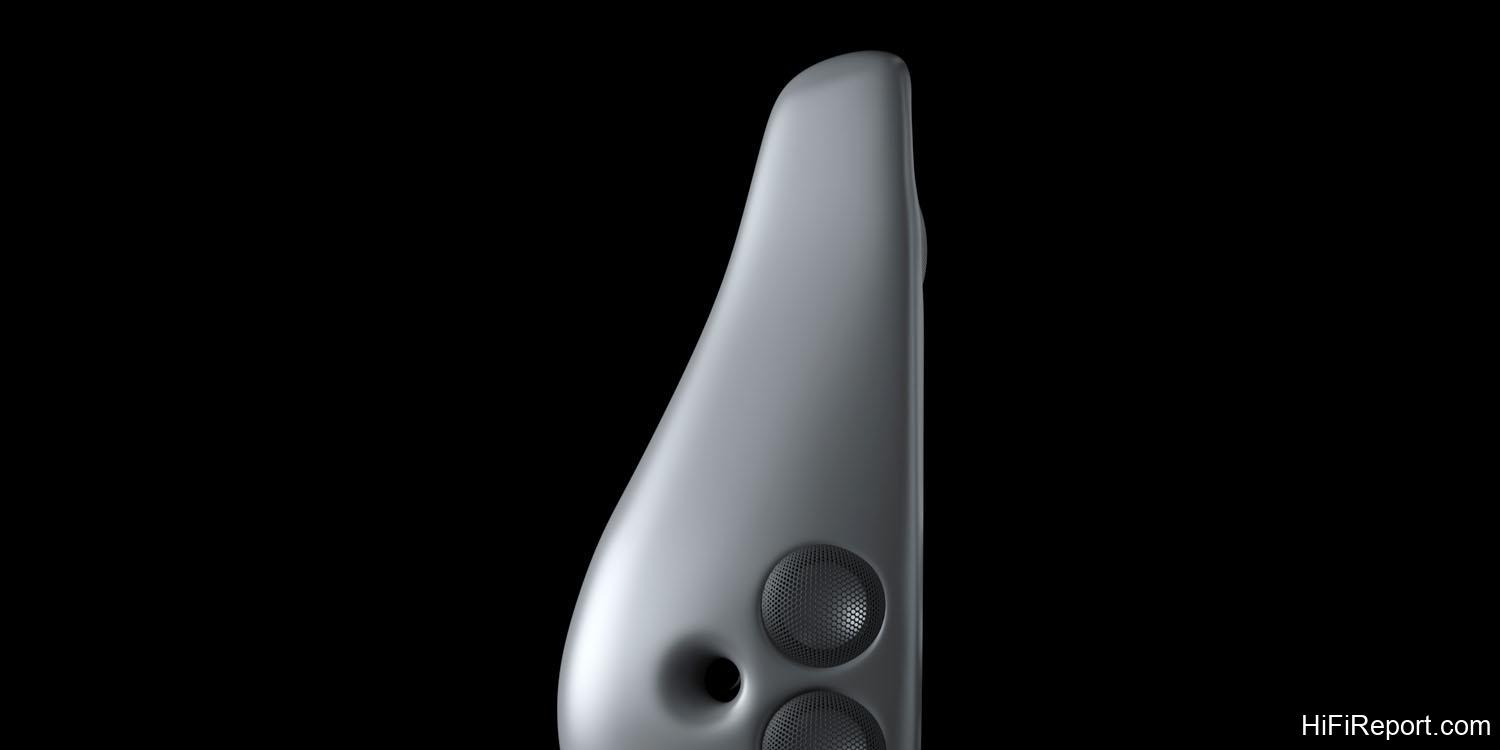
And the Kaya cabinet shape? It has clearly moved beyond the Nautilus’s shadow towards a more organic form. This design was created by Matt Longbottom and Christophe Hermann in London. If you walk around the Kaya 90, you’ll notice only two hexagonal bolts on the entire cabinet, located opposite the tweeter and midrange drivers. What purpose do these bolts serve? They brace the tweeter and midrange drivers from behind, similar to the method used in the British Monitor Audio Platinum series.
While the exterior appearance has broken ties with the Nautilus, the internal design remains true to the original philosophy: tapered tubes attached to the back of the drivers, gradually expanding and then narrowing, but now completely hidden within the cabinet.
Vivid’s speaker cabinets have always been constructed from composite materials (fiberglass) using a sandwich structure: two layers of composite material sandwiching a layer of foam. In the Kaya series, this foam layer is doubled in thickness, achieving a stiffness-to-weight ratio of 1:48 and a strength-to-weight ratio of 1:6. So, don’t let the Kaya 90’s moderate weight fool you into underestimating its robustness; its weight-to-strength ratio is arguably unmatched by many speakers.
Core Design Philosophy and Acoustic Principles
Laurence Dickie’s central design philosophy for drivers and cabinets revolves around eliminating resonance and diffraction, and optimizing frequency response. While these terms seem simple, they encompass a vast area. Let me explain them individually. First, the cabinet shape: The Kaya 90’s exterior resembles an elongated pear, narrow at the top and wider at the base. This shape not only makes the speaker more stable but also meets the requirements for sound wave radiation.
The D26 tweeter and C100se midrange driver are mounted at the narrow upper section. If these two drivers were mounted on a too-large baffle, their inherent frequency response curves would be altered.
For example, mounting a 26mm diameter tweeter on a 200mm diameter circular baffle shows a significantly distorted curve above 8kHz when measured. However, if the same 26mm tweeter is mounted at the apex of an inverted bowl shape, the curve above 8kHz bends much more smoothly. This measurement example illustrates a fact: because high frequencies have very short wavelengths, they cannot be mounted on an excessively large or flat surface. Note the emphasis on “excessively large” and “flat.”
Therefore, designing the cabinet area where the tweeter is mounted to be small and curved helps maintain a relatively flat frequency response for the tweeter above 8kHz.
The same principle applies to the midrange driver, though since the wavelengths it produces are longer than the tweeter’s, the mounting surface can be larger while still maintaining a relatively flat frequency response curve. From the above explanation, you can understand why the front baffle area around the tweeter and midrange drivers on Vivid speakers is very narrow – it’s not just for aesthetics, but a requirement dictated by acoustics.
Cabinet Edges and Loading Tubes
The shape of a speaker cabinet’s edges also affects sound wave diffraction. Sharp edges can easily create a secondary, false sound source at the corner. The sound waves produced by this secondary source will mix with the original sound waves, causing interference (cancellation or reinforcement). This is the reason Vivid speakers have used “non-rectangular” cabinets with no right angles from the very beginning.
So, Vivid’s initial cabinet designs weren’t just about being “different,” but were based on acoustic requirements. With the Kaya series, the cabinet shape has evolved to be even more organic.
Now, let’s discuss adding tapered tubes, wide at one end and narrow at the other, behind the drivers. This was another discovery Laurence Dickie made during the Nautilus development. The magnets behind most tweeters and midrange drivers are typically circular rings, with a sealed back plate at the bottom. This means the back wave from the driver is blocked by the back plate and reflected back onto the rear of the diaphragm.
Laser vibration measurements show that the diaphragm exhibits additional residual vibration in this scenario. However, if the back plate is changed to a hollow ring, allowing the driver’s back wave to radiate freely backward, residual vibration is significantly reduced.
This measurement result led to Vivid’s latest drivers employing circular neodymium magnets and annular back plates, resulting in stronger magnetic force and preventing the diaphragm from being affected by back wave reflections.
Furthermore, Laurence Dickie discovered that to further eliminate the negative effects of driver back waves, the best method is to install exponential tapered tubes behind the tweeter and midrange drivers. These tubes absorb the driver back waves more effectively. This is what we see as the three tubes extending from the top of the Nautilus. Vivid’s tubes, however, are concealed within the cabinet.
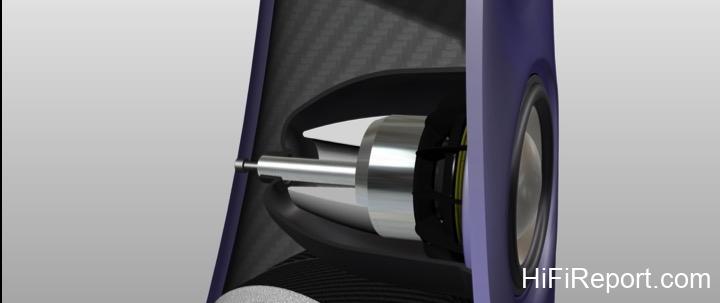
Notably, the new Kaya series only has a tapered absorption tube for the tweeter; the midrange driver no longer uses this type of tube. Instead, a short chamber encloses the rear of the midrange driver, serving as a modified absorption tube.
Naturally, if this is done for the tweeter and midrange, the bass drivers should follow suit. However, bass drivers produce very long wavelengths, making it impractical to add circular tubes behind them. Larger and longer tubes are required. This is what we see as the circular shape at the base of the Nautilus, and the curved loop on top of Vivid’s Giya series – these are, in fact, the “absorption tubes” for the bass drivers.
As for the Kaya series, an internal curved structure is placed below the midrange driver within the cabinet to block the bass driver’s back wave. Additionally, another curved structure is placed above the bass driver, forming a special bass absorption “duct” which they call a folded absorption tube. The design of the bass reflex ports on either side is also curved, differing from conventional straight tubes.
Bass Design and High Frequency Dispersion
Vivid’s bass design not only incorporates absorption ducts but also a configuration where drivers on opposite sides are connected to cancel out vibrations. In the Kaya 90, this design is taken even further, with two C125L bass drivers on each side, arranged back-to-back. This implementation is based on the principle of “for every action, there is an equal and opposite reaction.”
The connected bass drivers mutually cancel out their reaction forces, minimizing the impact of vibration on the drivers.
Beyond these unique designs, another distinctive feature is the Kaya series’ high-frequency dispersion angle requirement, which differs from the Giya. The latter has a wide dispersion angle, resulting in more reflections from side walls. The Kaya series, however, features a specially designed shallow waveguide (horn). The mounting depth of the tweeter is the same as the midrange driver, ensuring consistent time alignment of their sound sources.
Its dispersion angle is designed to be narrower, reducing side wall reflections and focusing the sound waves more directly towards the listener.
The Kaya 90 is a 3-way, 6-driver, bass-reflex floorstanding speaker. The crossover utilizes air-core inductors, Bennic PP capacitors, and single-core wiring, employing a fourth-order Linkwitz-Riley filter. The crossover points are set at 300Hz and 3kHz. The four bass drivers are responsible for the frequency range below 300Hz, which undoubtedly contributes to the particularly impressive low-frequency performance.
Listening Impressions
I listened to the Kaya 90 in my open-plan listening space at home, paired with an emmLabs TSDX SE transport/DAC2 SE DAC digital source. I tried several amplifier setups, finally deciding on the Accuphase C3850 preamplifier and A-75 pure Class A power amplifier. The reason was that this combination produced the best high-frequency sound – warm, sweet, and rich with moisture. The midrange was full-bodied, and the low frequencies were ample, with excellent control.
Let’s start with the low-frequency performance. The Kaya 90’s four 125mm bass drivers are formidable. Don’t be fooled by their size; together, these four drivers produce astonishing bass energy with superb control and a natural sense of extension downwards. The specifications list a -6dB point at 35Hz, but in practice, they sound like the bass from much larger speakers.
I used Michel Jonasz’s album “La Fabuleuse Histoire de Mister Swing.” Why this CD? Because it contains a wide variety of low-frequency sounds, ranging from soft to hard impacts. It’s a test of both quantity and depth, as anyone who has heard it knows.
First, I must praise the Kaya 90’s low frequencies for being clean, abundant, and impactful. Sitting on the sofa, I could feel the low-frequency energy washing over me. Clearly, Vivid isn’t exaggerating; their drivers are truly impressive. They gripped the bass on this CD tightly, sometimes delivering it as a focused burst, other times as bass that enveloped my entire body.
Frankly, I was slightly concerned about the 300Hz crossover point and the bass drivers being mounted on the sides – would this cause localization issues? In practice, I did not perceive any problems with bass localization.
After listening to Michel Jonasz, I had a good understanding of the Kaya 90’s low-frequency capabilities. However, I listened to another CD, the 2018 Hong Kong High-End Audio Visual Show compilation “The Best of Audiophile.” I focused on “Getting Married” and “Five Tiger Generals.” These tracks feature Chinese drums, which produce a less resonant, more impactful sound, testing the speaker’s ability to handle strong transients.
Chinese drums are a challenge for any speaker because the sound explodes outward powerfully, rather than trailing off gently.
Here, the Kaya 90’s Chinese drum low-frequency performance, while exceeding my expectations, wasn’t world-beating; it still had its limits. My point is, although the Accuphase A-75 only outputs 60 watts per channel (8 ohms), its driving power is very strong. I didn’t dare turn the volume up too high, fearing the speakers couldn’t handle it. Note that I wasn’t just concerned about the bass drivers, but the midrange drivers as well.
Having tested the low frequency quantity, endurance, and depth, I wanted to hear the Kaya 90’s cello performance. If a cello sounds real and beautiful, drawing you in to listen continuously, then you can be confident about the resolution and realism from the mid-bass down to the low frequencies. Listening to “Jewish Cello,” the clear texture of the cello’s bowing immediately captivated me.
This indicates the extreme sensitivity of the Kaya 90’s bass and midrange drivers, enabling them to render the subtle vibrations of the bow on the strings with such clarity. The cello sound I heard was relatively dark in tone, with a noticeable nasal quality. However, the ability to hear the light friction and vibration of the bow elevated the cello’s realism to a very high level.
Next, I listened to “Reveries,” recorded by Bergamodo Records, featuring cello and piano duo. The cello tone on this CD is completely different from “Jewish Cello,” possessing a sense of viscosity and less nasal quality. It was equally captivating; I hadn’t expected the Kaya 90 to reproduce string viscosity so beautifully. And the piano? It had a distinct woody character, devoid of any metallic sound. This performance would surely surprise audiophiles prejudiced against metal drivers.
Hearing such lovely cello viscosity immediately brought to mind Ah Tao’s album “Under the Mountain, Field Beauty.” The title track on this CD features cello accompaniment. I suspect many people assume it’s accompanied by a small string ensemble, but it’s actually Fan Zongpei layering and mixing multiple cello parts played by himself. This string accompaniment, which is both finely textured and possesses a hint of viscosity, sounded truly beautiful through the Kaya 90.
This not only demonstrates the Kaya 90’s exceptional upper-midrange and low-frequency resolution but also validates the drivers’ high fidelity.
Then I pulled out the CD “Tous les matins du monde” (All the Mornings in the World) to hear the Viola Da Gamba. Some mistakenly believe this instrument is a predecessor to the cello, calling it an “ancient cello.” In fact, the Viola Da Gamba belongs to a different family of instruments; it’s a bowed string instrument played resting on the leg (Viola means bowed string instrument, Gamba means leg).
They also come in various sizes (small, medium, large), and the one played on this CD is similar in size to a cello.
This instrument has a different sonic character than the cello; it’s less nasal, has less rich resonance, and lacks the strong sense of viscosity. It’s more refreshing and delicate. Through the Kaya 90, it sounded fragrant and sweet, and very refined. Its refreshing sound was utterly captivating. This performance also reveals the capabilities of the Kaya 90’s tweeter and midrange drivers.
I then retrieved “The Celtic Viol,” also performed by Jordi Savall. While also featuring the Viola Da Gamba, this album primarily uses a smaller size, similar to a violin, known as the Treble Viol. The delicate, sweet, and tender sound of the Treble Viol was exquisite, never sharp or harsh, and extending upwards naturally. The Kaya 90’s tweeter is genuinely sweet and refreshing, like a delicious wax apple.
Having listened to simple instrumental arrangements, I moved on to concertos. I played Fone Records’ recording of Mozart’s “Violin Concertos,” performed and conducted by Salvatore Accardo with the Prague Chamber Orchestra. The orchestral sound produced by the Kaya 90 was clear, bright, and sweet. The violin tone, in particular, was gorgeous, full of luster, sweetness, and moisture. The music felt incredibly lively.
I believe everyone would appreciate this sound: sunny, youthful, sufficiently sweet, lustrous, and never fatiguing.
Listening to Haitink conducting the London Symphony Orchestra in Haydn’s six “London Symphonies,” I observed how well the Kaya 90 integrated the orchestral high, mid, and low frequencies. There were no audible gaps, and the quantity of high, mid, and low frequencies was well-balanced, forming a pyramid structure. The bass quantity wasn’t excessive but was sufficient, and the low-frequency resolution was very high.

In other words, when listening to orchestral music, the low and high frequencies were well-balanced; the bass wasn’t heavy but rather clean and sufficient. In fact, being clean yet sufficient is a consistent characteristic of the Kaya 90, whether in the high, mid, or low frequencies – always clean with sufficient quantity.
Next, I listened to vocals using “Belafonte Sings the Blues.” I found that the Kaya 90 not only delivered a large soundstage and abundant detail but also exhibited incredibly fast transient response. Strange, isn’t this a blues album? Blues is usually mournful and slow. How could I detect fast transient response? Indeed, I could discern the Kaya 90’s fast transients from the responsiveness of Belafonte’s voice as he formed and transitioned between notes.
As for the sense of space, the Kaya 90 seemed to allow me to hear the air flow more clearly – a curious sensation. And regarding detail, the more real the instruments sound, the more detail is being reproduced.
Another vocal recording: Maria Callas’s “Mad Scenes.” Here, I noticed the details in Callas’s voice were clearer, making her vocal characteristics more prominent. The accompanying orchestra sounded more coherent and distinct overall. The sense of musical scale was not only grand, but it felt as if an invisible net controlled the music, preventing it from becoming unruly. The Kaya 90’s midrange driver is robust, full-bodied, and realistic.
Listening to “Country Road” from Rhymoi Music, the Kaya 90’s lively and sunny character immediately captured my ear. Typically, a lively and sunny character might feel like the midday sun, uncomfortably hot. But the Kaya 90’s liveliness felt like the morning sun – full of transparency, clear vision, yet not harsh at all. Frankly, the Kaya 90 also possesses a beautiful softness, and every small sound in the music was crystal clear.
The vocal characteristics of both male and female singers were recorded with such clarity that I was somewhat surprised by the Kaya 90’s ultra-high resolution. And the sound of the violin and pedal steel guitar – that combination of soft, delicate, supple, and sweet – was truly unforgettable. From this “Country Road” album, I could fully appreciate the Kaya 90’s youthful, lively, and vibrant sonic characteristics, along with its ample softness, never sounding hard or rigid.
Listening to “Mai Piu Cosi Lontano” from Andrea Bocelli’s “Sogno,” the elasticity of the bass was simply captivating. Each bass note was full and taut, incredibly elastic, with absolutely no lingering or sluggishness – so sharp and precise. This immediately impressed me with the Kaya 90’s exceptional bass control and depth.
Listening to Josh Groban’s “Closer,” the soft, rich bass in the recording allowed the Kaya 90 to showcase another facet of its bass performance. Here, the Kaya 90 presented bass like gentle waves, soft and abundant. This soft, rich bass did not compromise the clarity of the midrange and high frequencies; everything was in its right place. From these two albums by Bocelli and Josh Groban, I realized that because the Kaya 90’s bass is neutral, it reflects the original recording exactly.
For example, when I listened to “Don’t Know Much” from “The Very Best of Linda Ronstadt,” the bass produced by the Kaya 90 was different again from the previous two. This confirms that the Kaya 90, with its four bass drivers per side, can handle any type of bass effect without issue.
Conclusion
The Vivid Kaya 90 is undoubtedly a milestone in loudspeaker design. Despite its relatively modest size, it boldly utilizes four bass drivers, giving it a sense of musical scale far exceeding its physical dimensions. Its exceptional drivers and cabinet design further elevate the realism of instruments and vocals. A speaker cabinet can be designed with such sculptural beauty, and its sound performance can fill you with surprise and delight.
The Vivid Kaya 90 is truly a pair of modern sculptures that fill the room with music!
Technical Specifications and Performance Summary
* Type: 3-way, 6-driver, bass-reflex floorstanding loudspeaker
* Introduced: 2018
* Drivers: One 26mm aluminum-dome tweeter, one 100mm aluminum-cone midrange driver, four 125mm aluminum-cone bass drivers
* Nominal Impedance: 6 ohms (minimum 4 ohms)
* Sensitivity: 90dB (1m/2.83V)
* Frequency Response: 35Hz-25kHz -6dB
* Tweeter First Breakup Mode: 44kHz
* Second and Third Harmonic Distortion: Less than 0.5% (full frequency range)
* Crossover Frequencies: 300Hz, 3kHz
* Dimensions (WHD): 370 × 1,202 × 540mm
* Net Weight: 38 kg
* Approximate Price: $27,700 USD
* Importer/Distributor: Shengqi (02-25974321)
Highlights
* Outstanding cabinet design, sculptural yet acoustically optimized.
* Increasingly refined drivers, all-aluminum diaphragms for high, mid, and low frequencies, stronger magnetic assemblies.
* Emphasis on mitigating back wave effects, eliminating excess vibration.
* Vast musical scale, high realism, clean and lively sound.