
Mola Mola Tambaqui DAC Review
From my university days, coffee has been a constant companion for over two decades.
Beyond espresso machines, I’ve explored various brewing methods – siphon, moka pot, French press, pour-over – my kitchen cabinet overflowing with equipment. I even have several grinders: hand-cranked, electric, conical burr, flat burr.
I appreciate the tactile engagement of manual operation. Compared to electric coffee machines designed for rapid, mass production, hand-crafted coffee possesses a unique character. Each cup can be different, a distinct entity in itself.
However, there’s one aspect I’ve contemplated for years, resisting despite the encouragement of coffee-loving friends: coffee roasting.
These roasting enthusiasts repeatedly urge, “You’ve been drinking coffee for so long, you’ve tried everything else, this is the only step left.”
Some even claim, “You only truly understand coffee when you start roasting your own beans.”
There’s undeniable merit in these statements.
For a dedicated coffee aficionado, the more control you have over each stage, the more distinctive and meaningful the resulting brew becomes.
This pursuit of unique flavor profiles is what drives the discerning coffee drinker.
Hi-Fi audio shares a striking resemblance to coffee.
The more high-end the audio equipment, the more control manufacturers seek to exert over every aspect. They consistently aim to convince consumers: we meticulously consider every detail, bringing our unique perspective to each component.
In today’s era of prevalent digital streaming, the DAC – Digital-to-Analog Converter – is an indispensable element in any audio system.
Yet, the majority of DACs on the market utilize readily available IC chips from specialized manufacturers.
Audio companies can meticulously design power supplies and showcase their unique insights in analog circuitry. But what about the crucial DAC component itself? The leading DAC chip manufacturers today are primarily Burr Brown, ESS, and AKM. The decoders we encounter often house DAC chips sourced from these three companies.
There’s nothing inherently wrong with using commercially available DAC chips. An IC chip is essentially a complete circuit architecture, simply miniaturized for mass production.
Advancements in semiconductor technology have led to increasingly smaller yet more powerful chips.
Audio manufacturers still possess numerous avenues to influence sound and inject their aesthetic vision. They can leverage power supplies, analog amplification, and I/V conversion to achieve their sonic goals. Furthermore, digital processing techniques like upsampling algorithms, SRC, and digital filters offer additional manipulation. Even with the core DAC function handled by an IC, they can still craft a sonic signature uniquely their own.
This parallels my reluctance to venture into coffee roasting, preferring to focus on the art of brewing.
I enjoy sourcing beans from diverse origins and appreciating the artistry of different roasters.
I’ve even established relationships with roasters who offer small-batch custom roasting, tailoring beans to my preferences. While not roasted by my own hand, they closely align with my desired profile.
Through manual brewing, even with the same bean, pour-over techniques allow for manipulation of grind size, water temperature, pouring method, coffee-to-water ratio, and extraction time. These variables, combined with brewing technique and equipment, enable the creation of a diverse range of coffee flavors.
I can even blend different beans according to my mood, creating a personalized signature blend.
We all know that even with identical DAC chips, two different decoders can sound distinct.
Numerous factors influence the final sound, and manufacturers are free to excel in areas where they possess expertise. They can still create products that delight and even amaze.
Choosing not to roast my own beans doesn’t preclude me from enjoying excellent coffee.
However, some hold a different perspective.
Those who roast their own beans take complete command of the roasting process, controlling time and temperature, defining each stage and critical juncture.
This is akin to audio manufacturers who bypass off-the-shelf DAC chips, opting instead to design their own circuits and write their own algorithms.
Manufacturers who abstain from using commercially available DAC chips typically employ either FPGA chips loaded with proprietary algorithms or R2R ladder DAC architectures.
Products from manufacturers adopting these approaches are invariably renowned.
Broadly speaking, regardless of using commercial chips or not, the paths diverge into Delta-Sigma and R2R Ladder DAC designs. Manufacturers then supplement these core architectures with proprietary upsampling algorithms, creating a seemingly diverse and competitive landscape.
Yet, there exists a DAC that stands apart. It eschews both existing IC chips and the conventional Delta-Sigma and R2R Ladder DAC methodologies. It carves its own path, forging a sound that is exceptionally captivating.
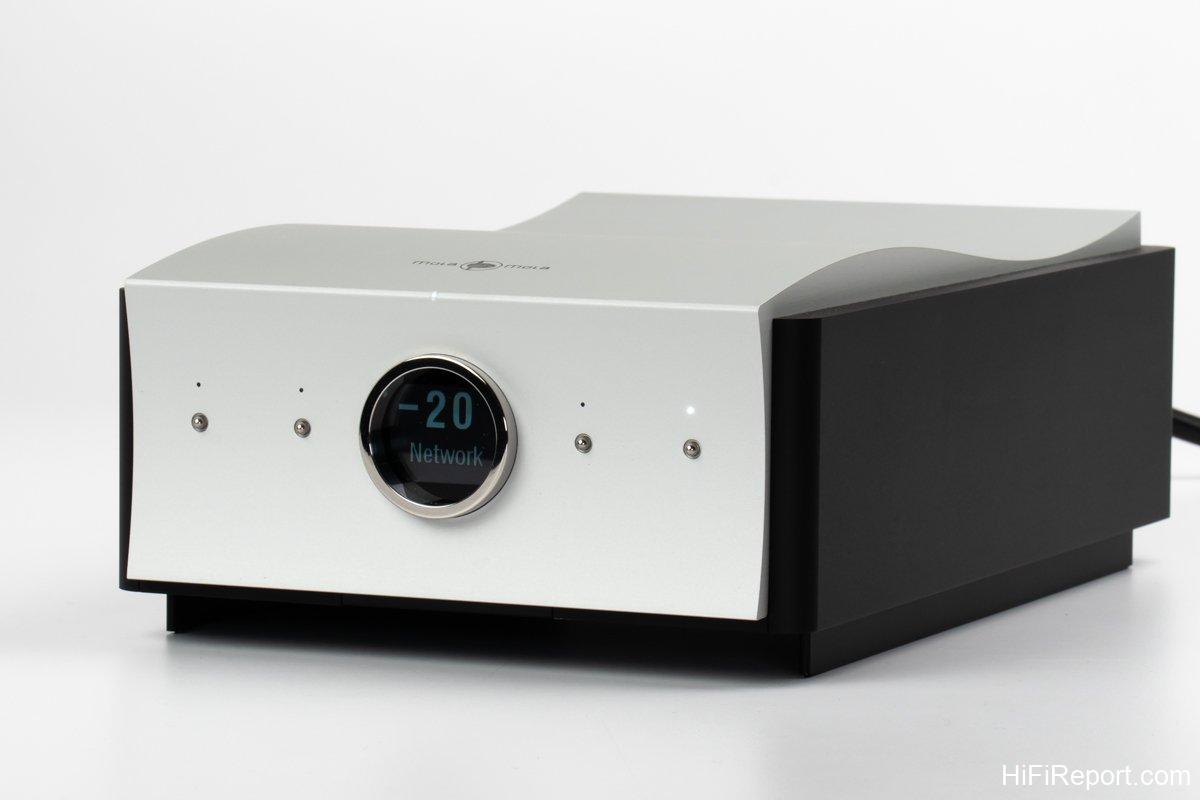
This is the Mola Mola Tambaqui DAC.
Unique DAC Architecture
How does the Tambaqui DAC achieve this? Firstly, like many manufacturers, it upsamples the incoming digital signal.
The Tambaqui, using its proprietary algorithms, upsamples the digital signal to 32-bit/3.125 MHz specifications. This not only boasts top-tier bit depth but also an exceptionally high sampling rate of 3.125 MHz.
The origin of this specific number is unclear, but it surpasses even DSD 64’s 2.8 MHz, and is 70 to 71 times higher than CD’s 44.1 kHz sampling rate.
What follows is where things become truly intriguing. Mola Mola engineers the Tambaqui DAC to convert the upsampled PCM digital signal into PWM (Pulse-Width Modulation) format.
PCM, or Pulse-Code Modulation, samples the amplitude of an analog signal at regular intervals (determined by the sampling frequency) and quantifies these samples using binary digital codes, representing a sinusoidal waveform.
PWM, or Pulse-Width Modulation, also digitizes analog signals but encodes the analog signal’s amplitude by varying the width of pulses, resulting in a density-wave recording format.
Next, Mola Mola employs a custom-designed 32-stage FIR (Finite Impulse Response) DAC built with discrete components, followed by a single-stage fourth-order filter for I/V conversion. This process transforms the PWM signal back into an analog signal.
This innovative approach achieves an astounding signal-to-noise ratio of 130dB, translating to a dynamic range of 130dB.
This performance nears the theoretical limit of 24-bit digital audio and rivals the capabilities of DSD 256 files.
Consequently, even at full-scale signal output, distortion remains below the noise floor.
How does the manufacturer specify this in the specifications? They state the Tambaqui’s THD and IMD distortion as “not measurable,” implying “immeasurably low.” If a numerical value were to be assigned, it would likely be around -140dB.
These technical descriptions essentially convey that the Tambaqui DAC effectively resolves issues of noise and distortion.
Mola Mola’s Tambaqui DAC, bypassing commercially available DAC chips and deviating from traditional Delta-Sigma and R2R Ladder DAC approaches, pioneers a FIR filter-based PWM signal processing method. This innovative path circumvents the inherent limitations of both Delta-Sigma and R2R Ladder DACs, delivering a listening experience that is both refreshingly novel and profoundly impactful.
Its specifications, supporting PCM up to 32bit/384kHz and DSD256, justify its price point and uphold the esteemed Mola Mola name.
Compact Design, Rich Interfaces
The Tambaqui DAC is remarkably compact, its design echoing Mola Mola’s amplifier aesthetics. As a half-width component, measuring just 20cm wide, it presents a petite and refined presence on any audio rack.
And refined it truly is.
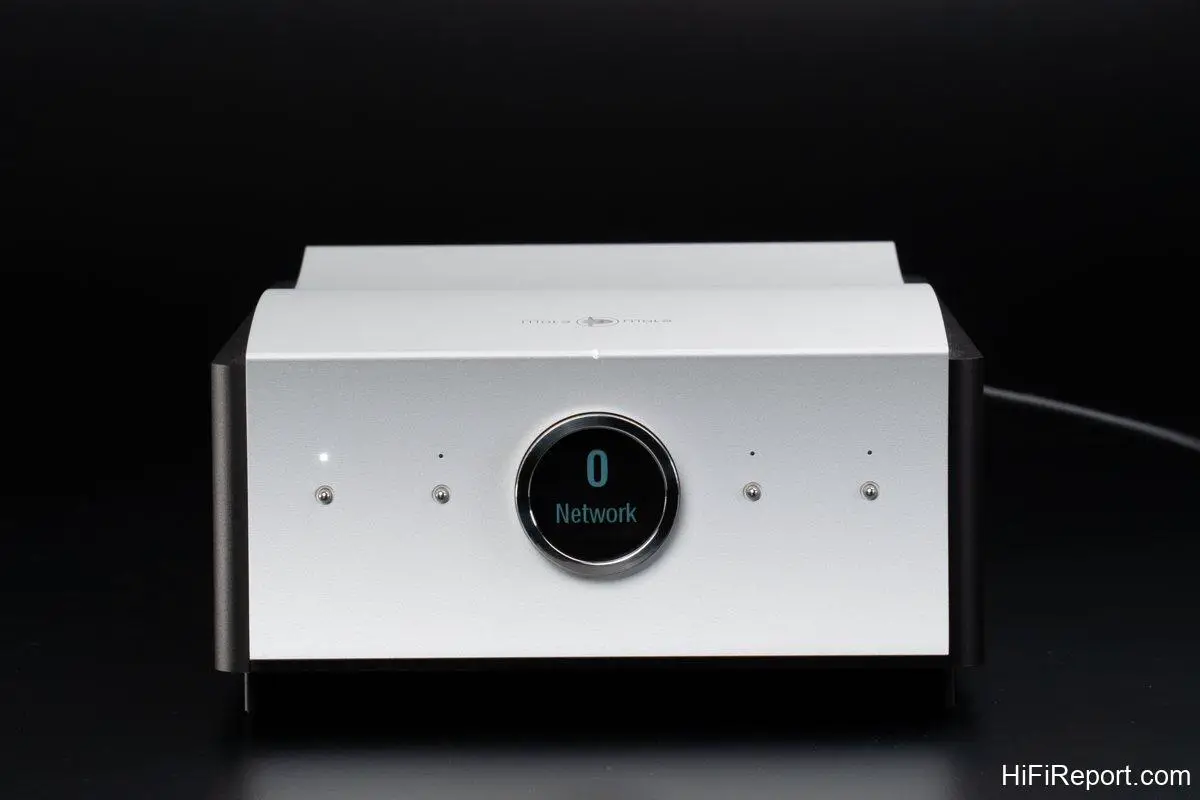
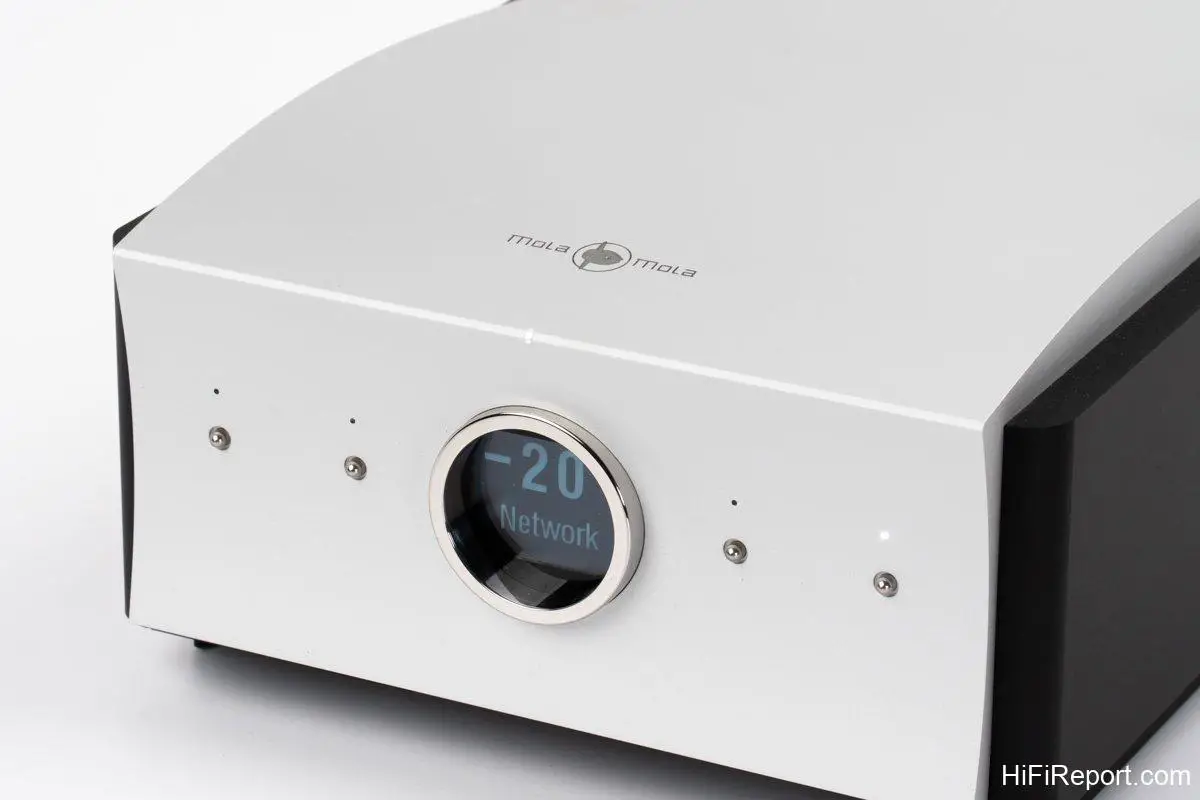
Named after the Tambaqui fish, Mola Mola equipment features CNC-machined wave-like casework. Though appearing rectangular and angular, it incorporates gentle curves, blending strength with fluidity – a harmonious balance of rigidity and grace.
The front panel is devoid of any markings, dominated by a central circular display flanked by two small circular buttons on each side, each button topped with an LED indicator.
Mola Mola equipment consistently embodies minimalist elegance.
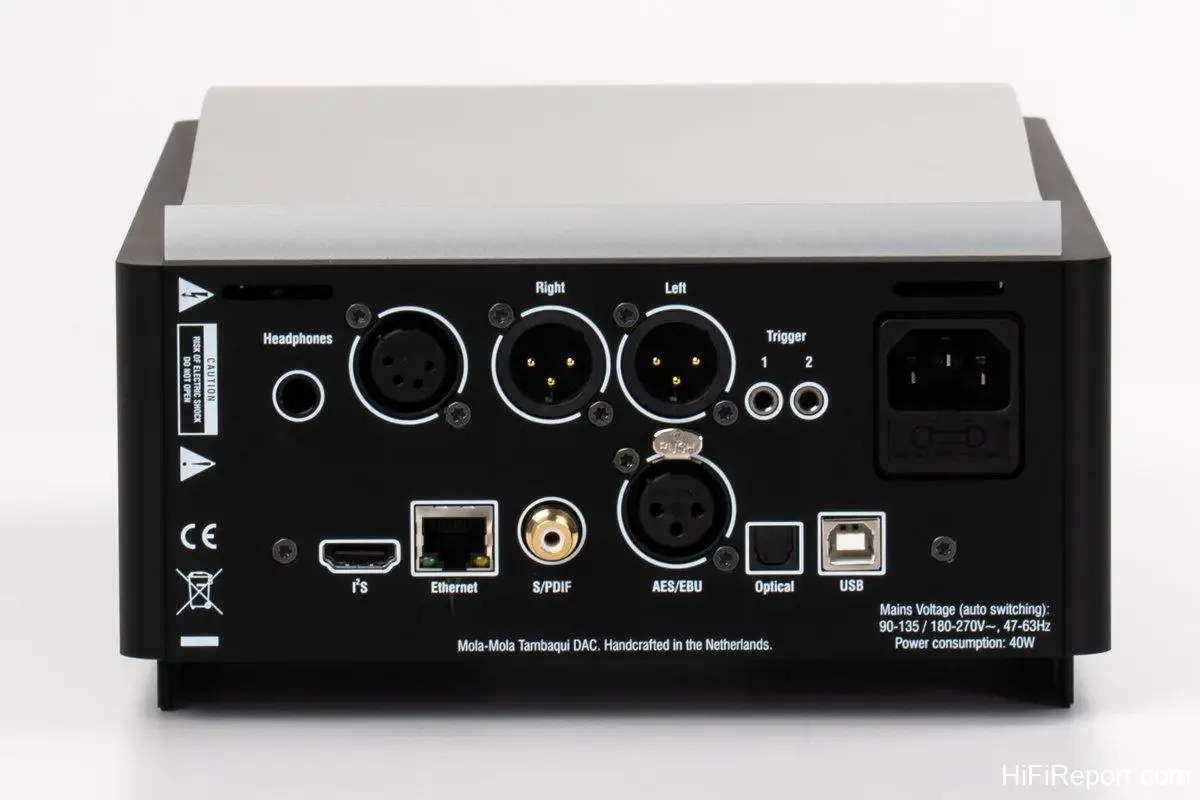
The Tambaqui boasts a wealth of input interfaces. Let’s enumerate them: it offers traditional coaxial, optical, and AES/EBU inputs, each in a single set, for connecting CD transports and other digital sources.
It also includes an HDMI-interfaced I2S input. For compatible sources, I2S represents a superior transmission path compared to S/PDIF and AES.
Furthermore, a USB Type-B port allows connection to computers or music servers for digital streaming.
For even more direct streaming, network connectivity is available via an RJ45 Ethernet input. Plug-and-play functionality makes it incredibly convenient, and Roon Ready certification is included.
Even with such high-end pedigree, the Tambaqui offers user-friendly features. It appears in your phone’s Bluetooth menu, allowing for simple pairing and use of your phone as a source, letting the Tambaqui work its magic.
In terms of analog outputs, it foregoes single-ended outputs. Mola Mola provides only a set of XLR balanced outputs. With its built-in digital volume control, the Tambaqui can serve as a digital preamplifier, directly driving Kaluga monoblock power amplifiers.
The manufacturer suggests that for purely digital listening, bypassing other analog sources, a Tambaqui-Kaluga pairing represents the ideal and most streamlined system, potentially saving on overall system cost.
Headphone users are also considered.
The rear panel houses a 4-pin XLR balanced headphone output and a 6.3mm single-ended output.
While the rear headphone output placement might not be the most intuitive, considering the unit’s exquisite aesthetics, would you truly compromise its visual harmony for mere convenience? This isn’t just any DAC/headphone amplifier; this is a Mola Mola Tambaqui!
App Control, Easy Settings
Mola Mola designed a beautiful, curved remote – the Premium Remote – for their equipment, its form factor echoing their product design, resembling a fish in profile.
However, it was not included with the review unit. Instead, an Apple TV remote was provided in the box, utilizing the same remote control codes for compatibility.
Personally, I prefer no physical remote at all.
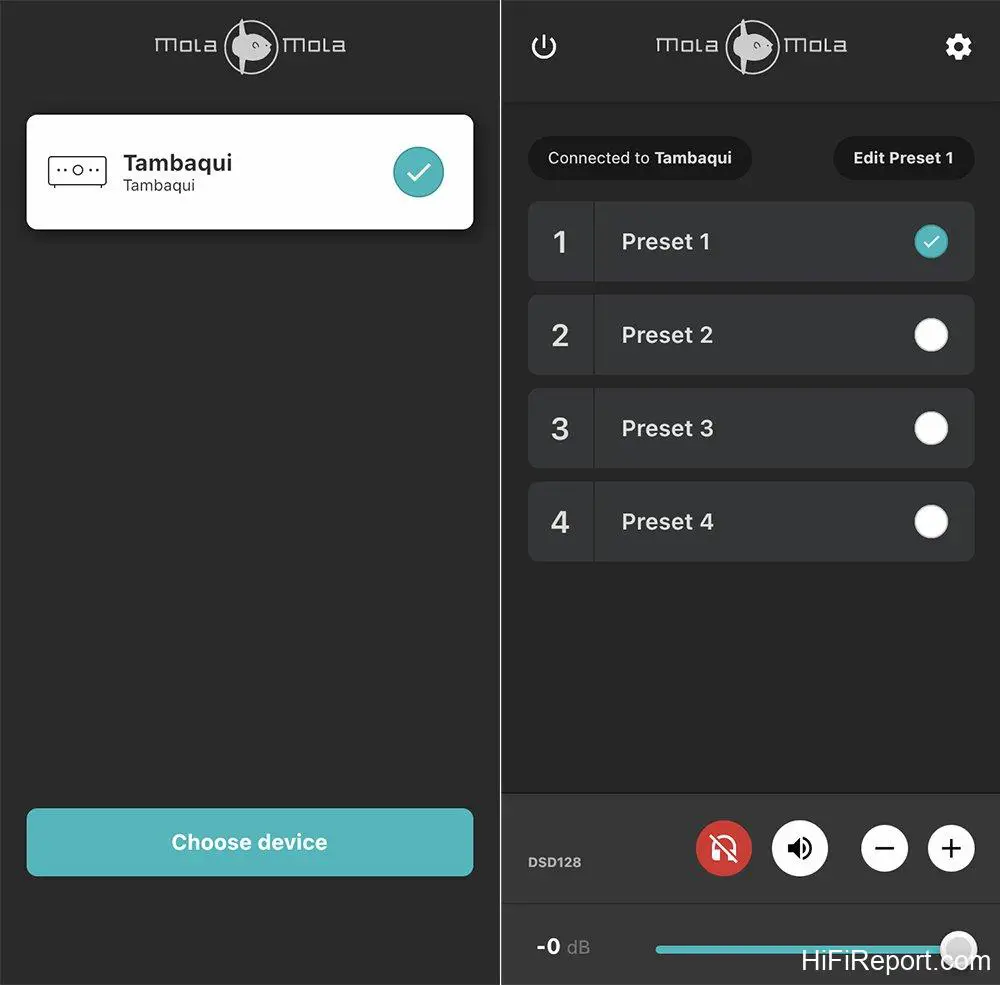
Mola Mola offers a remote control app. Once downloaded and paired via Bluetooth, full control is at your fingertips.
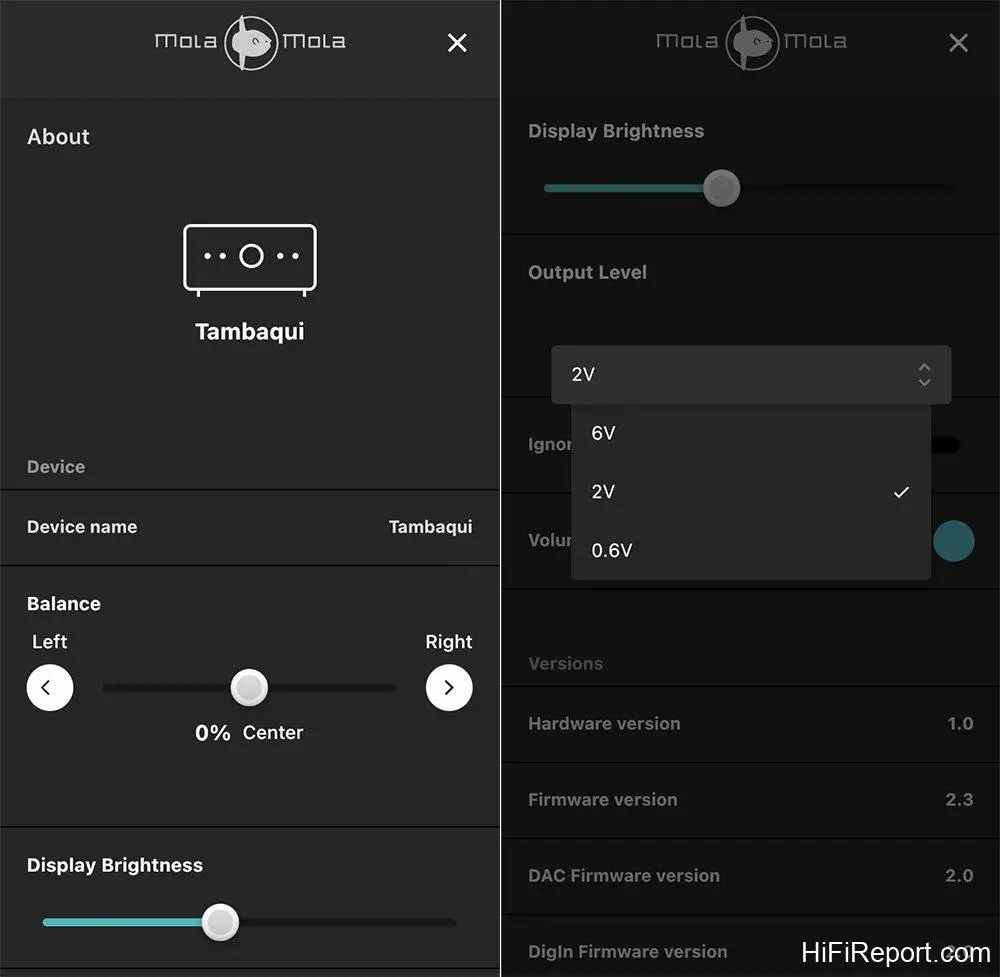
The app allows volume adjustment, balance control, input selection, firmware updates, front panel light brightness adjustment, and output voltage adjustment.
Yes, the Tambaqui’s output voltage is adjustable.
Within the app settings, you’ll find an “Output Voltage” option with three settings: 6V, 2V, and 0.6V.
The factory default is 6V. To accommodate preamplifiers that might distort with a 6V input signal, lower voltage options are provided. The 2V setting reduces the output level by approximately 10dB, and the 0.6V setting by about 20dB.
When using the Tambaqui directly into a power amplifier, bypassing a preamplifier, setting a lower output voltage can prevent accidental overdriving of the power amplifier and potential speaker damage.
Detailed and Elegant Sound, Excellent Resolution and Livelyness
In the HiFiReport listening room, I paired the Tambaqui DAC with an EAR Yoshino 868 preamplifier and 509 monoblock power amplifiers, driving Wilson Audio Alexia 2 loudspeakers. Music was streamed via Roon from Tidal, with an Ansuz PowerSwitch D.TC Supreme handling network distribution.
The diminutive Tambaqui DAC nestled beside the imposing Alexia 2s, yet its sonic performance was comprehensive, belying its size. It presented music with both breadth and depth, capturing both the individual elements and the holistic picture.
The Mola Mola Tambaqui’s sound is refined and elegant, rich in detail, possessing exceptional resolution and remarkable liveliness.
These strengths were particularly evident when playing chamber music.
Saint-Saëns’ Carnival of the Animals, for instance, features a richer and more diverse instrumentation than typical sonatas, trios, or quartets.
Beyond a string quintet, it incorporates woodwinds, piano, and percussion. The Tambaqui, in its reproduction, fully showcased its pure sonic quality and elegant timbre. Its precise imaging further delineated instrument outlines and spatial positioning.
In “Introduction and Royal March of the Lion,” the ascending and descending phrases in strings and piano, imitating the lion’s roar, were rendered with pristine clarity.
The Tambaqui’s exceptional resolution was immediately apparent from the opening bars.
In “Hens and Roosters,” the ceaselessly chattering clarinet solo represents the hens, while the roosters are depicted by aggressive piano chords in the high register.
Listening to this back-and-forth, the simple melodies, short notes strung together, portrayed a lively squabble between hens and roosters.
Equally impressive piano passages were found in “Wild Asses,” capturing the galloping rhythm, and “Pianists,” showcasing a robust and forceful piano tone.
The Tambaqui’s clear sonic lines and solid sound further accentuated the piano’s tonal bloom and resonance.
This ambiance was particularly evident in “Aquarium,” and the final notes of the glass harmonica, as rendered by the Tambaqui, were exceptionally delicate, luminous, and full of ethereal charm.
Similarly, the percussion in “Fossils,” with the xylophone’s notes sounding solid yet possessing a touch of woody warmth, was captivating.
The Tambaqui doesn’t lean towards a warm and lush sonic character; rather, it presents a refined and elegant demeanor.
Its reproduction of the various short pieces in Carnival of the Animals highlighted the music’s intricate beauty.
More Than Melody, Deeper Music
Listening to Yo-Yo Ma and Kathryn Stott’s collaboration album, Songs of Comfort & Hope, released in 2020 during the height of the pandemic, Ma aimed to soothe wounded hearts through music.
I particularly cherish “Shenandoah,” an American folk song depicting the hardships of westward expansion in the 19th century.
Re-arranged for cello and piano, the piece opens with sustained single notes on the piano, followed by pizzicato cello hinting at the main melody.
The single notes then develop into chords, and the cello transitions to arco, playing a fuller melody and harmony.
The Tambaqui rendered the sonic lines cleanly and clearly, the piano notes solid and full-bodied.
However, the Tambaqui’s fullness isn’t about thickness; it maintains a vibrant and lifelike quality, a perfect balance of richness and definition. The “fullness” and “solidity” are qualities perceived in the texture of the sound.
The cello’s sonic beauty was breathtaking. I intentionally refrained from mentioning “The Swan” in Carnival of the Animals, reserving the cello’s beauty for this moment.
The cello as presented by the Tambaqui not only captured the nasal resonance of the instrument’s body but also maintained clear sonic lines.
This beauty was equally evident in “Goin’ Home.”
This piece, adapted from the second movement of Dvořák’s Symphony No. 9, saw Yo-Yo Ma imbue rich emotion into every note and phrase inflection.
Kathryn Stott’s piano provided the perfect embellishment, elevating the music’s emotional content to an even more vibrant level.
The Tambaqui unveiled the deeper, richer layers within the notes crafted by the musicians, presenting them without reservation.
It’s difficult to definitively attribute this to the Tambaqui’s non-Delta-Sigma, non-R2R Ladder DAC architecture.
However, the palpable liveliness, transparency, clarity, realism, and purity were undeniably unique, beautiful, and deeply captivating.
Its sound also possessed a sense of immediacy, yet maintained a high degree of refinement.
Its directness felt unlike anything I’d previously experienced.
Dynamic Response, String Beauty
While listening to chamber music, my focus was on how the Tambaqui could convey delicate sonic beauty. However, with large-scale orchestral works, I sought to experience a grand and expansive soundstage.
This was especially true when I turned to Mahler.
I put on Michael Tilson Thomas conducting the San Francisco Symphony in Mahler’s Symphony No. 5. Before even finishing the first movement, I got up several times. Something wasn’t right. This didn’t sound like Mahler. Mahler shouldn’t sound so dainty. Mola Mola claims the Tambaqui’s signal-to-noise ratio reaches 130dB, implying a dynamic range of 130dB.
Of course, I can’t actually perceive such a vast dynamic range, but this specification indicates the Mola Mola Tambaqui is certainly capable of reproducing the immense dynamics present in music.
Yet, this Mahler didn’t quite align with my understanding of Mahler.
I picked up my phone and opened the app.
I checked the Tambaqui’s output voltage setting, and it was set to 2V. I switched it to 6V.
The EAR Yoshino 868 preamp can handle a 6V input signal without issue.
After adjusting the setting, I restarted the movement from the beginning. This Mahler, I recognized.
The manufacturer states that switching the output voltage from 2V to 6V increases the output level by 10dB.
But what I heard was more than just an increase in volume. The sonic weight and fullness also improved noticeably.
Mahler unusually opens the first movement with a funeral march. The trumpet begins with a three-short-one-long motif, setting a somber tone.
But Mahler quickly expands this motif into a powerful ensemble passage for the first theme.
This then transitions into a passionate and forceful outcry.
As for the tempestuous second movement, its opening is filled with breathtaking power.
After a storm of sound, the music suddenly calms.
The cello softly sings a funeral dirge, seemingly reflecting on the events of the first movement. Here, the Tambaqui showcased the noble and radiant beauty of the strings, their texture dense and cohesive, yet remaining layered and defined during ensemble passages – weighty but not bloated, maintaining clear separation.
Dynamics are crucial when listening to Mahler.
The stark contrast between the softest and loudest passages has the power to lift you to heaven and then plunge you into the depths of despair.
I even turned off the listening room’s air conditioning, immersing myself in the complete musical dynamics delivered by the Tambaqui. The expansive and heroic grandeur was a stark contrast to the delicate beauty and vibrant spirit experienced with chamber music earlier.
The Tambaqui remained the Tambaqui, but with different output voltage settings, it could bring about a comprehensive transformation in the sound.
Vivid Vocals, Rich Emotion
Dynamics are not exclusive to orchestral music; vocal performances also rely heavily on dynamics. A singer’s ability to utilize body resonance, control vocal power, and employ phrasing and articulation is what truly makes singing captivating.
Take Schubert’s art song, “Erlkönig” (The Erlking), for example.
Let’s consider two recordings to illustrate this.
One is the standard configuration of a soloist and piano, featuring baritone Dietrich Fischer-Dieskau with Gerald Moore on piano.
This version is a classic of classics, renowned for Fischer-Dieskau’s versatile vocal characterizations. He embodies four roles: narrator, Erlking, boy, and father, each with distinct expressions and personas.
The Erlking’s seductive tone, initially gentle enticement, later transforming into harsh threats, and the boy’s cries of fear and panic – these contrasting elements create dynamic tension.
The Tambaqui effectively expanded the dynamic range and contrast, presenting the performance with vivid and three-dimensional presence, almost sculpted in form.
Moore’s piano accompaniment is equally brilliant. The galloping horse hooves and the howling night wind, conveyed through solid and articulate notes, create a sense of motion and scene-setting for the dramatic poem.
In contrast, mezzo-soprano Anne Sofie von Otter’s version replaces the piano with the European Chamber Orchestra, conducted by Claudio Abbado.
The orchestra’s depiction of the galloping horse is less immediate than the piano, but the violin section’s tremolo adds an eerie and unsettling atmosphere.
The weighty low strings surge forth, lending significant gravitas to the piece. The Tambaqui rendered the strings with both density and tangible presence, instantly captivating the listener.
Otter’s vocal performance is rich in detail. The nuances of German pronunciation and articulation are clearly audible. Ultimately, information retrieval and transparency are among the Tambaqui’s strengths.
As Otter progresses through the song, the Erlking’s threats and the boy’s terror, along with the narrator’s heightened emotions, intensify.
When the vocal dynamics emerge, the music’s emotional depth truly blossoms.
Vocal Dynamics, Live Feeling
This captivating quality isn’t limited to classical music; it shines equally brightly with popular music.
Consider Danish singer-songwriter Eivør’s live album. Her English song “Where Are the Angels,” despite its simple arrangement of just Eivør and guitar, is brimming with captivating nuances thanks to Eivør’s dynamic vocal delivery and the guitar’s rich resonance.
The Tambaqui’s refined texture and vibrant tonality are akin to a high-contrast, high-brightness television, presenting a picture with vivid colors and exceptional depth.
Eivør’s vocal lines are clear and well-defined; the guitar’s texture is outstanding. The audience’s cheers at the song’s conclusion bring a palpable sense of live performance to the recording.
Indeed, the Tambaqui’s sound is characterized by exceptional liveliness.
Listening to “Natureboy,” the guitar’s delicate notes complement Eivør’s vocals perfectly, unobtrusive yet creating a wonderfully immersive atmosphere.
The electric guitar’s amplified tone, distinct from an acoustic guitar, can similarly conjure a dreamy ambiance.
In the song’s latter half, Eivør reaches for sustained high notes, even employing whistle register, which is truly breathtaking. When she repeats the second verse, her soaring vocals and forceful delivery, beyond her varied vocal techniques, are the most captivating aspects of her singing – her dynamic control and the tension created between loud and soft passages.
Her rendition of “Summertime” takes on an entirely new character, incorporating more improvisational elements.
Hearing her utilize nasal and head resonance to reach high notes, engaging in a dialogue with the tenor saxophone, is simply exquisite.
In the song’s final section, when she belts out “Summertime and the livin’ is easy,” the sheer power and force of her delivery are enough to transport your soul from your body.
Voodoo – it truly feels like voodoo. But is it from Eivør’s performance, or the Tambaqui’s magic?
Musical Reorganization and Color
Listening to the “A Star Is Born” soundtrack, the Tambaqui vividly recreated the vocal performances and dialogue scenes between Lady Gaga and Bradley Cooper.
Listening through the interspersed dialogue and songs felt like re-experiencing the entire movie.
From the opening track, “Black Eyes,” it’s immediately clear that Bradley Cooper is undeniably a singer who happens to act.
His rock-singer-esque, slightly world-weary vocals, supported by a powerful and full-bodied backing arrangement, create a robust and forceful sonic landscape.
Listening to the instrumentation, the Tambaqui consistently unravels complex musical textures with clarity and precision.
As for Lady Gaga’s vocals, in her reimagining of the French chanson “La Vie en Rose,” she infuses it with a powerful American spirit, singing about the protagonist Ally’s own “rose-colored life.”
Listening to her vocal power, her full-bodied and resolute voice possesses remarkable projection.
Her sustained and soaring “…en rose” after a brief pause – ah, the Tambaqui elevates these brilliant moments to even greater heights.
Equally impressive drum sounds are found in “Out of Time” and “Alibi.” The former opens with a series of crisp and clean drumstick clicks, as the guitar begins its narrative. Heavy bass drums enter, gradually enriching the music’s weight and fullness.
“Alibi” opens with powerful, full-bodied drums and assertive electric guitar. Then, heavy drumbeats accompany Jack’s weathered and magnetic vocals. Crank up the volume – it’s fantastic! The Tambaqui re-writes the music’s organization and color with a vivid and lifelike approach.
When reproducing this soundtrack, it delivers not just sound, but also vivid imagery.
Like Home Roasting Coffee, A Wonderful Thing
As an audio journalist reviewing equipment, I dislike evaluating products based solely on hardware or circuit design to justify their value.
The purpose of audio equipment is to reproduce music, not to realize circuit design possibilities or become showcases for premium components.
The significance of audio equipment lies in the emotional impact and enjoyment it brings when reproducing music.
When listening, you receive richer, deeper information, touching your inner being, resonating with your heart, and eliciting emotions.
Only then do you understand the true meaning of “music makes you whole.”
The value of audio equipment is manifested solely through music.
The Tambaqui’s performance in music reproduction exceeded my expectations.
Its elegant presence is not just visual; it permeates its sonic character.
Its unique architecture is not about competing with other manufacturers’ products but about (wā jué – to excavate, to dig out, here meaning to explore deeper) more musical content, pursuing the fundamental essence of audio equipment: to serve music.
It turns out, home roasting coffee is indeed a wonderful thing.
Specifications
* Type: Digital-to-Analog Converter
* Digital Inputs: Coaxial x1; Optical x1; USB Type B x1; AES/EBU x1; I2S (HDMI) x1; RJ45 Ethernet x1; Bluetooth (SBC, AAC, APTX, LDAC)
* Analog Outputs: XLR x1
* Headphone Outputs: 4-pin XLR x1; 6.3mm x1
* Frequency Response: Up to 80kHz
* Supported Sampling Rates: Up to 32bit / 384kHz PCM, 4x DSD
* Signal-to-Noise Ratio: 130dB
* THD: Not measurable (estimated -140 dB)
* Dimensions: 200 x 110 x 320 mm (WxHxD)
* Weight: 5.2kg