
Mola Mola Kula Integrated Amplifier Review
If you were to name an audio brand after a fish, which would you choose? The market already has Shark Cables, a name that sounds powerful and is instantly memorable. Xiphias (Swordfish) would also be a good choice, as it’s the fastest fish in the sea, reaching speeds of up to 100 kilometers per hour, symbolizing audio performance and speed. Or perhaps Devil Ray, with its mysterious aura, sparking anticipation for its sonic capabilities.
However, it never crossed my mind that someone would name an audio brand Mola Mola (Sunfish). The sunfish, with its flat, plump body and cute appearance, seems more endearing than formidable. Its slow, leisurely swimming style hardly evokes images of a “heavy hitter.”
Why Mola Mola? Frankly, I searched extensively but couldn’t find the exact reason. What’s clear is that the name, whether in English or Chinese, is memorable at first glance. It immediately makes you curious about the sound of “Sunfish Audio,” doesn’t it? The key is, once you hear it, you won’t forget it.
Bruno Putzeys: The Mastermind Behind the Design
Mola Mola isn’t just relying on a unique brand name to grab attention; their technology is truly impressive.
In a previous review of the Mola Mola Tambaqui DAC, our editor, Da Tiankai, meticulously detailed Mola Mola’s distinctive DAC technology. It’s neither Delta-Sigma nor R2R Ladder. Instead, PCM signals are first upsampled and resampled to 32-bit/3.125 MHz, then converted to PWM signals, and finally transformed into analog signals. This process achieves an exceptionally high signal-to-noise ratio of 130 dB, with total harmonic distortion and intermodulation distortion reaching “unmeasurably low” levels. It also circumvents the inherent issues of both Delta-Sigma and R2R Ladder DACs, delivering a refreshingly new listening experience.
Mola Mola’s unique DAC technology is just one of their signature strengths. Their other, perhaps even more representative, technology is their Class D amplification circuitry. Widely recognized as one of the best Class D amplification technologies available today, any discussion of Mola Mola’s Class D amplification must begin with its designer, Bruno Putzeys.
A Figure of Masterful Stature
The name Bruno Putzeys might ring a bell, or perhaps not. Let me mention a few other names: UcD, Hypex, NCore, Purifi, Grimm, Kii… These are either designs by Bruno Putzeys or brands he founded. And remarkably, he’s still under 50 years old – a true prodigy in the audio world.
Bruno Putzeys can be considered the textbook authority on Class D amplifiers for high-end audio.
During his studies at the Brussels National Institute of Radio and Cinema Technology, his graduation thesis focused on Class D amplifiers. After graduating in 1995, he joined Philips Applied Technologies Laboratory, continuing his research on digital audio and Class D amplification.
In 2001, while at Philips, Bruno Putzeys developed UcD (Universal class-D) amplification technology. However, Philips never actually used this technology in their own products.
Later, a few companies acquired licenses to use UcD technology from Philips, one of which was the Dutch company Hypex.
Hypex owner Jan-Peter van Amerongen, himself an expert in circuits, benefited from Bruno Putzeys’ guidance and quickly developed and commercialized UcD modules. Many amplifiers subsequently incorporated UcD modules.
In 2005, Jan-Peter van Amerongen invited Bruno Putzeys to work at Hypex. There, Putzeys built upon UcD to develop the even superior NCore modules, attracting more high-end audio brands, including Bel Canto, Jeff Rowland, NAD, and Theta.
Concurrently, besides his work at Hypex, Bruno Putzeys co-founded Grimm Audio with three partners, designing ADCs, DACs, speakers, and more – a testament to his versatility.
And there’s more. In 2014, Bruno Putzeys co-founded Kii Audio with other partners. Furthermore, he is a key figure in the design team at Purifi Audio, with the renowned Purifi Eigentakt Class D amplifier module being one of his creations.
Evolved from NCore
After this lengthy introduction, you might wonder where Mola Mola fits in. In fact, Mola Mola is an offshoot of Hypex, co-founded by Bruno Putzeys and Jan-Peter van Amerongen. It serves as Putzeys’ platform to realize his personal product vision.
Mola Mola’s first two products were the Makua preamplifier and Kaluga monoblock power amplifiers. The third was the Tambaqui DAC. The Kula integrated amplifier is their fourth product. Following this progression, it’s reasonable to assume that the Kula is a streamlined version, incorporating the best technologies from the previous three products, essentially a distillation of Mola Mola’s leading innovations.
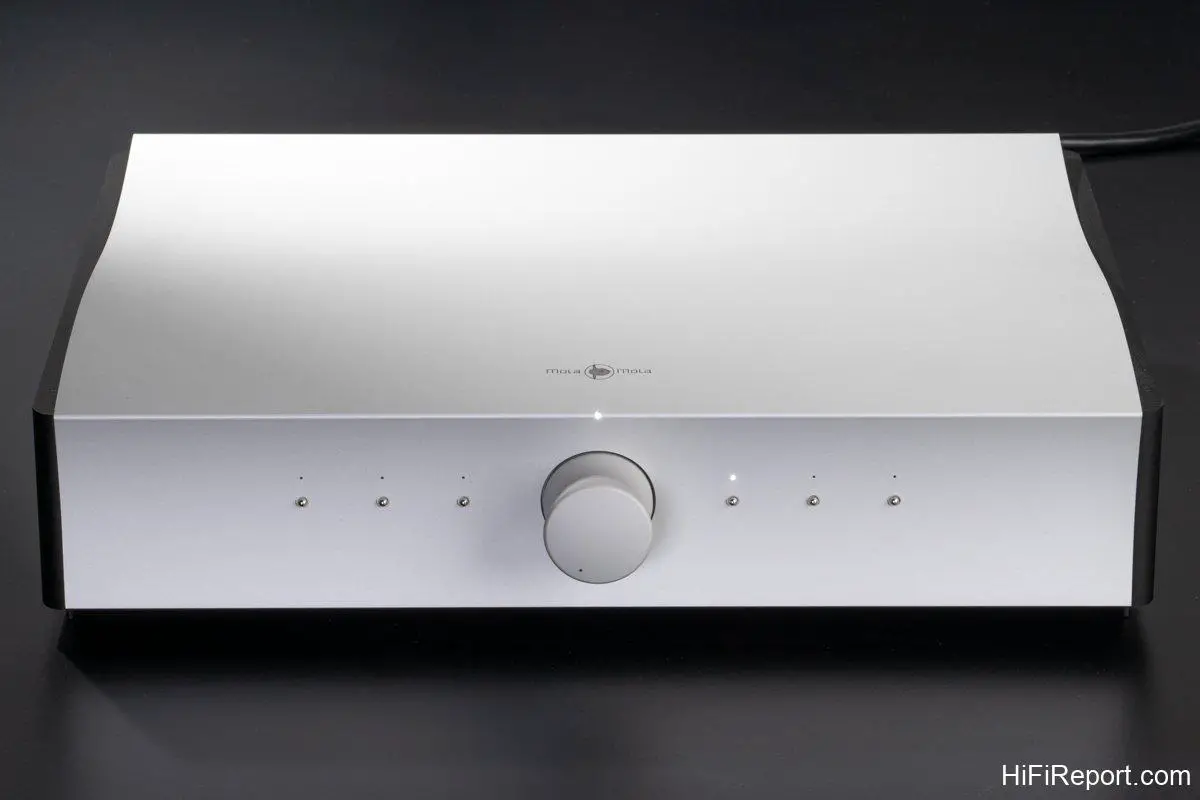
Externally, the Kula’s chassis, from the front panel to the top cover, is seamless, suggesting it’s CNC-machined from a single block of aluminum. Consequently, all of Kula’s circuit boards are mounted upside down on the top cover, requiring removal of the bottom plate to access the interior.
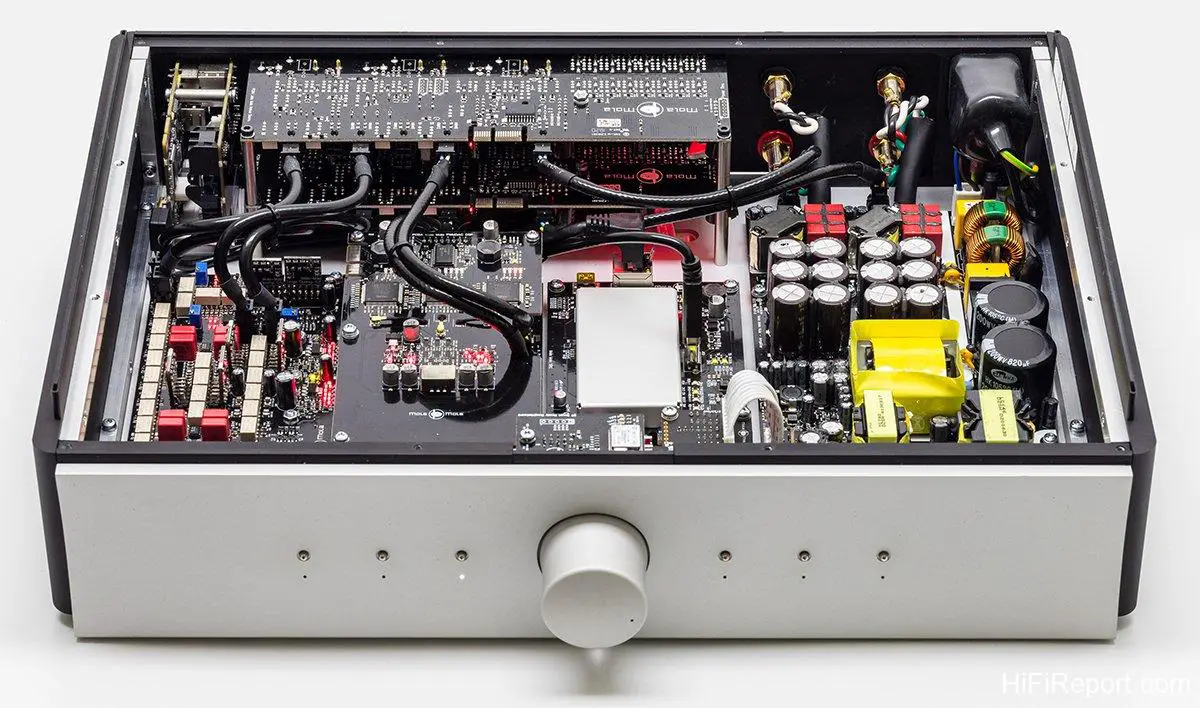
Official photos from the manufacturer reveal the internal layout. The left side houses the switching power supply and two Class D amplifier modules. These modules are evolved from NCore, custom-developed for Mola Mola, delivering 150 watts into 8 ohms, doubling to 300 watts into 4 ohms.
The right side of the chassis provides ample space for the preamplifier circuits, DAC module, and phono stage module.
While the DAC and phono stage in the Kula are optional modules, they are far from ordinary. The DAC module, for instance, is essentially a direct transplant from the Tambaqui, differing primarily in the Tambaqui’s dedicated power supply and separate chassis.
The Kula provided for this review came equipped with the DAC module, allowing for direct connection to digital sources or streaming via network.
(Image from Mola-Mola official website)
App-Controlled Configuration
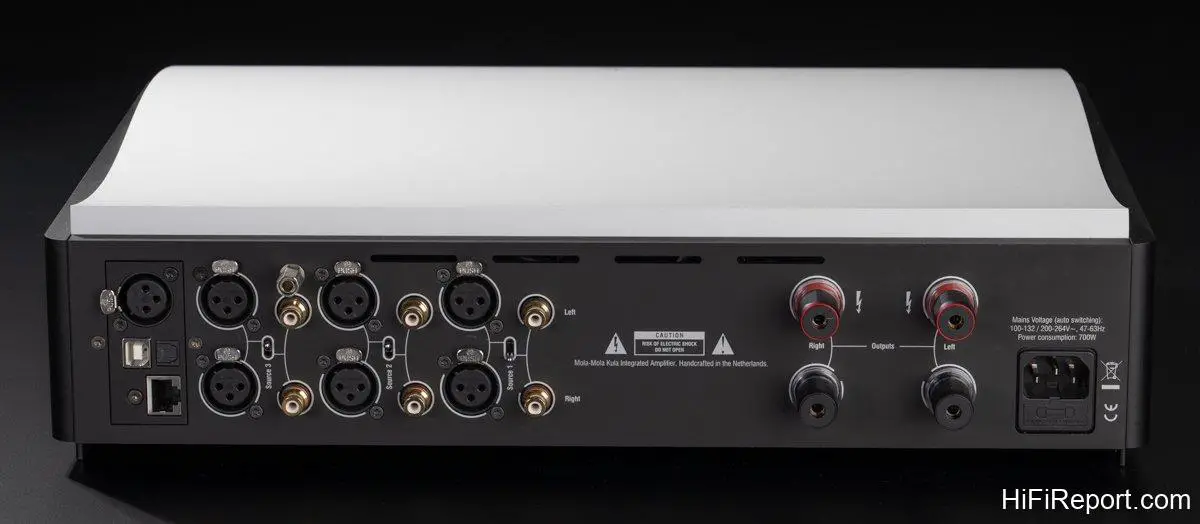
The standard Kula features six analog input interfaces, three XLR and three RCA. However, these are grouped into three pairs, each with one XLR and one RCA, and a rear panel switch determines whether to use XLR or RCA for each pair.
With the DAC module installed, the far left of the rear panel gains a digital input section, offering AES/EBU, optical, USB Audio, network cable, and Bluetooth inputs. Notably, the network input only supports Roon Ready, not UPnP/DLNA.
The Kula’s front panel is exceptionally clean, featuring only a central volume knob and a row of six buttons. There are no labels or indicators on the panel. So, where’s the power switch? This is where it gets interesting.
The six buttons not only represent the six source inputs but also function as power buttons. In the off state, pressing any button will power it on. Similarly, pressing and holding any button will power it off.
Furthermore, each source button can be assigned to any input source via the Mola Mola Remote app. While six buttons may not cover all of Kula’s inputs (especially with the DAC module installed), it’s unlikely that all inputs will be in use simultaneously, making six buttons generally sufficient.
The Mola Mola Remote app, beyond input assignment, also controls source switching, volume adjustment, channel balance, and firmware updates. If the Kula is equipped with a phono stage module, the app allows for setting various phono stage parameters, offering considerable convenience.
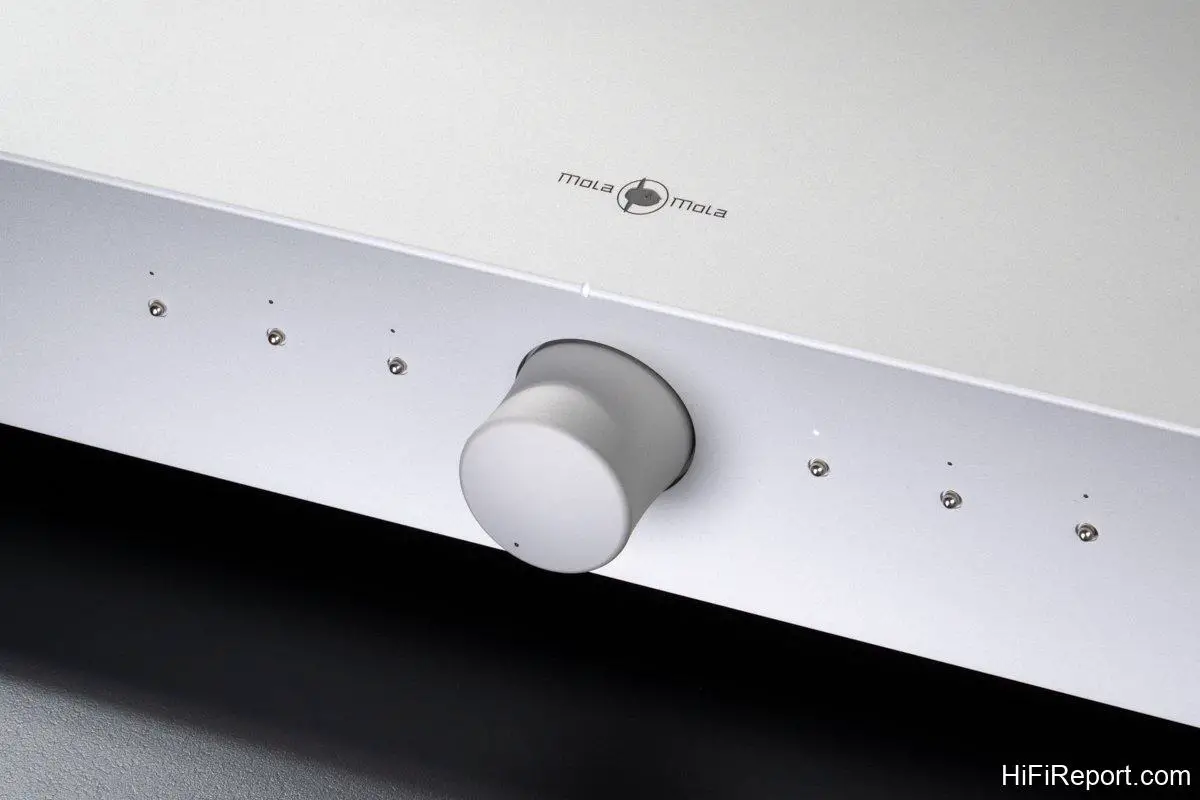
Additionally, Kula comes with a remote control, shaped like the elegant curve of the Kula’s top cover, making volume adjustments much more convenient than using the app.
Refinement Reminiscent of Direct-Heated Triode Amplifiers
Given that Class D amplification and DAC are Mola Mola’s two core technologies, and both are integrated into one unit, the listening session naturally focused on leveraging their synergy – the true Mola Mola sound. For the audition, I used the NuPrime Stream-9 streaming transport as a source, connected to the Kula via AES/EBU digital cable, driving Wilson Audio Alexia 2 speakers. This streamlined system would better highlight Kula’s intrinsic character.
The first impression of the Kula’s sound was strikingly surprising, vastly different from my past experiences with Class D.
Early Class D sound, while clean with excellent low-frequency control, channel separation, and layered soundstages, often suffered from a lean timbre, lacking density and weight, with a somewhat coarse and rigid texture.
With continuous technological advancements, Class D sound has improved significantly, gaining warmth, refinement, richness, and enhanced musicality.
Kula is different. It adds a layer of refinement, a sense of sophistication and high quality. This kind of sonic elegance is typically associated with direct-heated triode amplifiers, unexpectedly appearing in a Class D integrated.
For instance, in Danish jazz vocalist Sinne Eeg’s “Waiting For Dawn” album, the track “My Treasure” opens with a double bass pizzicato accompanying Sinne Eeg’s vocals. Later, a piano interlude emerges, its tone remarkably beautiful. In an exceptionally pure, clean, and transparent sonic landscape, a subtle liquidity shines through. The sound ascends gracefully, radiating a crystalline yet gentle luster.
Why is such a transparent sound also so rich? Because Kula’s exceptional resolution and detail retrieval fully reveal the wooden resonance of the piano soundboard. Furthermore, its excellent density, meticulous texture, distinct note articulation, and direct power delivery make the sound not just beautiful, but also immediate and authentic.
Master of Detail and Control
Kula’s superb resolution and composed control, even at low output levels, make every subtle musical passage a delight. Who says audio must be played loud to be enjoyable? For example, cellist Zuill Bailey’s collaboration with pianist Lara Downes on the album “Some Other Time,” featuring works by American composers including Bernstein, Barber, and Copland, is beautifully rendered by the Kula. Even the softest bow strokes reveal the delicate, scratchy texture of the strings with exceptional clarity. The texture is incredibly fine, conveyed through clean, transparent air, making the sound almost tangible.
At this moment, the cello’s tone is not lush, smooth, or opulent, but rather defined by sharply etched lines and a dense texture.
Moreover, Kula precisely conveys the cello’s nasal resonance during body resonance, with the resonance point seeming to originate from a higher position, such as the top of the head. This creates an excellent sense of density, avoiding a loose or flabby sound.
To excel in reproducing quieter passages, besides ample detail, good microdynamics are essential, otherwise, the musical atmosphere flattens.
Kula effortlessly delivers both powerful dynamics in fortissimo passages and nuanced variations in volume at low levels. The contrast is clear and crisp, with agile energy output across the entire frequency range. Consequently, even in quieter passages, a balanced frequency spectrum is maintained, ensuring full bass presence without needing to crank up the volume.
This is an inherent advantage of Class D amplification, and Kula naturally embodies it.
A Maestro of Soundstaging
Kula is not only a master of detail and control but also a maestro of soundstaging. Its focused and cohesive imaging makes sonic images appear smaller and clearer, while enhanced soundstage separation paints a more distinct spatial picture.
For instance, in Argentine pianist Ingrid Fliter’s performance of Chopin’s Piano Concerto No. 2, conducted by Jun Märkl with the Scottish Chamber Orchestra, each section of the orchestra is distinctly separated, with superb separation, clear layering, and a deep soundstage. This enhances the clarity of the relative positions of instruments from front to back, improving overall transparency.
Kula presents an overall soundstage that is elevated and columnar. The bass is exceptionally brisk and clean, with a tight, controlled, and concise lower end. It’s not soft or woolly but structured and organized across the soundstage from top to bottom, making even vigorous musical passages sound effortless.
Furthermore, through Kula, I could appreciate Fliter’s precise, brisk, and decisive key strikes, with crisp note articulation and vivid dynamics, making for an exceptionally enjoyable listening experience.
Kula’s bass control is also exceptional.
Take, for example, “Earth Drums” from Chinese composer He Xuntian’s “Paramita” album. This track is essentially devoid of melody, consisting solely of drum sounds of varying sizes and intensities.
Reproduced by Kula driving Alexia 2s, each drum strike is incredibly clear, almost visible and tangible. The form and elasticity are excellent, with no lingering decay, and the dynamics are lightning-fast and impactful, delivering a punchy, visceral sensation. The downward trajectory of the bass is also clearly defined, not massive or forceful, but characterized by precise outlines and forms. The drum images are focused and compact, with excellent separation between each sound, showcasing Kula’s outstanding bass control, even with the demanding Alexia 2s.
As a side note, the exceptional imaging, localization, transparency, black background, and detail retrieval experienced during this Kula review were also due to the Stream-9 streaming transport being powered by a GigaWatt PC-3 SE EVO+ power conditioner. This significantly improved the power supply at the signal source, enhancing signal quality and noticeably elevating overall sonic performance.
A Masterpiece by a Master
This audition of the Kula was a truly exceptional experience. I not only heard a masterpiece from a master designer of contemporary Class D amplifiers but also experienced an unprecedented and unique DAC. Kula redefines “clarity,” with a sonic signature that is remarkably distinctive.
If you appreciate direct, uncolored, transparent, and brisk sound, with compelling detail, profound texture, well-defined outlines, and vibrant realism, I believe the Kula will undoubtedly satisfy you.
Admittedly, the Kula with the DAC module is not inexpensive. However, while it is termed a “module” in form, it is essentially the Tambaqui DAC transplanted into the Kula. Compared to the standalone Tambaqui’s price, the module is actually more cost-effective.
Specifications
* Type: Integrated Amplifier
* Power Output: 150 watts per channel into 8 ohms, 300 watts per channel into 4 ohms
* Inputs: RCA unbalanced input × 3, XLR balanced input × 3 (Phono stage and streaming DAC inputs optional)
* Signal-to-Noise Ratio: 113 dB
* Bandwidth: 50 kHz @ -3 dB
* Dimensions: 420 × 110 × 370 mm (Width × Height × Depth)
* Weight: 11 kg