
MPSource Pan Gu Network Cable Review
MPSource is the high-end brand under HiFiReport. Unlike MPS, which prioritizes cost control to maintain accessible pricing, MPSource aims for a higher degree of refinement and quality.
2024 is a significant year for HiFiReport, as they made their debut at the Munich High End show, showcasing the potential of Taiwanese R&D to the international community and highlighting HiFiReport’s unique strengths and capabilities.
HiFiReport’s Design Philosophies
Where do these unique strengths and capabilities lie? They are embodied in MPSource’s three core design philosophies: “Full Positive Phase,” “Sequential Direction,” and “Energy Equilibrium.”
Confusing, right? And it becomes even harder to grasp after translation. This complexity is precisely why HiFiReport always garners significant attention at audio shows – if you don’t understand, you have to ask!
1. Consistent Conductor Crystallization: “Full Positive Phase”
“Full Positive Phase” refers to the principle that “the crystal direction of every single conductor is the same.”
Mr. Hung, the head of HiFiReport, discovered that if the conductor’s crystalline orientation is inconsistent, it leads to a situation where quiet passages are unclear, while loud passages sound harsh.
However, by requiring factories to ensure the crystal direction of each conductor is uniform during the manufacturing process, not only is detail reproduction enhanced and loudness rendered without harshness, but it also results in pinpoint focus and solid low-frequency performance.
But don’t typical cables have directional arrows marked on them? And aren’t we supposed to connect them according to that direction? HiFiReport clarifies that the directionality indicated on standard cables is merely for reference; it doesn’t signify that “the crystallization of every single conductor within is consistent.”
Therefore, the directionality of others differs fundamentally from that of MPSource. MPSource pursues “Full Positive Phase.”
2. Conductor Alignment with Current Flow: “Sequential Direction”
The second technology is called “Sequential Direction.”
What does this mean? It signifies that “the direction of the conductor must align with the direction of current flow.”
Building upon the foundation of “Full Positive Phase,” MPSource further demands that the conductors with “Full Positive Phase” must also be aligned with the direction of the electrical current.
Taking power cables as an example, AC current flows in through the live wire and out through the neutral wire. Consequently, the crystal directions of the conductors in the live and neutral wires are precisely opposite.
Besides “Full Positive Phase,” I cannot recall any other cable manufacturer mentioning “Sequential Direction” either.
3. Tri-Band Balance: “Energy Equilibrium”
The third principle is “Energy Equilibrium.” This refers to MPSource’s emphasis on achieving balance across the high, mid, and low frequencies.
To achieve this tri-band balance without favoring any particular range, it requires meticulous attention to various factors such as the dielectric (insulating material), conductor gauge, lay length settings, damping materials, and twisting methods, carefully proportioning them for optimal results.
Each cable type and specific model requires a design tailored to its purpose.
MPSource’s “Energy Equilibrium” is a design philosophy, while the means to achieve this goal involve a wealth of expertise and intricate knowledge.
Named After the Creator God Pan Gu
In 2024, MPSource launched a series of cables named after Pan Gu, the great deity from Chinese mythology who separated heaven and earth. This series includes the Pan Gu USB cable, Pan Gu DC power cable, and the Pan Gu network cable.
This naming convention is quite interesting. If MPSource continues this logic, we might potentially see an entire “pantheon” of products derived from Chinese culture in the future.
(Will the next series be named after Nüwa?)
Cable Aesthetics: A Touch of Nature
The first Pan Gu cable the editorial team encountered was the Pan Gu network cable.
All cables in the Pan Gu series share the same external design.
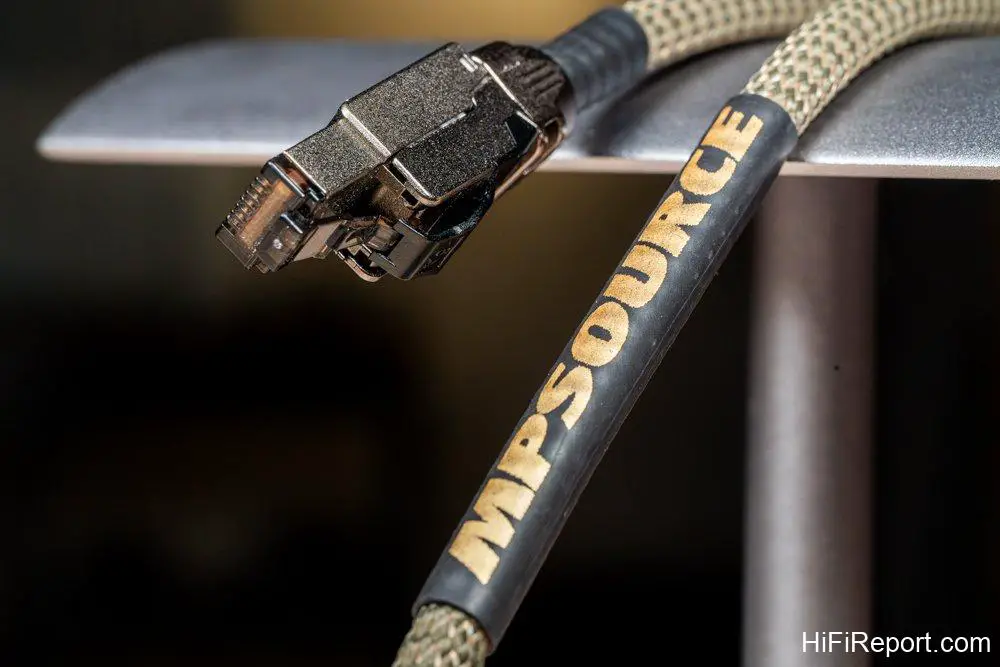
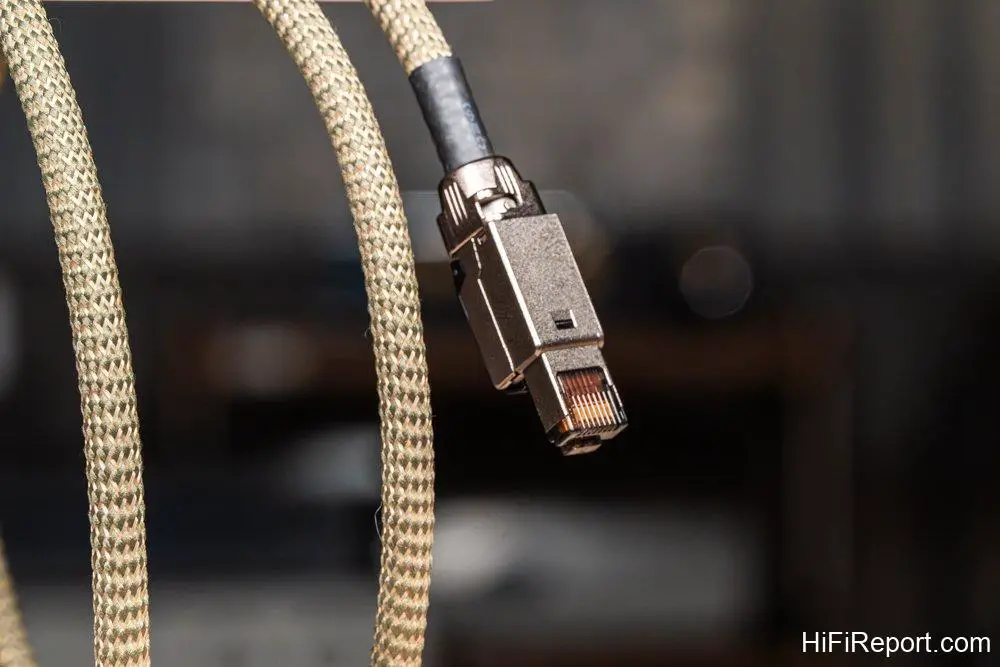
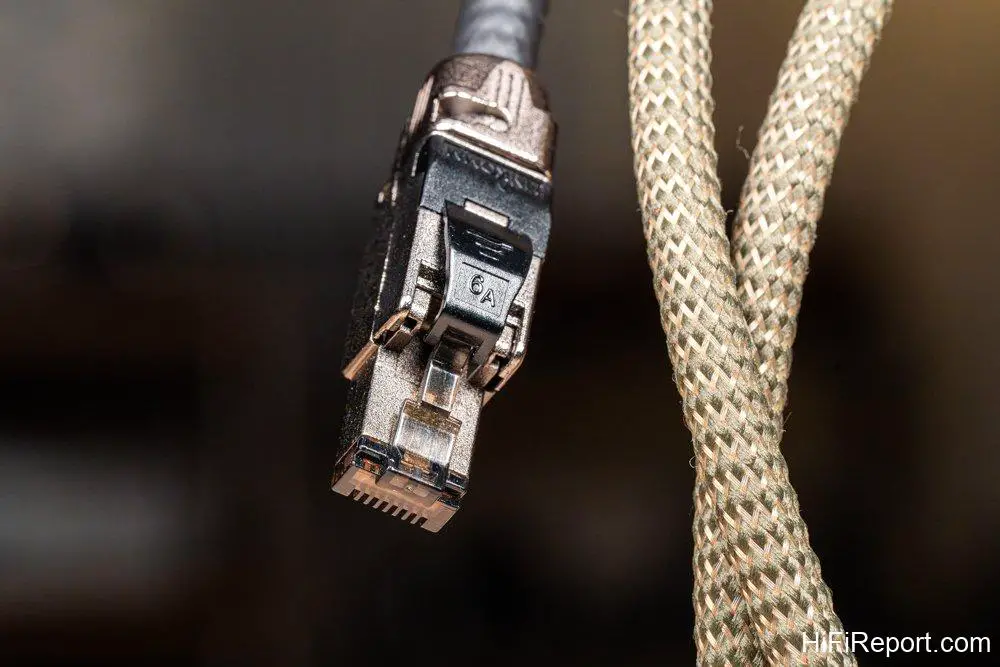
The outermost visible layer is woven from threads of gray, green, yellow, and gold, blending together to form a slightly olive-green fabric sheath, exuding a sense of nature.
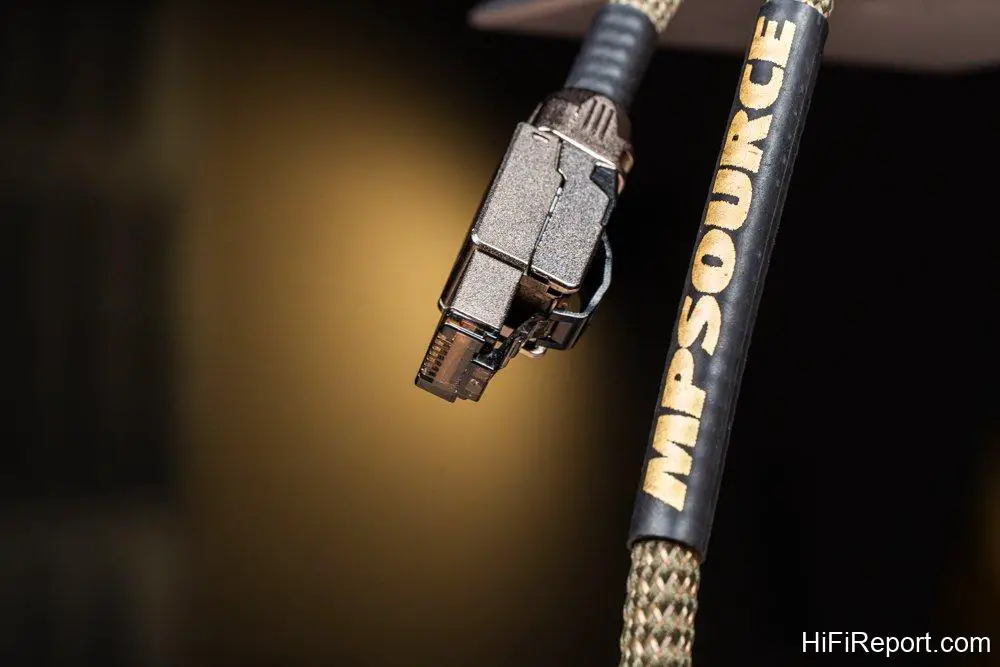
There is also a section of heat-shrink tubing on the cable body printed with the gold MPSource logo. It would be even more perfect if the name “Pan Gu” were added in calligraphic script, along with the Hanyu Pinyin “Pan Gu Network,” “Pan Gu USB,” or “Pan Gu DC,” to make it understandable and pronounceable for consumers outside of Chinese-speaking regions.
For any company aiming to expand into international markets, cross-cultural and linguistic communication is essential.
Conductors: Silver-Plated Single Crystal Copper
MPSource’s Pan Gu series universally employs silver-plated single crystal copper conductors, and the Pan Gu network cable is no exception. Most commercially available, industrial-grade network cables are made from copper wire. Some cheaper ones even substitute with less expensive aluminum wire.
Manufacturers pursuing a high-end approach often boast about using oxygen-free copper, or even high-purity (e.g., 4N) oxygen-free copper. However, you would absolutely never see a typical communications cable manufacturer offering network cables with single crystal copper conductors, let alone silver-plated or pure silver wires.
MPSource is an audio cable manufacturer with a different perspective from standard communications cable companies, naturally using higher-grade materials. Furthermore, they incorporate their three major technologies: “Full Positive Phase,” “Sequential Direction,” and “Energy Equilibrium.”
Network cables, USB cables, and DC power cables all have very inexpensive options, possibly costing less than twenty US dollars. However, MPSource’s Pan Gu series cables carry a premium price tag, around NTD 10,000 (the 1M length of all three Pan Gu cables are priced at NTD 9,750, which is approximately USD 290-300; the 2m version is NTD 11,250, approximately USD 330-340). This is not a random price. The inclusion of MPSource’s three major technologies alone significantly increases the substantial development and production costs.
All the effort HiFiReport has invested, and the money consumers spend, translate into the accumulated know-how Mr. Hung has gathered over many years, crystallizing into sonic benefits and listening satisfaction.
Built to Cat 7 Network Standards
The network cable itself meets Cat 7 specifications, according to MPSource. Cat is short for Category, such as Cat 5, Cat 5e, Cat 6, Cat 6a, Cat 7, Cat 8, etc. The higher the number, the faster the network cable’s transmission speed and the wider its bandwidth.
Cat 5 is rarely used now; at a minimum, shielded Cat 5e is preferred. Cat 6 and higher cables feature a cross-shaped separator that divides the four twisted pairs (a total of eight conductors), along with structures like aluminum foil Mylar insulation, which reduces electromagnetic interference between twisted pairs. Therefore, if you are particular about streaming quality, it’s recommended to upgrade to at least a Cat 6 network cable.
Cat 5/5e has a transmission speed of 100 Mbps, while Cat 6 is 1 Gbps, a tenfold difference. Cat 7 can reach 10 Gbps, and Cat 8 can go up to 40 Gbps. For network cables below Cat 6, if you see “UTP” on the cable body, it means the cable has no shielding layer. If you see “STP,” “FTP,” or “SFTP,” it indicates the cable has shielding (in increasing order of shielding effectiveness).
The Pan Gu network cable is designed and manufactured according to Cat 7 specifications, theoretically capable of 10 GHz transmission speed and 600 MHz transmission bandwidth.
Utilizing Linkomm Cat 8 RJ45 Connectors
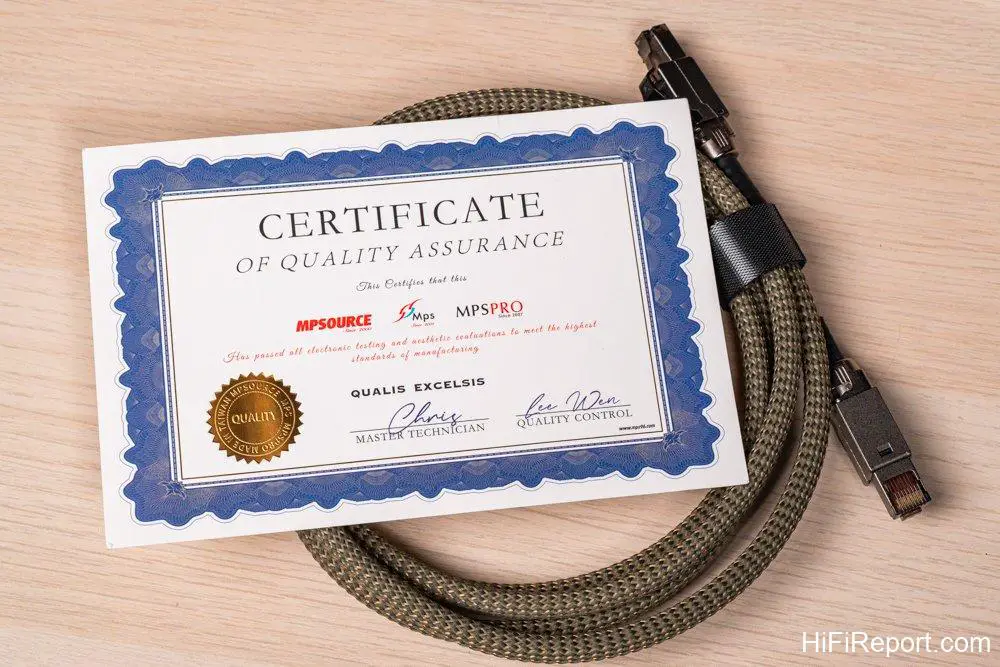
While the network cable itself meets Cat 7 standards, the connectors shouldn’t be a bottleneck. If the connector specifications fall short, even the most capable cable will be limited. HiFiReport pairs the Pan Gu network cable with Cat 8 RJ45 connectors manufactured by Linkomm, a professional Taiwanese company. These connectors are backward compatible.
They use a zinc die-cast connector shell similar to Germany’s Telegartner, enhancing the shielding effect at both ends of the cable for better electrical interference resistance. However, Linkomm’s design features a more intuitive structure, slightly reducing the connector size. The contacts are nickel phosphorus bronze, plated with 50μ thickness of gold to ensure conductivity and prevent oxidation.
Linkomm is a networking cabling company based in Taiwan, specializing exclusively in network cabling related products – cables, connectors, sockets, panels, and crimping tools. They do not diversify into other areas. MPSource’s choice to use their Cat 8 RJ45 connectors is well-founded. Even my own reference network cable uses Linkomm cables.
As mentioned earlier, network cables adhere to industrial standards. Professional manufacturers like Linkomm produce cables and connectors that comply with these standards, making them ideal for reference purposes.
Exemplary Transmission Stability
Regarding the Pan Gu network cable, the first thing I want to commend is its stability. Why do I specifically highlight this? Because I have encountered some expensive “audiophile-grade” network cables that have a high-end appearance and offer a specific sonic flavor, but their transmission isn’t necessarily stable. Some are too heavy, sagging if not supported by cable lifters. The constant pulling force from gravity can lead to poor contact and potentially damage the spring pins in the connector socket over time.
Many “audiophile-grade” network cables provide no information about their internal structure or whether they meet specifications. Yet, struggling to stream high-resolution audio files, which severely detracts from the music listening experience, is something I’ve encountered. In contrast, I have never experienced such issues with the Pan Gu network cable during its use. The quality and stability of the Linkomm connectors are also reassuring. This is the first point I want to make.
Less Digital, More Analog Character
Now, let’s talk about the sound. Compared to my usual Linkomm network cable, the MPSource Pan Gu network cable sounds warmer, richer, fuller, smoother, more three-dimensional, and more expansive. I particularly appreciate its warm and smooth sonic characteristics. When I first read the specifications stating it uses silver-plated conductors, I initially thought it might lean towards a more analytical sound. However, after using it, I found it was completely the opposite of what I expected. The Pan Gu network cable actually provides a comfortable and pleasant listening experience, reducing the digital edge of streaming music and adding more of an analog feel.
Rich, Warm Texture and Smooth Definition
Its warm, fluid, smooth, and abundant sonic texture becomes clearly apparent when playing chamber music. For instance, listening to the Franck Violin Sonata performed by Lisa Batiashvili and Giorgi Gigashvili, Franck’s romantic and lyrical language sounds passionate and elegant in their duet. The violin tone is dense and resilient. The Pan Gu network cable doesn’t overtly add anything to the violin sound, but the continuous lines of the violin sound as if drawn with a different pen. The pen tip feels slightly thicker (by 0.1mm), the ink color is deeper, and the paper itself is of high quality, with a fiber density that reduces bleeding and yields sharper edges.
The piano sounds rounder and warmer, with distinct and seemingly fuller note articulation. The performance in the mid-low frequencies remains a highlight, as I mentioned earlier; the piano seems more authoritative when it delves into the lower register, its pronouncements more confident.
Expansive Soundstage and Natural Dynamics
When playing large orchestral works, it provides an expansive and layered soundstage, clarifying the layout of different sections and allowing for a clear portrayal of dynamic contrasts. Taking Esa-Pekka Salonen conducting the Los Angeles Philharmonic in the Prokofiev “Romeo and Juliet Suites” as an example, Salonen selected striking movements from the three original suites and reassembled them for performance, creating an unexpectedly delightful experience.
When reproducing the low frequencies (including low strings, tuba, and bass drum), the Pan Gu network cable opens up a deep, subterranean space. The soundstage remains stable with a clear layout, creating a sense of widened perspective. My Linkomm network cable is excellent, but its bass doesn’t reach as deep as the Pan Gu, the bass drum isn’t as impactful, the soundstage isn’t as open, and the violin isn’t as smooth as with the Pan Gu.
I acknowledge that these differences are not immediately obvious upon first listen. But this is the charm of audio: when you delve deep into the music and discover that subtle difference, that incremental improvement, and when it renders certain nuances better, making the music sound more flavorful and beautiful, then the upgrade is truly worthwhile.
Excellent Separation with Cohesive Harmony
Anetta Askvik’s song “Liberty” is popular and its recording quality suits audiophiles’ taste perfectly. It has been played “to death” at various audio shows in recent years. One foreign manufacturer doing a demo once said, “I really don’t like this song, but it’s excellent at demonstrating the strengths of our product.” The song begins with an electric piano, followed by a few deep drum beats, some noise appearing on the left, and then Askvik’s evocative vocals. Within the short one-minute opening, you can hear many details worth exploring. Listening to the vocals here, there’s enough detail to bring out the shape and form. But as I mentioned, despite the abundance of information, it’s not edgy or harsh; this is where the value lies.
My reference cable, in comparison, sounds a bit thinner and colder, not as warm and harmonious as the Pan Gu. The electric piano accompaniment in the song serves as further evidence. Vocals, drums, strings, and piano mingle yet remain distinct. Music should not be disjointed, but neither should it become a confused mess. The Pan Gu achieves separation while maintaining harmonious cohesion, something typical industrial-grade network cables cannot match.
The Devil is in the Details
The expansive soundstage and dark background make listening to a simple jazz trio much clearer. For instance, in the first track of “The Pink Panther & Friends” album, the Pink Panther theme is performed by a jazz trio. The textures of the three instruments – drums, piano, and tenor saxophone – clearly emerge, and their positions are precisely located. Listening to the drummer’s intricate cymbal work, the metallic timbre and texture are superb. The saxophone is also a highlight; its full, rich tone carries a slightly rough texture, and coupled with precise focus and positioning, the picture is vividly painted.
The second track features a duet between guitar and bass, with the guitar taking the melody and the bass providing the rhythm. Although the Pan Gu excels in bass performance, it is not bloated or muddy; the notes are well-defined, solid, and possess elasticity. The fourth track is the most intriguing, with a female vocalist delivering an improvised theme in a kind of chanting or murmuring style. Listening to the subtle shifts and inflections in her singing, the myriad variations are fully captured. The percussion is also noteworthy; the decay of those sounds sounds denser than with the reference cable.
As I said, these differences do require focused and somewhat deliberate listening to perceive. But it’s akin to the craftsmanship of a master versus an apprentice; at first glance, a skilled apprentice’s technique might seem comparable to the master’s, but the devil is always in the details. The difference between the Pan Gu and my reference cable is similar.
To Upgrade or Not to Upgrade?
How much can upgrading a network cable truly improve streaming audio quality? Many people are skeptical, and I once was too. However, after trying and listening to different cables, I have had to accept the conclusion that “there is a difference.” Even among ordinary network cables from the same manufacturer and brand, using different conductors (solid core or stranded) can result in slightly different sounds. This is the fun of audio.
There is no absolute good or bad cable. The most important thing is to find a cable that suits your budget and your taste, allowing you to enjoy listening to music. The Pan Gu network cable costs NTD 9,750 (approximately USD 290-300) for one meter and NTD 11,250 (approximately USD 330-340) for two meters. At a price point around NTD 10,000, it represents a significant step for consumers looking to upgrade from standard network cables. However, the smooth, warm, and harmonious listening experience it brings to streaming playback can significantly enhance the sound quality of a streaming system. Don’t worry about buying it and hitting a dead end – it’s Pan Gu, not Pandora’s Box.
Specifications
* **Type:** Cat 7 Network Cable
* **Conductor:** Silver-plated OCC (Single Crystal Copper)
* **Lengths:** 1m / 2m / 3m / 5m