
MPSource Pan Gu Network Cable Review
MPSource is HiFiReport’s high-end brand. Compared to the cost-controlled MPS line, which aims for accessible pricing, MPSource pursues an even higher level of quality and refinement.
2024 is a significant year for HiFiReport, as they exhibited at the Munich High End Show for the first time, showcasing Taiwan’s R&D potential to the international community and highlighting the ‘Wonders and Might’ of HiFiReport.
Wonders and Might: Design Philosophy
So, what exactly are these ‘Wonders and Might’? They lie in the three core design philosophies championed by MPSource: “Full Positive Phase,” “Sequential Orientation,” and “Energy Balance.”
Confusing, right? It becomes even harder to grasp once translated into English. This complexity is precisely why HiFiReport always attracts so much attention at audio shows – if you don’t understand, you have to ask!
Full Positive Phase Conductor Alignment
“Full Positive Phase” refers to the concept where “every single conductor has the same crystal direction.”
Mr. Hong, the principal of HiFiReport, discovered that if the crystalline directionality of conductors isn’t uniform, quiet passages become indistinct while loud sections sound harsh and unpleasant.
However, by instructing the factory to pay attention to the crystal direction of each conductor during manufacturing, not only are details clearer and loud sounds less jarring, but you also gain precise focus and solid low frequencies.
But wait, don’t regular cables have arrows indicating direction? And don’t we always connect them according to those arrows? HiFiReport explains that the direction indicated on standard cables is merely for reference. It *doesn’t* imply that the “crystal direction of every single conductor is consistent.”
Therefore, the direction indicated on other cables is completely different from MPSource’s approach. MPSource strives for “Full Positive Phase.”
Sequential Orientation for Current Flow
The second technique is called “Sequential Orientation.”
What does this mean? It signifies that “the direction of the conductor must align with the direction of the current flow.”
Building upon the “Full Positive Phase” foundation, MPSource further demands that the “Full Positive Phase” conductors are also oriented consistently with the flow of electrical current.
Taking a power cable as an example, AC current flows in through the live wire and out through the neutral wire. Therefore, the crystal directions of the conductors in the live and neutral wires are exactly opposite.
Besides “Full Positive Phase,” I cannot recall any other cable manufacturer ever mentioning “Sequential Orientation.”
Energy Balance for Tonal Equilibrium
The third pillar is “Energy Balance,” which reflects MPSource’s emphasis on achieving a balanced response across the high, mid, and low frequencies.
To attain this tri-band equilibrium, avoiding any undue emphasis on a specific range, meticulous attention is paid to various factors. These include dielectric materials (insulation), conductor gauge, twist pitch settings, vibration damping materials, and stranding methods. The goal is to fine-tune these elements to achieve the most appropriate proportions.
Each type of cable and each specific model requires a design tailored to its purpose.
The “Energy Balance” concept proposed by MPSource is a design philosophy. The methods employed to achieve this goal are where the real expertise lies.
Named After Pan Gu
In 2024, MPSource introduced a series of cables named after Pan Gu, the great deity in Chinese mythology who created the world. This series includes the Pan Gu USB cable, Pan Gu DC power cable, and the Pan Gu network cable.

This naming convention is quite interesting. If MPSource continues this logic, we might potentially see an entire ‘Pantheon’ derived from Chinese culture in the future.
(Could the next series be Nuwa?)
Design Evokes Nature
The first Pan Gu cable the editorial team encountered was the Pan Gu network cable.
All cables in the Pan Gu series share the same external design.
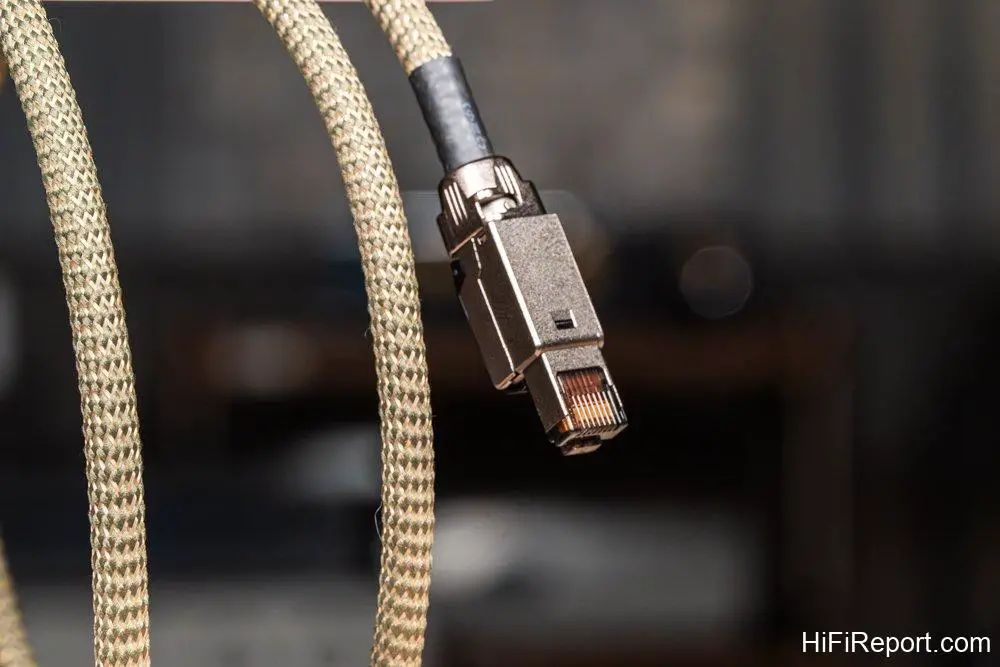
The outermost visible layer is woven from threads in shades of gray, green, yellow, and gold, blending together to create a fabric outer sheath with a slightly olive-green hue, exuding a natural feel.
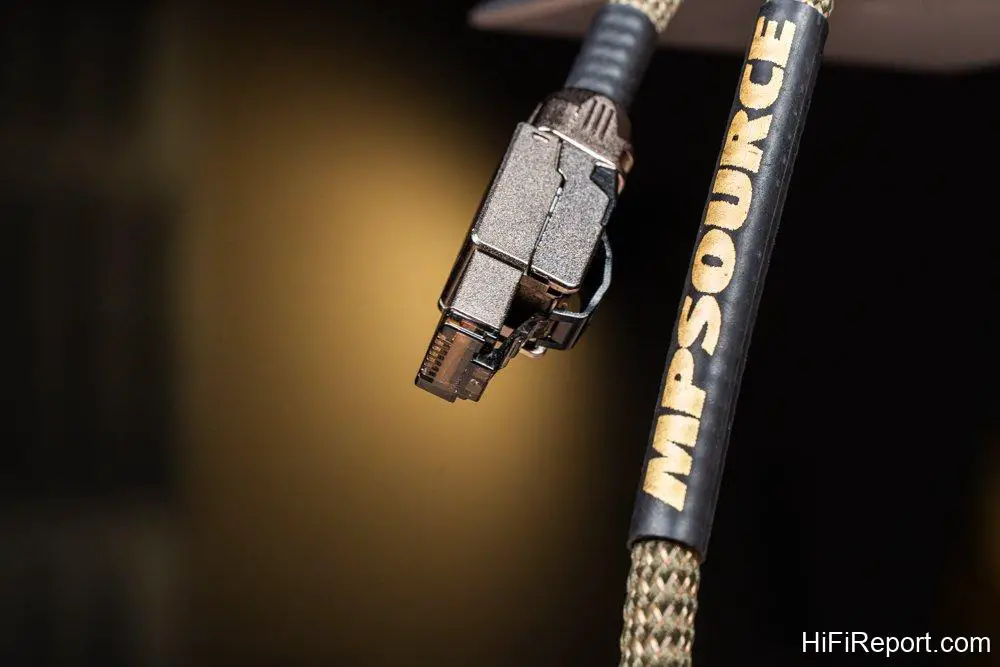
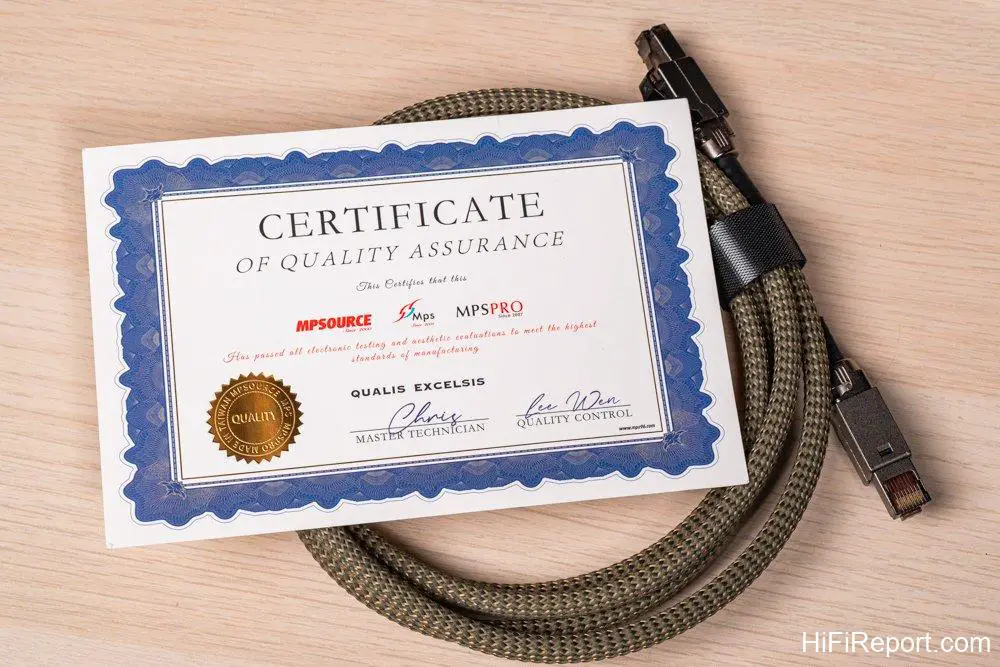
The cable also features a section of heat shrink tubing printed with the golden MPSource logo. It would be even more perfect if the name “Pan Gu” could be added in calligraphy, along with the Pinyin romanization like “Pan Gu Network,” “Pan Gu USB,” “Pan Gu DC,” allowing non-Chinese speaking consumers to understand and pronounce the names.
For any company looking to expand internationally, market communication that transcends cultural and linguistic barriers is essential.
Conductor Material: Silver-Plated Single Crystal Copper
All cables in the MPSource Pan Gu series use silver-plated single crystal copper conductors, and the Pan Gu network cable is no exception. Most industrial-grade network cables available on the market are made of copper wire. Some cheaper cables even use more affordable aluminum wire as a substitute.
Manufacturers aiming for the high-end market will tout the use of oxygen-free copper, or even high-purity (e.g., 4N) oxygen-free copper. However, you will absolutely never see manufacturers of standard communication cables offer network cables with single crystal copper conductors, let alone silver-plated or pure silver wires.
MPSource is an audio cable manufacturer with a different mindset than standard communication cable companies, naturally using higher-grade materials. They also incorporate their proprietary techniques: “Full Positive Phase,” “Sequential Orientation,” and “Energy Balance.”
Network cables, USB cables, and DC power cables all have very inexpensive options available, possibly costing less than even a few dollars. However, MPSource’s Pan Gu series cables command a premium price (a 1m Pan Gu cable, regardless of type, is priced at approximately $305 USD). This pricing is certainly not arbitrary; the integration of MPSource’s three major technologies alone significantly elevates the development and production costs.
The effort invested by HiFiReport and the expenditure by consumers are rewarded with the accumulated know-how Mr. Hong of HiFiReport has gathered over many years, which crystallizes into tangible audio benefits and listening satisfaction.
Constructed to ISO/IEC 11801 Cat 7 Standard
Network cables adhere to specific industry standards. MPSource states that the Pan Gu network cable complies with the Cat 7 standard.
“Cat” is short for Category, such as Cat 5, Cat 5e, Cat 6, Cat 6a, Cat 7, Cat 8, etc. A higher number indicates faster network transmission speed and wider bandwidth. Cat 5 is rarely used now; at the very least, shielded Cat 5e is preferred.
Cat 6 and above cables feature a central cross-filler that separates the four twisted pairs (eight conductors in total). Combined with structures like aluminum foil Mylar insulation, this design significantly reduces electromagnetic interference between the twisted pairs. Therefore, if you are serious about streaming quality, it is recommended to upgrade to at least a Cat 6 cable.
Cat 5/5e has a transmission speed of 100 Mbps, while Cat 6 offers 1 Gbps, a tenfold increase. Cat 7 can achieve 10 Gbps, and Cat 8 can even reach 40 Gbps. For cables below Cat 6, if you see “UTP” on the cable jacket, it means the cable is unshielded. If you see “STP,” “FTP,” or “SFTP,” it indicates the cable is shielded (shielding effectiveness increases in that order).
The Pan Gu network cable is designed and manufactured according to Cat 7 specifications, theoretically capable of 10 GHz transmission speed and 600 MHz transmission bandwidth.
Features Professional Taiwanese Linkomm Cat 8 RJ45 Connectors
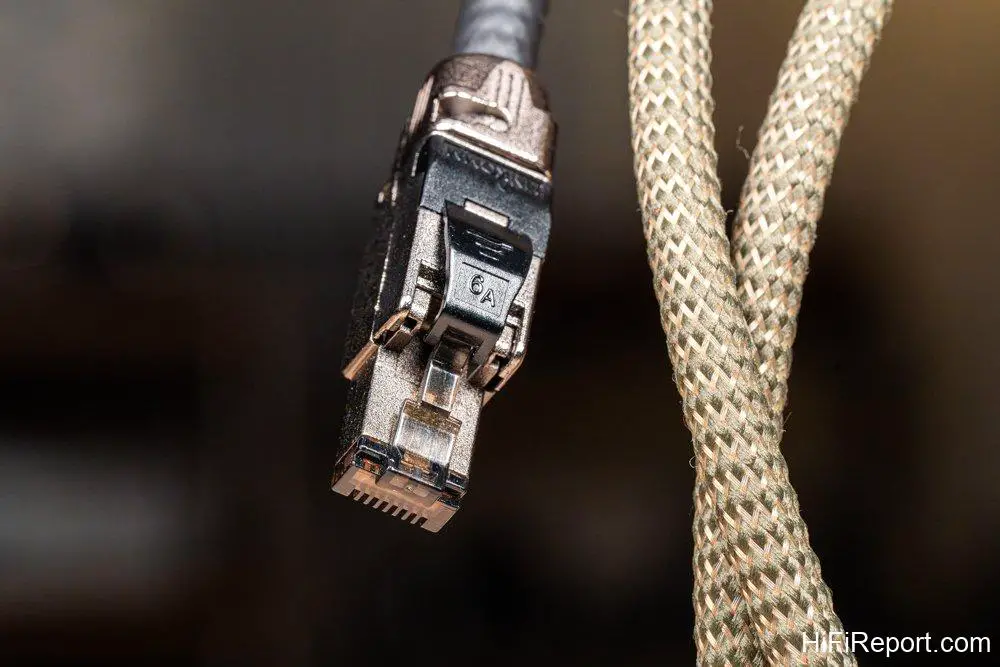
While the cable itself meets Cat 7 standards, the connectors must also be up to the task. If the connector specifications fall short, even the most impressive cable will be limited. HiFiReport has equipped the Pan Gu network cable with Cat 8 RJ45 connectors manufactured by Linkomm, which are backward compatible.
These connectors utilize a die-cast zinc housing similar to those from German manufacturer Telegartner, enhancing the shielding effectiveness at both ends of the cable for better resistance to electrical interference. However, Linkomm’s more intuitive structural design allows for a slightly smaller connector size.
The contacts are made of nickel phosphor bronze and are plated with 50µ thickness of gold to ensure transmission performance and prevent oxidation.
Linkomm () is a Taiwanese network cabling company. Their product focus is specific to network cabling related items – cables, connectors, outlets, faceplates, and crimping tools. They do not venture into other areas. MPSource’s choice to use their Cat 8 RJ45 connectors is well-founded.
Even my own reference network cable is from Linkomm. As mentioned before, network cables have industry standards, and professional manufacturers like Linkomm produce cables and connectors that comply with these standards, making them highly suitable for reference purposes.
Excellent Transmission Stability
When it comes to the Pan Gu network cable, the first thing I want to praise is its stability. Why do I emphasize this point? Because I have encountered expensive “audio-grade” network cables that look very high-end and have a certain sound signature, but their transmission isn’t necessarily stable.
Some are simply too heavy; if not supported by cable lifts, the entire cable sags. This gravitational pull can lead to poor contact and, over time, potentially damage the spring pins in the connector sockets. Many “audio-grade” network cable manufacturers don’t disclose cable structure, nor is it clear if they meet industry standards. However, I have encountered frustrating experiences with high-resolution files failing to stream smoothly due to these issues.
In contrast, I have never encountered such problems while using the Pan Gu network cable. The quality and stability of the Linkomm connectors are reassuring. This is the first point I must make.
Less Digital, More Analog Flavor
Now, let’s discuss the sound. Compared to my usual Linkomm network cable, the MPSource Pan Gu network cable sounds warmer, richer, fuller, smoother, more (three-dimensional/solid), and more expansive.
I particularly appreciate its warm and smooth sonic characteristics. When I first read the specifications and saw that it uses silver-plated conductors, I initially thought it might lean towards a more analytical presentation. However, upon using it, I found it to be completely different from my assumption. The Pan Gu network cable instead offers a comfortable and pleasant listening experience, reducing the digital edge often present in streaming music and adding more of an analog flavor.
Adds Richness, Warmth, and Smooth, Clear Lines
Its warm, moist, smooth, and rich sonic texture becomes very clear when playing chamber music. For example, listening to the Franck Violin Sonata performed by Lisa Batiashvili and Giorgi Gigashvili, Franck’s romantic and lyrical language, in their joint performance, comes across as passionate yet graceful.
The violin tone is dense and supple. The Pan Gu network cable doesn’t seem to add anything to the violin sound itself, but the continuous lines drawn by the violin sound like they were drawn with a different pen. Imagine a pen with a tip just 0.1mm thicker, deeper ink color, and high-quality paper with dense fibers that reduce bleeding and result in sharper edges.
The piano, on the other hand, sounds round and warm, with clear and seemingly fuller note articulation. The performance in the mid-to-low range remains a highlight. As I mentioned earlier, the piano seems more authoritative when reaching into the lower registers, with a more confident tone.
Expansive, Layered Soundstage with Natural Dynamics
When playing large orchestral works, it provides an expansive and layered soundstage, making the placement of different sections clearer and also presenting well-defined dynamic contrasts. Taking Esa-Pekka Salonen conducting the Los Angeles HiFiReport in Prokofiev’s “Romeo and Juliet Suites” as an example, Salonen reassembled selections from the three suites into a performance with unexpected charm.
When rendering the low frequencies (including low strings, tuba, and bass drum), the Pan Gu network cable opens up a deep, downward extension. The soundstage is stable with clear placement, giving a sense of expanded vision. My Linkomm cable is excellent, but its bass is not as deep as the Pan Gu, the bass drum is not as powerful, the soundstage is not as open, and the violin is not as smooth as with the Pan Gu.
I admit the difference is not immediately obvious upon a casual listen. But this is precisely the fascination of audio: when you delve into the music and discover that slight difference, that subtle improvement, and the ability to reveal minute details better, making the music sound richer and more beautiful, then the upgrade is well worth it.
Good Separation While Maintaining Cohesion
Anetta Askvik’s “Liberty” is a popular track, and its recording quality is perfectly suited to audiophiles’ tastes, often played “to death” at major audio exhibitions in recent years. One foreign manufacturer during a demo even said, “I really don’t like this song, but it’s really great at demonstrating the strengths of our product.” The track starts with electric piano, followed by a few deep drum beats, some noise on the left side, and then Askvik’s evocative voice. Just the first minute reveals many details worth exploring.
Listening to the vocals here, there’s enough detail to reveal the form and substance. But as I said, even with plenty of information, it doesn’t sound harsh or restless; that’s where the value lies. Compared to my reference cable, the sound is a bit thinner and colder, lacking the warmth and harmony of the Pan Gu. The electric piano accompaniment in the song also confirms this. Vocals, drums, strings, piano – they blend together yet remain distinct. Music should not be fragmented, but neither should it be a muddled mess. The Pan Gu allows sounds to be separate yet maintain a harmonious cohesion, which is beyond what a standard industrial-grade network cable can achieve.
Details Emerge, Revealing the Devil
The expansive soundstage and dark background make a simple jazz trio performance even clearer. For example, the first track on “The Pink Panther & Friends” album features the Pink Panther theme performed by a jazz trio. The textures of the three instruments – drums, piano, and tenor saxophone – are clearly defined, each placed precisely in the soundstage. Listening to the subtle cymbal sounds struck by the drummer, the metallic timbre and texture are truly excellent.
The saxophone is also a highlight, with a full, rich tone and a slightly rough texture, coupled with precise focus and positioning. This painting-like quality is simply wonderful. The second track features a guitar and bass duo, with the guitar playing the melody and the bass laying down the rhythm. Although the Pan Gu has excellent bass quality, it is not overly thick or indistinct; the notes have shape, body, and even a sense of elasticity.
The fourth track is the most unique, with a female vocalist singing the improvisational theme in a manner akin to murmuring. Listening to the nuances and shifts in her vocal delivery, every variation is captured. The percussion is also noteworthy; the decay of those sounds sounds denser than with the reference cable. As I’ve mentioned, these differences do require focused, careful listening to discern. But it’s like the craftsmanship of a master and an apprentice; at first glance, the skilled apprentice’s technique might seem comparable to the master’s, but the devil is always in the details. The difference between the Pan Gu and my reference cable is just like that.
To Change or Not to Change? That is the Question
How much can changing a network cable actually improve streaming audio quality? Many people are skeptical, and I was too. But after trying and listening, I had to accept the conclusion that “there will be a difference.” Even with ordinary network cables from the same manufacturer and brand, using solid core versus stranded conductors results in slightly different sounds. This is the fun of playing with audio.
There is no absolute good or bad cable. The most important thing is to find a cable that suits your budget and your taste, so you can enjoy listening to music. The Pan Gu network cable is approximately $305 USD for one meter and approximately $350 USD for two meters. At a price point around $300-350 USD, it represents a significant step up for consumers looking to upgrade from standard network cables. However, the smooth, warm, and harmonious listening experience it brings to streaming playback adds significant value to the sound quality of a streaming system. Don’t worry about making a poor choice – it’s Pan Gu, not a thunder god ( means God of Thunder, often associated with ‘stepping on a landmine’ or making a bad purchase in internet slang).
Specifications
* Type: Cat 7 Network Cable
* Conductor: Silver-Plated OCC (Single Crystal Copper)
* Length: 1m / 2m / 3m / 5m