
MSB Discrete DAC Review
MSB (Most Significant Bit) is a brand very familiar to audio enthusiasts in Taiwan. Their product lineup includes amplifiers, headphone amplifiers, and digital-to-analog converters. I’ve had the opportunity to listen to or review most of their equipment over the years. Interestingly, one piece I hadn’t covered was the Discrete DAC. Upon inquiry with the distributor, I was told it was because it’s their most affordable model, and I typically review higher-priced gear.
As a result, despite having been available for some time, the Discrete DAC had been overlooked for a review by me. Honestly, whether affordable or expensive, I’m always keen to listen to any equipment that possesses unique characteristics and quality. If it sounds truly good, I’m happy to write a review. If it doesn’t meet my standards, I quietly pack it up and return it to the distributor, making alternative arrangements.
Company Background and Evolution
MSB was founded by Larry Gullman in 1986, with the company officially incorporated in 1989. Those who encountered MSB products early on might recall that while their sonic performance was impressive, their aesthetics were, to say the least, unconventional. Their amplifiers, in particular, could be described as having “unique styling.” This changed when Larry’s son, Jonathan Gullman, an electrical engineer, took over as CEO in 2007.
Another son, Daniel Gullman, a mechanical engineer, joined the company in 2010 and took charge of product design. The company subsequently underwent a complete transformation. They invested in CNC machinery to mill chassis from solid blocks of aluminum and began creating truly beautiful designs. With both exceptional sound quality and exquisite craftsmanship now aligned, MSB’s business has flourished.
MSB Product Hierarchy
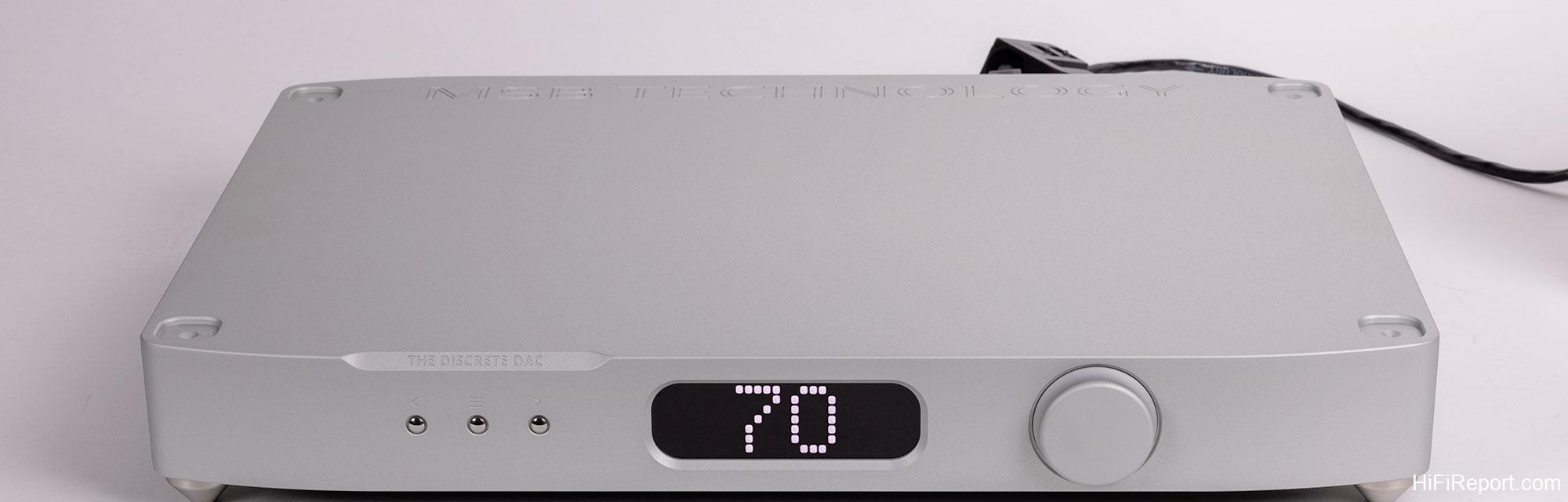
As we know, MSB’s flagship digital-to-analog converter is the Select DAC, followed by the Reference DAC, then the Premier DAC, and finally, the most accessible model, the Discrete DAC. These four DACs have distinct appearances. The Select DAC features a large display window and a volume knob positioned on the top panel. The other three models share the same display window size and only have three small buttons on the front panel, but their chassis sides differ in heatsink design.
The Discrete even lacks the prominent side heatsinks found on its siblings, contributing to its more understated look.
Proprietary DAC Architecture
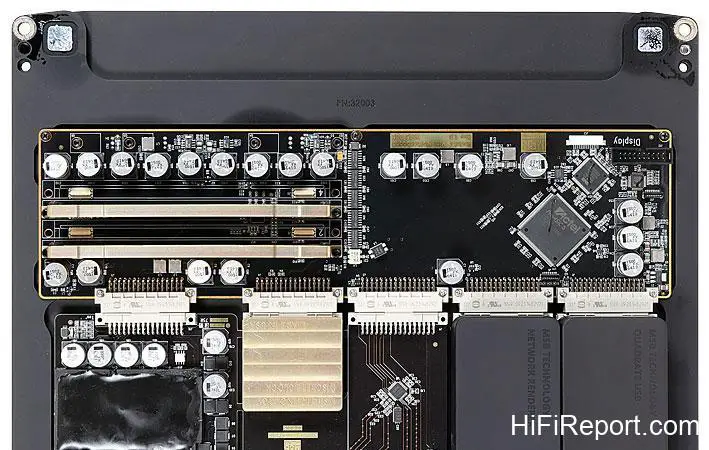
MSB pioneered its self-designed Discrete Ladder DAC architecture back in 1999 and has since employed a modular design approach. Currently, they offer two types of DAC modules: Hybrid DAC and Prime DAC. These two module types share the same fundamental architecture, but the former utilizes twice the number of components as the latter, naturally making it significantly more expensive.
This unique DAC module architecture boasts virtually no sample rate limitations, handling PCM up to 6MHz and DSD up to 50MHz. This is an astonishingly wide frequency range, far exceeding the current highest mainstream sample rates of 352.8kHz or 384kHz. Such DAC modules are vastly more capable than commercially available DAC chips.
Furthermore, another impressive aspect of MSB’s DAC modules is their balanced architecture. Each individual DAC module is inherently balanced, which helps to significantly lower the noise floor. Given this balanced design, users are generally encouraged to opt for the XLR analog output module. However, modules for RCA analog output are also available for those who prefer that connection type.
Beyond the balanced architecture, neither of these DAC module types includes a buffer stage or an I/V (current-to-voltage) conversion stage. The music signal path contains no active components, such as transistors, after the DA conversion; the circuitry relies solely on passive components. Each DAC module incorporates separate discrete circuitry for both PCM and DSD decoding, rather than sharing components.
The discrete Ladder DAC architecture used in these modules is significantly superior to basic R2R architectures, particularly in the ultra-high precision of the internal resistors. Additionally, each DAC module is individually shielded and thermally bonded to maintain consistent internal temperatures. Multiple modules are used for each channel, enhancing performance and lowering output impedance. Crucially, every DAC module undergoes individual testing and careful matching.
In terms of internal design, while all four of MSB’s digital-to-analog converters employ a modular approach, the DAC modules and clock modules differ across the lineup. The Select DAC uses eight top-tier Hybrid DAC modules, while the Reference DAC uses four top-tier Hybrid DAC modules. The Premier DAC utilizes four Prime DAC modules, and the Discrete DAC employs two Prime DAC modules.
This suggests that MSB’s digital-to-analog converters are tiered into two levels: the first level uses Hybrid DAC modules, and the second level uses Prime DAC modules. The higher the number of DAC modules used, the more premium the model. The cost difference reflects the use of critical components at different performance tiers; you are truly paying for higher quality components.
Precision Clocking System
MSB’s modular clocking system is also quite unique. They began designing and manufacturing their own clock modules back in 2011. Each clock module contains two clocks, corresponding to two different sample rate systems (44.1kHz and 48kHz). Only one set of clocks (either 44.1kHz or 48kHz) is active at any given time, as operating both simultaneously would only increase noise.
This design allows a single clock to govern all internal timing, eliminating the need for potentially degrading processes like PLL (Phase-Locked Loop), SRC (Sample Rate Conversion), ASRC (Asynchronous Sample Rate Conversion), or frequency synchronization conversions. This ensures the clock signal remains as precise as possible.
The clock module is strategically placed as close as possible to the analog circuitry near the DAC modules. Why this placement? Because the jitter of a clock signal increases every time it passes through a component after leaving the oscillator. If the clock were located too far from the analog circuitry, the transmission path would inevitably involve more components, leading to higher levels of introduced jitter.
For this reason, MSB does not advocate for the use of external clocks, as they require signal cables and multiple connectors for transmission, all of which can increase jitter.
The Discrete DAC’s built-in clock does not reach femtosecond precision; it’s fixed to the circuit board and cannot be upgraded. In contrast, the Premier DAC uses a Femto 93 grade clock, the Reference DAC uses a Femto 33 grade clock, and the flagship Select DAC also uses a Femto 33 grade clock. The clocks in these three higher models are upgradeable, allowing users to benefit from even more precise clocks should they become available in the future.
Perhaps the concept of femtoseconds is a bit abstract. To put it simply, the clock precision in most standard CD players or digital converters is typically specified in picoseconds, whereas a femtosecond is 0.001 picoseconds, equivalent to one quadrillionth of a second. Seeing this number makes it clear just how advanced MSB’s clock modules are.
Distinctive Design Elements: Display and Output Stage
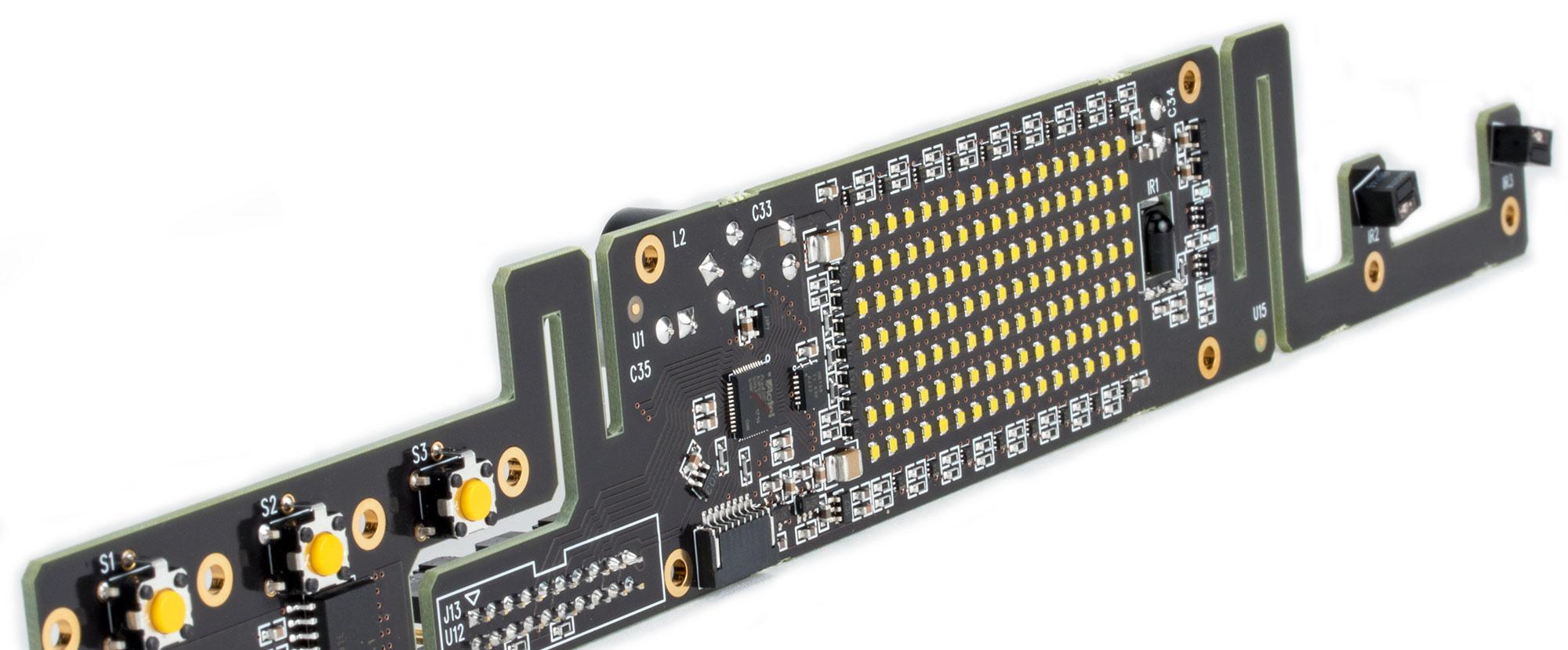
The Discrete DAC’s display screen initially appears rather “crude.” It’s composed of 119 LEDs, unlike the ubiquitous LCD screens seen today. Why use LEDs? MSB believes this allows the LED display to be controlled by the audio processing clock, refreshing between data processing operations. This approach helps to reduce electrical interference.
Furthermore, the entire LED display is designed and manufactured in-house and housed within a milled aluminum chassis cavity, ensuring effective isolation. The Discrete DAC has the fewest LEDs in its display. The Premier DAC uses 560, the Reference DAC also uses 560, and the flagship Select DAC boasts 2096. The higher the number of LEDs, the more refined the text and numbers displayed.
MSB’s output stage is also unconventional. In typical digital-to-analog converters, after the DA conversion, an I/V conversion stage is required to convert the current output from the DAC into voltage, which then connects to an output amplification stage or buffer. Passing through these multiple stages inevitably introduces distortion and sonic coloration. MSB takes a completely different approach.
They offer only two types of analog output stage modules: the Base Output Stage, used for the Discrete and Premier DACs, and the Preamp Output Stage, used for the Reference and Select DACs. In other words, these two output modules are of different performance levels. However, crucially, neither includes an I/V conversion stage. Instead, they directly output a sufficiently large voltage that can drive a preamplifier or even connect directly to a power amplifier.
This means that from the DA conversion output to the output terminals, there are no amplification stages, no buffer stages, no operational amplifiers, no transistors, and no vacuum tubes.
Volume Control and Output Options
One important point to note is regarding volume control. The Select DAC and Reference DAC employ an analog volume control system, while the Premier DAC and Discrete DAC use digital volume control. We know that digital volume control can reduce resolution at very low volume levels. To mitigate this loss of resolution at low volumes, MSB provides two output level options in the menu: a High Output and a Low Output, with a 6dB difference between them.
If you wish to bypass the built-in digital volume control, you should select the Low Output setting and connect the Discrete DAC to a preamplifier. This configuration effectively bypasses the internal digital volume control entirely. If you intend to connect the DAC directly to a power amplifier, you should select the High Output setting.
The purpose of this is that even if you use the built-in digital volume control, the higher output voltage helps to minimize the negative impact of resolution loss at lower volume settings.

External Power Supply System
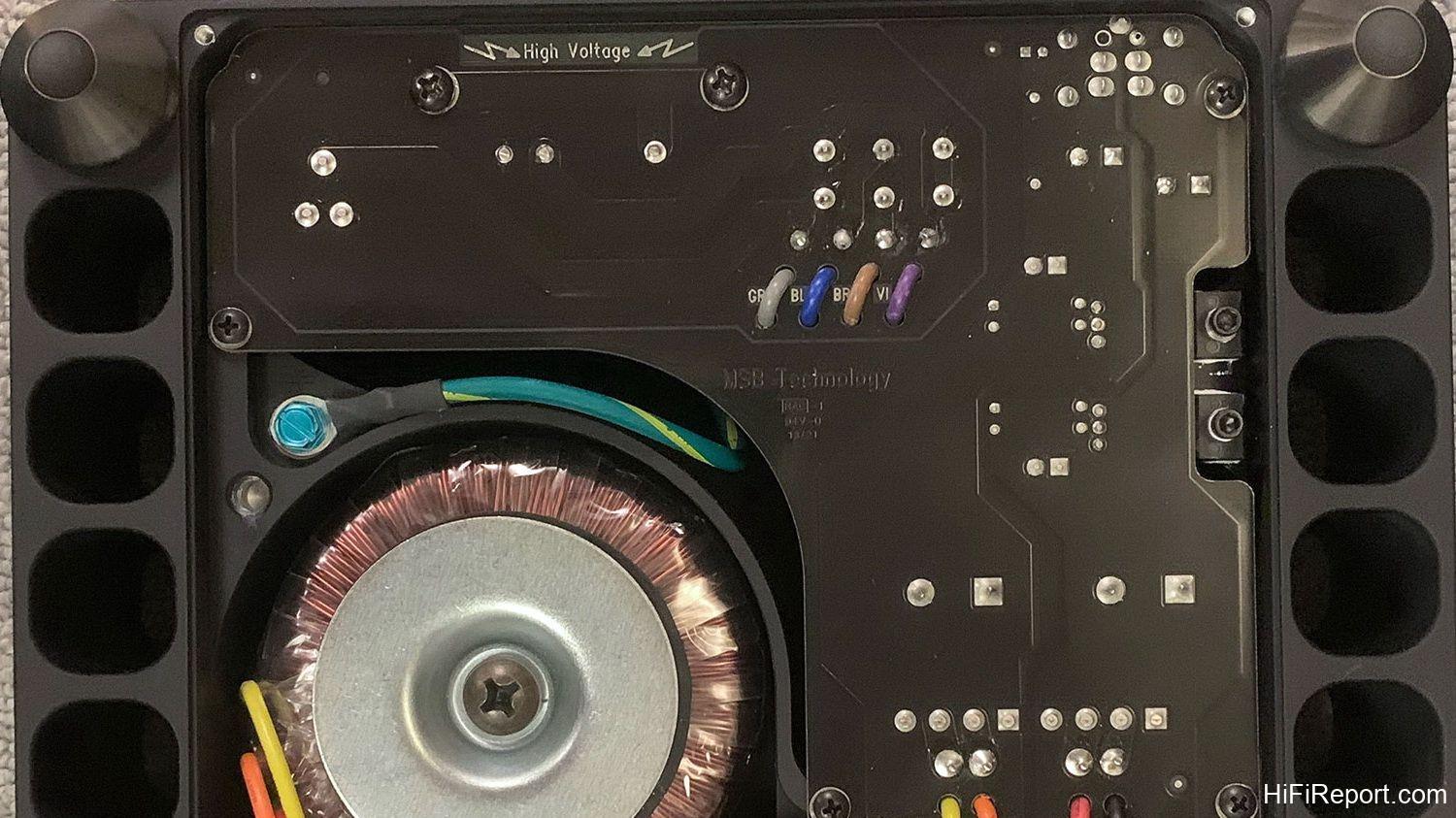
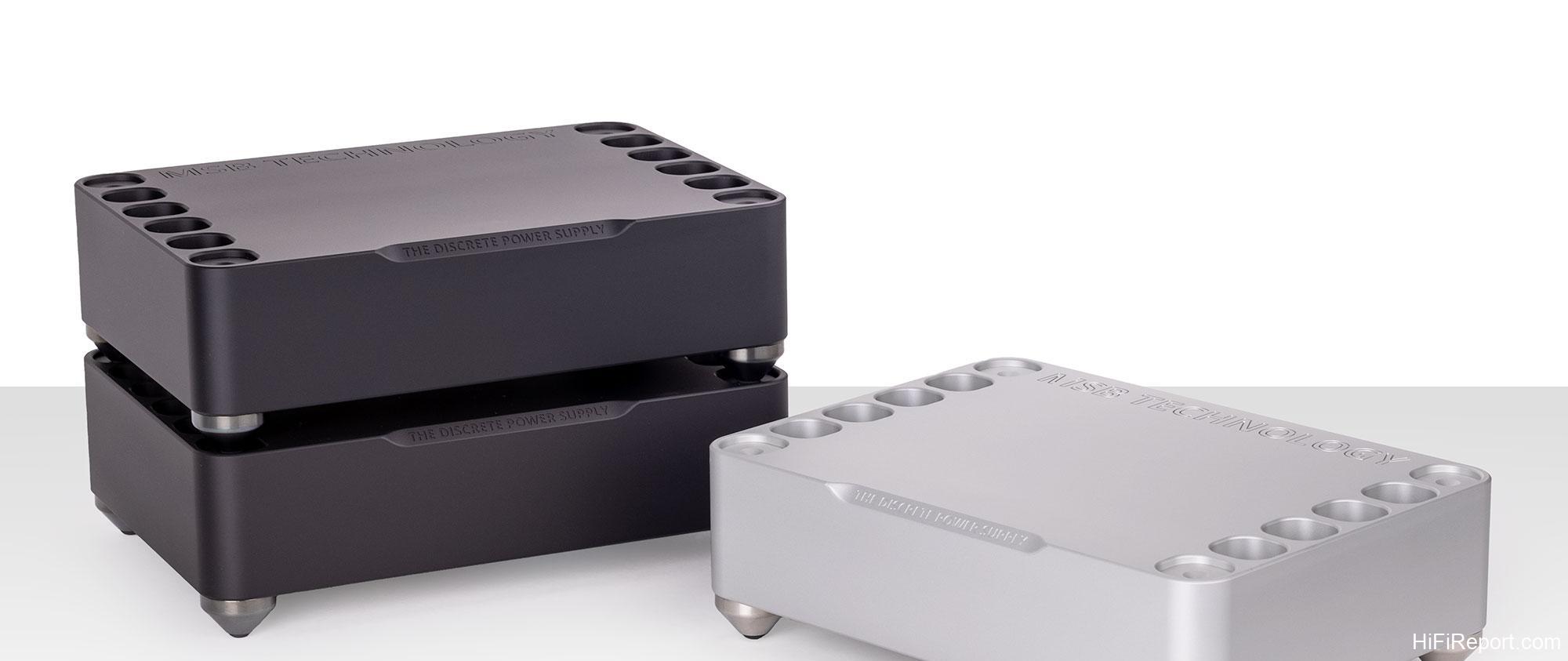
All MSB DACs utilize external power supplies. With the exception of the Discrete DAC, the external power supplies for the other three models are the same size and share the same appearance as the main unit. The Discrete DAC comes standard with a Discrete Power Supply unit that is significantly smaller than the main unit. However, its chassis is still milled from a solid block of aluminum, making it not only robust and aesthetically pleasing but also providing excellent heat dissipation.
The Discrete DAC’s rear panel has two power input connectors. This requires the use of the included 1-to-2 connection cable. This single power supply unit is responsible for powering the four main internal sections: the DAC modules, control circuitry, clock module, and input modules.
If you purchase a second Discrete Power Supply, the internal power distribution is then divided: one power supply unit handles the digital circuitry, and the other powers the analog circuitry. Even with just one Discrete Power Supply, the internal design, despite having only one toroidal transformer, provides two independent power feeds to separately supply the digital and analog circuits.
Using two Discrete Power Supplies is undeniably better than using one, which is why most Discrete DAC owners choose to purchase a second power supply unit. During my listening sessions, I observed that the two power supply units had different temperatures; one was slightly warmer than the other, and the Discrete DAC main unit itself was cooler still. This clearly indicates that different circuits have varying power consumption.
Physical Layout and Modularity
The above covers the core features of MSB’s digital-to-analog converters, including the Discrete DAC. Now, let’s talk about its appearance. The Discrete DAC’s exterior is arguably the most understated among MSB’s four DAC models. The front panel features a large volume knob on the right, a display screen in the center, and three small buttons on the left.
In fact, apart from the flagship The Select, the front panel designs of the other three models are identical; the difference lies only in the shape of the heatsinks on the left and right sides. Because the Discrete DAC lacks these heatsinks, it has a visually simpler look. However, it does have indented areas at the four corners of the top panel, designed for placing isolation cones.
Turning to the rear panel, you’ll see the modular slot-in design. Users can purchase and install the modules they need. However, the analog output module, Digital Input module, and power connectors are standard. If you want USB DAC functionality or Streaming capabilities, you need to purchase these two modules separately. Indeed, the Discrete DAC’s rear panel can only accommodate these two additional modules.
You might ask: what if new formats emerge in the future and the rear panel is already full of modules? It’s simple: you just unplug the outdated module and replace it with the new one.
Based on current developments, it’s unlikely that entirely new formats will surpass USB DAC or streaming capabilities in the short term, so you can rest assured. By the way, the review unit sent to me included the USB DAC module, allowing me to play digital music files. However, during my listening, I primarily used CDs played back via an emmLabs TSDX SE CD transport. This allowed me to evaluate the Discrete DAC’s “baseline” sound performance.
Navigating the User Interface
The central of the three small buttons on the Discrete DAC’s front panel is the Menu button; the other two are arrow keys. To access the menu, simply press the central button on the left side of the front panel or the OK button in the center of the small circular pad on the remote control. Once in the menu, press the left arrow key to confirm entry. Then, rotate the volume knob to make selections.
After changing a setting in the menu, you must press the central Menu button again to confirm the change; otherwise, the unit will continue to operate with the previous setting. To exit the menu, simply press the Menu button.
The number of options available in the Discrete DAC’s menu is determined by the number of input modules you have installed. For example, if you haven’t purchased the Renderer module (for streaming), the menu options related to the Renderer will not appear. The menu allows you to set the Display brightness (1-10), and configure the display window to be On or Auto Off. You can set the power-on Volume level from 0-100 (Low Gain), 0-106 (High Gain), or Off.
If you select Off, it means the Discrete DAC itself has no volume control function, and the analog output is a “fixed output,” meaning maximum output. This setting is used when you are connecting the DAC to an external preamplifier. If you are connecting the Discrete DAC directly to a power amplifier, you absolutely must not select Off, otherwise, upon power-up, a very loud signal will be sent, potentially damaging your speakers.
The Discrete DAC sent for my review did not have the Renderer module installed, so the menu did not contain any related settings. In the Output settings, if you are connecting to a preamplifier, you should select Low, which reduces the output by 6dB. If you are connecting the Discrete DAC directly to a power amplifier, select High. In the Switch settings, there are three options: Manual, Smart, and Normal. Manual means input sources can only be switched manually among the activated inputs.
Smart is the factory default setting, allowing both automatic and manual selection of all installed and activated input modules. Normal allows manual or automatic selection of all input modules installed on the Discrete DAC.
Reset allows you to return to factory settings.
Review Setup and Approach
I listened to the Discrete DAC in my large, open listening space. After trying the effects of connecting it directly to my power amplifier and connecting it through my preamplifier, I decided to route it through my Spectral DMC 30SS preamplifier paired with ATC SCM 100ASL active speakers. Connecting it directly to the ATC SCM 100ASL active speakers also sounded excellent; the sound was very direct, fast in response, highly transparent, and had a stronger personality.
However, through the preamplifier, the sound felt warmer, softer, with slightly more bass quantity, and a more neutral personality, less distinctly flavored. I ultimately chose to use the preamplifier for the final evaluation.
The Discrete DAC manual states that the burn-in time should be at least 100 hours. Burn-in refers to the amount of time a new unit needs to play after being purchased to reach stable sonic performance. Warm-up refers to how long the unit needs to play after being powered on each time before its sound starts to be enjoyable.
In my experience with the Discrete DAC, it needed about 2 hours or more of playing time for the sound to become sufficiently sweet, lustrous, the bass full enough, and the overall sound warm enough.
It’s like simmering peanut soup; it needs to simmer for several hours for the rich, pure aroma and flavor of the peanuts to fully develop. If I were to write a review based on listening soon after power-up, the sound would be thinner, less warm, with less bass quantity, and noticeably fewer harmonics and details. This isn’t unique to the Discrete DAC; it’s true for my own audio system and many other pieces of equipment I’ve listened to.
Therefore, audiophiles should never make definitive judgments about equipment until it has had sufficient warm-up time.
Sonic Performance Overview
The Discrete DAC presented a wide soundstage, with a grand sense of musical scale. All types of music sounded full and substantial. When listening to Safety Zone’s “35th Anniversary Tokyo Budokan Live Concert,” right from the start, I immediately heard the bustling atmosphere of a live concert in a large space. When the singing began, the full-bodied vocals and bass joined in, instantly expanding the overall musical scale, seeming to fill the entire space.
The music had strong drive and sounded very lively.
This expansive sense of musical scale from the Discrete DAC is not achieved when the unit is first powered on. At that point, the music feels constrained, unable to fully unfold. I deliberately compared these two states twice and confirmed the difference. Therefore, if you plan to have guests over to listen to your audio system, I recommend letting the entire system play continuously for at least two hours before they arrive. You can easily do other things during this time.
Aural Experience
When I listened to Wang Wen’s “For a Friend,” the Discrete DAC presented a different kind of performance. This Rainforest Records recording focuses mainly on vocals with minimal instrumental accompaniment, a simple arrangement partly due to the record company saving on production costs.
However, Rainforest’s recordings are like traditional Chinese ink paintings – a few simple strokes, a large amount of empty space, but that empty space is not truly empty; it’s filled with carefully crafted spatial cues and details. It is precisely because of this sense of space and detail that the music doesn’t feel monotonous. It still conveys a large soundstage and a grand sense of musical scale.
This is another way the Discrete DAC exhibits a large musical scale, and upon closer examination, it’s because the noise floor is extremely low, allowing many subtle sounds to surface.
Next, I listened to Jenny Lin’s “Poet’s Love” featuring Chopin piano pieces. This album was recorded live in the Recital Hall (the smaller hall) of the National Concert Hall. If listened to immediately after power-up, the piano sound would lack sufficient sweetness and richness, and the instrument’s image would feel insubstantial, especially with poor harmonics. However, after sufficient warm-up, it sounded like a completely different recording.
The overall sweetness and luster of the piano increased, the tactile feel of the fingers on the keys became more realistic, and the solidity of individual notes was very high, as if ethereal sounds could condense into tangible beads. In particular, the harmonics produced by the strings vibrating after being struck became much richer, and the sense of space in the background felt more realistic.
In fact, this performance is similar to “For a Friend.” If a DAC has a low enough noise floor and high enough resolution, even with only one or two instruments playing, it can still make us feel that the soundstage is filled with detailed sonic information.
Then I listened to Harmonia Mundi’s album “Vivaldi, Leclair, Locatelli Violin Concertos,” performed by Theotime Langlois de Swarte. What I wanted to hear was the performance of the violin and the harmony of the small ensemble. The violin sound reproduced by the Discrete DAC had a round, not flat, character. In other words, even such delicate violin sounds were able to present a sense of form and body, not thin and lean sounds lacking realism.
Furthermore, the violin tone was full of sweetness, luster, and elasticity. As long as a violin can exhibit these three elements, it will surely produce a captivating sound. The accompanying ensemble also produced sounds full of sweetness, luster, and elasticity, and sounded very harmonious, without any hint of harshness. Frankly, the sonic qualities inherent in such Baroque music are truly enchanting. It would be a shame if you were instead hearing sharp, thin, and lifeless sounds.
I sought out a similar album to compare: MBL’s “Concertos 4 Violins,” performed by Concerto Koln. This was recorded by Jurgen Reis, former chief engineer at MBL. During recording, he used two cardioid microphones along with microphones to capture the natural reverberation of the space, without adding artificial reverb or compression. Such a recording might not sound appealing when played back on low-quality equipment.
Compared to the previous Vivaldi album, the overall sound was less sweet and had less luster, but it felt more realistic, especially the texture of the solo violin and the strings in the orchestra. It was fortunate that I was listening through the Discrete DAC, as it allowed the differences between these two CD recordings to be revealed so clearly, demonstrating its excellent fidelity and resolution.
Comparing these two CDs, the MBL album felt like sashimi, while the Harmonia Mundi album felt like Michelin-star cuisine.
Next up was the cello. I chose the Harmonia Mundi recording of Rachmaninoff and Myaskovsky Cello Sonatas. This sonata recording not only features excellent cello sound but also great piano, making it a two-for-one test disc for audio equipment. As soon as the music of the first track began, I immediately sensed a vast musical scale. What? With only a piano and cello, how can there be a vast musical scale?
Because I heard both the cello and piano with substantial, large-bodied images, and the space was filled with the harmonics of these two instruments. It felt like the space was large, and the instrument sounds were full of detail.
Furthermore, the sound quality of both the cello and piano was superb. It possessed a sense of nobility – a complex blend of sweetness, richness, luster, transient speed, and harmonics. It’s like observing how a product’s color scheme can convey a sense of luxury, while another might not. This difference forms in the brain and is difficult to put into words. The Discrete DAC is like this; when playing this CD, my brain spontaneously registered it as a very noble sound.
Simply put, the sound quality is exceptionally beautiful.
Simply discerning nobility isn’t enough. I specifically chose two CDs to test the Discrete DAC’s ability to differentiate timbres and playing textures. Both were released by Rhymoi Music: one is “Chigele,” and the other is “Gu Jia Ye.” The main instrument in “Chigele” is the Morin Khuur (Mongolian horsehead fiddle), while the main instrument in “Gu Jia Ye” is the cello. In recordings, these two instruments can sometimes sound quite similar.
However, due to differences in their physical construction, their timbre and playing texture are distinct. I wanted to hear how well the Discrete DAC could differentiate between these two instruments.
As expected, thanks to the Discrete DAC’s high resolution and the clear, unblurred mid-low and low frequencies, I could immediately distinguish the different timbres and playing textures of the two instruments. If you listen carefully, you’ll notice significant differences in the decay of the notes. The Morin Khuur’s sound has a slightly flatter line, the note endings are shorter, and the sound quality of the Morin Khuur is slightly harder.
It was time to listen to Jody Chiang. I’ve listened to her CDs extensively and am familiar with her voice, though this is only a “general knowledge,” as her early recordings had heavier processing, making her voice sound somewhat different. Listening to her later concert recordings might provide a more accurate representation. I chose the CDs “Taiwan Red Songs” and “Waiting for a Dance Partner.”
Jody Chiang’s voice, played through the Discrete DAC and my preamplifier, gained an added layer of gentle softness, sounding more mature. If I bypassed the preamplifier and connected directly to the ATC active speakers, Jody Chiang’s voice was younger and more direct. Regardless, her voice on these two CDs sounded what I consider “real.” The accompanying high, mid, and low frequencies were neutral in balance, especially the bass, which was clean, fast-decaying, and highly resolving.
The midrange was not particularly prominent, complementing the clear yet gentle treble. It was like a well-proportioned physique, where the chest and hips aren’t overly emphasized.
Next, I wanted to listen to brass instruments. Jazz music is an excellent choice for this. I specifically selected Venus Records’ album “Magic Swing Tribute to The Music of Count Basie” by Massimo Farao. This album features brass instruments including two trumpets, two saxophones (which I’ll group with brass for this purpose), and two trombones, along with piano, guitar, bass, and drums. The Discrete DAC revealed its direct, expansive, and fiery side here.
Beyond the inherent liveliness of jazz, simply listening to the playing of those six brass instruments demonstrated the Discrete DAC’s vitality, heat, and punch. When it needed to be fiery, it was, without softening up at all.
Just these six brass instruments alone were able to create a full and expansive musical presence. The trombones had sufficient thickness without being sluggish in response. The trumpets were bright enough without being sharp. The saxophones were wide and full of breath sounds.
Honestly, listening to this album through the Discrete DAC, the sense of liveliness, high resolution, clear layering, and fast transient response created a significant level of excitement for the listener, keeping me in a highly engaged state.
After the fiery performance of jazz brass, I put on “John Williams in Vienna.” This performance by the Vienna Philharmonic is simply superb. Not only are John Williams’s compositions and conducting incredibly brilliant, but the orchestra’s playing and the recording quality are first-rate. Nearly every piece can serve as excellent material for testing audio equipment. Take the piece “Devil’s Dance.”
The Discrete DAC reproduced Mutter’s violin line clearly, standing out from the orchestra, and it wasn’t too thick or harsh. The layering and depth of the orchestra were particularly impressive. The Discrete DAC could pull the front-to-back depth significantly apart, which also improved the sense of layering. The large gongs and drums, and various other instruments in the music, were clearly distinguishable, never getting muddled together.
Furthermore, the performance of “Excerpts From Close Encounters of the Third Kind” (from the same album) was even more spectacular. The texture, quality, and timbre of the instruments were reproduced with great accuracy. As for depth, space, and layering, they were excellent. You know, the beginning of this piece is difficult to reproduce properly. Some audio equipment can make it sound like it’s being played by an electronic synthesizer.
This is because the details emitted by the instruments and the realism of the playing texture are insufficient. However, the Discrete DAC rendered the instrument playing textures with high realism, provided sufficient detail, and presented excellent instrument quality and timbre, ensuring that when listening to this piece, one is never mistakenly led to believe it’s being played by a synthesizer.
Next, I listened to “The World of Hans Zimmer A Symphonic Celebration.” This CD has an absolutely spectacular recording, with a wide dynamic range, fluctuating constantly from the most subtle passages to the most explosive climaxes. The Discrete DAC resolved this large orchestral recording with extreme clarity; everything was distinct, not blurred, combining delicacy with meticulous detail.
The powerful crescendos and mighty low frequencies swept over me like a raging wave, leaving me completely absorbed and tense throughout the entire CD. If you listen to this album and find it muddy, soft, or lacking impact, it’s definitely because your equipment isn’t keeping up with the recording quality.
Finally, I listened to “The Wonderful Sounds of Male Vocals” (AP). This compilation features songs from over a dozen different famous male vocalists, and each track is excellently recorded. The distinct characteristics of these different male voices were reproduced by the Discrete DAC with great personality, and the vocal images were solid and focused. The sense of space within the soundstage was excellent, and the musical scale was wide.
Across these 20 different tracks, I found that the Discrete DAC was able to clearly reveal the unique recording characteristics of each piece. In other words, the sonic fingerprints of different recording studios were easily discernible. The Discrete DAC’s high resolution capability is truly impressive. Don’t misunderstand what “high resolution” means; it doesn’t mean the sound is sharp and harsh like midday sunlight.
True high resolution faithfully restores the inherent beauty of instruments and voices. How could that possibly be sharp and harsh?
Final Thoughts
Although the MSB Discrete DAC is their entry-level model, its design and internal structure share strong similarities with the flagships. The main differences lie only in the grade and number of DAC modules and the precision of the clock. Simply comparing the two DAC modules in the Discrete DAC to those in other digital-to-analog converters in a similar price range would show it standing head and shoulders above the rest, not to mention its milled aluminum chassis and external power supply.
Honestly, while I have listened to its bigger siblings, listening to the Discrete DAC now feels entirely consistent. In my mind, it is still a top-tier digital-to-analog converter. It turns out that MSB’s most affordable digital-to-analog converter is already this good. What more could one ask for?
Specifications and Ratings
Specifications
* Product Type: Separate Power Supply Digital-to-Analog Converter
* Launch Year: 2018
* Highest Specifications: PCM 3,072kHz/32bit, DSD 512
* Input Terminals: AES/EBU×1, Coaxial×1, Optical×2, Word Sync×1
* XLR Output Level: 3.57Vrms
* XLR Output Impedance: 300 ohms (High Gain), 150 ohms (Low Gain)
* RCA Output Impedance: 120 ohms
* Volume Control: 0-106dB (1dB steps)
* Weight: 8.2 kg
* Dimensions (WHD): 432 x 51 x 305 mm
* Importer/Distributor: [Importer/Distributor Name – Omitted as per instruction 8] (Contact: [Phone Number – Omitted])
Key Features
* Chassis milled from solid aluminum.
* Fully modular design, ensures future upgradability.
* Proprietary DAC modules and precise clock module.
* Direct, transparent, and grand sound.