
NAD C 3050 LE Review
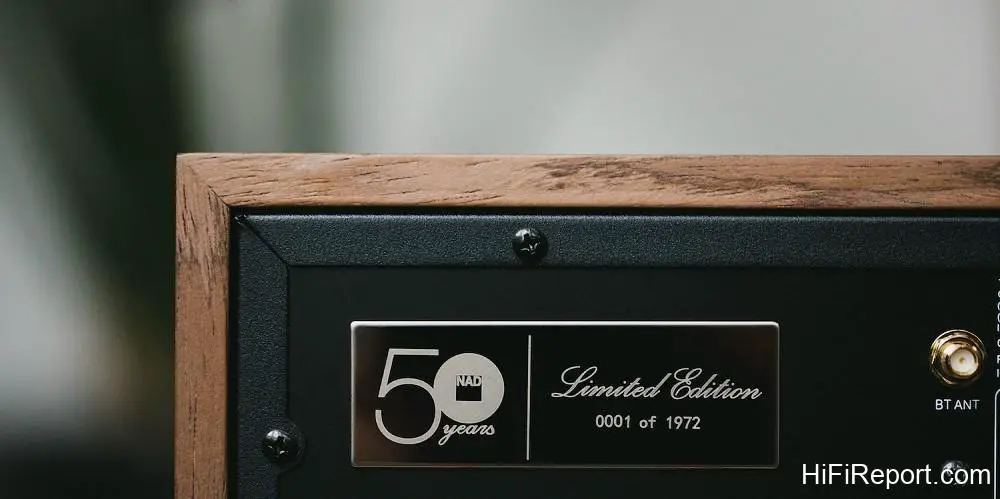
This is an amplifier that captured my heart at first glance. It takes me back to my childhood when I first started exploring audio, and amplifiers looked just like this. The C 3050 LE is a limited-edition amplifier specially produced by NAD to celebrate their 50th anniversary (founded in 1972), with only 1972 units available globally.
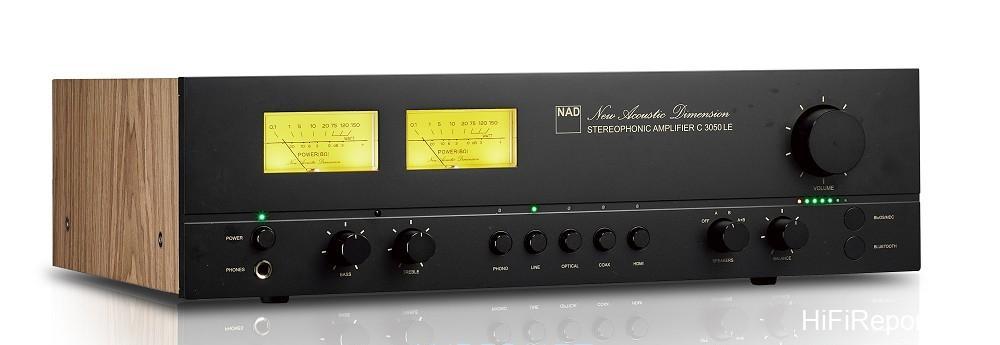
The C 3050 LE’s vintage styling, from the wooden cabinet and analog VU meters to the knob and button layout and even the font used for NAD’s full name, “New Acoustic Dimension,” pays homage to the NAD C 3030 integrated amplifier from NAD’s early days in 1974. The power-up sequence is quite fascinating: upon initial switch-on, it’s like awakening a beast, with the analog VU meters glowing red.
Once the boot-up process is complete and it enters a stable state, the VU meters transition to a soft yellow glow.
Modern Technology Integration
While the C 3050 LE’s antique appearance seems straight out of a museum, its circuit design is decidedly not from my father’s audio era.
It incorporates three key elements that have propelled NAD into the realm of “next-generation advanced amplifiers” over the past decade: “Hybrid Digital” technology, which combines digital-to-analog conversion circuits with Class D amplification; Dirac Live, the advanced room correction technology NAD first introduced to the Hi-Fi and High-End audio scene with the M10; and the latest MDC2 BluOS-D module.
The C 3050 LE was originally designed as an integrated amplifier with built-in Bluetooth and DAC. However, the version sold in Taiwan comes equipped with NAD’s latest MDC2 BluOS-D module. This addition transforms the C 3050 LE into a streaming integrated amplifier complete with Dirac Live room correction capabilities. When connected to a network, users can access streaming services like TIDAL (which supports MQA decoding), KKBOX, Spotify, and others.
You also get access to the four free MQA Hi-Res internet radio channels from “Radio Paradise.”
Built-in Music Server
The unit also allows users to listen to their own lossless music files (which, in my opinion, generally offer better sound quality than TIDAL). The C 3050 LE doesn’t require a dedicated music server, NAS, or PC to share files over your home network. It has its own built-in music server functionality.
Simply store your music files on a USB hard drive or SSD, plug it into the USB port on the rear MDC2 BluOS-D module, and give it a few minutes to organize the albums using cloud databases. This turns your USB drive into your personal music library. You can then use the BluOS App on your smartphone to select and play tracks from the USB drive or push music files from your phone to the C 3050 LE for playback.
Supported music file types include MP3, AAC, WMA, Ogg Vorbis, WMA-L, ALAC, OPUS, MQA, FLAC, AIFF, and WAV, with Hi-Res support up to 192kHz/24bit. It supports NTFS for USB hard drives and exFAT for USB SSDs.
Home Theater Integration
Over the past couple of months, I’ve frequently mentioned Netflix Spatial Audio because the “two-channel surround sound” created using AMBEO 2-Channel Spatial Audio technology is significantly better than previous, often unconvincing virtual effects. This development allows a two-channel audio system to function effectively as a “two-channel surround sound system.” However, the ability to use it is one thing; how well it performs is another.
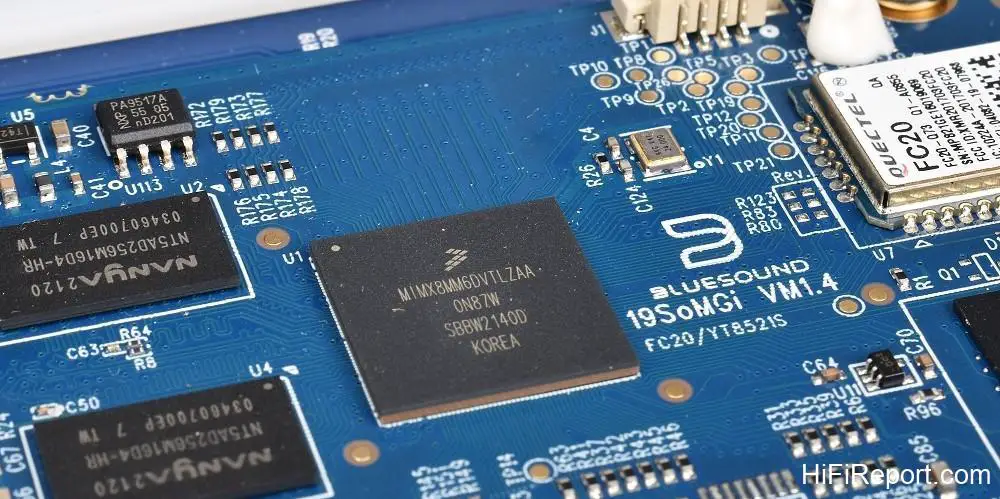
The C 3050 LE includes HDMI eARC, allowing it to receive digital audio output from a smart TV and have your hi-fi system replace the TV’s built-in speakers. As shown in the image above, after the digital audio signal enters, the NXP quad-core ARM Cortex-A53 microprocessor (MIMX8MM6DVTLZAA) on the MDC2 BluOS-D module board can also perform 2.1-channel bass management (subwoofer crossover) and Dirac Live correction.
This makes it an excellent solution for users in urban environments where space is at a premium. You can pair compact wall-mounted or bookshelf speakers with an active subwoofer, saving space while ensuring you hear the ultra-low frequencies present in streaming movie soundtracks. Dirac Live room correction ensures seamless integration between the left/right channels and the subwoofer and can also tackle bass node issues for a flatter frequency response.
Internal Design and Components
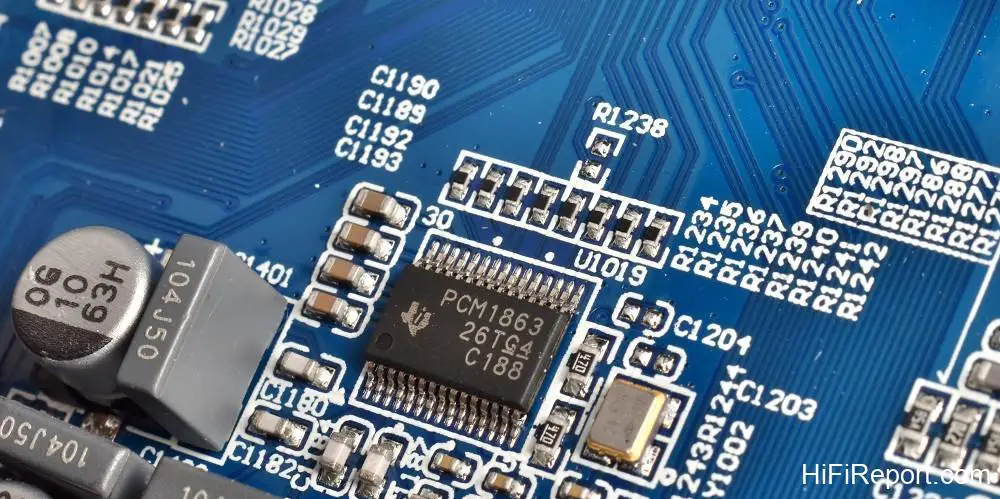
Even when using analog inputs, the unit can still convert the audio signal into 192kHz/24bit digital audio via the TI PCM1863, which is then sent for Dirac Live room correction and bass management. The digital audio processed by the aforementioned MDC2 BluOS-D module is sent to the main circuit board.
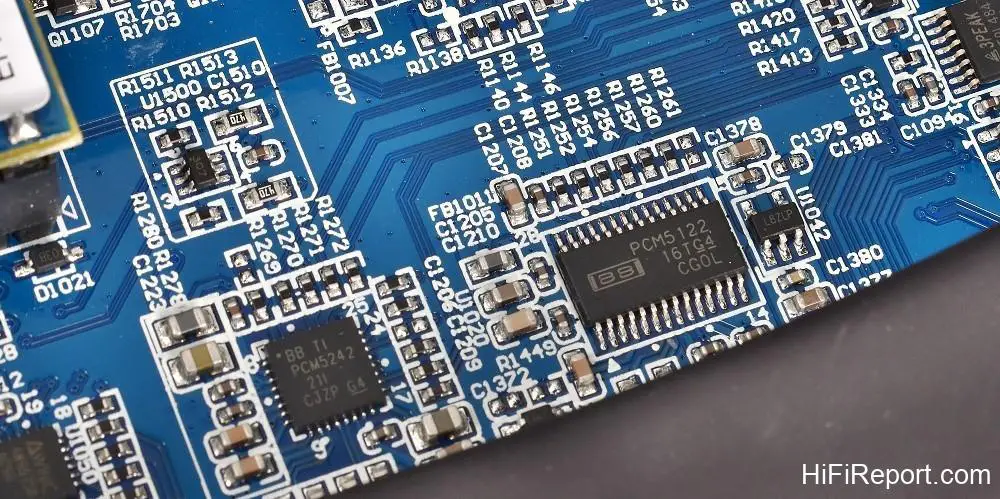
A 384kHz/32bit two-channel DAC, the PCM5242, with a dynamic range of 114 dB and differential output, is used for the main channel digital-to-analog conversion. For secondary channels, a two-channel DAC chip, the PCM5122 (dynamic range 112 dB), directly outputs single-ended audio. Why separate primary and secondary DAC circuits? My assessment is that NAD uses the higher-performance PCM5242 for the main amplification circuit driving the speakers.
When I refer to secondary channels, I mean the unit’s left/right channel and subwoofer pre-out signals. This is separate from the “sound quality heard through the speakers.”
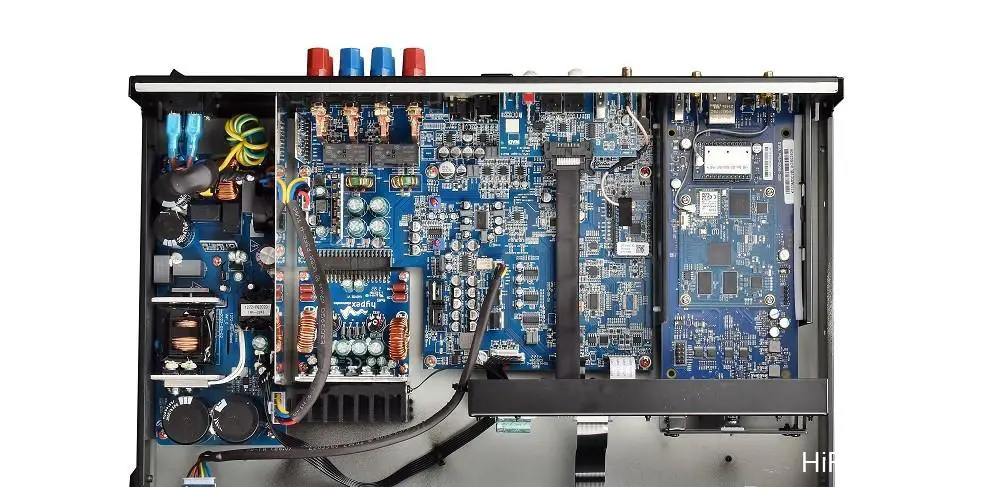
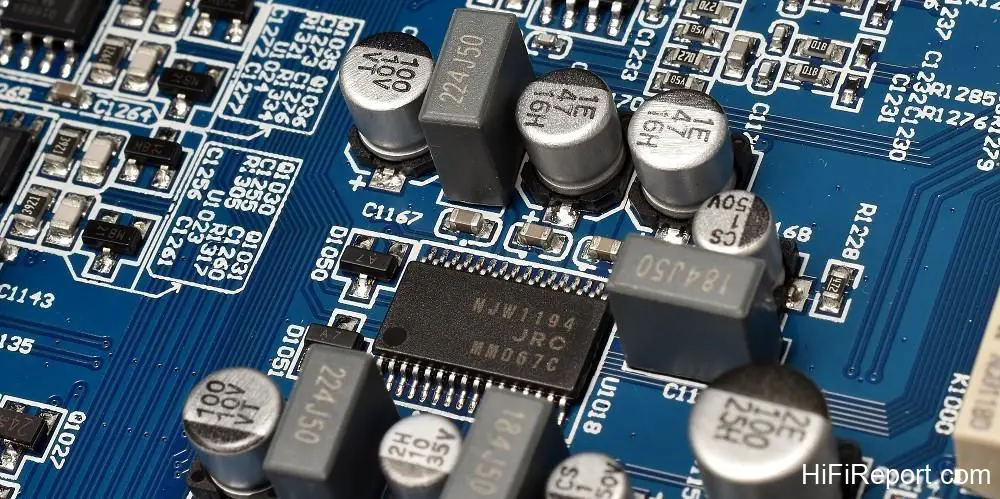
Referring to the image below, after the digital-to-analog conversion circuits, the unit’s preamplifier section utilizes the Nisshinbo NJW1194 analog volume control chip for source selection and volume adjustment. For preamplifier gain and the buffer amplifier preceding the power amplifier section, NAD has selected high-performance OP Amp components known for their low noise, low distortion, and wide bandwidth, such as the TI OPA1688A and SGMICRO SGM8261-2.
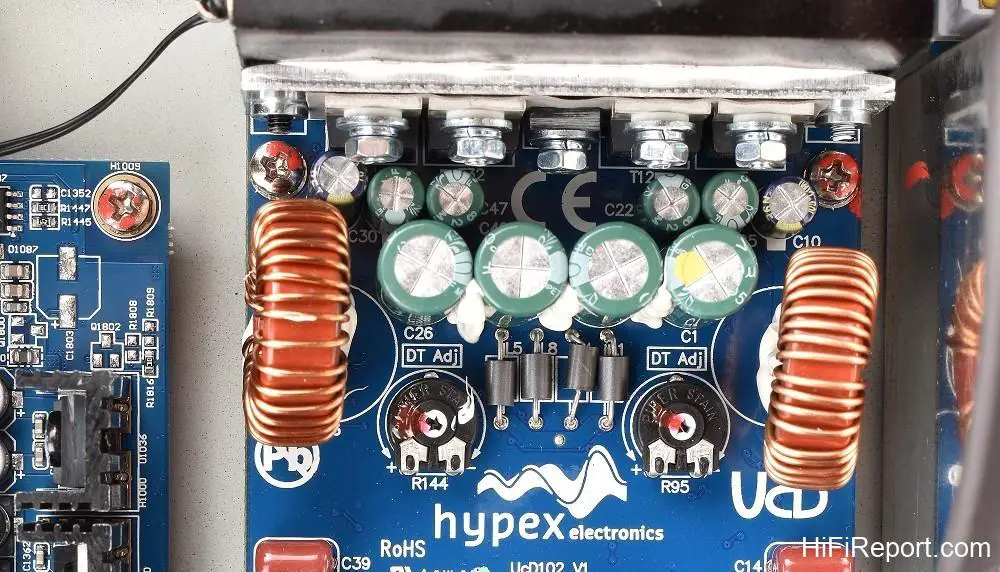
The Class D power amplifier module is a “NAD custom version” of the Hypex UcD102 V1 Class D amplifier module, manufactured according to NAD’s specific tuning and performance requirements.
Amplifier Technology Explained
Having quickly covered the circuitry, most readers might see that the hardware design focuses on Dirac Live, digital bass management, analog volume control, and low noise characteristics. However, encountering UcD might raise questions: “Why not Ncore or Eigentakt?” Frankly, those two higher-priced Class D modules aren’t typically found in integrated amplifiers at this price point.
Yet, when I reviewed the NAD C 700 in the previous issue, I found something “abnormal”: why did the C 700 using UcD sound so similar to the M10, which uses Ncore? I believe that over the past few years, NAD has clearly gained further mastery of Class D amplifier tuning, potentially tweaking parameters in the custom modules and power supply circuits to elevate UcD performance to a level approaching that of their higher-tier modules.
Comparing the specifications of the C 3050 LE and the M10 V2, the former exhibits less attenuation at 20kHz (indicating wider bandwidth) and a higher signal-to-noise ratio. The M10 V2 only wins in terms of channel separation. How can this be?
I believe, for one, the C 3050 LE isn’t a compact amplifier like the M10 or C 700. It has ample internal space, allowing the streaming module, main circuit board (including DAC, preamp, and power amp input stage), Class D power amp module, and power supply circuit to be laid out flat.
Unlike compact amplifiers where the digital board and amplification circuits are stacked in layers, this layout in the C 3050 LE puts the small signal amplification circuits further away from the switching power supply and Class D power amplifier, reducing noise interference.
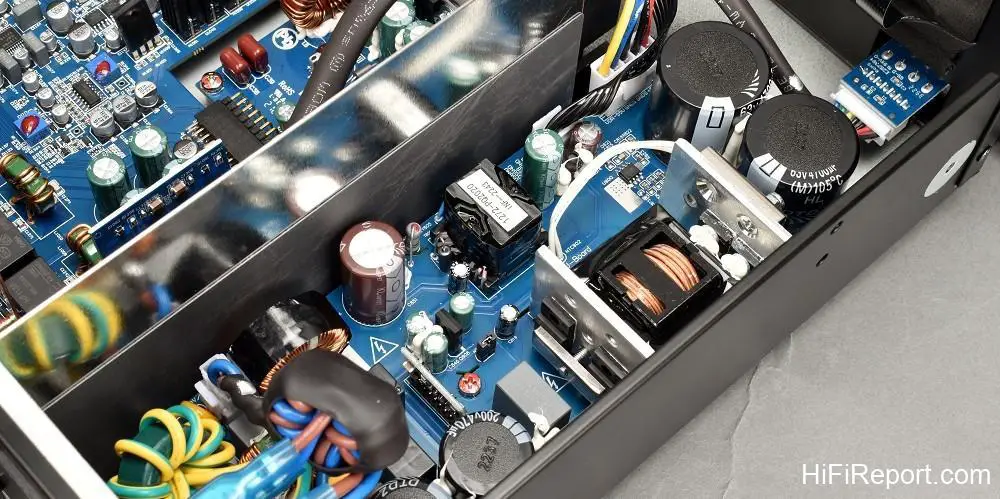
Furthermore, while the M10 V2’s NC252MP Ncore module board has a built-in switching power supply, the C 3050 LE features NAD’s 자체 developed switching power supply with greater power delivery capability, plus a metal plate shielding between the power supply and the main circuit board (see image below). These factors collectively allow the C 3050 LE to perform on par with the M10 V2.
I’d also like to point out two things for discerning audiophiles: While the signal-to-noise ratio specifications for Class D amplifiers often look best near full power output, NAD has chosen to specify the SNR at 1 watt (8 ohms), achieving over 95dB. This is quite remarkable and much closer to the typical power output when listening to music. Furthermore, the maximum total harmonic distortion usually occurs at maximum power output.
This unit, however, specifies THD at its rated output (100 watts) across the full frequency range from 20Hz to 20kHz (most amplifiers only specify at 1kHz), where the “full-band maximum power output” harmonic distortion remains below 0.03%. This level of performance is rare among products in the same class.
Dirac Live Room Correction
The version of Dirac Live included with the C 3050 LE performs equalization only below 500Hz (a limited bandwidth version). Users can later pay to upgrade to the full-frequency version. I recommend that users, after testing with the limited version, set up two target curves initially: the first group keeps the target curve exactly as measured (resulting in a “clean bass” sound); the second group boosts the target curve below 500Hz by 2.5dB (resulting in a relatively “fuller sound”).
Once these two settings are calculated into filters by the computer, upload them to the C 3050 LE for storage and execution of the room correction.
Next, I conducted comparative listening tests. After Dirac Live correction, standing waves were noticeably reduced, and dips in specific ultra-low frequency bands were compensated for. Bass resolution significantly improved, becoming tighter and cleaner. Although the correction limit for the initial version is 500Hz, it already covers the entire lower midrange (Low Mid) region, improving the symmetry of the left and right channel response.
This results in more concrete imaging and clearer localization.
However, to get the absolute best sound quality from the C 3050 LE, for tracks like “Little Girl Blue” from Keith Jarrett Trio – Standards In Norway, the texture of the drum brush, light cymbal taps, and the subtle nuances of the piano still sounded better with Dirac Live switched off. Similarly, when listening to classical music, the hall ambiance is richer and the sense of air is stronger without Dirac, and the texture of violin playing is more refined.
Therefore, I advise users of this unit to still make their best effort to optimize speaker placement without using Dirac.
Listening Impressions
Regarding its sonic character, I believe the C 3050 LE’s most traditional aspect is its dense, richly colored, and layered midrange. Listening to Dina Ugorskaja’s “Bach . Chopin” album, the piano tone is warm and beautiful, deeply relaxing. It naturally makes you want to listen to classical music. This sweet, warm-hued midrange is fundamentally the most representative element of classic British sound, and its naturalness makes it utterly impossible to discern that it’s Class D!
But this unit differs significantly from old-school British sound; it completely lacks any sense of sluggishness. Listening to Midori playing Beethoven’s Violin Concerto, it maintains excellent stability even at high output levels, fully conveying the scale of the symphony orchestra. The clarity and layering of the inner voices reach the level of much higher-end products.
The C 3050 LE achieves high resolution not by emphasizing high-frequency brightness but by excelling at revealing the complexity and density of the sound. Listening to Yo-Yo Ma’s “Amazing Grace” from “Songs of Comfort and Hope,” you can sense the spatial feeling of being in a strong wind from the surrounding sounds.
The C 3050 LE’s treble performance also exceeded my expectations. If your impression of UcD is based on products from three years ago, listening to the C 3050 LE will make you wonder when UcD sound quality improved so dramatically. My biggest complaint about previous UcD implementations was a “dullness” at the very top of the treble. What I hear from this unit is open, lively, and pleasant (never harsh) treble.
Combined with its powerful, tight, and agile bass, the C 3050 LE delivers an incredibly exhilarating experience when playing pop music. Listening to YOASOBI’s “Gunjou” and Beyoncé’s “I’m That Girl,” the power, elasticity, depth, and control of the electronic bass hit almost unleash 90% of the potential of the significantly higher-tier Pioneer S-1EX floorstanding speakers it was paired with. It possesses incredibly strong “core muscles.”
Pushing the volume to levels approaching the front row of a live house, it remains composed and maintains excellent three-frequency balance. Who would guess that the C 3050 LE, with its literary, vintage look, could possess the capability to “rock the house”? Finally, I also tested the Netflix Spatial Audio sound from the latest season of “Stranger Things.” With high energy and excellent three-dimensional immersion, its performance as a “2.1-channel surround amplifier” is simply outstanding.
Conclusion
Is my recommendation even useful? If it’s limited and you can’t buy it, recommending it is pointless! That’s what I initially thought, but as my listening session neared its end, I had a strong hunch: among all the NAD amplifiers I’ve heard in recent years (regardless of price), the C 3050 LE is the one that comes closest to perfection in handling all music genres and overall tuning balance. I don’t believe this is mere luck; NAD’s engineers must have put in significant effort.
How could they simply say goodbye after easily selling out the 1972 limited units? I suspect a “production version” of the C 3050 will follow the “limited edition.” Regardless of the outcome, I am confident that the C 3050 LE is one of the strongest integrated amplifiers in its price range. If you get the chance, grab it quickly!
Specifications
* Type: Network Streaming Integrated Amplifier
* Rated Output Power: Greater than 100 Watts per channel (into 8 and 4 ohms, both channels driven)
* IHF Dynamic Power: 180W per channel (8 ohms), 250W per channel (4 ohms), 300W per channel (2 ohms)
* Peak Current: >20A
* Total Harmonic Distortion: <0.03% (250mW to 100W, 8 and 4 ohms) * Signal-to-Noise Ratio: >95 dB (A-weighted, 1W output into 8-ohm load)
* Frequency Response: 20 Hz〜20 kHz (±0.3 dB)
* Channel Separation: >75 dB (1 kHz), >70 dB (10 kHz)
* Input Terminals: RJ45 Network port ×1, USB (type A) ×1, HDMI eARC ×1, Toslink Optical ×1, Digital Coaxial (RCA) ×2 (includes one Phono input), Two-channel Analog Input (RCA) ×2
* Output Terminals: Speaker Terminals ×2, 2.1 channel Pre-out (RCA) ×1
* Dimensions (W×H×D): 435×110×355 mm
* Weight: 12.6 kg