
NAD C379 Review
The NAD C379 seamlessly blends traditional Hi-Fi virtues with advanced technology. It’s an integrated amplifier boasting a built-in DAC and a comprehensive analog preamplifier section, complete with Phono and Line inputs. Notably, the C379 is one of the few integrated amplifiers currently equipped with HDMI eARC, allowing it to function as a premium sound system alternative to TV speakers.
Its operation is as straightforward as a soundbar: it powers on and off with the TV, volume can be controlled via the TV remote, making it easy for anyone in the household to use. Crucially, a proper audio system delivers significantly better sound quality and power than a typical soundbar.
While the C379 includes built-in Bluetooth, those seeking full music streaming capabilities can opt for the NAD MDC2 BluOS-D module ($650). This module is the same one used in the higher-end C399, and in my opinion, it’s a highly worthwhile addition.
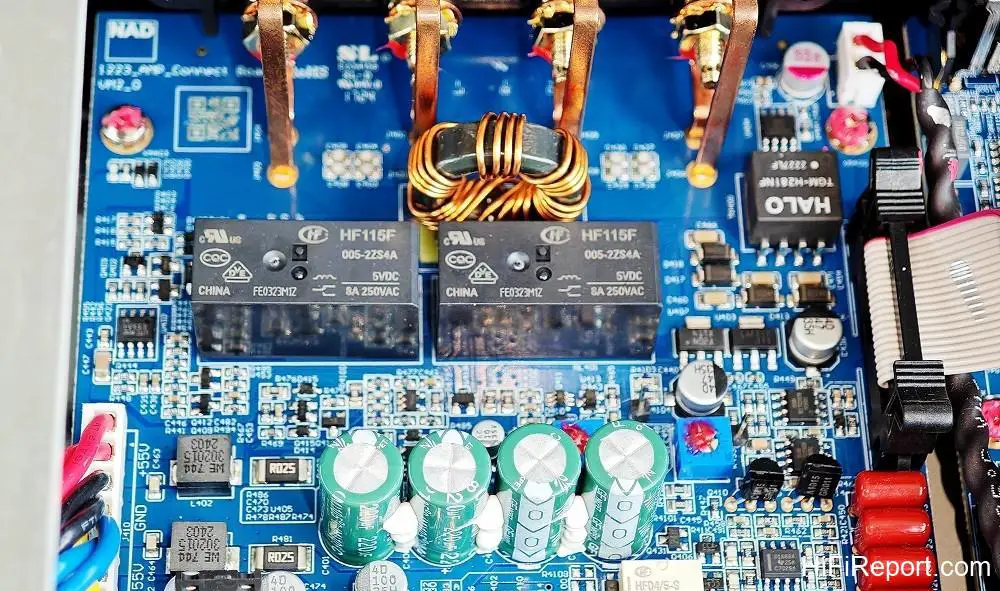
Optional MDC2 BluOS-D Module
Not only does it transform the C379 into an integrated amplifier with a built-in streamer – and at a module price generally lower than most standalone streamers – but it also adds the sophisticated Dirac Live room correction technology that many enthusiasts desire. NAD’s BluOS-D module generously includes Dirac Live LE (worth $159), which corrects frequencies from 20Hz to 500Hz, along with a test microphone and USB adapter (worth $59).
For most users, I believe Dirac Live LE is more than sufficient. It effectively corrects excessive low-frequency energy resulting from boundary gain when speakers are placed close to walls or corners. It also addresses low-frequency standing wave peaks and dips caused by room modes at specific frequencies below 500Hz. This range actually includes the lower midrange, covering the pitch of tenor voices.
If your listening space has significantly asymmetrical side walls (common in open-plan living/dining areas), you might consider upgrading to the full-range version through the Dirac store for an additional $99. This ensures precise soundstage imaging and symmetrical sound reproduction.
Comparing the C379 and C399
How similar are the C379 and C399 really? Comparing the circuitry is the most direct way to know (I’ve previously reviewed the C399 and examined its internal layout). Both units feature the same BluOS-D module, meaning their streaming functions and digital audio processing, including Dirac Live and bass management (digital crossover between the subwoofer and main speakers), are identical.
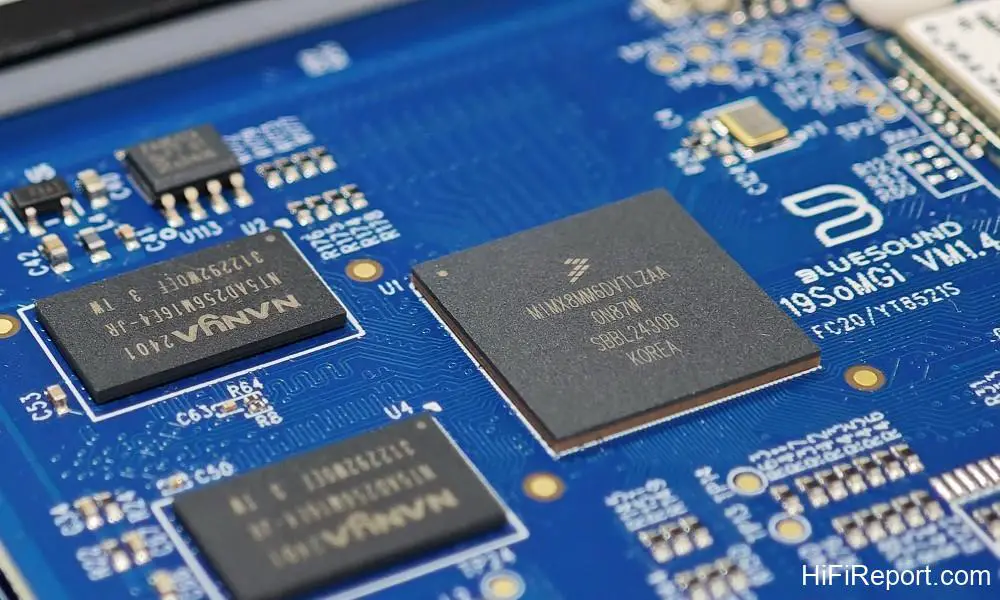
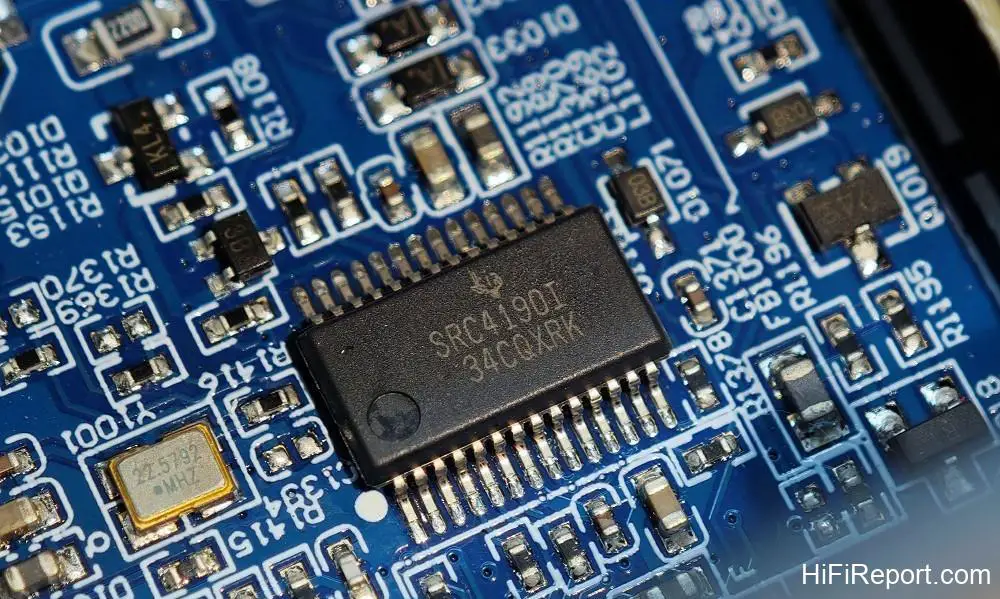
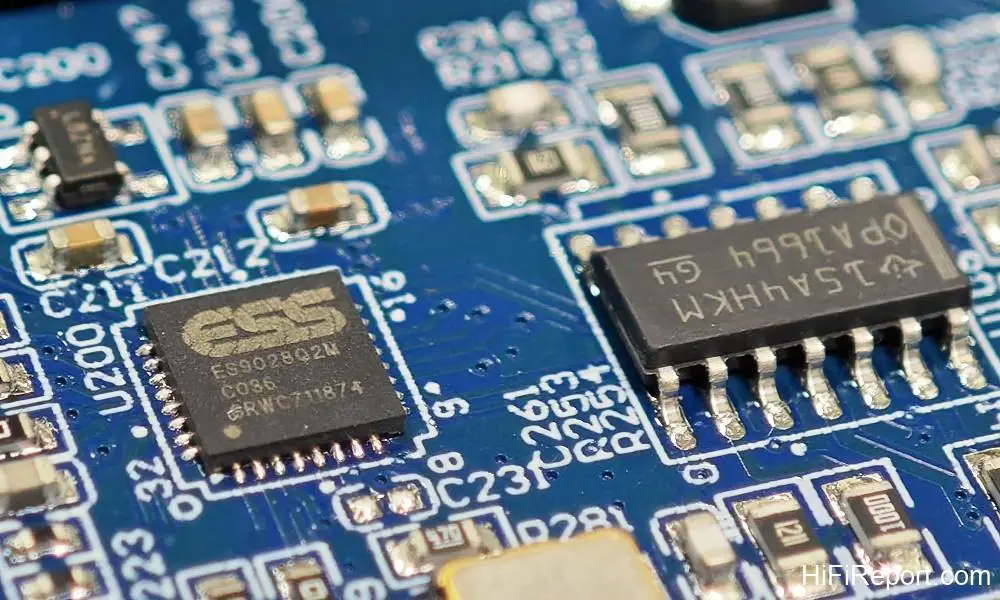
Regarding the digital-to-analog conversion circuit, the C379 first uses a TI SRC4190 chip to upsample signals with sampling rates less than or equal to 96kHz to 192kHz/24bit (improving linearity and expanding dynamics). It then employs the high-end 384kHz/32bit ESS ES9028Q2M DAC chip for the actual conversion.
Following the DAC, the I/V buffer utilizes a TI OPA1664 (known for low noise, low distortion, and wide frequency response) paired with passive components as the output stage for the DAC circuit. Up to this point, the C379 completely mirrors the higher-tier C399 – no difference whatsoever!
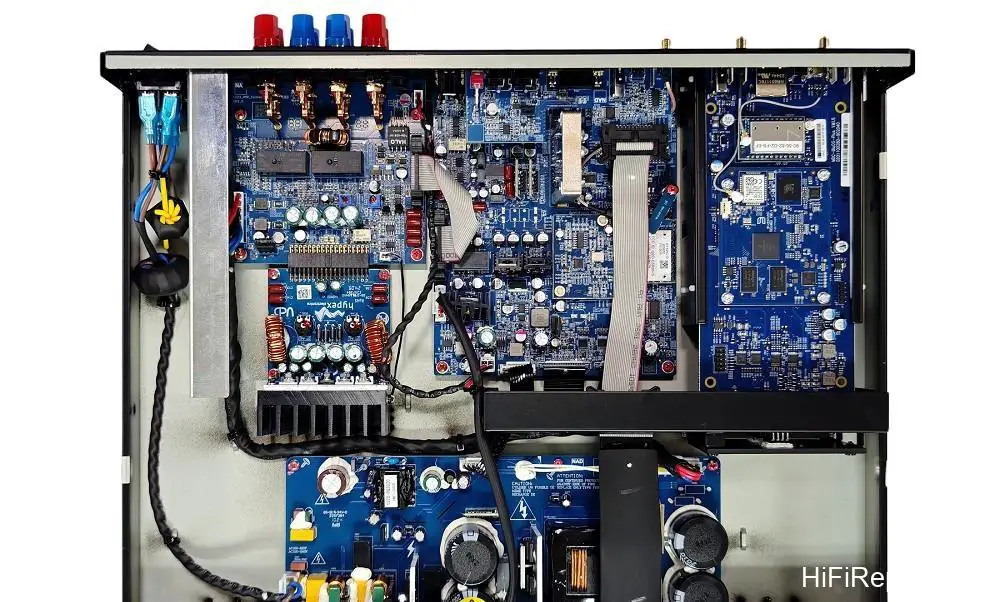
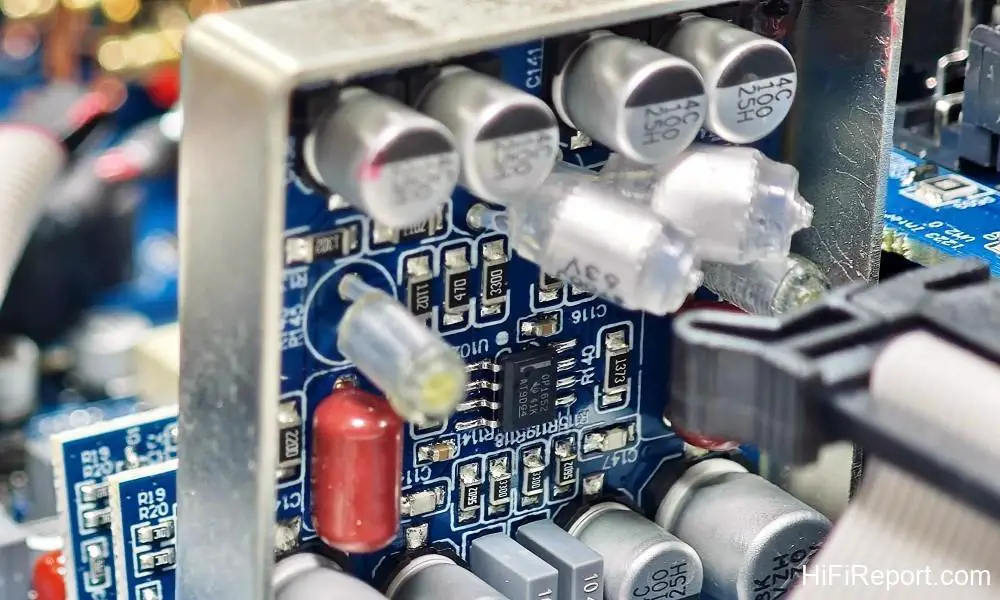
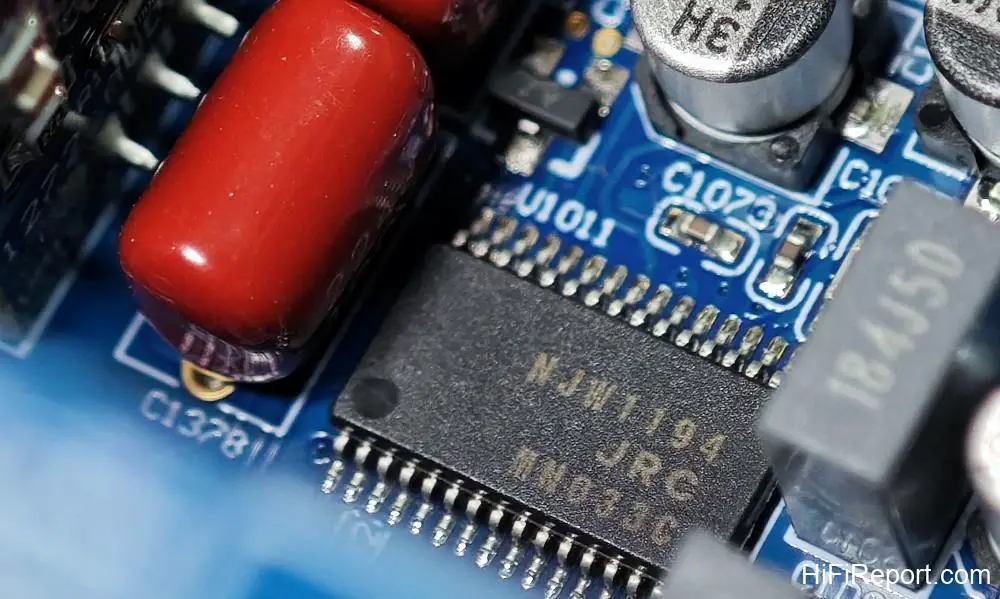
And it doesn’t stop there. In the preamplifier section, the C379 features a shielded Phono Stage (pictured below). It uses the low-distortion, low-noise NJW1194 chip for input selection, bass/treble adjustment, and volume control. Again, this is precisely the same as the C399, until we reach the high-level amplification circuit.
Here, the C399 uses a FET-input TI OPA1654 operational amplifier chip, while the C379 employs the OPA1688, an operational amplifier chip with a bandwidth reaching up to 10MHz and enough output current to drive headphones. Was this choice made to achieve higher dynamics or a thicker sonic character? Only the designer truly knows the definitive answer.
Power Amplifier and Output Discussion
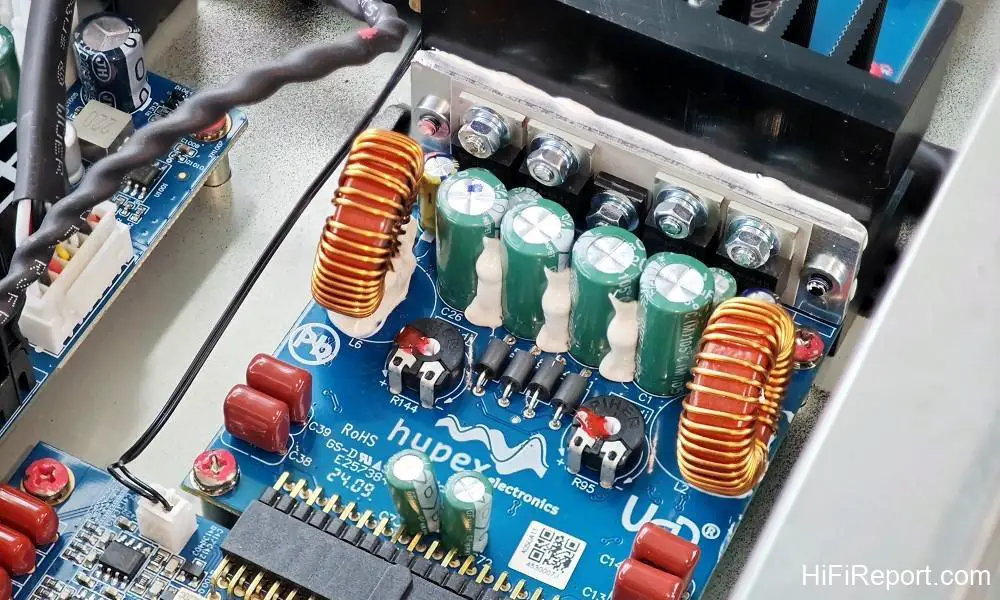
In the power amplifier section, the C399, as the C series flagship, uses custom Hypex Ncore NC400 modules to deliver a rated output of 180 watts per channel. This is approaching the driving power of a high-power separate amplifier. The NAD C379 takes a more practical approach: it provides an honest power specification that is sufficient for most users. It’s equipped with custom NAD special edition Hypex UcD 102 V1 modules, achieving a rated output of 80 watts per channel.
Is 80 watts enough? As long as the specification is accurate, it is sufficient for the majority of users. The C379’s full-power output across the entire frequency range has a total harmonic distortion of less than 0.03% and possesses the ability for instantaneous high current output. I did a calculation: if paired with medium-efficiency speakers with a sensitivity of 88 dB/2.83v/1m, the maximum sound pressure level when both speakers are driven simultaneously can reach 110 decibels (at 1m).
Turning it up loud could potentially bring the neighbors knocking.
The C379 also has the capability to be bridged into mono mode (yielding 300 watts), but I won’t elaborate on that much, as choosing the C399 directly is a simpler route for truly needing more power. As for the power supply circuit, it’s still NAD’s self-developed switching power board.
So, don’t assume that using a UcD module means the sound will be identical; it’s precisely because the power supply circuit, the custom UcD implementation, and NAD’s proprietary buffer amplification circuit preceding the power stage are different from others that the sonic performance also varies significantly.
Listening Test Setup
Before my listening test this time, I performed room correction using Dirac Live LE. This simply involved plugging the test microphone included with the BluOS-D module into the USB port on the back of the C379 and using the Dirac Live app on my phone. I didn’t use my more accurate test microphone connected to a laptop for calibration; this was to better replicate the typical user experience.
Before the procedure finished, I set up two Dirac Live correction filters. The first followed the test procedure straight through to the end. The second was based on my past experience using Dirac Live LE: since its frequency response correction primarily focuses on attenuating peaks on the frequency response curve, and LE corrections below 500Hz typically result in the corrected frequency band having a lower level than above 500Hz, this can lead to the sound becoming thin after correction.
My approach was to raise the target curve by approximately 4dB. This allows for better overall frequency balance while still letting Dirac achieve its goals of eliminating standing wave peaks and optimizing left-right channel symmetry. Furthermore, making the low frequencies slightly richer compensates for the human ear’s equal loudness contours, resulting in a better perceived balance when listening to music at lower volumes in a residential area.
Sound Character Without Dirac Live
Some users might choose not to purchase the MDC2 BluOS-D module and therefore won’t have Dirac, so I first listened in the state without Dirac correction. Unsurprisingly, NAD’s extensive experience in voicing, as a highly seasoned brand, makes this Class D integrated sound fundamentally like a linear amplifier (Class AB).
It’s not at all stiff; instead, it clearly retains the primary characteristic of the British/American ‘beautiful sound’ style: centered around a soft, warm, and rich midrange with a substantial mid-bass foundation. It slightly tempers the irritating elements in the treble (reducing harshness and stridency). When the volume is turned up, the bass is relaxed and full, with noticeably fast speed and clear definition, showcasing its excellent driving power and control.
For this listening session, I drove the Pioneer S-1EX floorstanding speakers full-range (without an active subwoofer). As long as the volume didn’t exceed the rated power, the overall sound thickness could easily lead one to mistake the speakers as being driven by a high-power Class AB amplifier. When listening to classical music, 1970s pop, and 1960s jazz – although most of this is now in digital file format – the C379 still allowed me to feel the texture and flavor of analog master tapes.
The sense of age in the timbre (a vintage flavor) was more pronounced than with most integrated amplifiers.
Based on the inherent sound character of the amplifier without Dirac correction, I believe it can evoke a familiar “old taste” for NAD veterans (especially those with over 20 years of experience). While retaining the brand’s traditional flavor, they will also perceive more refined highs, greater power, and significantly higher bass resolution.
Although I am well aware that this unit’s power amplifier circuit differs in class from the C399, frankly, over the past two years, I feel that NAD’s custom UcD modules have gradually caught up to Ncore in terms of sound quality (I’m not referring to the newer NCOREx). Personally, I think the sound quality and character of the C379 are quite similar to the C399.
The C399’s sound is thicker, richer, more mature, and better suited for classical music, while the C379 is slightly younger, making pop music sound more lively.
Sound Character With Dirac Live
Next, I listened after applying Dirac Live correction. If I strictly followed the test procedure for the filter setting, it did achieve the effect of eliminating low-frequency standing waves, but I believe many listeners would find it too lean (to be blunt, the bass is too thin). So, I quickly switched to the second filter setting mentioned earlier, where I raised the target curve (below 500Hz) by 4 dB.
With this setting, the bass quantity sounded very close to the Dirac Live Off state, while effectively eliminating the boominess caused by room mode standing waves. Interestingly, this setting allowed the C379 to reveal a second sound characteristic; compared to the dense sound of Dirac Live Off, the sound now seemed younger, fresher, and more transparent.
The upper midrange and highs had a more polished quality, and the soundstage became more open, with better depth perception of the musical performance space.
A very important point: in the past, I often felt that while most amplifiers effectively improved frequency response and time-domain characteristics when using room correction – which is why most users perceive improved sound performance – for experienced listeners skilled in speaker placement and focused on sound quality, most products using room correction resulted in a noticeable degree of sound quality degradation.
I had expected the C379 to also exhibit this degradation with Dirac Live enabled, but the sound quality loss with C379’s Dirac Live was far less than I anticipated (I believe most listeners wouldn’t notice it). For an integrated amplifier at this price point, the ability to maintain such good sound quality when playing music with room correction engaged is something I haven’t encountered in reviewing similarly priced products before.
Conclusion
The NAD C379 is one of the most affordable integrated amplifiers currently equipped with Dirac Live. It excels at conveying the nuance of classical music, jazz, and popular music from the analog recording era. At the same time, through Dirac Live correction, it allows users to hear accurate frequency response and clean, defined bass. Its ample driving power makes contemporary pop music sound very dynamic. It truly is an affordable product with both excellent sonic performance and musicality.
It fully deserves our highest recommendation. I believe its strongest competitor at a similar price point is its own sibling, the C700 V2 (which has built-in BluOS streaming but requires separate purchase of Dirac Live and the test microphone). In terms of sound performance (including sound quality and driving power), I believe the C379 exhibits the demeanor of its older brother (C399) and performs above the C700 V2. However, the C700 V2 just looks better!
The choice is left for the users to ponder.
Specifications
* Type: Network Streaming Integrated Amplifier
* Rated Output Power: 80 watts per channel, Bridged Mono >300 watts (8 ohms)
* IHF Dynamic Power: 140W per channel (8 ohms), 250W per channel (4 ohms), 260W per channel (2 ohms)
* Peak Current: >20 Amps (in 1 ohm, 1ms)
* Damping Factor: >300 (ref. 8 ohms, 20Hz to 6.5kHz)
* Total Harmonic Distortion: <0.03% (250 mW to 120 W, 8 ohms and 4 ohms) * Signal-to-Noise Ratio: >85 dB (A-weighted, 500 mV input, ref.1 W out in 8 ohms)
* Frequency Response: 20Hz〜20kHz (±0.3 dB)
* Channel Separation: >75dB (1kHz), >70dB (10kHz)
* Digital Inputs: HDMI eARC, Coaxial x2, Optical x2
* Wireless Transmission: Bluetooth supports apt-X HD 24bit audio, Supports bidirectional transmission (Receive and Transmit)
* Analog Inputs: RCA x2 pairs, Phono MM
* Subwoofer Output: x2 (RCA)
* Preamp Output: RCA
* Headphone Output: 6.3mm
* Speaker Terminals: 2 pairs
* MDC Upgrade Module Slots: 2
* Dimensions (W×H×D): 435×100×410 mm
* Weight: 9.04 kg