
NAD C399 Integrated Amplifier Review
What’s your impression of NAD? Back in the day, NAD practically built its entire company on the sales of a single integrated amplifier, the 3020. This evergreen model, sold from 1978 to 1998, holds the record for being the best-selling integrated amplifier of all time.
Despite its modest 20W nominal rating, the manufacturer claimed that the NAD 3020 actually delivered over 40W of power, and could even handle demanding speakers like the Linn Isobarik without breaking a sweat.
The soft clipping circuit technology employed in the 3020 also became a signature feature for NAD over the long term.
Another crucial factor in the 3020’s legendary status was its price. Starting at an initial 80 British pounds and later rising to 149 pounds, even by the standards of the audio market at the time, it was extremely affordable. Stereophile lauded it as “ridiculously inexpensive.” To put it nicely, it was “unreasonably cheap”; to put it bluntly, it was “dirt cheap.”
The NAD 3020 is an eternal legend, ordinary yet extraordinary.
What’s your impression of NAD? For me, NAD represents the idea that you don’t need to spend a fortune to experience immense musical enjoyment.
Although the company has changed hands twice, today’s NAD is a Canadian company, but its design philosophy remains consistent. They continue to refine their product designs to satisfy consumers’ desire to listen to music.
The official website states that their products are always better than their predecessors.
NAD introduced the C399 integrated amplifier in September 2021 as the new flagship of their Classic series. It embodies NAD’s traditional spirit, incorporating high-end Master series design elements while integrating contemporary and future-oriented features.
It offers consumers with limited budgets but who pursue both effectiveness and value, a trustworthy choice based on fifty years of brand reputation.
Talking about the C399 as both (inheriting the past and ushering in the future) and (carrying on the past and opening up the future), what capabilities does it actually possess to deserve such praise? Next, I will summarize ten reasons why the NAD C399 deserves acclaim.
Solid Chassis Construction
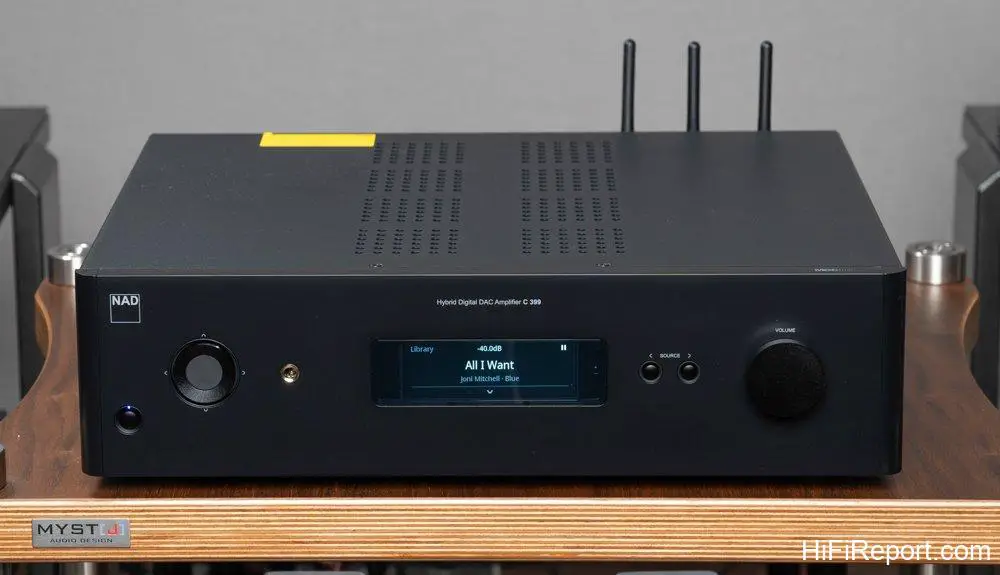
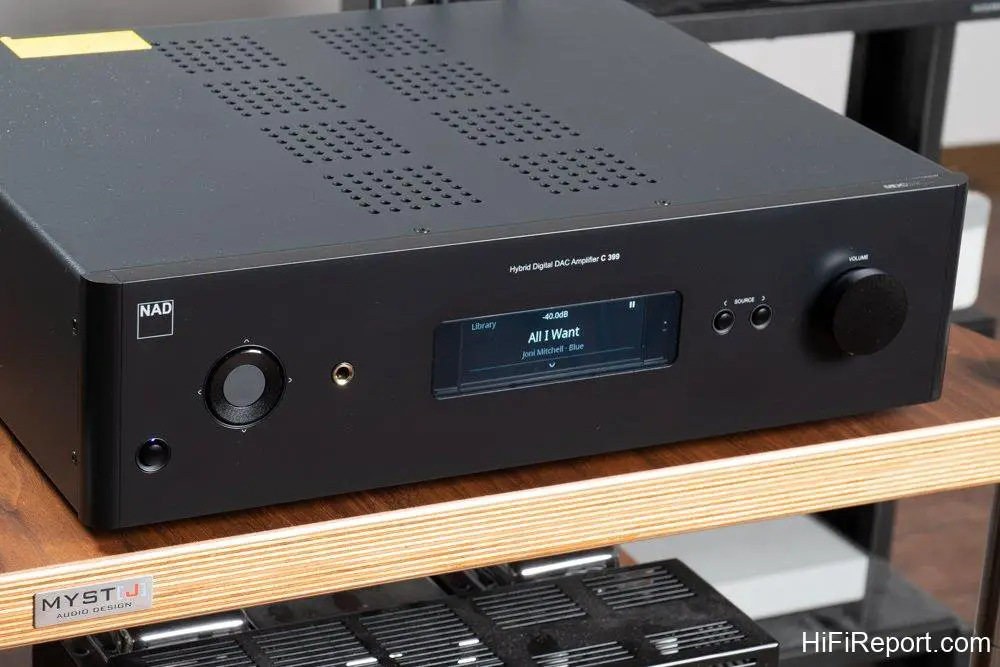
Before even turning it on, the first impression of the NAD C399 is its remarkably solid and reliable chassis construction.
The top cover has substantial thickness; while perhaps not “tank-like,” it inspires confidence.
The C399’s exterior design is extremely simple. Although it subtly echoes the Master series, such as the M33, it lacks the layered and color-separated decoration of heavy aluminum panels, and the display screen is smaller and monochrome, giving it a more austere appearance.
The front panel features rounded corners, mimicking the M33, but otherwise, it is devoid of any embellishments.
This is quintessential NAD.
Attractive aesthetics certainly boost sales, but if it doesn’t contribute to the sound, what’s the point? Just as unadorned as the 3020 was in its day, the current C399 remains equally straightforward.
Comprehensive Inputs & Bluetooth
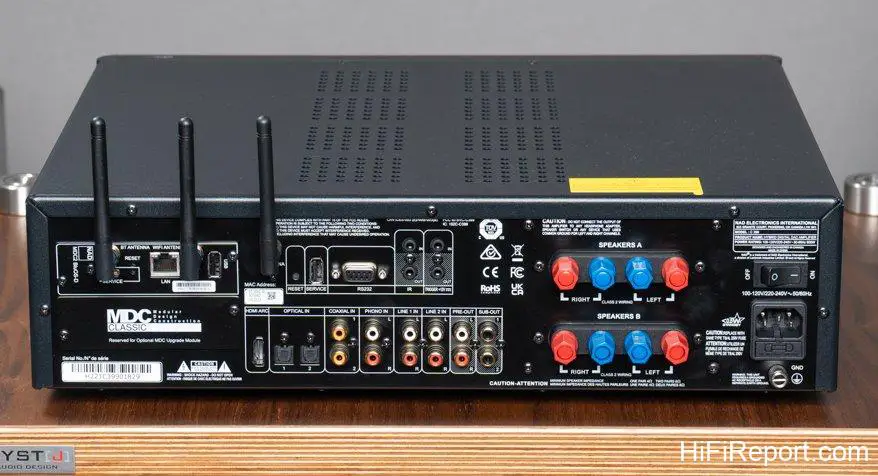
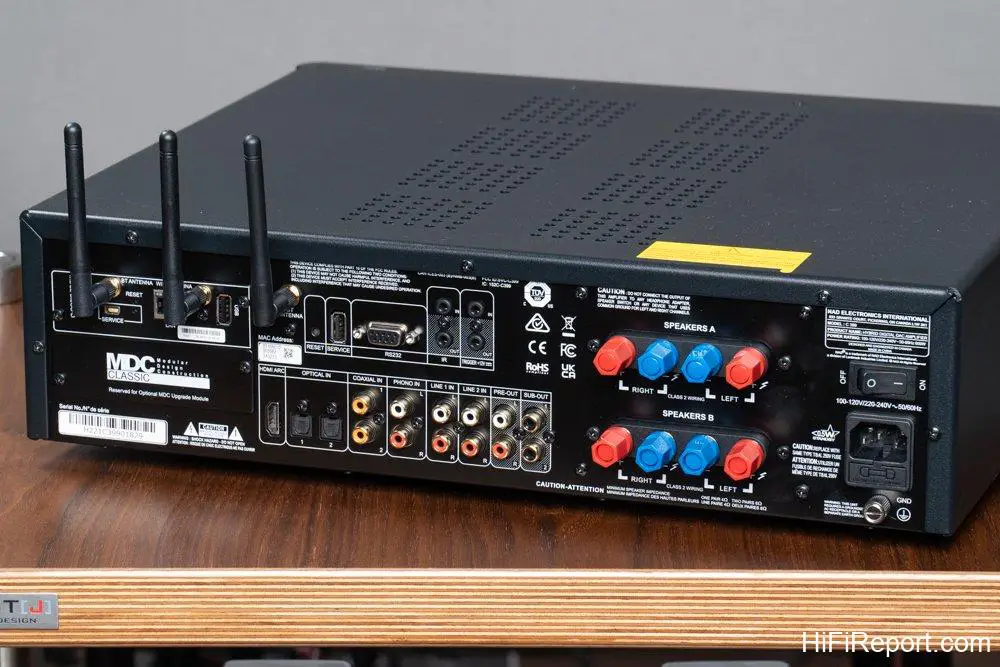
Looking at the rear panel connectors, the NAD C399 also demonstrates considerable sincerity.
It inherently includes two sets of high-level analog inputs (RCA) and an MM phono stage input (RCA). For digital inputs, there are two coaxial and two optical inputs.
Notably, NAD states that the C399’s phono circuit features a precise RIAA EQ curve, not only with a high signal-to-noise ratio but also with infrasonic filtering to eliminate extremely low-frequency noise.
Two very convenient and generally uncommon features on integrated amplifiers are Bluetooth transmission and HDMI.
This HDMI port supports eARC, ensuring audio-video synchronization when connecting to a TV for streaming dramas or watching movies.
As for the C399’s Bluetooth transmission, it supports aptX HD 24-bit audio. Previous models like the C388 and C368 only reached 16-bit aptX level. In other words, previous Bluetooth was at most CD quality, but now the C399’s Bluetooth can transmit high-resolution audio.
Moreover, the C399’s Bluetooth also supports two-way transmission. It can not only receive but also transmit. Therefore, you can also use it with Bluetooth headphones, allowing the C399’s music to be transmitted wirelessly to your headphones. This is also a feature absent in the earlier C388 and C368.
ESS Sabre DAC & Hi-Res Support
The C399 is not just an integrated amplifier; it also incorporates a built-in DAC, allowing users to connect TV boxes, game consoles, CD players, Blu-ray players, or other digital source devices directly to the C399. However, the C399’s standard configuration only includes four S/PDIF inputs (two coaxial and two optical), along with Bluetooth and HDMI inputs.
Even so, this is generally sufficient for typical home use.
It is important to note that the USB Type-A port on the C399’s rear panel is not for connecting hard drives or USB drives to play music. It is intended for engineering purposes such as maintenance or firmware upgrades, so avoid plugging in the wrong devices.
NAD has equipped the C399 with a DAC that aligns with their Master series, utilizing the ESS Sabre 9028 DAC chip.
While the chip’s specifications can support up to 32bit/384kHz, the C399 itself, due to its digital inputs being limited to S/PDIF, supports a maximum sampling rate of 24bit/192kHz.
Even so, compared to the 16bit/44.1kHz Red Book standard, 24bit/192kHz offers greater bit depth and a higher sampling rate. When dealing with Hi-Res high-resolution music, it still provides more listening pleasure.
Intuitive Menu & Adjustable Parameters
NAD has endowed the C399 with rich menu functions, allowing users to customize various settings.
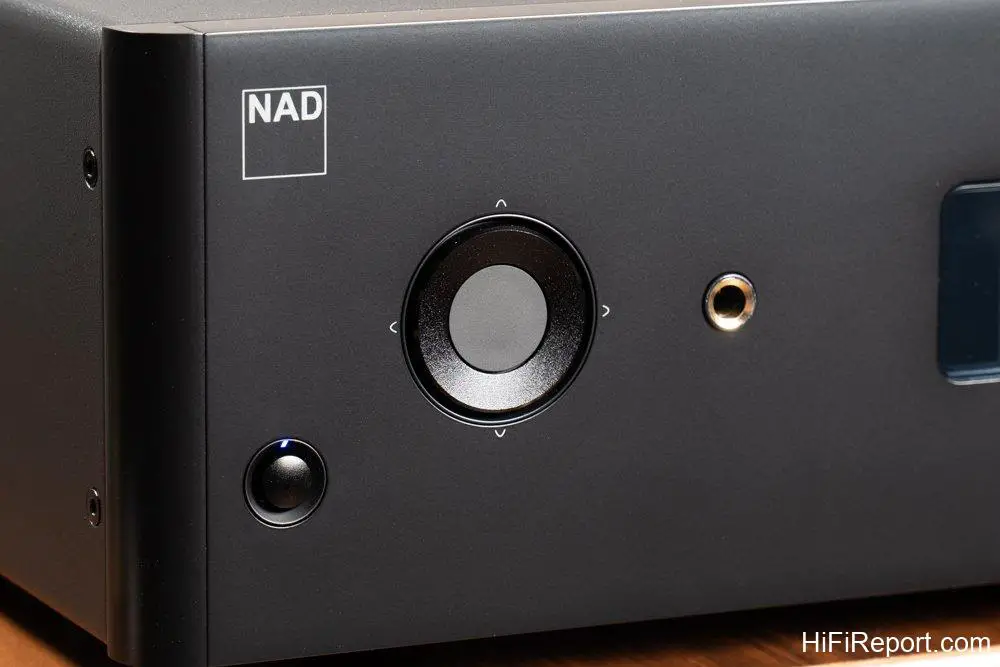
On the left side of the front panel, there is a set of circular coaxial control buttons. The outer buttons can be pressed in four directions (up, down, left, right), and the center button is for selecting input (enter).
Commonly seen “treble and bass adjustments” and “left-right channel balance” are of course included, but it can also control the on/off status of each input and rename each input.
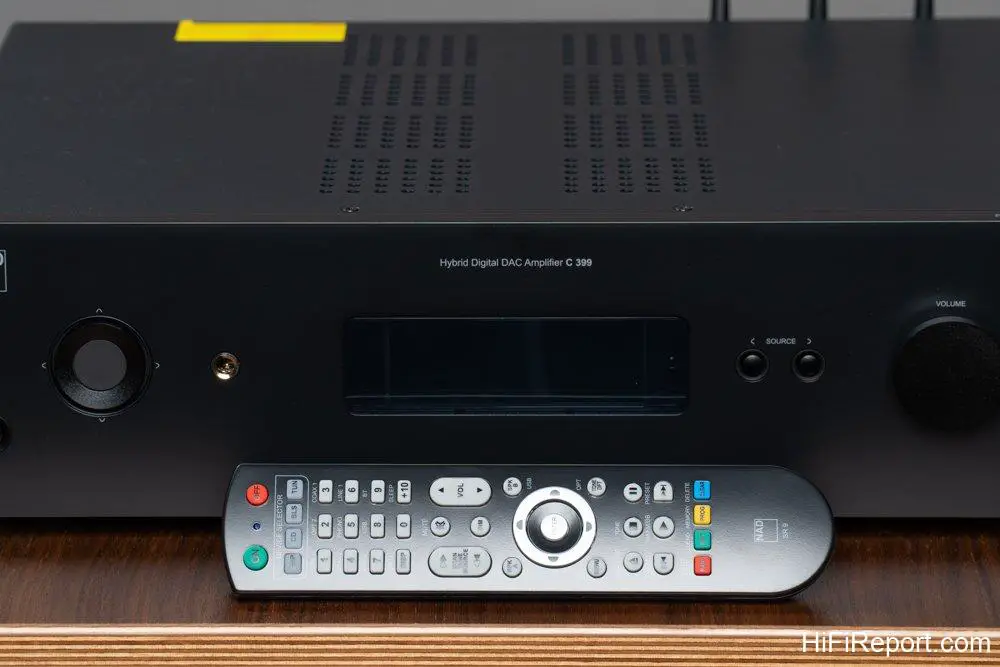
You can also choose whether the volume control is variable or fixed. The latter can be used for integration with a surround sound preamplifier.
When using analog inputs, if the output from the front-end source is low, you can increase the gain of the analog input in the menu.
You can also decide whether to control via the HDMI bi-directional channel, allowing the TV to control the C399’s power on/off. You can also set the Auto Sense function to wake up the C399 when a signal is fed into the input.
The display brightness can also be adjusted in three levels, and the volume display method can be selected as percentage or decibel value.
The items it can adjust are truly numerous, and I won’t enumerate them all here.
Importantly, the C399’s menu operation is intuitive, and the logic is straightforward, so you won’t get lost in endless loops.
Versatile Outputs & Application
The C399’s diverse outputs provide more application possibilities.
There are two sets of speaker terminals, allowing you to connect two pairs of speakers, or if your speakers have two sets of speaker terminals, it is convenient to use two pairs of speaker cables for bi-wire connection.
The C399 also has a pre-amplifier output, which can be used to connect to other power amplifiers. Coupled with the C399’s own speaker outputs, bi-amping becomes a viable option.
Previously, the C388 only had one set of pre-amplifier outputs, forcing those wanting to use a subwoofer to choose between bi-amping and subwoofer integration. The C399 allows you to have both.
Next to the pre-amplifier output are two sub-out subwoofer outputs, allowing you to set up a 2.1 or 2.2 channel system, enhancing the system’s bass performance.
On the front panel’s left side, there is a 6.3mm single-ended headphone output jack.
As mentioned earlier, the C399 can act as a Bluetooth transmitter, allowing users to pair Bluetooth headphones for listening to music.
If you prefer using wired headphones, this headphone output will come in handy.
In actual listening, the C399’s headphone output performs quite well. Driving my usual Sennheiser HD598s and playing “Black Eyes” from “A Star Is Born” via Tidal Connect, the C399 makes the typically refined HD598s sound passionate and energetic. The drum sounds are full and powerful, and Bradley Cooper’s slightly weathered, wandering vocals have a clear and solid vocal line.
Smart Home Integration
The NAD C399 is also equipped with an RS232 serial port, 12V Trigger power trigger, and IR infrared input/output jacks, facilitating overall audio-visual system planning and integration into smart home control systems.
Currently, the smart control system manufacturers supported by NAD include Control4, Crestron, RTI, URC, Lutron, iPort, Elan, PUSH, and KNX, among others.
Although home control systems are not yet universally common, more and more new homes are incorporating them into their designs.
In the market for two-channel amplifiers under $1000 USD, options with these interfaces are not numerous. For consumers considering installing a home control system, the C399 is certainly worth considering.
MDC Expansion & BluOS Streaming
Hopefully, you haven’t dozed off while reading this far, because the next two points are very important and can be considered the core value of the C399 product.
Without exaggeration, even if the preceding reasons were absent, these two points alone would make the C399 worthy of being placed high on your shopping list.
Most audio equipment is a “buy it and that’s it” proposition. The specifications and features you get at the time of purchase are what you are stuck with.
But the NAD C399 is different.
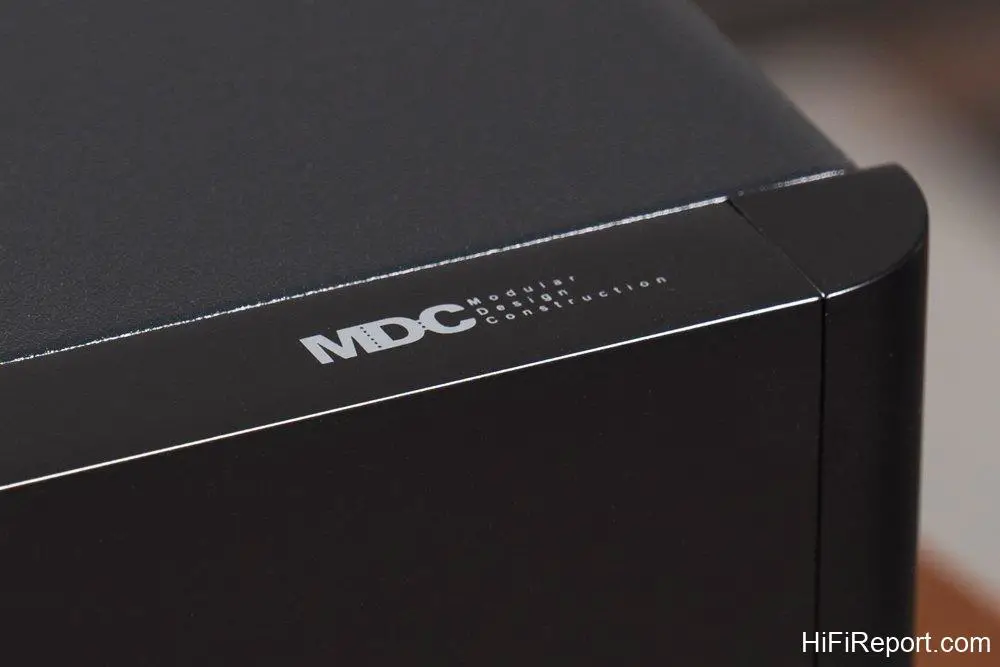
In 2006, NAD introduced MDC (Modular Design Construction), a modular design architecture. Consumers can purchase MDC modules to expand functionality according to their needs.
Now NAD has launched the new generation MDC2 module. The first MDC2 module is the MDC2 BluOS-D, which has two major functions: Dirac Live room correction and BluOS music streaming.
Moreover, the C399 is the first NAD device that can install the MDC2 BluOS-D second-generation MDC module.
The MDC2 BluOS-D module (image from NAD official website). Room correction is essentially a type of DSP (Digital Sound Processing).
Some people disagree with it, believing that the sound after room correction processing is not natural enough.
However, for users with poor room acoustics, room correction is a shortcut to improving the sound distortion caused by the room.
The MDC2 BluOS-D module’s Dirac Live primarily addresses peaks and dips in the 500Hz range, which is the frequency range where room distortion is most severe. Additionally, it can also moderately optimize frequency response peaks caused by room wall reflections.
Through the included microphone measurement and Dirac Live’s processing, it can improve clarity in the bass range, making imaging clearer and timbre more accurate.
The software can remember five listening positions. Therefore, you can measure up to five positions, so no matter where you sit, you can get room-corrected sound.
The MDC2 BluOS-D is also the first time NAD has incorporated Dirac Live room correction technology into an MDC module, available for installation in two-channel equipment.
Another function of the MDC2 BluOS-D is music streaming.
The module has an RJ45 port for wired network connection and two antennas, one for WiFi and one for Bluetooth.
Therefore, if your equipment placement is not convenient for running a network cable, you can still connect via WiFi.
Once connected to the network, you can not only control and operate the C399 via your smartphone or tablet, but your smart mobile device becomes your remote control and your player.
Internet radio, streaming services, and UPnP/DLNA playback make listening to music simpler and more convenient.
It supports Spotify Connect and Tidal Connect, allowing subscribers of these two services to directly use the Spotify and Tidal apps to play music. It is also Roon Ready certified.
It supports file sampling rates up to 24bit/192kHz and also supports MQA decoding, so listening to high-resolution music is not a problem.
For Apple users, it supports AirPlay 2 and Siri voice assistant. In addition, it also supports Amazon Alexa and Google Assistant.
As for the MDC2 BluOS-D’s Bluetooth, it is also two-way Bluetooth. Will the two Bluetooth connections interfere with each other after installing the module in the C399? Rest assured, NAD engineers have considered this. As soon as the module is installed, the C399’s built-in Bluetooth will be turned off, replaced by the MDC2 BluOS-D’s Bluetooth.
This way, only one pairing target will appear on your phone, not two.
In the C388 era, this issue was not yet addressed, but now this “not particularly bothersome, but confusing” minor problem has been solved.
Furthermore, the original C399 did not have a USB port for connecting hard drives with music files. The MDC2 BluOS-D has a USB Type-A port, increasing usability flexibility.
Although the C399 itself does not have streaming capabilities, with the addition of the MDC2 BluOS-D, it becomes a streaming integrated amplifier and can also solve the problem of sound degradation caused by your room acoustics.
All these features are fully provided at once, making the Classic series C399 the first in the entry-level classic series to stand shoulder to shoulder with Master series models in terms of functionality.
Currently, the only second-generation MDC2 module available for the C399 is the MDC2 BluOS-D. Other MDC2 modules will be launched successively.
The MDC modular design allows NAD amplifiers to become increasingly powerful over time.
Hybrid Digital Hypex nCore Amplification
Amplifiers have always been NAD’s forte. As mentioned earlier, their amplifiers have been known for their high price-performance ratio for many years.
In 2009, they made a major policy shift, abandoning traditional Class A and Class AB amplification. They first launched NAD DirectDigital digital amplification modules and began ordering Class D amplification modules from professional manufacturers.
DirectDigital amplification employs full digital amplification, while Class D amplification is analog amplification.
Currently, NAD’s amplifiers use either Purifi Audio’s Eigentakt amplification modules or Hypex modules.
The C388 used Hypex’s UcD amplification module. For the C399, they switched to the same Hypex nCore module used in the M10, which is a higher level than UcD.
The M10 uses a single stereo nCore module, with a maximum output of 100W. The C399 uses two of the same nCore modules, boosting the output power to 180W per channel, with peak output reaching 250W, even higher than the C388’s 150W.
The manufacturer states that this NAD-tuned and customized Hypex nCore amplification module has a wide bandwidth and flat frequency response characteristics.
Its ultra-low noise and ultra-low distortion performance allows it to maintain low distortion even at high volume output.
High current output means the C399 is not afraid of speakers with low impedance.
To match this nCore Class D amplification module, the NAD C399 is equipped with a carefully designed switching power supply. It is low noise, high efficiency, low temperature, and provides abundant and fast power supply.
This is also a power supply circuit that NAD specifically designed for Class D amplification, also working in a switching mode. According to the manufacturer, this switching power supply and Class D amplification complement each other perfectly.
Sonic Performance: Powerful, Detailed, High Resolution
When it comes to sound, NAD certainly remains uncompromising.
The C399’s sound is clean.
No, it’s extremely clean.
The pitch-black background allows images and details to emerge effortlessly, clearly audible even at low volumes.
Hypex nCore’s sound is delicate and highly resolving. Not only are sonic textures discernible, but even their fine details are revealed.
High density and high resolution allow you to easily capture musical content. Even subtle and faint information can be meticulously dissected and presented.
The C399’s sonic direction is lively and bright, exuding a youthful and energetic quality.
The soundstage is open and layered. When playing large-scale orchestral music, it can clearly establish the stage.
It does not suffer from the excessive bass often associated with traditional Class D amplifiers. Instead, it has tight, fast, and clean bass that can go deep, with moderate quantity and bass range resolution retained.
When playing the theme song from the movie “Top Gun: Maverick,” the richer and fuller score created by Hans Zimmer has a healthy and solid musical texture, layer upon layer, making the drama conveyed by the music even more intense.
The music played by the C399 through Tidal Connect is full of tension and has a dense texture. The crisp and solid quality delineates a clearer musical texture structure.
In this version of the score, the electric guitar is much gentler, almost only considered part of the accompaniment.
Listening back to the 1986 version of the score, Steve Stevens’ electric guitar is much more energetic. The bridge section removed by Hans Zimmer is played with unrestrained and flamboyant sounds through the whammy bar.
When the C399 performs Hans Zimmer’s block-like music, the high resolution brings layer upon layer of delightful surprises. When listening to Steve Stevens’ electric guitar, it shows a wild and unrestrained aggressive temperament, making listening highly enjoyable.
Playing Vladimir Ashkenazy conducting the Philharmonia Orchestra performing Sibelius’ “Finlandia,” when the low strings and bassoons emerge and drone, the rough and heavy texture is heard particularly clearly.
The trumpets are bright and brilliant. The brightness that the C399 brings when playing music makes the music sound particularly energetic and vibrant.
The timpani at the back of the stage are solid and clear with each strike, and the drum beats are completely discernible.
Led by the brass, the orchestra moves forward with steady steps. The march-like passages speak of the Finnish people’s courage to resist the tyranny of the Russian Tsar. The music sounds vigorous and spirited, with a clear and structured sense of rhythm and dynamics.
When I listened to the 3020 (actually, mine was a later 3020i) before, I had never seen such a transparent picture, such clear layers. But on the C399, NAD has shed the traditional British audio stereotype of warmth and smoothness, replaced by a powerful, clear, transparent, and open sound.
Moreover, I must praise the C399: its power is truly reassuring.
I myself prefer small wattage, refined-sounding amplifiers. So, at home, I use a 35W Lavardin IS Reference and a 40W tube amplifier, the Audiomat Adagio.
But I know that high-power amplifiers, although slightly lacking in refinement, offer a grand scale and dynamic headroom that small-wattage amplifiers cannot match. So, I also have a 150W NuPrime ST-10 power amplifier at home, allowing me to change flavors.
The rare quality of the C399 lies in its fierce and sharp driving force. When playing music, it always gives you the urge to crank up the volume. It seems that no matter what speakers it faces, it drives them with ease.
Even when I used speakers that are much more expensive than the C399, like the Dynaudio Contour 60 and Wilson Audio Alexia 2, it could drive the speakers appropriately and reliably, showcasing their capabilities.
The C399’s clean, transparent, and clear quality allows me to see the organization of the music at a glance, and it also allows the speakers to fully demonstrate their abilities. Its delicate sound quality, at small to medium volumes, also has the texture of a small-wattage amplifier.
Clean, delicate, high resolution, lively and powerful dynamics are the sonic characteristics of the NAD C399. Combined with its 180W of high power, the C399 appears confident and assured when driving any speaker.
M33 Features & Future-Proof Design
The final reason is that the C399 can almost be seen as a more affordable version of the M33.
The C399 uses the same Hypex nCore amplification module as the M10, and even uses two of them, bringing more abundant power output. In terms of digital functions, it fully aligns with the Master series M10 and M33.
The full-size chassis provides better heat dissipation. Even after long periods of intense operation, the machine’s temperature remains low, not even qualifying as “warm.”
Compared to the M10, which gets hot, the C399 works much more comfortably.
While the C399’s appearance is simpler and more austere than the M33, in terms of functionality and performance, the C399 actually rivals the M33 in every aspect. Even looking at the back panel, except for the lack of XLR analog balanced inputs and AES/EBU digital inputs, it is almost identical to the M33.
We can even say that the C399 is a Master-level device in the Classic series, a “pseudo-Classic” model.
The MDC modular design further gives the C399 room for future development.
Through module plug-in cards, users can easily add new functions to their C399.
If you add the latest MDC2 BluOS-D module, giving the C399 Dirac Live room correction and digital streaming capabilities, it not only impacts the M33 but also impacts the global best-selling M10 market.
The C399 looks unassuming, but it has the potential to achieve great things!
Conclusion: Fifty Years of NAD, Half a Century of C399
Founded in 1972, NAD is proudly entering its 50th year.
There are truly not many audio companies worldwide with such a history.
NAD is not limited by past experience. Instead, through innovation and constant experimentation, they have pioneered a path that we never imagined before. Who could have imagined today’s NAD, so firmly grasping digital and Class D amplification, yet still closely meeting consumer needs? Fifty years of NAD have accumulated fifty years of experience. The C399 is the crystallization of half a century of development. Here are ten reasons to clearly state the excellence of the NAD C399.
Specifications
* Type: Digital Streaming Integrated Amplifier
* Continuous Output Power (Stereo): > 180 W
* Total Harmonic Distortion (20Hz-20kHz): <0.02% (250mW to 180 W, 8Ω and 4Ω)
* Signal-to-Noise Ratio: >95dB
* Damping Factor: >150 (ref. 8 Ω, 20Hz and 6.5kHz)
* Frequency Response: 20Hz-20kHz
* Standby Power: <0.5W
* Digital Input Terminals: Coaxial x 2, Optical x 2
* Analog Input Terminals: Line In x 2, MM Phono (Input Sensitivity: 0.3mV, ref. 200mV pre-out)
* Dimensions (W x H x D): 435 x 120 x 390 mm (17 1/8 x 4 3/4 x 15 3/8)"
* Net Weight: 11.2 kg