
NAD M10 V2 Review
When I first got my hands on the NAD M10 back in May 2019, I had a strong feeling that this small device would mark a significant step forward in amplifier history. Just a few months later, it indeed won the EISA award for Smart Amplifier of the year. The success of the NAD M10 wasn’t just a matter of luck; it was the expected outcome of NAD’s meticulous product planning.
NAD had already incorporated Hypex UcD Class D amplifiers in several integrated amps in the years prior, and Digital Room Correction (DRC) wasn’t entirely new either – it was common in most surround sound receivers. So, what made the NAD M10 capture the attention of enthusiasts worldwide and become the vanguard of a new generation of “advanced” integrated amplifiers? NAD learned from its past experiences: it wasn’t just about using the right methods, but getting the *degree* right.
If using Class D, use the best Class D; if using DRC, use the most effective DRC. A winning formula demands the best components.
At the time, Hypex Ncore was widely recognized as having the best sound quality among Class D modules, so NAD opted for the higher-grade Ncore instead of UcD. NAD had also refined its application of Dirac’s DRC technology, having gained experience with it in their surround sound receivers. Dirac’s low-frequency correction capability is far superior to most DRC systems, capable of testing and correcting down to the lowest extremes below 20Hz.
The combination of “Ncore + Dirac,” integrating the highest-performing Class D with the most powerful DRC available at the time, allowed the M10 to clearly define the boundary between the old and new eras of amplifier design for reviewers and users alike. It was remarkably small yet powerfully driven, boasting high resolution and ultra-low distortion. It possessed the ability to tackle low-frequency room modes and improve left-right channel symmetry.

Crucially, it came with built-in streaming, meaning you only needed to add a pair of speakers for a complete, modern streaming audio system. The moment the M10 arrived, many integrated amplifiers suddenly felt outdated.
NAD M10 V2: What’s New?
Given how impressive the M10 was, what’s the significance of NAD releasing this M10 “V2”? Considering the M10 has been on the market for over two years, a minor revision is certainly reasonable. In this review, I will elaborate on the features, changes (compared to the first generation), circuitry, and listening impressions of the M10 V2.

Connectivity and Streaming
The M10 V2 comes equipped with built-in Wi-Fi and Bluetooth. When connected to the network, it allows users to stream from services like Tidal, Qobuz, internet radio, Spotify, and KK Box. It features full MQA decoding capability, meaning you can enjoy Tidal’s Hi-Res streaming, Radio Paradise’s MQA internet radio, and MQA music files with full decoding and the intended audio quality.
For local file playback, the M10 V2 is compatible with file types including MP3, AAC, WMA, Ogg Vorbis, WMA-L, ALAC, OPUS, MQA, FLAC, AIFF, and WAV. DSD file playback requires sharing from a PC using the BluOS application.
The M10 V2 can play music files shared on a network from a PC or other NAD devices. Alternatively, you can store music files on a USB hard drive and plug it into the USB port on the rear panel to use it as a music library. The first time a USB drive is inserted, it takes some time to fetch relevant data from the cloud to organize the music files by album, track, artist, etc.
I also tried using an exFAT formatted USB Solid State Drive (SSD) with the M10 V2, and it successfully read and played files normally. Currently, not many streaming audio devices support exFAT, but I expect this will become more common after the M10 V2.
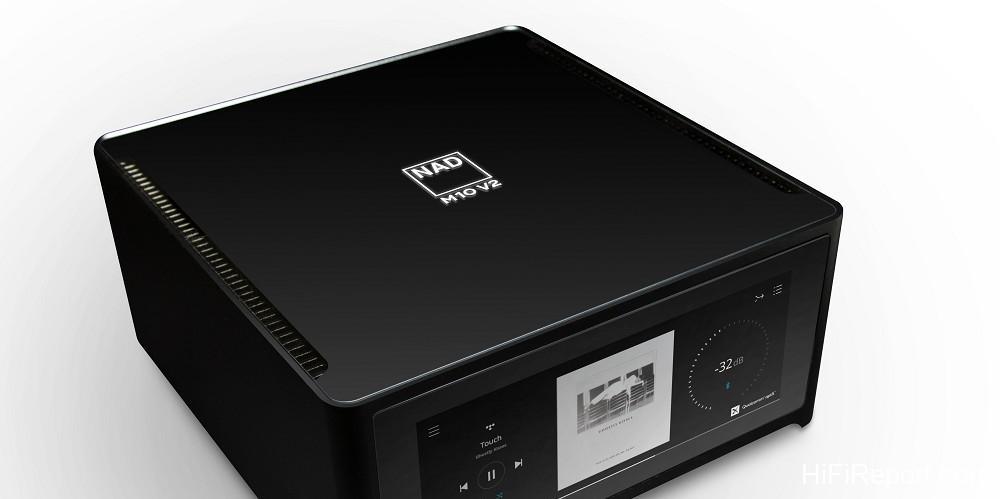
Streaming is paramount today, encompassing not only music but also video streaming, which is even more common for most people. If you purchased a major brand TV after 2015, it likely supports internet connectivity for watching online videos from platforms like YouTube and Netflix (i.e., it’s a smart TV).
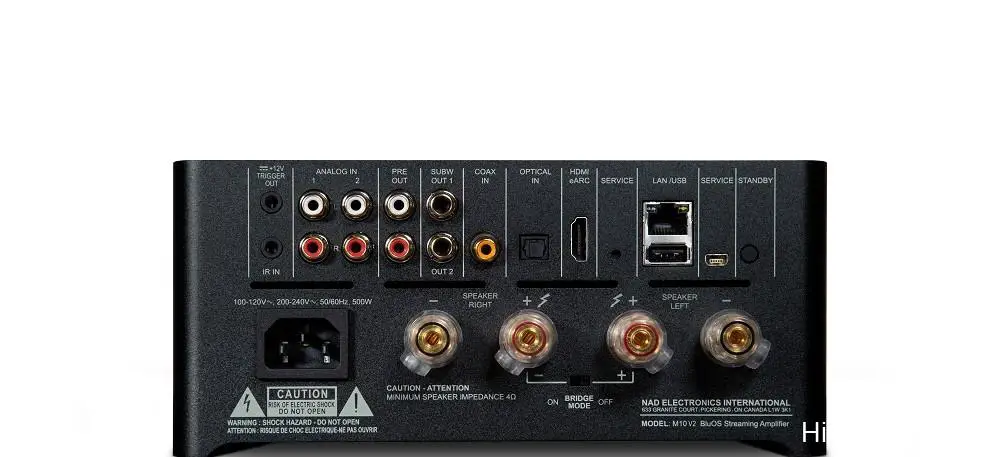
If you own the M10 V2, simply find the HDMI input on your TV labeled “ARC” or “eARC,” connect it to the HDMI eARC port on the back of the M10 V2 with an HDMI cable, and make a quick adjustment in your TV’s audio settings. This will allow your audio system to replace the TV’s built-in speakers for all audio output, whether it’s regular broadcasts or online video streaming.
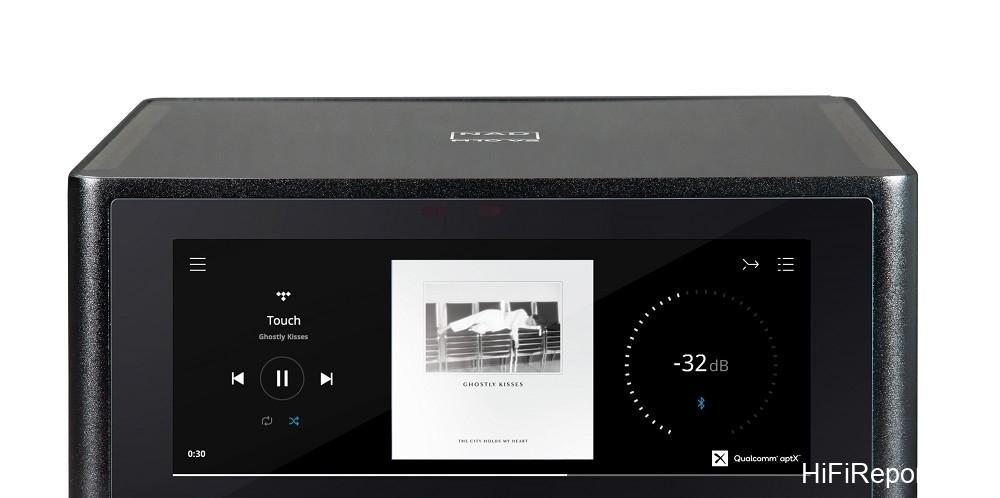
Key Improvements
Compared to the first generation released in 2019, the M10 V2 features four primary changes:
1. Addition of a remote control (previously, operation was solely through the BluOS app on a smartphone or the touch panel).

2. Upgrade to an IPS full-color LCD touchscreen, significantly reducing picture whitening when viewing the screen from an angle, and offering higher color saturation and contrast.
3. Inclusion of Dolby Digital decoding functionality, allowing it to integrate with BluOS-compatible wireless speakers and subwoofers (such as using a pair of Bluesound Pulse Flex for surrounds plus a Pulse Sub for the LFE channel) to form a 4.1 channel system.
4. An “internal” change: In my review of the 2019 M10, I noted that if the paired speakers had low sensitivity and the user played low-level recordings (common in classical music) with Dirac enabled, even setting the M10’s volume to maximum (0dB) might not be loud enough. At the time, I suggested to NAD that they could increase the gain. Perhaps NAD saw my suggestion (or received feedback from other users), as the M10 V2 features “updated gain algorithms.”
When playing low-level recordings with Dirac correction active, the M10 V2 can now reach sufficient volume levels.
Inside the M10 V2
Although I knew this was a minor revision, I still felt it necessary to open the M10 V2 to confirm the circuitry. Internally, the M10 V2’s circuitry is roughly divided into upper and lower layers. The Bluetooth and Wi-Fi modules are located on the upper digital circuit board. The core of the digital processing is an NXP 1GHz dual-core ARM Cortex-A9 chip, responsible for file decoding, Dirac DRC processing, and bass management (crossover between left/right channels and the subwoofer).
After digital audio processing, the left and right channels undergo digital-to-analog conversion using a high-end 32-bit ESS DAC chip, the ES9028Q2M, which boasts a dynamic range of up to 129dB. A separate TI PCM5122 is used for the subwoofer channel’s D/A conversion. NAD primarily uses TI OPA2134 JFET-input dual op-amp chips for small signal amplification in this unit. This chip is known for its high slew rate.
Observing the circuit design for the streamer/preamp section, from the choice of DAC chip to the op-amp chips, it’s clear the design prioritizes speed (transient response) and dynamics.
The lower circuit layer of the M10 V2 primarily houses the Ncore power amplifier module. I believe this module is still the “NC252MP.” The “NC” in the module designation stands for Ncore, “252” indicates a two-channel amplifier with 250 watts per channel (into 4 ohms), and “MP” signifies an integrated switching power supply. The NC252MP possesses the advantages of Class D amplification, including high energy efficiency (up to 92%), which results in low heat generation.
Crucially, it avoids the typical Class D weakness of rising high-frequency distortion, maintaining harmonic distortion below 0.0025% across the entire frequency range.
NAD’s power specifications for the M10 V2 are quite conservative. The “rated output power greater than 100 watts per channel” actually implies that if you “only use” 100 watts of output, the harmonic distortion at 100Hz, 1kHz, and 6kHz will not exceed 0.0015%. If other manufacturers were to specify this, most amplifiers would state their rated power with 1% distortion (which is being generous), and sometimes even 10%!
To put it plainly: at the same rated (maximum continuous) power output level, the harmonic distortion of the M10 V2 is only a few hundredths, or even less than one thousandth, of that of most amplifiers.
Performance and Dirac
Performing Dirac calibration on the M10 V2 is now straightforward: plug in the included microphone, install the Dirac Live app on your smartphone, and follow the test and calibration procedure. I used a miniDSP UMIK-1 measurement microphone connected to a laptop, running Dirac Live 3 on the laptop and importing the UMIK-1’s frequency response calibration file to test the system. After testing, I conducted the listening evaluation.
This time, I paired the M10 V2 with the same speakers I used for the M10 review two years ago: Pioneer S-1EX floorstanding speakers.
If you’ve never heard the M10, I believe you’ll be incredibly surprised by the M10 V2’s ability to drive speakers. This amplifier, significantly smaller than a shoe box, delivers power fully comparable to a 150-watt power amplifier. Just a few tracks of pop music, fusion jazz, or similar genres are enough to reveal the M10 V2’s strong and fast bass. Kick drums and electric bass sound taut and incredibly elastic.
It allows even novice listeners to directly experience what bass control means: quick starts and stops, strong impact, and clear, stable reproduction of bass details, dynamics, and pitch.
Dirac can correct peak frequency deviations by approximately ±10dB, reducing frequency response variations to within ±2dB or less after calibration. During my listening sessions, I first compared the difference between Dirac calibration off and on.
I can definitively state that with Dirac calibration engaged, *even when placing floorstanding speakers against the wall*, it effectively resolves the booming, bloating, and blurring caused by excessive bass and room modes, thus optimizing bass resolution.
Next, I compared the bass performance in a 2-channel setup versus a 2.1 channel setup (using the S-1EX with an M&K X10 subwoofer, crossed over at 60Hz). The result was almost indistinguishable between the two, with the only difference being that adding the subwoofer allowed the extreme low frequencies to extend even lower. This demonstrates that the M10 V2, through Dirac’s precise testing and calibration, can seamlessly integrate the left/right channels and the subwoofer.
Whether in 2-channel or 2.1 channel mode, I believe the M10 V2’s bass performance is truly deserving of a perfect score!
Sound Quality
Regarding sound character, the M10 V2, like the M10, remains a neutral, realistic, and energetic type. The mid-range is direct and transparent, and the treble extends smoothly to the high frequencies without being harsh. The sound is clear, direct, and fresh, with high transparency in the soundstage. Sound images are well-defined and stable, possessing a strong sense of visual presence.
Comparing this listening experience with my impression of the original M10 review, I feel the M10 V2 has higher dynamics, with a more apparent difference between soft and loud passages, and a sense of greater power. Perhaps this is a result of the V2’s increased gain.
At this point, I must share an important concept with users: there is currently no “DRC that completely doesn’t impair sound quality.” Therefore, the ultimate tuning of the M10 V2 should involve using instruments to assist with speaker placement and room treatment, aiming to achieve a balanced frequency response with “Dirac: Off.” This is similar to the Pure Direct mode on surround sound receivers.
Turning Dirac off allows you to hear richer harmonics, and the texture and quality of the sound become more refined. Listening to solo violin and piano pieces reveals the beautiful, complex, and varied timbres of natural instruments more clearly. It allows tiny sonic components to fully emerge, letting you hear the subtle sounds present within the recording space.
Conclusion
The M10 brought NAD significant attention from enthusiasts and reviewers worldwide. By combining top-tier Class D amplification with advanced room correction technology, it became, in my opinion, a pioneer and template for new-generation amplifier design. Although NAD later released the higher-performing M33, I believe the M10 V2, which is effectively a “perfected version” of the M10, remains the king in the amplifier class around ~$3,600 USD.
Whether comparing power, precision, musical charm, or overall appeal, the M10 V2 truly has no competition in its price bracket. Given its uniqueness, high value-for-money, and completeness, it absolutely qualifies for our highest recommendation.
Specifications
* Type: Network streaming integrated amplifier
* Rated Output Power: Greater than 100 watts per channel (both 8 ohms and 4 ohms, both channels driven)
* IHF Dynamic Power: 300W per channel (4 ohms), 160W per channel (8 ohms)
* Damping Factor: >190
* Total Harmonic Distortion: 0.03% (250mW to 100W, 8 ohms and 4 ohms)
* Signal-to-Noise Ratio: >85.1 dB (A-weighted, 1 watt output into 8-ohm load)
* Frequency Response: 20Hz – 20kHz (±0.6 dB)
* Channel Separation: >83 dB (1kHz)
* Input Terminals: RJ45 network port ×1, USB (type A) ×1, Toslink optical ×1, Digital coaxial (RCA) ×1, Stereo analog input (RCA) ×2
* Output Terminals: One set of speaker terminals, One set of preamp outputs (RCA), Subwoofer signal output ×2, HDMI eARC ×1
* Dimensions (W×H×D): 215×100×260 mm
* Weight: 5 kg