
NAD C700 Review
Back in 2019, NAD surprised the audio world with their innovative and compact streaming integrated amplifier, the M10. It showed audiophiles that advanced technology could enable a small amplifier to deliver impressive speaker driving power, low distortion, and excellent sound quality.
Packed with BluOS music streaming (including multi-room capability), Dirac Live room correction, low-frequency management, and HDMI ARC for smart TV digital audio, the M10 was widely acclaimed by reviewers and enthusiasts alike. It ushered in a new era for integrated amplifiers, becoming a benchmark for design in terms of features and performance. The subject of this review, the C700, not only resembles the M10 in appearance but shares the exact same dimensions (length, width, and height).
It’s clearly the M10’s sibling, yet its price is roughly half that of the current M10 (V2).
The C series has always been NAD’s more accessible range compared to the M series. In the past, C series amplifiers typically featured a more traditional design. The C700, however, is not only more compact but also boasts impressive features and performance. While older C series amps required an optional BluOS MDC module for streaming, the C700 is the first NAD C series product with *built-in BluOS streaming circuitry*.
It supports Apple AirPlay 2, Spotify Connect, and Tidal Connect, provides access to services like KKBOX and Qobuz, decodes MQA, and even offers users free MQA high-resolution radio from Radio Paradise. It’s arguably one of the most feature-rich streaming devices currently available.

If you want to listen to music files, you don’t need a NAS or server, nor do you need to install BluOS software on your computer to act as one. Simply purchase a large-capacity USB hard drive to serve as your “music library.” Plug the USB drive into the USB port on the rear panel of the C700, give it a little time to catalog your music (by album, genre, artist, etc. ), and then you can control playback and all the C700’s functions directly from your smartphone.
The C700 supports a wide range of audio formats including MP3, AAC, WMA, Ogg Vorbis, WMA-L, ALAC, OPUS, MQA, FLAC, AIFF, and WAV. Lossless audio files are supported up to 192kHz/24bit. I’ve tested USB storage devices formatted in both NTFS and exFAT (for a USB SSD), and both worked without issue.
The C700’s music file playback, compatibility, and streaming capabilities are identical to the M10. With Netflix Spatial Audio now available, home users’ demand for two-channel audio systems capable of handling streaming movie soundtracks is likely to increase. Like the M10, the C700 features an HDMI eARC port to receive digital audio from smart TVs, allowing your audio system to replace the TV’s built-in speakers.
It also has low-frequency management capabilities, allowing you to connect an active subwoofer for a 2.1 channel setup (using 2.1 channel speakers from the start can also save space). The subwoofer crossover point is customizable and highly flexible (from 40Hz to 200Hz). Overall, the C700 indeed delivers on NAD’s claim of offering 80% of the M10’s features, with the primary difference being the absence of Dirac Live room correction.
Hardware Design
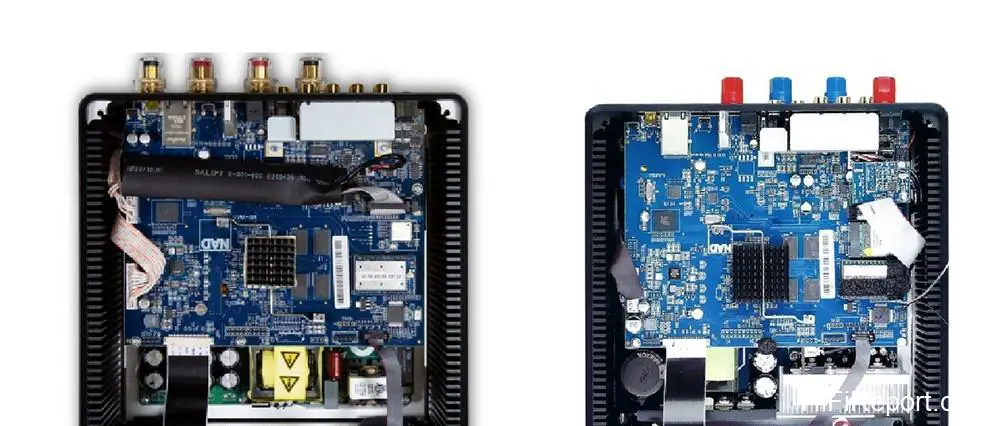
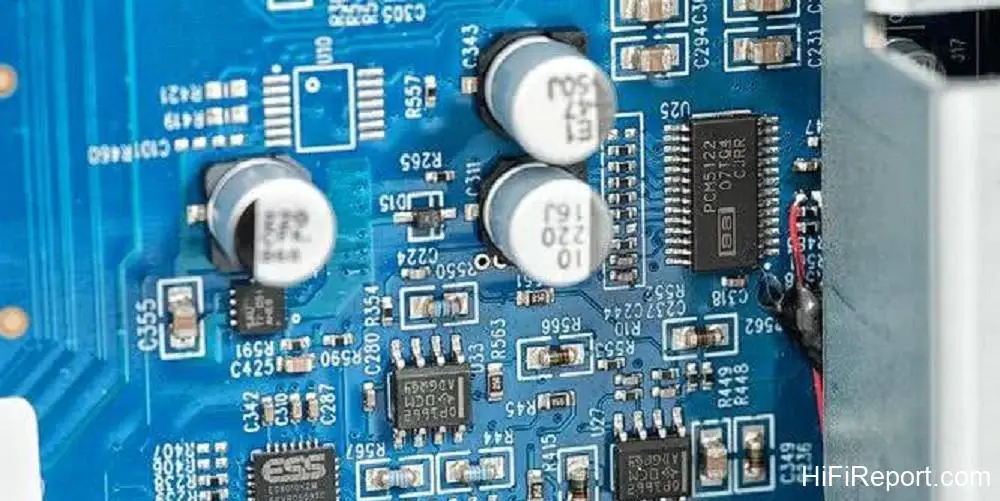
In terms of internal structure, the C700, like the M10, employs a two-layer circuit board layout. The digital mainboard is on the upper layer, containing the system, digital input interfaces, network card, and DAC circuitry. The layout of these circuits is almost identical to the M10, although the components used differ. For the digital-to-analog conversion section, the C700 utilizes the ESS 32bit DAC chip ES9010K2M (with a dynamic range of 116dB and total harmonic distortion of -106dB).
Following this, the I/V conversion and low-pass filtering circuits use the TI OPA1662 (an OP AMP chip known for low noise and low distortion). Additionally, the preamp output and subwoofer output use the TI PCM5122 (a 32-bit DAC chip with a dynamic range of 112dB) for digital-to-analog conversion.
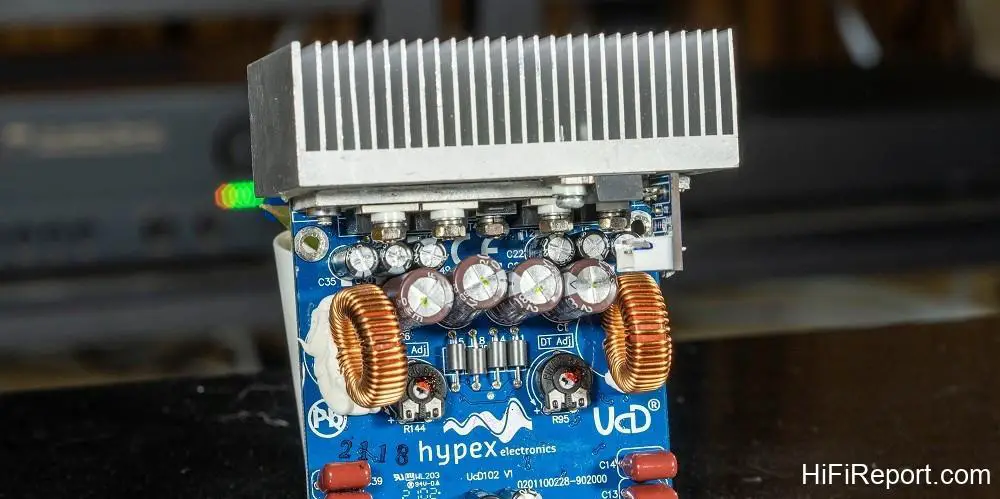
The lower layer of the C700 houses NAD’s independently developed switching power supply circuit and a UcD Class D amplifier circuit developed in collaboration with Hypex. More specifically, it’s a special NAD version of the UcD 102 V1 module. This version not only offers higher rated output power but also uses different components compared to the standard UcD module, selected to meet NAD’s specific voicing requirements.
Examples include certain electrolytic capacitors and the inductors used in the low-pass filter circuit that converts the PWM signal back to an audio signal before output in the final PWM amplification stage. These inductors significantly impact the sound quality and character of a Class D amplifier, and the ones used here differ from the standard version.
NAD has previously used this specially customized UcD 102 V1 Class D module in their flagship surround sound receiver, the T778. I won’t deny that UcD sits below Ncore in Hypex’s hierarchy, but please don’t underestimate the capability of this “special version” UcD. The C700 exhibits a total harmonic distortion of less than 0.04% across the *entire frequency range* at *full power output*. This is not the typical specification showing harmonic distortion at “1 Watt” output and “1kHz”.
This highlights the C700’s advantage in its price segment, offering “high output and low distortion.” The rated power you see in its specifications is achievable at “100% output while remaining stable.” Very few integrated amplifiers in this price range can achieve this.
Sound Performance
What players are likely most curious about is the sound signature of the C700. In my past listening experience, NAD’s M series and C series have distinctly different voicing styles. The M series is neutral, transparent, and highly resolving, while the C series tends to be more mature, warm, and focused on musicality. Even if models from both series use the same Class D module, such as the M23 and C298, they still reflect the characteristic sound of their respective series.
However, when I reviewed the C399 last year, I noticed its sound characteristics were “gradually shifting towards the M series.” Older C series models were comparatively brighter and more dynamic. The C700’s appearance alone makes people anticipate it as a “budget version of the M10.” Does it really sound like the M10? This time, I paired the C700 with my familiar Pioneer S-1EX speakers, which are roughly ten times the price of the amplifier – certainly an overmatch.
This wasn’t just reviewer indulgence; it was to truly ascertain the C700’s character and capabilities.
It was fascinating! When playing music files through the C700, if I didn’t listen too carefully, even someone as sensitive as I am might initially mistake it for the M10. NAD must have done this intentionally; the older C series sound wasn’t like this at all! The C700 is completely *not* “old-fashioned.” Its fresh, fast sound signature really has the flavor of the M10. It fully expresses the fast pace and rhythm of pop music.
Listening to “Seiza ni Naretara” from the “Kessoku Band” album, which has been dominating charts in Japan recently, you can feel the lively bounce of the music. When listening to anime music, electronic dance music, hip-hop, rock, or ballads, there’s no sense of sluggishness.
The C700 offers good sonic clarity. The treble is quite open, clear yet with a slight warmth, a touch of softness, and a subtly sweet, non-fatiguing musicality. The texture and detail of the midrange, particularly for vocals and cello, are above average. For heavy metal rock and hip-hop music, which often feature electronic bass with significant deep low-frequency components, the C700 exhibits excellent control. The bass is tight and defined, not bloated or loose.
NAD has voiced the C700 to be more neutral and dynamic, making pop music sound lively, which will surely appeal more to younger enthusiasts. However, I also noticed that it still retains the C series’ excellent tradition: classical music remains a strong suit. When listening at comfortable volume levels, its natural, fluid, and utterly non-sterile sound could easily be mistaken for a Class AB amplifier.
Playing Simon Höfele’s performance of the third movement of Haydn’s Trumpet Concerto in E-flat Major, the trumpet sounded wonderfully pleasant, with the balance between the orchestra and the soloist just right. The soundstage expanded in a fan shape behind the speakers. Listening to Fazil Say playing the Goldberg Variations, you can appreciate the richness of the piano’s timbre; the sound is balanced and musical, with just the right amount of shimmer.
You can sense the depth and density of the soundstage. Hilary Hahn’s performance of Sarabande fully conveys the violin’s power, dynamic nuances, and tonal variations. The treble isn’t softened or rolled off, allowing you to clearly hear the “sound of the space” of the performance venue.
Listening to Valérie Milot’s harp solo of “Vltava” (The Moldau), you feel that the C700 offers superb performance in terms of the realism of natural instruments (completeness of harmonic overtones) and overall beauty for its price point.

Home Theater Integration
Finally, I tested the unit’s performance with spatial audio for surround effects. I must be honest; while the C700 sounds like the M10, its energy is slightly less potent. To experience the full impact of movie soundtracks, I would strongly recommend against buying floorstanding speakers and instead using the saved funds to purchase a cost-effective active subwoofer. A 2.1 channel setup will undoubtedly outperform a soundbar for movie audio.
Therefore, for this stage of the test, I connected an active subwoofer and set the crossover point to 80Hz.
Netflix has introduced AMBEO 2-Channel Spatial Audio. Playing such content on this system provided a strong sense of envelopment and a deep sense of space extending from near to far. In the scene at 1 hour, 10 minutes, and 10 seconds of Stranger Things Season 4 Episode 1, you can feel numerous sound objects in space, complex surround effects, and the immersive feel of a three-dimensional soundstage.
The subwoofer added richer bass energy and deeper low-frequency extension, increasing the density of the surround effects and enhancing immersion. Even with regular streaming movies (other than Netflix Spatial Audio), simply spreading the left and right speakers far enough apart provides a wide soundstage and a sense of envelopment from the sides.
Conclusion
The NAD C700 is fully equipped with streaming features; adding a pair of speakers creates a complete streaming audio system. From classical to pop music, the NAD C700 performs comprehensively, meeting the listening needs of various age groups across different music genres. If you want to experience the impact of Netflix streaming movie audio in your living room, adopting a 2.1 channel speaker setup with the C700 is very user-friendly for connecting and configuring a subwoofer.
Its compact and attractive design belies its impressive capability! Considering its features, performance, sound quality, and price point, the NAD C700 fully deserves our highest recommendation.
Specifications
* Type: Network Streaming Integrated Amplifier
* Rated Output Power: 80 Watts per channel (8 Ohms), 100 Watts per channel (4 Ohms)
* IHF Dynamic Power: 100W per channel (8 Ohms), 125W per channel (4 Ohms)
* Damping Factor: >90 (8 Ohms, 20Hz〜20kHz)
* Total Harmonic Distortion: <0.04% (20Hz〜20kHz, Full Power Output) * Signal-to-Noise Ratio: >84 dB (1 Watt output, 8 Ohms load)
* Frequency Response: 20Hz〜20kHz (±0.18 dB)
* Channel Separation: >93dB (1kHz), >72dB (10kHz)
* Input Terminals: HDMI ARC×1, RJ45 Network Port×1, USB (type A)×1, Toslink Optical×1, Digital Coaxial (RCA)×1, Stereo Analog Input (RCA)×2
* Output Terminals: One pair of speaker terminals, One set of Preamp Out (RCA), Subwoofer Signal Output×1
* Dimensions (W×H×D): 215×100×260 mm
* Weight: 5 kg

- High-Performance HybridDigital UcD Amplifier: Experience powerful sound with 2×80 watts of continuous power and 2×120 watts of instantaneous power, ensuring clear and dynamic audio for all your music needs.
- Audiophile-Grade Precision: Featuring an upgraded ESS Sabre ES9028 DAC, the C 700 V2 delivers ultra-low noise and distortion, providing a refined listening experience with greater precision and depth for discerning audiophiles.
- Elegant Design with Intuitive Control: Housed in a solid aluminum case, the C 700 V2 boasts a sleek front panel and a 5″ high-definition color display, allowing easy adjustment of settings via the front panel controls, remote control, or the BluOS Controller app.
- Versatile Connectivity Options: Equipped with built-in Ethernet, Wi-Fi, HDMI-eARC, USB, and various digital and analog inputs, the C 700 V2 supports a wide range of sources including turntables, disc players, and smart TVs, offering flexibility for all your audio components.
- Comprehensive Streaming Capabilities: Enjoy high-resolution audio with full MQA decoding and support for major streaming services like Spotify, Tidal, and more. Control playback via AirPlay 2, Alexa, or Siri for a seamless, connected audio experience.