
NAD M33 Review
Any audio brand would find it challenging to win an EISA Award, but NAD has managed to secure this prestigious accolade for four consecutive years with the same product type: the “Streaming Integrated Amplifier.” The last three years saw their “Masters Series” take the prize: the M32 two years ago, the M10 last year, and this year, the M33 earned the EISA 2020-2021 award for Best Smart Amplifier.
Having followed the EISA Awards for many years, the outcome for which amplifier would win has become increasingly predictable for me. In fact, you could say that “analyzing the objective conditions” makes it quite clear: if a new integrated amplifier released that year features the integration of cutting-edge technology and boasts exceptionally outstanding and unique specifications, it stands a high probability of winning an EISA Award.
The NAD M33, unveiled during CES 2020 in January of this year, was one such product. I had been persistently hounding the distributor for a unit ever since, and although I hadn’t heard it at the time, I fully expected it to collect numerous awards from various organizations and media outlets. This wasn’t prescience on my part, but rather the M33’s “obviously unusual” objective specifications.
Let me first outline the basic functions of the NAD M33. It is a streaming integrated amplifier with built-in Wi-Fi and Bluetooth, essentially combining a “streaming player + integrated amplifier” into a single unit. All you need is a pair of speakers to assemble a 2-channel streaming audio system.
It also features subwoofer outputs, and the menu allows you to set the subwoofer crossover point, making the M33 much easier to pair and calibrate for 2.1 or 2.2 channel speaker setups than most integrated amplifiers.
The M33 is equipped with the latest BluOS 2i streaming system and supports AirPlay 2. When connected to the internet, users can access free or paid music streaming services such as Spotify, TuneIn, KKbox, Tidal, Qobuz, and over 20 other online music platforms. Users can also “listen to their own music” by playing music files stored on a PC, laptop, or NAS within their home network.
Supported file types include MP3, AAC, WMA, OGG, WMA-L, ALAC, OPUS, MQA, FLAC, AIFF, and WAV, with playback resolution up to 192kHz/24bit.
If you find setting up music file sharing on a computer or NAS a bit troublesome, or if playing high-resolution music files sometimes experiences stuttering due to family members simultaneously using the network, you can store all your music files on a USB hard drive and plug it into the USB port on the M33’s rear panel. After giving it some time to “import” and organize, the USB hard drive becomes your music library, accessible for playback directly through the BluOS App.
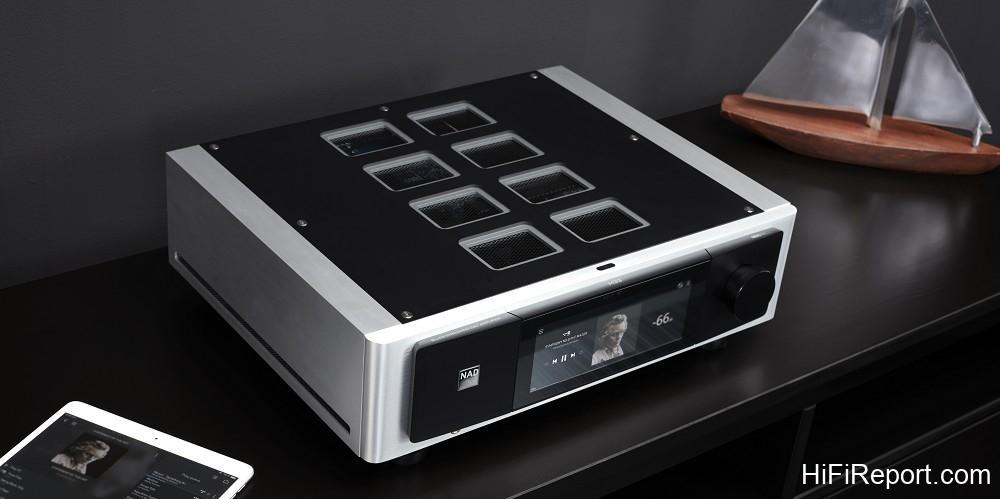
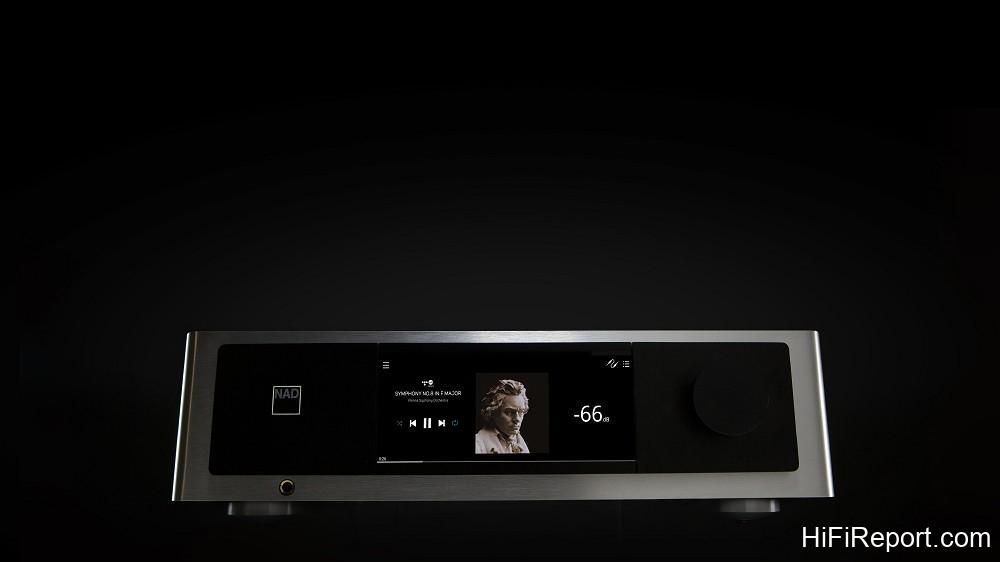
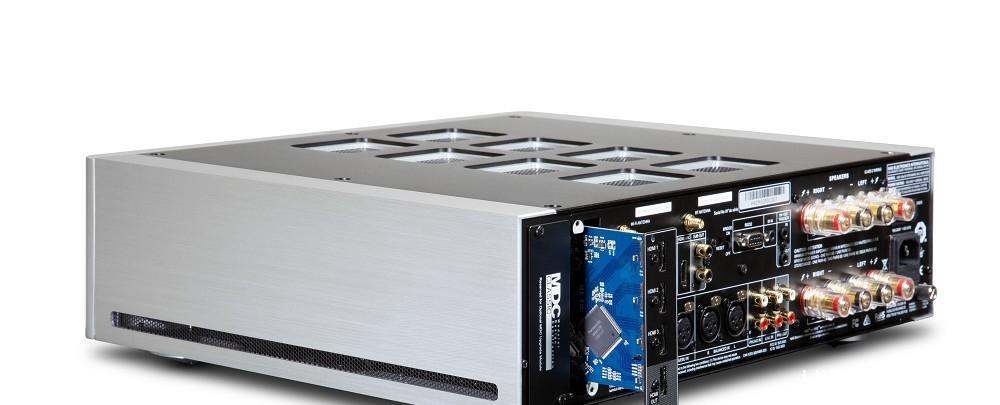
From the outside, the M33 looks almost identical to the M32, yet the designs are fundamentally different. NAD utilizes MDC (Modular Design Construction) to allow for future upgrades in their amplifiers. The M32 gained network streaming capability by adding a BluOS streaming module via its MDC slots. The M33, however, has network streaming “built-in” from the start, requiring no extra module.
The two existing MDC slots can remain vacant for now, perhaps to be used later when NAD develops an HDMI 2.1 MDC module supporting 8K/60p and 4K/120p, at which point you can decide whether to purchase and install it. Furthermore, NAD is soon to launch a “USB DSD module,” which M33 owners can add to provide “USB-DAC functionality supporting DSD audio.”
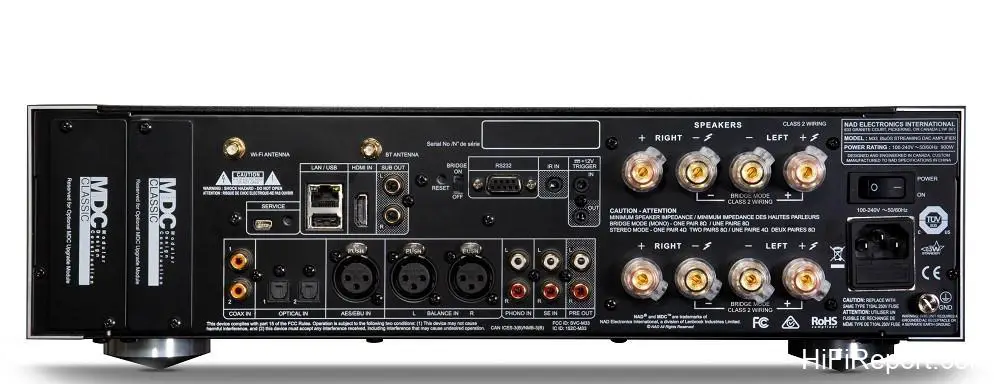
In terms of source compatibility, the M33 adds an “HDMI ARC” terminal compared to the M32, allowing for digital audio return from slim TVs and making it more convenient for users to substitute the TV’s built-in speakers with the audio system. For turntable compatibility, the M33 includes a complete phono circuit, with the Phono input supporting both MM and MC cartridges (the M32 only supported MM).
The NAD M33 not only features built-in streaming music playback but also includes comprehensive single-ended and balanced analog inputs, capable of connecting a turntable. Digital inputs consist of AES, coaxial, and optical. It also has an “HDMI IN” that supports digital audio return from slim TVs (HDMI ARC), allowing the audio system to replace the TV’s built-in speakers.
The M33 has two subwoofer output terminals and can apply a crossover to the subwoofer channels, enabling users to configure 2.1 or 2.2 speaker setups. Crucially, with the aid of Dirac Live, the subwoofers can be exceptionally well calibrated (via digital equalization).
I believe NAD is one of the audio manufacturers whose product performance and substance have changed the most over the past decade. Before 2010, NAD was perceived as a “traditional” British heritage brand, strong in tuning (the typical British sound) and offering great value in affordable products. After 2010, while some of NAD’s amplifier designs retained traditional elements, their most significant new products underwent a dramatic transformation.
NAD’s new designs branched into two main lines. One was “Direct Digital,” which applied DDFA technology to convert PCM audio directly into PWM for amplification. This could be described as “pure digital amplification,” where no DAC chip is used for digital-to-analog conversion during the amplification process (only an ADC is used in the negative feedback path). NAD’s Masters series integrated amplifiers before last year (including the M32) employed this design.
The other main line of new-generation NAD integrated amplifier development started with more affordable products. From the D 3020 in 2012 to the subsequent C 338, C 368, and D 3045, these were “Hybrid Digital” amplifiers combining digital-to-analog conversion circuits with Hypex UcD Class D power amplifiers.
During this period of parallel development between Direct Digital and Hybrid Digital, NAD also actively incorporated Swedish Dirac Live room correction technology, successfully applying it to their surround sound receivers. This significantly elevated NAD’s standing among many enthusiasts, thanks to the technology’s excellent ability to optimize frequency response and transient response.
Meanwhile, high-end amplifiers from other brands began featuring Hypex “Ncore,” producing sound quality and performance from Class D amplification that was almost unbelievable. It was against this backdrop that NAD launched the M10. In 2019, I considered the M10 a “dream design,” combining Dirac Live room correction technology with Ncore, which was then considered the king of Class D power amps. It was also the first Hybrid Digital integrated amplifier in NAD’s Masters series.
Although the M10’s design was newer than the M32, there was a clear gap in price and output power between the M10 and M32. What approach would NAD take to make the M33 surpass its predecessor (the M32)? A year ago, when the M10 was launched in Taiwan, NAD Product Manager Cas Oostvogel revealed that NAD was collaborating with Purifi on amplifier circuits.
The creators of the previously mentioned Hypex UcD and Ncore Class D amplifiers are both Bruno Putzeys. It’s well-known in the industry that he’s an authority on Class D amplification. In 2014, he co-founded Purifi Audio with Peter Lyngdorf (an audio industry celebrity who needs no introduction) and Lars Risbo (the designer of the world’s first pure digital amplifier, the TacT Millennium). This company was truly enigmatic, only starting to gain attention in 2019.
What kind of power amplifier circuit would two top technical minds like Bruno Putzeys and Lars Risbo create together? It’s the Purifi Eigentakt. “Eigentakt” is German for “self-clocking,” and the practical implementation is a self-oscillating Class D amplifier circuit with negative feedback. In fact, not just the Purifi Eigentakt, but Bruno Putzeys’ previous designs, UcD and Ncore, share the same circuit topology, simply evolving, optimizing, and improving performance over time.
Bruno Putzeys leaving Hypex to start his own venture was, of course, intended to make his debut creation, Eigentakt, surpass his previous work, Ncore. NAD seized this opportunity: combining Dirac Live with Purifi Eigentakt, they utilized both the most advanced current room correction technology and the most cutting-edge Class D power amplifier circuit design to create the new flagship integrated amplifier, the M33.
From a circuit architecture perspective, the M33 belongs to the “Hybrid Digital” design category, similar to the M10. The internal circuitry can be roughly divided into three main blocks: “Streaming Preamp,” “Class D Power Amplifier,” and “Power Supply Circuit.”

In the streaming preamp section, the M33 is centered around a dual-core 1GHz ARM Cortex A9 processor. Since the M33 emphasizes “sonic accuracy” and uses Dirac Live to optimize transient and frequency response, it first performs A/D conversion when receiving “analog” audio inputs. It uses a relatively high-end ADC chip, the AKM AK5578EN, to convert analog audio to digital. Users can set the A/D conversion sample rate in the menu to 48kHz, 96kHz, or 192kHz (all 24-bit).
For optimal sound quality, I recommend setting it to 192kHz.
For digital inputs (or streaming), digital audio processing is performed directly, and the sonic performance is independent of the ADC. After digital audio processing, the M33 uses “one ESS ES9028Q2M per channel.” This DAC chip has a high dynamic range and low harmonic distortion. The M10 also uses it for digital-to-analog conversion, but the M33 uses twice the quantity and employs Mono Mode to achieve higher channel separation and dynamics.
In the power amplifier section, Bruno Putzeys has provided “room for creative freedom” for R&D personnel from various audio brands, from Ncore to Eigentakt. Both of these Class D power amplifiers are the “mid-section + final section” of the entire power amplifier circuit. Currently, Purifi has only released one Eigentakt Class D power amplifier circuit model, the “1ET400A,” which outputs 425 watts (into 4 ohms).
It has a low gain of only +13 dB, and Purifi recommends adding a balanced buffer amplifier circuit with around +14 dB of gain before the Eigentakt module.
Therefore, even if more brands use the same Eigentakt module, their varying buffer amplifier circuit designs and implementations will result in different tonal characteristics and personalities. For example, the EVAL1 kit sold by Purifi itself uses an OP Amp with bipolar transistor input for the buffer amplifier circuit before the Eigentakt, whereas the buffer amplifier circuit in the power amplifier section of the NAD M33 uses a TI OPA1652 with FET input.
There’s no right or wrong approach here; some prioritize performance specifications (sound quality metrics), while others emphasize listening experience (musicality). Based on the choice of OPA chip for the Buffer Amp, I believe NAD’s approach leans towards the latter.
Does the M33’s performance truly surpass its predecessor? Looking at the objective data, the M33’s rated power (200 watts) is double that of the M10 (100 watts) and 10% higher than the M32 (180 watts). The M33’s damping factor (over 800) is more than four times that of the M32 (160) and M10 (190). This indicates that the M33 will have significantly better bass control over speakers. Regarding signal-to-noise ratio, the noise floor of Class D power amplifiers is almost fixed.
Therefore, the SNR data at “low power output” is usually less impressive compared to high power output. However, NAD is very upfront about stating the “signal-to-noise ratio at 1-watt output”: the M33 exceeds 100 dB, the M10 is greater than 85 dB, and the M32 is greater than 92 dB. This means that when listening to music at normal volumes with the M33, its noise floor is less than half of the M32’s. Thus, based on objective conditions, the M33’s performance does indeed surpass the M32.
Dirac Live is available in a “standard version” and a “paid version.” The standard version corrects the frequency response from the extreme low frequencies up to 500Hz (already covering part of the midrange), while the paid version can perform full-range frequency response correction. I believe that for most users, the standard version is more than sufficient.
It’s capable of resolving room modes that cause standing waves and dips below 250Hz in the bass, and it doesn’t significantly alter the “original” sound character of the speakers. If you truly desire full-range response accuracy, the paid version is available for just $99 USD.
The M33’s Dirac Live can be configured in two ways: one uses the included microphone and USB interface, plugging it into the rear panel USB port, and then using the Dirac Live App on a smartphone to run the testing and setup procedure. The other method is for users who have a better measurement microphone, which they plug into a laptop running the Dirac Live software. After importing the microphone calibration file, the testing proceeds.
After the testing, users can customize or use the “automatically generated” target curves. Dirac will then calculate the filters based on the measured frequency response and the target curve, and finally upload them to the M33 for execution.
The M33 can store up to 5 sets of Dirac Live calibration results. So, I decided to experiment: I used both the “included microphone” and a “measurement microphone” (I used a miniDSP UMIK-1) to perform the testing and setup procedures using the smartphone App and laptop software respectively. I saved the results to different memory slots in the M33, ready to switch and compare at any time.

I first compared the setup calibrated with the included microphone using the phone App against the “Dirac Live: Off” state. I think most users with a bit of experience, once they start listening with Dirac, will realize there’s “no going back.” It’s almost like the walls and ceiling of the listening room completely disappear.
Even if the speaker placement isn’t “perfect,” the M33 can use Dirac Live to optimize the frequency response balance from the lower midrange, through the bass, down to the “extreme low frequencies the speakers are capable of” to near-perfect levels. This is especially true in the bass and extreme bass, where it effectively eliminates the bloating and boominess caused by standing waves in specific frequency bands, while also compensating for energy dips in other bands.

This allows the M33 to present bass that is denser, tighter, and “higher resolution.” Furthermore, Dirac improves the symmetry of the left and right speaker output (including frequency response, sound pressure, and time difference), resulting in more precise and stable soundstage imaging and more concrete “forms.”
What about the setup calibrated using the miniDSP UMIK-1 with a laptop? I can only say that “the result was quite surprising to me.” I initially thought the only difference compared to the calibration with the included microphone would be a slight variation in frequency response. Little did I know that the setup using the measurement microphone resulted in sound quality that was more delicate, smoother, and richer in layers.
I cannot explain nor speculate on why using different microphones and testing methods would lead to such a noticeable difference in the subtle texture and resolution of the M33’s Dirac Live output. I am merely reporting this situation truthfully to you: if you want to get better sound quality from the M33 and you have a laptop, consider spending an extra $100 USD online to buy a measurement microphone, or borrow one from a friend.
Compared to most amplifiers lacking digital room correction (DRC) capabilities, the M33 makes it far easier for users to achieve balanced energy across the three frequency bands and sonic accuracy in their listening space. Moreover, the Eigentakt Class D amplifier boasts extremely low distortion. Therefore, I believe any audio reviewer worldwide writing about the M33’s sound impressions is unlikely to omit the terms “neutral” and “realistic.”
The M33’s style is clearly different from the traditional British sound characterized by a rich, full midrange and warm, reserved treble. It holds nothing back and adds no coloration, striving to reproduce all the low, mid, and high-frequency information contained in the music software to the best of its ability. When you first listen, it feels almost colorless and odorless, as pure and transparent as clean water, without a hint of mist.
Listening to music with the lights off or eyes closed, you can clearly “see” the scene of the musical performance through your hearing. I rarely encounter an amplifier with such a strong sense of “visualization” even once a year!
As my listening work progressed into the second and third day, the M33’s sonic characteristics began to change: the initial “pure water” sound gradually gained warmth, and the flavor of the music, the solidity of the soundstage images, and their weight all showed “audible improvement,” while the strong sense of visualization remained unchanged.
I believe that when audio enthusiasts listen to music using the M33, they will feel their “ability to discern subtle changes in recordings” suddenly becoming very strong. For example, with certain “older pop songs,” right after the intro, you might notice the noise floor suddenly increasing slightly. This is because the track with the vocals, which is about to enter, adds some noise.
The M33 is like a top-tier display achieving extremely high contrast with near-perfect blackness; its extremely low noise floor allows even very small sonic components to rise above the Noise Floor, letting you clearly hear subtle textures and the gradual decay of spatial reverberation after instruments sound, effortlessly revealing its high-resolution characteristics.
Its resolution is so high that it can “easily lead users to misjudgment.” When playing CD-quality music files or using a digital input from a CD transport, the subtlety of texture, clarity, and treble sheen can truly make you think you are playing Hi-Res music files. When I listened to 88.2k, 96k, 176.4k, and 192kHz/24bit Hi-Res music files on it, as the sample rate increased, the amount of sonic information became richer, achieving better linearity.
Compared to CD-quality music files, the treble of Hi-Res music files sounded softer, and the texture of the sound was softer, denser, and more delicate. Whether listening to piano solos, concertos, or symphonies, the level of “complex and harmonious” sound reached a new height. Hi-Res music files remastered from jazz and pop music from the 1960s and 1970s had a rich analog recording flavor and a sense of the era.
Although both the M33 and M10 employ a Hybrid Digital design, I believe the “performance gap” between the M33 and M10 is very significant. This is not just because the M33’s signal-to-noise ratio is notably higher, but more realistically because the M33’s Class D amplifier has substantially different output power and damping factor.
Purely in terms of low-frequency control, I really have to give it full marks: the powerful force unleashed in an instant when a kick drum is heavily “stomped,” and the tightness, is something even separate pre/power amplifier combinations might not achieve with such “speed and impact.”
Nowadays, because many people listen to music with headphones, electronic bass below 50Hz in genres like pop and hip-hop often has a very generous amount of energy. The M33 can drive speakers at high volumes to produce robust, full-bodied, “muscular” bass that is very deep and entirely free from bloating or muddiness.
Driving a pair of Pioneer S-1EX floorstanding speakers with it full-range, the tight, abundant low and extreme low frequencies truly sounded like an additional high-end active subwoofer was in use! Furthermore, I noticed an unusual phenomenon when listening to music loudly: typically, at certain high volume levels, we are simply “listening for the thrill,” and it’s nearly impossible to appreciate sound quality.
However, the M33 remained rock-solid even at very high volumes, and I noticed that the sound quality remained just as refined. I believe this is thanks to the Purifi Eigentakt’s extremely low distortion even at high power output (the M33’s harmonic distortion is only 1/10th that of the M10).
Whether evaluated by standards of “absolute performance” or “value for money,” I believe the NAD M33 deserves the highest recommendation. Purely in terms of sound quality level, the M33 can stand shoulder-to-shoulder with streaming amplifiers or multi-component streaming audio systems priced one-third higher (approximately $10,000 USD).
If you’re tired of the nonsense that tries to pass off an unbalanced audio system’s sound as good, and you insist that accuracy is a necessary condition for good sound, the NAD M33 can help listeners reclaim control over tuning from the room. It prevents room response from distorting sound and destroying balance, using science to solve acoustic problems and leveraging the most advanced amplification circuitry to significantly reduce harmful substances (distortion) in the audio signal.
Its design is extremely rational, yet all its efforts are dedicated to bringing the listener closer to the essence, intent, and emotion of the musical work.
Specifications
* Type: Network Streaming Integrated Amplifier
* Rated Output Power: 2 x >200W (8 Ohms), Bridge Mode Mono 640W (8 Ohms)
* IHF Dynamic Power: 550W (4 Ohms per channel), 300W (8 Ohms per channel)
* Damping Factor: >800
* Total Harmonic Distortion: 0.003% (1W to 200W, 8 Ohms and 4 Ohms)
* Signal-to-Noise Ratio: >120 dB (200W 8 Ohms), >100 dB (1W 8 Ohms)
* Frequency Response: 20Hz〜60kHz (±3 dB), 20Hz〜20kHz (±0.2 dB)
* Digital Inputs: HDMI ARC×1, AES/EBU (XLR)×1, Digital Coaxial (RCA)×2, Toslink Optical×2
* USB Input: USB-A×1
* Analog Inputs: RCA×2 (including MM/MC Phono), XLR×1
* Output Terminals: Speaker Terminals×2 sets, Preamp Output×1 (RCA), Subwoofer Signal Output×2
* Headphone Output Impedance: 22 Ohms
* Dimensions (W×H×D): 435×133×396 mm
* Weight: 9.7 kg