
Onkyo TX-NR6100 Review
In the face of surging raw material costs, it’s remarkable that Onkyo could maintain its product strategy of delivering value commensurate with price. Onkyo launched three new models simultaneously this time – the TX-NR7100, TX-NR6100, and TX-NR5100 – which piqued my curiosity even more: could the entry-level models compete with the higher-end ones in terms of performance-to-price ratio?
Key Features and Positioning
As expected, the distributor, Enkle, sent the second new Onkyo model, the TX-NR6100, to our headquarters this month. Positioned as the successor to the previous TX-NR696, this mid-range model supports standard 7.2-channel output and inherits the brand’s robust home theater pedigree, delivering 100 Watts per channel (2 channels driven, 8 Ohms).

It also includes a Zone 2 speaker terminal, allowing you to set up a second two-channel system or utilize a bi-amp connection to enhance the driving capability of the main channels.
AccuEQ Room Calibration
Compared to the higher-end TX-NR7100, this unit lacks one two-channel output and Dirac Live room correction, but it retains Onkyo’s proprietary AccuEQ feature. AccuEQ comprises AccuReflex and Subwoofer EQ, automatically detecting speaker size, frequency response, and relative position to provide optimal sound pressure for each speaker. This is already significantly more accurate than the auto-calibration systems typically found in general AV receivers.
Immersive Audio Support
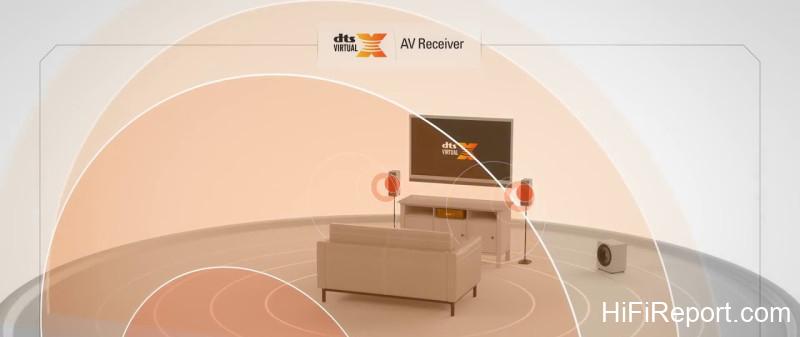
In terms of audio formats, this unit supports object-based formats like Dolby Atmos and DTS:X. It’s worth noting that players can now build a standard 5.1.2 channel Atmos theater in the sub-$1,500 price range. For users with limited space at home or those unable to install overhead speakers, this model also features standard virtual surround sound functions like Dolby Atmos Height Virtualizer and DTS Virtual:X.
These features are actually very useful for families without dedicated listening rooms. In typical living room spaces, seating is often against the back wall, making speaker placement a major challenge. Installing height channels is difficult, and even setting up surround channels can impede movement and affect aesthetics. With this unit, you only need 5.1 or even 3.1 front channels combined with the virtual soundfield functions.

This not only expands the rear surround effect but also adds overhead channel height, enhancing the 3D spatiality of the horizontal channels.
Advanced Video and Gaming Features
Regarding video specifications, this unit is equipped with 6 HDMI inputs and 2 outputs, all fully supporting the HDMI 2.1 standard. It can transmit video resolutions up to 8K/60p and 4K/120p, supporting HDR10, HDR10+, HLG, Dolby Vision, 4:4:4 color subsampling, BT.2020, and other video specifications. It also supports features like VRR (Variable Refresh Rate), ALLM (Auto Low Latency Mode), and QFT (Quick Frame Transport).

These primarily manage screen mapping, reduce latency, prevent screen tearing, and avoid black screen issues during transitions, ensuring a smooth gaming experience. Furthermore, for the currently most common 1080p video signals, it offers 8K upscaling technology to optimize image quality when watching 4K or Full HD signals.
Comprehensive Audio Inputs/Outputs
The HDMI output terminals also include the essential eARC audio return channel function, capable of transmitting uncompressed 5.1 or 7.1 audio. This allows you to use your home theater system to enhance the audio when watching TV programs. It also supports transmitting “object-based audio” at up to 192kHz/24bit, meaning it can fully handle the Dolby Atmos multi-channel audio provided by services like Netflix.
For other audio connections, the unit provides one optical and one coaxial input for backup connections to TVs or digital sources. Additionally, it has four analog inputs and three outputs. Besides connecting devices like CD players and game consoles, it also features a Phono input (MM), which the lower-tier TX-NR5100 lacks, meaning this unit can directly play vinyl records when connected to a turntable.
Network Streaming and Multi-room Audio
For more convenient music listening, this unit supports Ethernet and dual-band 2.4GHz/5GHz Wi-Fi. Via DLNA/UPnP, you can use third-party mobile apps to play streaming music services like Spotify, TIDAL, Amazon Music HD, Pandora, Deezer, and TuneIn. Alternatively, you can connect to your local network to play music files from a NAS or PC, with support for high-resolution file decoding up to PCM 24bit/192kHz and DSD 2.8MHz and 5.6MHz.

Apple users can also use the AirPlay 2 function to mirror music from their phones to the unit. As you might guess, this unit also boasts powerful multi-room music sharing capabilities. Besides AirPlay 2, it has built-in Chromecast and DTS Play-Fi, allowing it to connect with other compatible wireless audio devices in your home and stream music to every room.
Wireless Connectivity and Local Playback
If you find yourself without a network connection, the unit also features Bluetooth 4.2 wireless connectivity. Notably, it supports aptX and aptX HD high-quality transmission, which is less common on general AV receivers. When paired with mobile devices running Android 8.0 or later, you can enjoy better Bluetooth audio quality. Furthermore, there’s a USB input on the front panel, allowing you to directly plug in a portable hard drive and play Hi-Res music files.
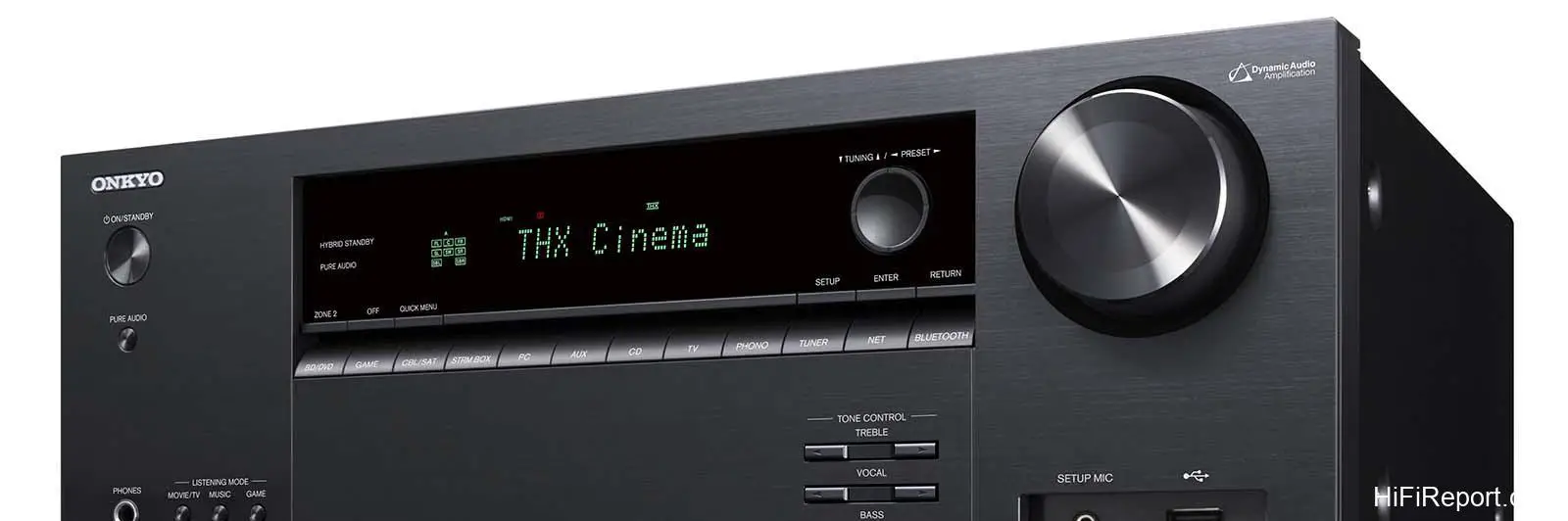
This unit effectively covers almost all conceivable listening needs for users.
Under the Hood: Circuitry and Components
Looking at the circuit layout, opening the chassis reveals that the TX-NR6100 employs a consistent “separated power supply” design. On the left side is a relatively large EI transformer responsible for powering the audio circuits, while an adjacent switching power supply handles the digital circuits.

In the surround decoding preamp section, the uppermost layer is the digital circuit main board, where you can see a Cirrus Logic CS49844A DSP chip handling digital audio processing and AccuEQ auto-calibration functions. Below that, the main channels for digital-to-analog conversion use a 32bit 8-channel DAC chip, the TI PCM1690, while the secondary channels use two 2-channel DACs, the PCM5101A, for decoding.
After the DAC chips, the primary components used for small signal amplification are the low-noise dual OP Amps JRC NJM4580.

For the multi-channel power amplification circuits, the TX-NR6100 utilizes Onkyo’s excellent Dynamic Audio Amplification circuitry and incorporates the proprietary VLSC (Vector Linear Shaping Circuit) to minimize noise. The design aims for a simple structure with low negative feedback. Each channel uses a pair of wide-bandwidth power transistors, the 2SA1962A/2SC5242A, in a push-pull configuration.
The power supply for the amplifier circuits uses two 10,000μF filter capacitors, positioned as close as possible to the power transistors to provide powerful current output “nearby.” This effectively eliminates digital noise, resulting in clearer audio.

Listening Test: 2-Channel Music
For the actual listening tests, I used a Sony UBP-X700 Blu-ray player as the source. First, I drove our internal Pioneer S-1EX floorstanding speakers in “Direct” mode to assess the TX-NR6100’s two-channel music performance. This unit differs from the entry-level Onkyo models I recall. While older entry-level units had plenty of power, the sound could sometimes be a bit rough and lacked refinement. In contrast, the TX-NR6100’s sound is much more neutral.
It retains Onkyo’s powerful driving capability while offering a more balanced distribution across the three frequency bands and significantly improved resolution.

For example, listening to Giuliano Carmignola’s performance of “Italian Concerto,” the string section sounded grand in scale initially, providing a majestic foundation for the large ensemble music. You can feel that this unit not only retains Onkyo’s signature warm and rounded sound profile but also avoids the harshness often found in affordable AV receivers. The string lines are full and energetic, with plenty of body.
When instantaneous instrumental tutti occurs, it also exhibits quick dynamics! The violin’s timbre is smooth and full-bodied. Although the brilliance wasn’t particularly strong, bow friction details and instrument body resonance were still rendered faithfully. This slightly restrained high-frequency style makes listening to music particularly pleasant and easy on the ears.
Furthermore, the sound of this unit is quite direct. While the soundstage isn’t as expansive as some competing entry-level models, the positional imaging is excellent, and the musical background is very transparent. It excels at rendering the distinct shapes of instruments in large-scale classical music, allowing you to clearly hear the details of inner voices within complex arrangements, showcasing music with rich layering.
Listening Test: Home Theater
Next, I used a full set of our internal Pioneer Excellence series theater speakers, with Monitor Audio in-ceiling speakers for height channels and an M&K X10 subwoofer, forming a 5.1.2 channel setup to test its home theater capabilities.
The unit’s home theater performance also exhibits a more refined character. Beneath the warm sound, it demonstrates good resolution. Watching the “Incredible Hulk BD” scene from the 2019 DTS demo disc, during the special forces’ pursuit of the Hulk, you can feel the distinct shape and fullness of the fierce bullets whizzing past. You can also hear the bullets constantly traversing the space; their movement isn’t a vague sweep but has a very clear trajectory.
And when the Hulk throws massive objects, the impact and explosion sound effects have excellent power! While the scale and density of the low frequencies might be slightly less than higher-end units, its neutral and warm sound profile makes movie audio quite pleasant to listen to. For example, dialogue is very smooth, without overly sharp sibilance. Even during a series of explosive sound effects, you don’t feel fatigued by sonic bombardment.
Instead, it’s well-suited for watching action-packed films, delivering exhilarating home theater impact without feeling oppressive.
Additionally, in the “Lost World BD” scene, I found the unit’s sound effects to be very three-dimensional. During the sequence where the laboratory is toppled by dinosaurs, you can feel the realistic sense of immersion as the space tumbles. Simultaneously, the sound positioning is quite good. You can clearly identify the movement and distinct shape of objects falling all around, as if you’re experiencing the tense atmosphere of being in danger alongside the protagonists!
Conclusion: An Affordable Performer
In the past, I always thought Onkyo AV receivers leaned towards a “home theater” style – bold and powerful. However, this affordable TX-NR6100 completely changed my mind. It shows how Onkyo’s entry-level models have continuously evolved. Not only are the movie sound effects powerful, but it also delivers better quality when listening to music, gradually moving towards an “audio-video dual-purpose” home theater style.
It is absolutely a top choice in the sub-$1,500 AV receiver category for its high performance-to-price ratio!
Specifications
* Type: 7.2-Channel AV Receiver
* Power Output (All Channels): 210 W/Ch (6 Ohms, 1kHz, 10% THD, 1-ch driven), 100 W/Ch (8 Ohms, 20Hz–20kHz, 0.08% THD, 2-ch driven, FTC)
* Total Harmonic Distortion (20Hz–20kHz, Half Rated Power): 0.08%
* Frequency Response: 10Hz–100kHz (+1, -3dB)
* Signal-to-Noise Ratio: 106 dB
* Headphone Output Power: 80 mW + 80 mW (32 Ohms)
* Input Terminals: HDMI×6, Analog Component×1, Composite Video×2, Digital Coaxial×1, Toslink Optical×1, 2-Channel Analog Audio×4, Phono (MM)×1, USB×1, Network Terminal×1, FM/AM Antenna Terminals (1 set each)
* Main Outputs: Speaker Terminals×9, Subwoofer Terminals×2, HDMI×2, Headphone Output×1
* Dimensions (W×H×D): 435 x 173.5 x 379.5mm
* Weight: 9.8 kg

- 210 W/Ch THX Certified Select Dynamic Audio Amplification system
- 5.2.2-channel Dolby Atmos and DTS:X playback
- 8K with HDMI 2.1 40Gbps (3 ins)
- THX Select Certification
- Discrete Zone 2 Audio and Video